.
Showing posts with label Verse 18. Show all posts

Tuesday, 23 December 2025

One of the most powerful spiritual responses to distress in Qur'an - attributed to Prophet Yaʿqūb (Jacob) عليه السلام

Al Qur'an, the last of the four Divine Books is a Divine guidance for the heart, mind, and life of every man and woman. It steers our lives to a path chosen Divinely for the mankind. Besides guidance, it spiritually heals a wounded heart when in distress and when one finds no other way to heal one's wounds. At many places in Qur'an man has been asked to be patient when passing through a test and have faith in Allah for He alone will take them out of the difficult times and ease their sufferings - provided they remain steadfast and do not lose hope in Allah.

The mention of story of Prophet Yusuf (Joseph, عَلَيْهِ ٱلسَّلَامُ) in the 12th Surah of Al Qur'an, which is also named after the revered prophet as Surah Yusuf, describes the spiritual response to extreme distress of Prophet Yaqub (Jacob عَلَيْهِ ٱلسَّلَامُ) when despite losing his most beloved son to the machination of his step brothers, remained steadfast and displayed an extreme level of patience by leaving his pain of loss in the hands of Allah.

The Surah and its explanation / exegesis has already been published by us which can be accessed from links given below:
Overview | ExegesisPart 1 | Part 2 | Part 3 | Part 4 |

We now share the 18th verse from Surah Yusuf which is about the complete faith and trust and display of Sabr (patience) by Prophet Yaqub (Jacob عَلَيْهِ ٱلسَّلَامُ) when apprised of the loss of his beloved son Yusuf, who was later to become a Prophet of Allah:

وَجَآءُوۡ عَلٰى قَمِيـۡصِهٖ بِدَمٍ كَذِبٍ​ؕ قَالَ بَلۡ سَوَّلَتۡ لَـكُمۡ اَنۡفُسُكُمۡ اَمۡرًا​ؕ فَصَبۡرٌ جَمِيۡلٌ​ؕ وَاللّٰهُ الۡمُسۡتَعَانُ عَلٰى مَا تَصِفُوۡنَ‏ 
(12:18) And they brought Joseph's shirt, stained with false blood. Seeing this their father exclaimed: "Nay (this is not true); rather your evil souls have made it easy for you to commit a heinous act. So I will bear this patiently, and in good grace. It is Allah's help alone that I seek against your fabrication."

This short verse captures one of the most powerful spiritual responses to distress in the Qur’an. To understand its depth, we must see the context, the choice of words, and its relevance for today.

Immediate Context of the Verse

This is the first recorded usage, spoken by a Prophet in response to: (1) grief, (2) injustice, (3) false accusation, and (4) helplessness

Let us briefly look back and see what had just happened which forced a father to leave his affairs to Allah. It has been told in the earlier verses of the Surah that Prophet Yaʿqūb (Jacob) عليه السلام loved his son Yūsuf (Joseph) deeply. This made his other brothers jealous of him and they plotted against Yusuf. Despite reservations of the father, the brothers took him out for fun time and threw him into a well and returned with a false alibi that a wolf had attacked them and took Yusuf away and brought back a torn shirt of their brother with false blood stains. 

The Qur’an says: “And they brought his shirt with false blood upon it…” (12:18)

Prophet Yaʿqūb immediately sensed the lie and responded “Rather, your souls have enticed you to something…” Yet, he did not show anger, no cursed his lying sons and did not retaliate - for he had faith in Allah and knew what had happened was the will of Allah. 

How Prophet Yaʿqūb Responded
Instead, Prophet Yaʿqūb responded as what a God fearing man should and in the verse shared above, use two beautiful phrases which displayed his hidden anguish. H he combined: Ṣabr jamīl (beautiful patience), and Tawakkul (reliance upon Allah). Let us expand these two words:
  • The first part of the phrase: فَصَبْرٌ جَمِيلٌ (Fa-ṣabrun jamīl) which translates into English as the "Beautiful Patience." This was not an ordinary patience like a p, without blaming Allahassive, bitter, resentful patience. Instead Ṣabr Jamīl meant a patience without complaint. without bitterness - but a grief contained within faith. But after all he was a father and could not overcome the grief of the loss of his beloved son, so Yaʿqūb would weep when alone yet never protested Allah’s decree (12:84–86).
  • The second part of the phrase is: وَاللّٰهُ الْمُسْتَعَانُ - “And Allah is the One whose help is sought.”
    • وَاللّٰهُ الْمُسْتَعَانُ (Wallāhu al-Mustaʿān) is a deep Qur’anic expression of tawakkul (reliance upon Allah). It is short, but rich in meaning and history.
    • Meaning of وَاللّٰهُ الْمُسْتَعَانُ (Word-by-word): وَ (wa) → and, اللّٰهُ (Allāh) → Allah, الْمُسْتَعَانُ → the One whose help is sought - Thus the full meaning: “And Allah alone is the One whose help is sought.” or “And it is Allah whose help we seek.”
    • It implies: (1) Human inability, (2) Divine sufficiency and (3) Complete dependence on Allah
    • This means that: (1) “I cannot fix this — Allah can.” (2) “Human betrayal has occurred — Divine justice remains.” (3) “I will not fight lies with rage, but with reliance.”
  • This phrase is spoken when truth is clear but power is lacking.
Why This Moment was Extraordinary
Here is a test case for a Prophet - Prophet Yaʿqūb had lost his most beloved son, due to betrayal by his own children and was emotionally shattered. Yet he did not accuse publicly, or sought revenge and above all did not collapse spiritually - This is prophetic emotional intelligence.

Even Prophet Muhammad صلى الله عليه وسلم advised: “If you were to rely upon Allah as He deserves, He would provide for you as He provides for the birds.” (Tirmidhī – ṣaḥīḥ)

Connection with Other Qur’anic Teachings
as mentioned earlier, this one of many responses with patience that Allah praises and appreciates his servants for being steadfast under extreme distress, blaming none and leaving everything to Allah alone. Some of the verses from Qur'an are mentioned herein under:
  • “Indeed, the patient will be given their reward without measure.” (39:10)
  • “Seek help through patience and prayer.” (2:45)
Even the Prophet ﷺ when in distress was taught this path: “So be patient, with a patience that is beautiful.” (70:5)

Why This Verse Is Critically Important Today
This verses is particular important even today when we are living in an age of  false accusations, character assassination, family disputes, emotional breakdowns, and social media outrage

Thus this verse teaches us dignity in distress is strength, not weakness, specially when we cannot defend ourselves. This may mean silence can be worship, restraint can be victory and reliance is not helplessness: “Allah is sufficient for us.” (3:173)

Although, when betrayal comes from loved ones, the pain is greatest — yet the response must be highest in faith.

What This Verse Does NOT Teach
Although, sometimes the grief surpasses a man's limits but this does not mean one must not suppress one's emotions, or accept injustice silently forever and avoid lawful means to find a rightful response. 

Prophet Yaʿqūb later too spoke of his loss, continued to pray to put his lamenting heart at ease and acted wisely by not forthrightly confronting his volatile and disrespectful sons. In fact he never lost hope and something in his heart told him not to lose faith for Allah is by the side of those who trust Him alone and are extremely patient.  

Final Reflection
This verse teaches us how to suffer with faith, not with bitterness. It reminds us that (1) Allah sees what others hide, (2) truth does not need loud defense, (3) time reveals what patience protects.

When Should We Say Wallāhu al-Mustaʿān?
Some of the appropriate situations could be when (1) Facing injustice or false accusations, (2) Enduring hardship with dignity, (3) After explaining the truth, (4) When no human solution remains and (5) When emotional pain is deep but faith is firm

Remember: It is not a phrase of despair, but quiet strength. So when words fail, say: فَصَبْرٌ جَمِيلٌ وَاللّٰهُ الْمُسْتَعَانُ and let Allah handle what you cannot. “Wallāhu al-Mustaʿān” is the language of prophets when truth is clear but circumstances are overwhelming.
May Allāh (سبحانه و تعالى‎) help us understand Qur'ān and follow the Sunnah of Prophet Muhammad ﷺ, which is embodiment of commandments of Allah contained in the Qur'ān. May Allah help us to be like the ones He loves and let our lives be lived helping others and not making others' lives miserable or unlivable. May all our wrong doings, whether intentional or unintentional, be forgiven before the angel of death knocks on our door. 
وَمَا عَلَيۡنَاۤ اِلَّا الۡبَلٰغُ الۡمُبِيۡنُ‏ 
(36:17) and our duty is no more than to clearly convey the Message.”
That is Our duty is only to convey to you the message that Allah has entrusted us with. Then it is for you to accept it or reject it. We have not been made responsible for making you accept it forcibly, and if you do not accept it, we shall not be seized in consequence of your disbelief, you will yourselves be answerable for your actions on Day of Resurrection.

May Allah forgive me if my posts ever imply a piety far greater than I possess. I am most in need of guidance.

Reading the Qur'ān should be a daily obligation of a Muslim - Reading it with translation will make it meaningful. But reading its Exegesis / Tafsir will make you understand it fully. It will also help the Muslims to have grasp over social issues and their answers discussed in the Qur'an and other matter related to inter faith so that they are able to discuss issues with non-Muslims with authority based on refences from Qur'an.

Note: When we mention God in our posts, we mean One True God, we call Allah in Islam, with no associates. Allah is the Sole Creator of all things, and that Allah is all-powerful and all-knowing. Allah has no offspring, no race, no gender, no body, and is unaffected by the characteristics of human life.

You may refer for more Selected Verses from Surah 12. Yusuf - Prophet Josef (عَلَيْهِ ٱلسَّلَامُ)  already published

You may also refer to our exclusive reference page: Selected verses from selected Surahs of Al-Qurʾān for compiled verses from other surahs.

For more Selected Subjects, please refer to our reference page: Selected Verses from Al Qur'an about a Specific Subject (Reference Page) to know more about what Qur'an says about specific subjects and our reference page: Selected Verses from the Qur'an. .

You may also refer to our Reference Pages  and Understanding Al Qur'an for knowing more about Islam and Qur'ān.
Photo

An effort has been made to gather explanation / exegesis of the surahs and selected verses of Al-Qurʾān from authentic sources and then present a least possible condensed explanation of the surah. In that the exegesis of the chapters of the Quran is mainly based on the "Tafhim al-Qur'an - The Meaning of the Qur'an" by one of the most enlightened scholars of the Muslim World Sayyid Abul Ala Maududi.  
    In addition, other sources which have been explored and views of other scholars have been incorporated while explaining meaning of a verse. Those desirous of detailed explanations and tafsir (exegesis), may refer to these sites. For expansion of meaning and themes / contextual background help from ChatGPT is also taken.

    Disclaimer: The material for this post has been collected from the references given above. If anyone differs with the material contained in this post, one may consult the references and their authors.  If someone has more material about the subject, he/she is most welcome to share in the comments box to make the post all encompassing.

    If you like Islam: My Ultimate Decision, and to keep yourself updated on all our latest posts to know more about Islam, follow us on Facebook. You may also refer to our Facebook  Group Islam: The Ultimate Truth for more on Islam and Da'wah.

    Please share this page to your friends and family members through Facebook, WhatsApp or any means on social media so that they can also be benefited by it and better understand Islam and the Qur'ān - Insha Allah (Allah Willing) you shall be blessed with the best of both worlds.

    Saturday, 14 September 2024

    Glad tidings for those who respond to the call of their Lord

    This worldly life of ours was not created to make merry, enjoy the abundant and unending means of sustenance and forget about our Lord who created all this for us. On the contrary, our Lord crated this universe full of resources to sustain us so that we are thankful to Him and bow our head in gratitude and utter humility. This theme has been repeated at a number of times in Qur'an .

    We pick up the 18th verse of Surah 13. Ar Ra'd and understand the Divine promise for those who respond to the Divine call and those who do not: 

    لِلَّذِيۡنَ اسۡتَجَابُوۡا لِرَبِّهِمُ الۡحُسۡنٰى​ؕ وَالَّذِيۡنَ لَمۡ يَسۡتَجِيۡبُوۡا لَهٗ لَوۡ اَنَّ لَهُمۡ مَّا فِى الۡاَرۡضِ جَمِيۡعًا وَّمِثۡلَهٗ مَعَهٗ لَافۡتَدَوۡا بِهٖؕ اُولٰۤـئِكَ لَهُمۡ سُوۡۤءُ الۡحِسَابِ ۙ وَمَاۡوٰٮهُمۡ جَهَـنَّمُ​ؕ وَبِئۡسَ الۡمِهَادُ‏ 
    (13:18) There is good reward for those who respond to the call of their Lord. And those who do not respond to their Lord, (a time will come when) they shall offer all they have - even if they have all the riches of the world and the like of it besides to redeem themselves (from the chastisement of Allah). They will be subjected to a severe reckoning and Hell shall be their refuge. What a wretched resting place it is!

    The verse contains two types of subjects: Those who respond to the Divine Call and those who do not. It will be seen that most part of the verse is about warning to those who do not heed to the Divine Call and have been warned of the consequences of their disbelief in the Lord of the entire universe. Let us try to understand the deep rooted meaning of this verse:
    • Those Who Respond to Allah: The verse begins by referring to those who respond positively to Allah's call (i.e., follow His guidance and obey His commands). For such individuals, the best reward awaits them, which includes Allah’s pleasure, Paradise, and His infinite mercy.
    • Those Who Do Not Respond: In contrast, the verse warns about those who reject or ignore Allah’s guidance. Even if they possessed all the wealth and riches in the world, they would not be able to ransom themselves on the Day of Judgment to escape punishment.
    • The Worst Accountability: These people will face a severe and difficult accounting for their actions on the Day of Judgment. This refers to a detailed and harsh reckoning of their deeds.
    • Their End is Hellfire: For those who rejected Allah's message, the verse ends with a grave warning: their ultimate destination is Hell, and it is described as a miserable and wretched resting place.
    Lessons from the Verse:
    • The verse contrasts the fate of the believers (those who respond to Allah) with that of the disbelievers (those who reject the message).
    • It highlights the futility of worldly possessions in the Hereafter and the severity of rejecting divine guidance.
    • The verse serves as a reminder to heed Allah’s call and follow His path to avoid the severe consequences in the Hereafter.
    We learn from the Quran that the rebels of Allah shall have to render a reckoning, whereas there shall be a light reckoning from those who have been faithful and obedient to their Lord. In consideration of their loyal services, their cases will be dealt with leniently, and taking their general goodness into account many of their shortcomings will be forgiven.

    That is whoever responds to Him will have a fine reward, and whoever turns away will face great suffering. So much so that the latter will want to offer the earth’s riches twice over, in order to release himself. But there is no chance of release. There is only an awful reckoning and a fitting abode in hell.

    Here again the contrast is clear between those who respond to their Lord and those who do not. Between the rich reward and the awful reckoning, hell and its painful abode. This follows the same pattern of the sūrah in providing one contrasting image after another. 

    This is further amplified by a tradition of the Prophet (peace be upon him). Aishah relates: I said, O Messenger of Allah, the most dreadful verse of the Quran is this: “Whoso shall commit an evil, he shall be punished for it. (Surah An- Nisa, Ayat 123).” The Prophet answered: O Aishah, don’t you know how Allah clears the accounts of His faithful and obedient servant. Whatever harm or trouble he receives in this world, even so much as the pricking of a thorn, is taken by Allah as atonement for one or the other of his sins. As regards to the Hereafter, everyone who shall be called upon to render an account of any sin, shall be punished for it. At this Aishah asked: Then what is meant by light reckoning in this verse: Whoso shall be given his “Book of Deeds” in his right hand, he will render a light reckoning? (Surah Al- Inshiqaq, Ayats 7-8). The Prophet (peace be upon him) answered: This means merely the presentation of his whole conduct, that is, all his deeds, good and bad, shall be presented before Allah but he shall not be called upon to clear the account of all his deeds; for the one who shall be called upon to clear the whole of his account, shall be totally ruined.

    The same thing is happening even in this world. A master deals very leniently with his faithful and obedient servant and connives at his minor faults and even forgives his major faults in consideration of his meritorious services. On the other hand, if a servant is proved to be treacherous and dishonest, no consideration is given even to his services, and he is punished both for his minor and for major faults.

    May Allāh (سبحانه و تعالى‎)  help us understand Qur'ān and follow the Sunnah of Prophet Muhammad ﷺ, which is embodiment of commandments of Allah contained in the Qur'ān. May Allah help us to be like the ones He loves and let our lives be lived helping others and not making others' lives miserable or unlivable. May all our wrong doings, whether intentional or unintentional, be forgiven before the angel of death knocks on our door. 
     
    وَمَا عَلَيۡنَاۤ اِلَّا الۡبَلٰغُ الۡمُبِيۡنُ‏ 
    (36:17) and our duty is no more than to clearly convey the Message.”
    That is Our duty is only to convey to you the message that Allah has entrusted us with. Then it is for you to accept it or reject it. We have not been made responsible for making you accept it forcibly, and if you do not accept it, we shall not be seized in consequence of your disbelief, you will yourselves be answerable for your actions on Day of Resurrection.

    Reading the Qur'ān should be a daily obligation of a Muslim - Reading it with translation will make it meaningful. But reading its Exegesis / Tafsir will make you understand it fully. It will also help the Muslims to have grasp over social issues and their answers discussed in the Qur'an and other matter related to inter faith so that they are able to discuss issues with non-Muslims with authority based on refences from Qur'an.

    May Allah forgive me if my posts ever imply a piety far greater than I possess. I am most in need of guidance.

    Note: When we mention God in our posts, we mean One True God, we call Allah in Islam, with no associates. Allah is the Sole Creator of all things, and that Allah is all-powerful and all-knowing. Allah has no offspring, no race, no gender, no body, and is unaffected by the characteristics of human life.

    For more Selected Verses, please refer to our reference page: Selected Verses from the Qur'anYou may also refer to our Reference Pages  and Understanding Al Qur'an for knowing more about Islam and Qur'ān.
    Photo | Tafsir References: | 1 | 2 | 3 |

    An effort has been made to gather explanation / exegesis of the surahs and selected verses of the Qur'ān from authentic sources and then present a least possible condensed explanation of the surah. In that the exegesis of the chapters of the Quran is mainly based on the "Tafhim al-Qur'an - The Meaning of the Qur'an" by one of the most enlightened scholars of the Muslim World Sayyid Abul Ala Maududi.  
    In addition, references of other sources which have been explored have also been given above. Those desirous of detailed explanations and tafsir (exegesis), may refer to these sites. For expansion of meaning and themes / contextual background help from ChatGPT is also taken.

    Disclaimer: The material for this post has been collected from the references given above. If anyone differs with the material contained in this post, one may consult the references and their authors.  If someone has more material about the subject, he/she is most welcome to share in the comments box to make the post all encompassing.

    If you like Islam: My Ultimate Decision, and to keep yourself updated on all our latest posts to know more about Islam, follow us on Facebook. You may also refer to our Facebook  Group Islam: The Ultimate Truth for more on Islam and Da'wah.

    Please share this page to your friends and family members through Facebook, WhatsApp or any means on social media so that they can also be benefited by it and better understand Islam and the Qur'ān - Insha Allah (Allah Willing) you shall be blessed with the best of both worlds.

    Friday, 22 September 2023

    What is patience in Good Grace (صَبۡرٌ جَمِيۡلٌ)

    Patiance is the hallmark of a believer. When confronted with a setback, a loss or being devastated by a calamity, Allah advises His servants to be patient. Although, man by nature is too weak and meek, exercising patience more often than not becomes too difficult to exercise. Therefore, at number of places in Qur'an, man has been continuously advised to be patient for Allah has something better in store against what has been lost.
    "And resort to patience and As Salat (Prayer) for help.  Truly Prayer is burdensome for all except the devout," (Surah 2 Al Baqarah: 45)

    Above shared verse is one of so many verses from Qur'an which encourages man to resort to patience and when it becomes difficult to bear, resort to As Salat for Divine help.

    But how do we exercise patience in good grace?  Can patience be in good grace, that is one is laden with the enormous grief of one's loss, yet he should be patient in good grace? And when it comes to losing something very precious, like one's beloved son, can a man be still be patient is good grace? Well, one can, provided one has complete faith in Allah and when one knows that the loss has come to him as a test and one must bear the loss gracefully and then leave rest to Allah.

    This is the theme of our selected verse from 12th Chapter of Qur'an, that is Surah Yusuf (Prophet Joseph, peace be upon him) which is related to the time when young Yusuf was taken by his envious brothers, thrown in a dead well and came back with his shirt with blood stains on it and lamented to their father Prophet Yaqoob (Jacob, may peace be upon him).

    That is Our duty is only to convey to you the message that Allah has entrusted us with. Then it is for you to accept it or reject it. We have not been made responsible for making you accept it forcibly, and if you do not accept it, we shall not be seized in consequence of your disbelief, you will yourselves be answerable for your actions on Day of Resurrection.

    وَجَآءُوۡ عَلٰى قَمِيـۡصِهٖ بِدَمٍ كَذِبٍ​ؕ قَالَ بَلۡ سَوَّلَتۡ لَـكُمۡ اَنۡفُسُكُمۡ اَمۡرًا​ؕ فَصَبۡرٌ جَمِيۡلٌ​ؕ وَاللّٰهُ الۡمُسۡتَعَانُ عَلٰى مَا تَصِفُوۡنَ‏  

    (12:18) And they brought Joseph's shirt, stained with false blood. Seeing this their father exclaimed: "Nay (this is not true); rather your evil souls have made it easy for you to commit a heinous act. So, I will bear this patiently, and in good grace. It is Allah's help alone that I seek against your fabrication.

    In Quran the term "sabr e jamil" (صبر جميل) translates to "beautiful patience." This phrase embodies a form of patience that is characterized by:

    • Calm Acceptance: It reflects a serene and dignified acceptance of hardship without complaint.
    • Faith and Trust in Allah: Beautiful patience involves placing trust in Allah's wisdom and timing, believing that He will provide relief or justice in due course.
    • Avoidance of Grievance: It indicates refraining from expressing anger or frustration, and instead maintaining a positive attitude despite the adversity faced.

    Overall, "sabr e jamil" highlights the virtue of enduring challenges with grace, dignity, and unwavering faith in God's plan.

    The verse is explained as under by one of the famous Muslim scholars and exegete Sayyid Abul Ala Maududi:

    The literal meaning of "good patience صَبۡرٌ جَمِيۡلٌ" implies patience that enables one to endure all kinds of troubles and afflictions in a calm, self-possessed and unemotional manner, without complaining or crying or weeping, as is worthy of great minds

    (And this how Prophet Jacob maintained himself, knowing the foul play and said: I will bear this patiently, and in good grace. It is Allah's help alone that I seek against your fabrication. He said that he would hold his heart in patience and implore Allah's assistance, for he had faith, and knew that all that Allah does is for the best!)

    Prophet Jacob's reaction to the news of Joseph's death, as depicted in the Qur'an, is different from that given in the Bible and the Talmud. According to them he was upset by the sad news and behaved like an ordinary father. The Bible says, "And Jacob rent his clothes, and put sackcloth upon his loins. And mourned for his son for many days." (Gen. 37: 34). And the Talmud says that at the sad news Jacob gave himself up to the abandonment of grief, and lay with his face to the ground.... and refused to be comforted, and cried, 'Some wild beast has devoured Joseph and I shall never see him more'; and he mourned for Joseph for many years. (The Talmud, H. Polano, pp. 78, 79).

    When we contrast this picture with the one depicted in the Qur'an, we clearly see that the Qur'anic picture is that of a dignified and great personality. He is not upset in the least at hearing the sad news of his beloved son but at once gets to the bottom of the matter, and tells the envious brothers, "Your tale is false and fabricated." Then he shows "good patience" as a Prophet should and puts his trust in the help of God.  "

    Now my brothers and sisters in Islam, let us review our state in state of grief and loss. Many of us, especially women, weep and cry, beat their chests and openly ask Allah the why of such calamity that befall on them and words to that effect. Whereas, the above quoted verse and its explanation teaches us to be fully composed and bear the loss with patience in good grace. 

    Although it is very difficult to be calm and composed, a true believer should neither panic nor complain. Rather he would seek only God’s support against by repeatedly saying: وَاللّٰهُ الۡمُسۡتَعَانُ. This phrase وَاللّٰهُ الۡمُسۡتَعَانُ (Wallahul Musta'an) is used to call for Allah's help when one finds oneself in impossible situations and when one is confronted with teamed up people who by their lies want to defame you and tarnish your image, or when you feel sidelined and alone or devastated by a calamity or huge loss. he is said to have settled down for It should be repeatedly said when one realizes that there is no way out for him and it is Allah alone Who can render a helping hand.

    When one reaches this state of peaceful mind despite the loss, he is deemed to have settled down with patience in good grace. Please share this post with people under distress and try to explain to them what is patience in Good Grace (صَبۡرٌ جَمِيۡلٌ) and why it is to be exercised despite one's difficult times. May Allah be always there to help us out of our difficult times. Ameen

    Please listen to a short video clip on patience in good grace by eminent Muslim scholar Nouman Ali Khan:

    May Allāh (سبحانه و تعالى‎) help us understand Qur'ān and follow the Sunnah of Prophet Muhammad ﷺ, which is embodiment of commandments of Allah contained in the Qur'ān. May Allah help us to be like the ones He loves and let our lives be lived helping others and not making others' lives miserable or unlivable. May all our wrong doings, whether intentional or unintentional, be forgiven before the angel of death knocks on our door. 
    وَمَا عَلَيۡنَاۤ اِلَّا الۡبَلٰغُ الۡمُبِيۡنُ‏ 
    (36:17) and our duty is no more than to clearly convey the Message.”
    That is Our duty is only to convey to you the message that Allah has entrusted us with. Then it is for you to accept it or reject it. We have not been made responsible for making you accept it forcibly, and if you do not accept it, we shall not be seized in consequence of your disbelief, you will yourselves be answerable for your actions on Day of Resurrection.

    Reading the Qur'ān should be a daily obligation of a Muslim - Reading it with translation will make it meaningful. But reading its Exegesis / Tafsir will make you understand it fully. It will also help the Muslims to have grasp over social issues and their answers discussed in the Qur'an and other matter related to inter faith so that they are able to discuss issues with non-Muslims with authority based on refences from Qur'an.

    May Allah forgive me if my posts ever imply a piety far greater than I possess. I am most in need of guidance.

    Note: When we mention God in our posts, we mean One True God, we call Allah in Islam, with no associates. Allah is the Sole Creator of all things, and that Allah is all-powerful and all-knowing. Allah has no offspring, no race, no gender, no body, and is unaffected by the characteristics of human life.

    You may read more posts on similar theme in our series of posts related to: Selected verses from Al-Qurʾān about Sabr   "صبر "   / Patience

    For more Selected Verses, please refer to our reference page: Selected Verses from the Qur'anYou may also refer to our Reference Pages  and Understanding Al Qur'an for knowing more about Islam and Qur'ān.
    An effort has been made to gather explanation / exegesis of the surahs of the Qur'ān from authentic sources and then present a least possible condensed explanation of the surah. In that the exegesis of the chapters of the Quran is mainly based on the "Tafhim al-Qur'an - The Meaning of the Qur'an" by one of the most enlightened scholars of the Muslim World Sayyid Abul Ala Maududi.  

    Photo | Tafsir References: | 1 | 2

    Disclaimer: The material for this post has been collected from the references as given above. If anyone differs with the material contained in this post, one may consult the references and their authors.  If someone has more material about the subject, he/she is most welcome to share in the comments box to make the post all encompassing.

    If you like Islam: My Ultimate Decision, and to keep yourself updated on all our latest posts to know more about Islam, follow us on Facebook

    Please share this page to your friends and family members through Facebook, WhatsApp or any means on social media so that they can also be benefited by it and better understand Islam and the Qur'ān - Insha Allah (Allah Willing) you shall be blessed with the best of both worlds.

    Sunday, 16 October 2022

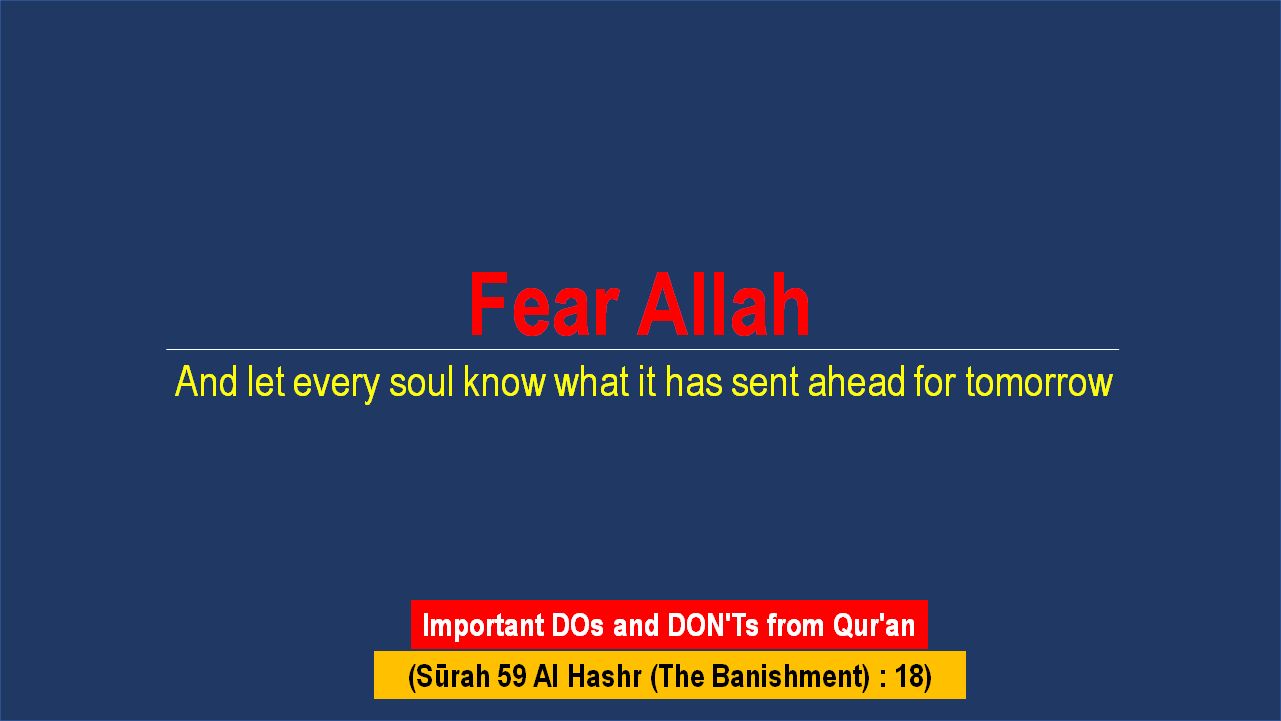
    Fear Allah and let every soul know what it has sent ahead for tomorrow

    Qur'an is a book of guidance for the mankind. It abounds in directives and commandments for man to walk on the straight path and never ever to disorientate itself for all disorientations are due to machinations of evil forces. Time and again it has been reminded to fear Allah, for those who fear Allah remain steady and do not lend ears to evil whispers. 

    Qur'an also reminds man to review his conduct sheet much too often to see what he has sent forward for the Day of Resurrection, which is any day tomorrow. If we keep track of our actions and ensure that these are in accordance with the teachings of Qur'an and Sunnah, we shall never have to worry about our fate tomorrow. But if we have not been fearing Allah and are engrossed in merrymaking, the 18th verse of Surah 59 Al Hashr (The Banishment) draws our attention to be cautioned lest it is too late to even review our actions.

    Note: The entire section of Surah Al Hashr from verses 18-24 is cautions to warn men and cautiones them that there is still time to review what they have sent forward and seek forgiveness of Allah lest the angel of death knocks at their door and there is no time to repent. Please read the exegesis / tafsir of Surah Al Hashr already posted to connect to the following verses correctly:

    يٰۤاَيُّهَا الَّذِيۡنَ اٰمَنُوۡا اتَّقُوا اللّٰهَ وَلۡتَـنۡظُرۡ نَـفۡسٌ مَّا قَدَّمَتۡ لِغَدٍ​ ۚ وَاتَّقُوا اللّٰهَ​ؕ اِنَّ اللّٰهَ خَبِيۡرٌۢ بِمَا تَعۡمَلُوۡنَ‏  
    (18) O you who have believed, fear Allah. And let every soul look to what it has put forth for tomorrow - and fear Allah. Indeed, Allah is Acquainted with what you do.
    It is a rule of the Qur'an that whenever the hypocritical Muslims are taken to task for their hypocrisy, they are given admonition also so that whoever of them has some life left in his conscience, may feel remorse for his conduct and attitude and may make an effort, out of the fear of Allah, to come out of the pit into which his worship of the self has thrown him. 

    " Fear Allah and let every person look to what he sends forward for the morrow " "For the morrow": for the Hereafter. That is, this whole worldly life is "today", whose "tomorrow" is the Day of Resurrection, which is going to follow it. Adopting this style Allah has, in a wise manner, made man understand the truth that just as that person is highly foolish, who gambles away his all for the enjoyment of today and does not realize whether tomorrow he would be left with anything to eat and a place of shelter or not, so is that person also only working for his own doom, who is too absorbed in making; his world to pay heed to the Hereafter, whereas the Hereafter is to follow this world just as today is to be followed by tomorrow, and there he would find nothing if he has sent nothing ahead for the morrow. Besides, the other wise point here is that every person has been appointed his own censor. Unless a person develops in himself the sense of what is good for him and what is evil, he cannot appreciate whether what he is doing will make his future in the Hereafter or mar it. And when this sense becomes active in himself, he will have to calculate and see for himself whether the way in which he is expending his time, his wealth, his energies and capabilities leads to Heaven or Hell. To do so is in his own interest; for if he does not do so he will ruin his own future itself.

    Yusuf Ali Explanation: The "fear of Allah" is akin to love; for it means the fear of offending Him or doing anything wrong that will forfeit His Good Pleasure. This is Taqwa, which implies self-restraint, guarding ourselves from all sin, wrong, and injustice, and the positive doing of good. See ii. 2:
    (ii:2) This is the Book; in it is guidance sure without doubt to those who fear Allah. 
    Taqwa and the verbs and nouns connected with the root, signify: (1) the fear of God which according to the writer of Proverbs (i.7) in the Old Testament is the beginning of Wisdom; (2) restraint, or guarding one's tongue, hand, and heart from evil; (3) hence righteousness, piety good conduct. All these ideas are implied; in the translation, only one or other of these ideas can be indicated according to the context. See also xivii 17; and ixxiv 56.
    The positive side of Taqwa, or "fear of Allah" (see last note) is here emphasized. It is not merely a feeling or an emotion: it is an act, a doing of things which become a preparation and provision for the Hereafter, - the next life, which may be described as "the morrow" in relation to the present Life, which is "to-day". A) The repetition emphasizes both sides of Taqwa: "let your soul fear to do wrong and let it do every act of righteousness; for Allah observes both your inner motives and your acts, and in His scheme of things everything will have its due consequences."

    Javed Ahmad Ghamidi Explanation: This refers to what he has done for the Day of Judgement. It is referred to by the word “tomorrow.” The purpose is to direct attention to its proximity as well as to its certainty.

    The words اِتَّقُوا اللّٰہَ (fear God) are repeated so that the importance of the matter is driven in the minds of the addressees.

    Having asked man to fear Allah and take a look at one's past which has been already recorded, there comes another caution in the next verse, the number 19, which tells man the fate ofthose who did not fear Allah and were forgotten by Allah:

    وَلَا تَكُوۡنُوۡا كَالَّذِيۡنَ نَسُوا اللّٰهَ فَاَنۡسٰٮهُمۡ اَنۡفُسَهُمۡ​ؕ اُولٰٓـئِكَ هُمُ الۡفٰسِقُوۡنَ‏ 
    (19) And be not like those who forgot Allah, so He made them forget themselves. Those are definitely disobedient.
    That is, forgetfulness of God inevitably leads to forgetfulness of one's own self. When man forgets that he is slave to the Almighty, he will inevitably form a wrong view of his position in the world, and his whole life will go wrong because of this basic error. Likewise, when he forgets that he is slave to nobody except Allah, he does not serve the one whose slave actually he is not. This also is a grave and all-pervading misunderstanding, which corrupts his whole life. Man's real position in the world is that of a slave; he is not free and self-sufficient; and he is slave of only One God, and is no one else's slave beside Him. The person who, in not know this truth, does not in fact know himself. And the person who in spite of knowing this, forgets it at any moment, may commit an act at that very moment, which a disbeliever, or a polytheist or a man forgetful of God only would commit. Man's remaining firm and steadfast on the right path entirely depends on his remembering God at all times. For as soon as he, becomes heedless of Him. he becomes heedless of himself and this very heedlessness turns him into sinfulness. 

    Javed Ahmad Ghamidi Explanation: This is a reference to the Jews from whom the Hypocrites received guidance and with whom they would connive to oppose Islam and the Muslims. The words فَاَنۡسٰہُمۡ اَنۡفُسَہُمۡ used for them point to a very important reality. 

    Imam Amin Ahsan Islahi has explained it thus: … Those who forget God become indifferent to their own good and evil and to their fate. All value, significance and majesty of life depends on understanding the reality that the Almighty has not given it to us to indulge in a few days of luxury; He has given it to us so that we spend it in obedience to Him and earn the eternal kingdom of heaven. This pinnacle can of course be achieved by someone who always keeps in mind that he has not been given life by chance; on the contrary, it is a blessing of a Gracious being and He has given it with a special purpose. If a person leads his life in accordance with this special purpose, it will be a great eternal reward for him, and if he forgets this, it will automatically become an eternal curse for him.(Amin Ahsan Islahi, Tadabbur-i Qur’an, vol. 8, 308)

    Having explained the above said verse in detail, you may now listen to explanation of the Ayat by eminent Muslim scholar Nouman Ali Khan:
    May Allāh (سبحانه و تعالى‎) help us understand Qur'ān and follow the Sunnah of Prophet Muhammad ﷺ, which is embodiment of commandments of Allah contained in the Qur'ān. May Allah help us to be like the ones He loves and let our lives be lived helping others and not making others' lives miserable or unlivable. May all our wrong doings, whether intentional or unintentional, be forgiven before the angel of death knocks on our door. 
    وَمَا عَلَيۡنَاۤ اِلَّا الۡبَلٰغُ الۡمُبِيۡنُ‏ 
    (36:17) and our duty is no more than to clearly convey the Message.”
    That is Our duty is only to convey to you the message that Allah has entrusted us with. Then it is for you to accept it or reject it. We have not been made responsible for making you accept it forcibly, And if you do not accept it, we shall not be seized in consequence of your disbelief, you will yourselves be answerable for your actions on Day of Resurrection.

    Reading the Qur'ān should be a daily obligation of a Muslim - Reading it with translation will make it meaningful. But reading its Exegesis / Tafsir will make you understand it fully. It will also help the Muslims to have grasp over social issues and their answers discussed in the Qur'an and other matter related to inter faith so that they are able to discuss issues with non-Muslims with authority based on refences from Qur'an.

    May Allah forgive me if my posts ever imply a piety far greater than I possess. I am most in need of guidance.

    Note: When we mention God in our posts, we mean One True God, we call Allah in Islam, with no associates. Allah is the Sole Creator of all things, and that Allah is all-powerful and all-knowing. Allah has no offspring, no race, no gender, no body, and is unaffected by the characteristics of human life.

    For more Selected Verses, please refer to our reference page: Important DOs and DON'Ts from Qur'anYou may also refer to our Reference Pages: Understanding Al Qur'an and  Selected Verses from the Qur'an for knowing more about Islam and Qur'ān.
    Photo | Tafsir References: | 1 | 2 | 3 | 4 | 5 | 6 | 7 | 8 | 9 | 

    An effort has been made to gather explanation / exegesis of the surahs of the Qur'ān from authentic sources and then present a least possible condensed explanation of the surah. In that the exegesis of the chapters of the Quran is mainly based on the "Tafhim al-Qur'an - The Meaning of the Qur'an" by one of the most enlightened scholars of the Muslim World Sayyid Abul Ala Maududi.  
    In order to augment and add more explanation as already provided, additional input has been interjected from following sources: 
    • Towards Understanding the Quran
    • Tafsir Ibn Khatir
    • Muhammad Asad Translation
    • Javed Ahmad Ghamidi / Al Mawrid
    • Al-Quran, Yusuf Ali Translation
    • Verse by Verse Qur'an Study Circle
    In addition, references of other sources which have been explored have also been given above. Those desirous of detailed explanations and tafsir (exegesis), may refer to these sites.

    If you like Islam: My Ultimate Decision, and to keep yourself updated on all our latest posts to know more about Islam, follow us on Facebook

    Please share this page to your friends and family members through Facebook, WhatsApp or any means on social media so that they can also be benefited by it and better understand Islam and the Qur'ān - Insha Allah (Allah Willing) you shall be blessed with the best of both worlds.

    Monday, 13 June 2022

    No one can share burden of sin committed by another - even though he be a near of kin

    Sin is an immoral act considered to be a transgression against divine law. No religion or culture advocates committing of sins or wrongdoings. Islam lays immense attention to committal of sins and cautions the believers to stay away from everything that has been ordained to be stayed away from.

    And if the sin is committed, only the person who committed the sin will be help responsible and none other than him can carry the burden of his sin, no matter how close he may be. Even a son cannot bear the load of his father's sins, nor can father carry his son's sins.

    There are many verses that caution men about committing sin for none will help them sharing even a small sin of his on the Day of Resurrection. We choose today 18th verse of Surah 18. Fatir with the same theme:

    وَ لَا تَزِرُ وَازِرَةٌ وِّزۡرَ اُخۡرَىٰ ؕ وَاِنۡ تَدۡعُ مُثۡقَلَةٌ اِلٰى حِمۡلِهَا لَا يُحۡمَلۡ مِنۡهُ شَىۡءٌ وَّلَوۡ كَانَ ذَا قُرۡبٰى ؕ اِنَّمَا تُنۡذِرُ الَّذِيۡنَ يَخۡشَوۡنَ رَبَّهُمۡ بِالۡغَيۡبِ وَاَقَامُوا الصَّلٰوةَ ؕ وَمَنۡ تَزَكّٰى فَاِنَّمَا يَتَزَكّٰى لِنَفۡسِهٖ ؕ وَاِلَى اللّٰهِ الۡمَصِيۡرُ‏ 
    (35:18) No one can bear another's burden. If a heavily laden one should call another to carry his load, none of it shall be carried by the other, even though he be a near of kin. (O Prophet), you can warn only those who fear their Lord without seeing Him and establish Prayer.41 Whoever purifies himself does so to his own good. To Allah is the final return.
    "Burden": the burden of the responsibilities of actions. It means: In the sight of Allah every one is responsible for his own actions and for no one else's. There is no possibility that Allah will place the burden of one man's responsibility upon the other, nor is there the possibility that a person will take the burden of another's responsibility upon himself and get himself seized for the crime committed by the other. This thing has been said here because the polytheist kinsmen and relatives of the people who were embracing Islam in Makkah, used to urge them, saying, Give up Islam and return to your ancestral faith. We take the responsibility of any punishment etc. on ourselves."

    In the preceding sentence, Allah's law of justice has been enunciated, according to which He will not seize any person for the sin committed by another, but will hold everyone responsible for his own sin. In this sentence the Muslims have been told: `Those who urge you to give up faith and commit evil on the assurance that they will take on themselves the burden of your sins on the Day of Resurrection, are in fact giving you a false hope. When Resurrection comes and the people see what fate they are going to meet in consequence of their misdeed, everyone will be concerned only about himself. Brother will turn away from brother and father from son, and no one will be prepared to take even an atom's weight of another's burden on himself." 

    In other words, "Your warnings cannot have any effect on obstinate and stubborn people. Your admonitions can bring only such people to the right path, who have fear of God in their hearts, and who are inclined to bow before their real Master." 

    Tafsir Ibn-Kathir
    (And no bearer of burdens shall bear another's burden;) means, on the Day of Resurrection.

    (and if one heavily laden calls another to (bear) his load, ) means, if the person who is carrying a heavy burden calls someone else to help him carry his load, all or part of it,

    (nothing of it will be lifted even though he be near of kin.) means, even if he is closely-related to him, even if he is his father or son, for each person will be preoccupied with his own self and his own situation. Then Allah says:

    (You can warn only those who fear their Lord unseen and perform the Salah.) means, `the only ones who will draw a lesson from what you have brought are those who are possessed of insight and wisdom, who fear their Lord and who do as He commands.'

    (And he who purifies himself, then he purifies only for the benefit of himself.) means, who does righteous deeds, the benefit of that will come back to him,

    And to Alla0h is the Return. means, to Him everything will ultimately return, and He is swift in bringing to account. He will reward or punish everyone according to his deeds: if they are good, then the end will be good, and if they are bad, then the end will be bad.

    Muhammad Asad Explanation:
    ( AND NO BEARER of burdens shall be made to hear another's burden; ) I.e., on Judgment Day - for "whatever [wrong] any human being commits rests upon him alone" ( 6:164 , which is followed by a sentence identical with the one above).

    ( and if one weighed down by his load calls upon [another] to help him carry it, nothing thereof may be carried [by that other], even if it be one's near of kin. ) Thus, any transfer of moral responsibility from one person to another is shown to be impossible. Whereas the first part of the above statement implies a negation of the Christian doctrine of "original sin" with which mankind is supposedly burdened, the second part categorically refutes the doctrine of the "vicarious atonement" of that sin by Jesus. (See also 53:38 and the corresponding note [31].)

    ( Hence, thou canst [truly] warn only those who stand in awe of their Sustainer although He is beyond the reach of their perception, ) For an explanation of this rendering of bi'l-ghayb, see surah {2}, note [3]. The meaning is that only those "who believe in the existence of that which is beyond the reach of human perception" can really benefit by the "warning" inherent in the preceding statement. (See also {27:8-81} and {30:52-53}.)

    Yusuf Ali  Explanation
    Natural relationship may be considered as a reasonable cause or opportunity for bearing each other's burdens. For example, a mother or a father might offer to die for her or his child, and vice versa. But this does not apply to spiritual matters. There the responsibility is strictly personal and cannot be transferred to another. In xxix. 13 we are told that the misleaders "will bear other burdens along with their own"; but the context shows that the "other" burdens are the burdens of deluding others with their falsehoods. Both sins are their own, viz., their original sin, and the sin of deluding the others. But the responsibility will be doubled.

    Bil-gaibi "  بِالۡغَيۡبِ ": unseen in the adverbial sense. The man, who, though he does not see Allah, so realizes Allah's Presence in himself as if he saw Him, is the man of genuine Faith, and for him Allah's Revelation comes through many channels and is always fruitful.

    Prayer is one of the means of purifying ourselves of lower motives in life, for in prayer we seek the Presence of Allah. But the purity which we seek is for our own souls: we confer no favour on Allah or on any Power in the spiritual world, as some imagine who make "gifts" to Allah. In any case the destination of all is to Allah.

    Qur'an Wiki:
    The sūrah then emphasizes individual responsibility, which means that everyone will have what they deserve. No one benefits anyone else in any way. The Prophet has no personal interest in guiding people to the truth. Everyone bears his or her own burden, alone, without help. Therefore a person who seeks to be pure will be the only one to benefit from this endeavour. The matter is ultimately left to God to determine. The fact of individual responsibility and reward has a decisive effect on morality and behaviour. When people are fully aware that they are rewarded according to their own deeds, that none will be responsible for anyone else, and that none can escape responsibility, they realize the need to take stock of their actions before they have to answer for them. At the same time, this is reassuring, because no individual needs to worry about answering for the actions of his community. As long as he has done his duty, giving advice to his community to follow divine guidance, no further responsibility is laid on him. God Almighty does not hold mankind to account for their collective actions. They account to Him individually, each for their own work. It is the duty of the individual to advise others and try hard to bring them into line. Once he has done this, however, he bears no responsibility for their wickedness or corruption. He will he credited for his own good work. Similarly, if he lives in a good community, its goodness will not benefit him if he himself is wicked.

    We see, then, an image of a multitude, each person carrying his or her own burden, with none able to help others. Even if someone requests help from the closest of relatives, none will oblige. It is thus a long queue, with people carrying loads and moving towards the check-point where the load will he weighed. Everyone is tired, preoccupied with the heaviness of their load, unable to think of others, even their own kin.

    At this point, the sūrah’s address is directed to the Prophet: “Hence, you can truly warn only those who stand in awe of their Lord, even though He is beyond the reach of their perception, and attend regularly to prayers.” It is such people that can really appreciate the warning: they are the ones who fear God even though they have not seen Him, and who attend to their worship so as to maintain relations with Him. The Prophet is told that these are the ones to benefit by admonition. Others, who have no fear of God, need not worry him.

    “Whoever purifies himself does so for his own benefit.” No one receives the benefit of purification except the one who does it. Moreover, purification has pleasant and transparent connotations that apply to one’s heart, thoughts, feelings, behaviour and attitudes. “With God is all journeys’ end.” He is the one who reckons people’s actions and rewards them accordingly. Nothing good or evil is overlooked.

    Please listen to explanation of the ayat by eminent Muslim scholar Nouman Ali Khan:
    May Allāh (سبحانه و تعالى‎) help us understand Qur'ān and help us to act upon the commandments of Allah contained therein. Aameen.

    For more selected verses on the subject, refer to our Reference Page: Selected Verses from Qur'an: Slandering and False Accusations and Sins

    For more Selected Verses, please refer to our reference page: Selected Verses from the Qur'anYou may also refer to our Reference Pages for knowing more about Islam and Qur'ān.
    Photo | References: | 1 | 2 | 3 | 4 | 5 | 6 | 7 |
    Reading the Qur'ān should be a daily obligation of a Muslim - Reading it with translation will make it meaningful. But reading its Exegesis / Tafsir will make you understand it fully.

    An effort has been made to gather explanation / exegesis of the surahs of the Qur'ān from authentic sources and then present a least possible condensed explanation of the surah. In that the exegesis of the chapters of the Quran is mainly based on the "Tafhim al-Qur'an - The Meaning of the Qur'an" by one of the most enlightened scholars of the Muslim World Sayyid Abul Ala Maududi.  
    In order to augment and add more explanation as already provided, additional input has been interjected from following sources: 
    • Towards Understanding the Quran
    • Tafsir Ibn Khatir
    • Muhammad Asad Translation
    • Javed Ahmad Ghamidi / Al Mawrid
    • Al-Quran, Yusuf Ali Translation
    • Verse by Verse Qur'an Study Circle
    In addition the references of other sources which have been explored have also been given above. Those desirous of detailed explanations and tafsir (exegesis), may refer to these sites.

    If you like Islam: My Ultimate Decision, and to keep yourself updated on all our latest posts to know more about Islam, follow us on Facebook

    Please share this page to your friends and family members through Facebook, WhatsApp or any means on Social Media so that they can also be benefited by it and better understand Islam and the Qur'ān - Insha Allah (Allah Willing) you shall be blessed with the best of both worlds.
    Saturday, 3 July 2021

    Give Charity and give good loan to Allah to earn a noble reward


    All men have not been blessed equally by Allah for a reason - and the reason is two fold: Whether the have nots remain steadfast and still continue to worship Allah and whether the rich care for the poor and help them sustain their lives or not. However, the reward for helping the have nots depends on one's intention: Whether is done to please Allah or as a show off to tell the world one's generosity. 

    Charity is a means to sustain widows, orphans, war torn people and those living below poverty line. But it is certainly for not the professional beggars and those who do not strive for earning their livelihood by finding a work for the, Nor is charity to be given in the name of wordily gods and be always given in the name of Allah and none else.

    We have already shared a number of verses from Qur'an in which Allah has asked his servants to give charity in His name so that they be given a noble reward both here in the world and in the Hereafter. Today we share the 18th verse of Surah 57 Al Hadeed (The Iron) in which Allah terms charity given in His name as a good loan to Allah. Read this verse in conjunction with verse 11 of the same surah.

    اِنَّ الۡمُصَّدِّقِيۡنَ وَالۡمُصَّدِّقٰتِ وَاَقۡرَضُوا اللّٰهَ قَرۡضًا حَسَنًا يُّضٰعَفُ لَهُمۡ وَلَهُمۡ اَجۡرٌ كَرِيۡمٌ‏ 
    ( 18 )   Indeed, the men who practice charity and the women who practice charity and [they who] have loaned Allah a goodly loan - it will be multiplied for them, and they will have a noble reward.
    Sadagah, as an Islamic term, is the charity given sincerely and with a pure intention only with a view to seek Allah's good pleasure without making any show of it, and without the intention of doing any favor to the recipient. The donor should give it only because he has a true feeling of the service of his Lord. The word is derived from sidq; therefore, sadaqat(sincerity) is of its essence. No charity and no expending of the wealth can be a sadaqah unless it springs from a sincere and pure motive of spending only for the sake of Allah.

    Tafsir Ibn-Kathir: Reward for the Charitable, the True Believers and the Martyrs; and the Destination of the Disbelieve - Allah the Exalted describes the reward that He will award to those who spend from their wealth, whether male or female, on the needy, the poor and the meek, (and lend Allah handsome loan,) meaning, they give in charity with a good heart seeking the pleasure of Allah. They do not seek worldly rewards or appreciation from those to whom they give in charity. 

    Allah's statement, (it shall be increased manifold,) indicating that He will multiply the good deeds from tenfold, up to seven hundredfold and even more than that, (and theirs shall be an honorable good reward.) theirs will be a generous, handsome reward, a good dwelling to return to and an honorable final destination. 

    Yusuf Ali Explanation: Cf. lvii. 11; also see ii. 245 and note (reproduced below).
    Spending in the cause of God is called metaphorically "a beautiful loan". It is excellent in many ways: (1) it shows a beautiful spirit of self-denial; (2) in other loans there may be a doubt as to the safety of your capital or any return thereon; here you give in the Lord of All, in Whose hands are the keys of want or plenty; giving you may have manifold blessings, and withholding you may even lose what you have. If we remember that our goal is God, can we turn away from His cause?

    Muhammad Asad Translation : Or: "who give in charity" - depending on the vocalization of the consonants sad and dal. In view of the sequence, the sense given in my rendering seems preferable (and is, indeed, stressed by Zamakhshari), although in the reading of Hafs ibn Sulayman al-Asadi, on which this translation is based, the relevant nouns appear in the spelling mussaddiqin and mussaddiqat, "men and women who give in charity". 

    Qur'an Wiki: Those who give generously in charity do not couple their action by pressing for favours from the recipients of that charity. In all this, they do not deal with people. They deal directly with God, offering Him a loan. What better incentive for charity! Can there be a more profound feeling for a charitable believer than that he is giving a loan to God who has no need of anyone and who repays good deeds in multiples. Can he hope for anything better than dealing with the One who has dominion over the entire universe, and that whatever he spends in charity will be given back in multiples together with a generous reward?

    Those who uphold the truth enjoy a very high status, as indicated by several statements made by the Prophet. Yet this high status is, by the grace of God, easy to achieve. It is not reserved for any individual or group. Whoever truly believes in God and His messengers can aspire to this height. God's grace is without limit.

    May Allah help us understand Qur'ān and help us to act upon the commandments of Allah contained therein. And let us be as charitable as we can to give out good loan to Allah so that we be blessed. Aameen.

    For more Selected Verses, please refer to our reference page: Selected Verses from the Qur'anYou may also refer to our Reference Pages for knowing more about Islam and Qur'ān.
    Photo | Reference: 1 | 2 | 3 | 4 | 5 | 6 | 7 | 8 | 9 | 
    Reading the Qur'ān should be a daily obligation of a Muslim - Reading it with translation will make it meaningful. But reading its Exegesis / Tafsir will make you understand it fully.

    An effort has been made to gather explanation / exegesis of the surahs of the Qur'ān from authentic sources and then present a least possible condensed explanation of the surah. In that the exegesis of the chapters of the Quran is mainly based on the "Tafhim al-Qur'an - The Meaning of the Qur'an" by one of the most enlightened scholars of the Muslim World Sayyid Abul Ala Maududi.  
    In order to augment and add more explanation as already provided, additional input has been interjected from following sources: 
    • Towards Understanding the Quran
    • Tafsir Ibn Khatir
    • Muhammad Asad Translation
    • Javed Ahmad Ghamidi / Al Mawrid
    • Al-Quran, Yusuf Ali Translation
    • Verse by Verse Qur'an Study Circle
    In addition the references of other sources which have been explored have also been given above. Those desirous of detailed explanations and tafsir (exegesis), may refer to these sites.

    If you like Islam: My Ultimate Decision, and to keep yourself updated on all our latest posts to know more about Islam, follow us on Facebook

    Please share this page to your friends and family members through Facebook, WhatsApp or any means on Social Media so that they can also be benefited by it and better understand Islam and the Qur'ān - Insha Allah (Allah Willing) you shall be blessed with the best of both worlds.

    Twitter Delicious Facebook Digg Stumbleupon Favorites More