.

Wednesday, 10 August 2022

Believers! Make not unlawful the good things which Allah hath made lawful for you

Today in our series of posts on Important DOs and DONTs in Islam, we take up the concept of asceticism: The severe self-discipline and avoiding of all forms of indulgence, typically for religious reasons. Islam does not propagate seclusion and cutting off one's links with the world and the family on the plea of being nearer to God. The same concept of self-mortification practiced, in particular, by Christian priests and Hindu monks. This has been the practice at that time and even continues till date.

Yet there are men, who have formed their own reasonings to label a thing unlawful which otherwise has been made lawful for man by God. Can a man have reasoning comparable or even greater than God? Of course never ever.  So why indulge into reasonings which have mere personal signatures.

We share today the 87th verse of Surah 5. Al Mai' da which emphasizes on the Using Allah's gifts of all kinds with gratitude, but excess is not approved of by Allah:

يٰۤـاَيُّهَا الَّذِيۡنَ اٰمَنُوۡا لَا تُحَرِّمُوۡا طَيِّبٰتِ مَاۤ اَحَلَّ اللّٰهُ لَـكُمۡ وَلَا تَعۡتَدُوۡا​ ؕ اِنَّ اللّٰهَ لَا يُحِبُّ الۡمُعۡتَدِيۡنَ‏ 
O ye who believe! make not unlawful the good things which Allah hath made lawful for you but commit no excess: for Allah loveth not those given to excess.
This Divine Commandment implies two things:
  • First, "You have no authority to make certain things lawful and others unlawful. Lawful is only that which Allah has made lawful and unlawful is that which Allah has made unlawful. Therefore if you make a lawful thing unlawful, and vice versa, you will be following your own law and not the Divine Law." 
  • Secondly, "You should not adopt the way of asceticism like the Christian monks or the Hindu friars or the Buddhist mendicants and the like." 
This was meant to warn the Muslims against the general tendency, which has always existed among the religious-minded people, to consider even the normal satiation of the desires of the body and mind to be against spiritual progress. They imagine that self-torture, self-denial and abstinence are virtues in themselves and that one could not approach God without these austerities. As a matter of fact, there were some Companions, who had developed such tendencies. When the Holy Prophet came to know that some of his Companions had taken vows that they would always observe fast during the day and would not go to bed for sleep but keep awake and worship God the whole night, and would abstain from flesh, fat and women, he forbade them from such practices. He said, "I have not ordained such things; your own self has rights on you; therefore observe fast and also eat easefully. Stand in worship at night and also go to sleep. I myself sometimes observe fast and at others I do not. I eat flesh and butter. (This is my way) and the one who does not like my way, is not of me."

According to another 'Tradition, he emphasized the same and said, "Now is it that some people have made unlawful for themselves women, good food, scents and perfumes, sleep and other good things of the world? As for me I have not taught you to become monks and hermits. The way of life taught by me does neither allow abstention from women nor from eating flesh nor retirement and seclusion from the world. The Law has prescribed Fasting for self-discipline, and Jihad for the same benefits that might be obtained from asceticism. Worship Allah and associate none with Him as partner, perform Hajj and `Umrah, establish the Salat and pay Zakat and observe the Fasts during the month of Ramadan. The people who were doomed before you, were doomed because they practiced austerity of their own accord, and when they did so, Allah also prescribed the same for them. Those are of them whom you now see in the Monasteries.

In the same connection, we learn from some Traditions that when the Holy Prophet came to know that a certain Companion had been abstaining from having conjugal relations with his wife for a long time and had been devoting himself to worship, he immediately sent for him and ordered, "Go to your wife instantly. " The Companion replied, "I am with fast" The Prophet again said, "Break the fast and go to your wife. "

There is another instance of the same kind. A woman came to Caliph 'Umar and complained, "My husband observes fast during The day and passes the night in worship and does not have conjugal relations with me." Hadrat `Umar ordered Ka`b bin Saur al-Azdi to hear the case. He decreed that the husband was permitted to pass three nights in worship but he must go to his wife on the fourth night. 

"To go beyond the limits" has very extensive meanings. One goes beyond the limits, if one makes lawful things unlawful or abstains from things which Allah has declared to be pure as if they were impure or if one is extravagant in the use of pure things, or if one makes use of unlawful things as if they were lawful. Allah does not like such acts of transgression.

Tafsir Ibn-Kathir: There is No Monasticism in Islam
`Ali bin Abi Talhah said that Ibn `Abbas said, "This Ayah was revealed about some of the Companions of the Prophet who said, `We should cut off our male organs, abandon the desires of this life and travel in the land, just as the Ruhban (monks) do.' When the Prophet heard of this statement, he summoned them and asked them if they made this statement and they answered `Yes.' 

The Prophet said, (I fast and break my fast, pray and sleep, and marry women. Whoever follows my Sunnah is of me, and whoever abandons my Sunnah is not of me.)'' Ibn Abi Hatim also collected this Hadith. Ibn Marduwyah recorded that Al-`Awfi said that Ibn `Abbas narrated a similar Hadith. It is recorded in the Two Sahihs that `A'ishah said that some of the Companions asked the wives of the Prophet about the acts of worship that he performed in private. One of them said, "I will not eat meat,'' another said, "I will not marry women,'' while the third said, "I will not sleep on the bed.'' 

When the Prophet heard this statement, he said, (What is the matter with some people who said such and such I fast and break the fast, sleep and wake to stand to pray, eat meat, and marry women. He who is not pleased with my Sunnah is not of me.) 

Allah's statement, (and transgress not.) means, do not exaggerate and make it hard for yourselves by prohibiting the permissible things. Do not transgress the limits by excessively indulging in the permissible matters; only use of it what satisfies your need; and do not fall into extravagance. 

Allah said in other Ayat, 
(And eat and drink but waste not by extravagance.)﴿7:31﴾, and,
(And those, who, when they spend, are neither extravagant nor miserly, but hold a medium (way) between those (extremes).)﴿25:67﴾ 

So Allah legislated a medium way between those who are extreme and those who fall into shortcomings, and it does not allow excessive application, nor lack of application.  This is why Allah said here, (Make not unlawful the good things which Allah has made lawful to you, and transgress not. Verily, Allah does not like the transgressors.)

Tafsir Qur'an Wiki:
The first address in this passage to the believers reminds them that they may not exercise any of God’s attributes, since these belong totally to God. As such, they may not forbid themselves any of the wholesome and good things that God has made lawful to them. It is not open to them to make a demonstration of self-imposed prohibition, refusing to eat of such good food God has given them. They must remember that it is God who has provided them with such lawful and wholesome sustenance. It is only He who may designate things as permissible or forbidden.

The whole question of legislation is closely linked to that of Godhead. It is God alone who has the sole authority to regulate for people’s lives. His authority is derived from the fact that it is He who has created human beings and provided them with food and sustenance. Hence, to Him alone belongs the right to make permissible to them whatever He pleases of His own provisions and to declare any part of such provisions forbidden to them. Human beings themselves acknowledge this logic. Whoever owns something enjoys the right to dispose of it in any way he pleases. Anyone who violates this basic principle is undoubtedly a transgressor. It is only to be expected that believers do not make an assault on God in whom they believe. It is inconceivable that a believer could ever assault God’s authority.

Javed Ahmad Ghamidi Explanation:
The Sūrah ends here as far as its subject is concerned. The succeeding verses form a supplement. Sūrah al-Nisā’ too ended on a similar supplement. In this supplement of Sūrah al-Mā’idah, the Almighty has responded to the questions which arose in the minds of people about the various topics discussed in the sūrah. The answer to each of these questions begins with the words: يٰ٘اَيُّهَا الَّذِيْنَ اٰمَنُوْا. The Qur’ān has not cited the questions; however, it has answered them in a sequence and in between has also alluded to the fact that these are answers which it has given in this supplement. Sūrah al-Nisā’ and Sūrah al-Mā’idah are a pair. Their similarity in their concluding part shows what makes them a pair and what are the aspects that make sūrahs a pair in the Qur’ān.
The first question arose when, in the introductory verses of the sūrah, after mentioning that promises must be honoured, it was stated that barring a few exceptions all four-legged beasts are lawful. People wanted to ask that if promises made in the name of God are so important in religion, then what should be done if a person regards something forbidden to himself which the sharī‘ah has not forbidden?
The second question which also arose from these introductory verses is that if, except for the forbidden things they mention, everything is allowable, what is the directive about liquor and gambling? If the answer to this question is that both are forbidden, then how will people who have been involved in them before this prohibition be treated?

The third question also arose from these introductory verses. It arose because of a mention of hunting animals while wearing the iḥrām: what should a person who violates this directive do? Moreover, what is the status of hunting sea animals while wearing the iḥrām? This is because at times in sea travel there is no option but to hunt sea animals.

The fourth question also relates to these introductory verses. The Almighty has emphatically mentioned the sanctity of hadī (sacrificial animals), qalā’id (sacrificial animals wearing collars) and some other similar religious symbols (sha‘ā’ir) in these verses. The question which arose from this pertains to the final directive about the animals which because of religious rituals of ancient times were prohibited by the names of baḥīrah, sā’ibah, waṣīlah and ḥām etc. Does their prohibition still stand like that of the hadī and the qalā’id or does it stand dissolved?

The fifth and last question arose because of the comment of the Qur’ān on the attitude of concealment of evidence adopted by the Jews and the Nazarenes about the sharī‘ah of God and about the last of His Messengers. People became anxious about what they should do regarding bearing evidence to their will testaments. These are the answers to questions which are raised when the mind is diverted to things as a result of mention of some other thing.
( Do not forbid) This has been stated because certain things are originally pure and lawful, but an external factor makes them unlawful. For example, an animal is allowed, but it is not slaughtered or slaughtered such that someone other than God’s name was pronounced while slaughtering it.

(the pure and wholesome things which God has made lawful for you)  The implication is to regard something as forbidden with the claim that it is forbidden as per the directive of God or that this forbiddance is a means of attaining virtue and superiority or this can earn reward or punishment. This primarily relates to polytheistic beliefs and superstitions. However, this does not mean that not consuming something without making such a claim or estimation does not come under this Qur’ānic directive. Imām Amīn Aḥsan Iṣlāḥī writes:
… If no such concept is involved and a person purely out of taste or health considerations or caution or stringent resources does not consume anything, then this does not fall under the forbiddance mentioned by the Qur’ān. (Amīn Aḥsan Iṣlāḥī, Tadabbur-i Qur’ān, vol. 2, 588)
(And do not transgress bounds)   These words occur in contrast to the words “do not forbid” and hence refer to the fact that people should not forbid pure and wholesome things and in matters of the lawful and the unlawful they should not transgress the bounds prescribed by God thereby daring to make lawful what is unlawful.

( God does not like people who transgress bounds )  In the Qur’ān, this expression generally implies its consequence: God hates them.

Please listen to explanation of the ayat by eminent Muslim scholar Nouman Ali Khan:
May Allāh (سبحانه و تعالى‎) help us understand Qur'ān and follow the Sunnah of Prophet Muhammad ﷺ, which is embodiment of commandments of Allah contained in the  Qur'ān. May Allah help us to be like the ones He loves and let our lives be lived helping others and not making others life miserable or unlivable. May all our wrong doings, whether intentional or unintentional, be forgiven before the angel of death knocks on our door. 
وَمَا عَلَيۡنَاۤ اِلَّا الۡبَلٰغُ الۡمُبِيۡنُ‏ 
(36:17) and our duty is no more than to clearly convey the Message.”
That is Our duty is only to convey to you the message that Allah has entrusted us with. Then it is for you to accept it or reject it. We have not been made responsible to make you accept it forcibly, And if you do not accept it, we shall not be seized in consequence of your disbelief, You will yourselves be answerable for your actions on Day of Resurrection.

Reading the Qur'ān should be a daily obligation of a Muslim - Reading it with translation will make it meaningful. But reading its Exegesis / Tafsir will make you understand it fully. It will also help the Muslims to have grasp over social issues and their answers discussed in the Qur'an and other matter related to inter faith so  that they are able to discuss issues with Non Muslims with authority based on refences from Qur'an.

May Allah forgive me if my posts ever imply a piety far greater than I possess. I am most in need of guidance.

Note: When we mention God in our posts, we mean One True God, we call Allah in Islam, with no associates. Allah is the Sole Creator of all things, and that Allah is all-powerful and all-knowing. Allah has no offspring, no race, no gender, no body, and is unaffected by the characteristics of human life.

For more Selected Verses, please refer to our reference page: Selected Verses from the Qur'anYou may also refer to our Reference Pages: Understanding Al Qur'an and Important DOs and DON'Ts from Qur'an for knowing more about Islam and Qur'ān.
Photo | Tafsir References: | 1 | 2 | 3 | 4 | 5 | 6 |

An effort has been made to gather explanation / exegesis of the surahs of the Qur'ān from authentic sources and then present a least possible condensed explanation of the surah. In that the exegesis of the chapters of the Quran is mainly based on the "Tafhim al-Qur'an - The Meaning of the Qur'an" by one of the most enlightened scholars of the Muslim World Sayyid Abul Ala Maududi.  
In order to augment and add more explanation as already provided, additional input has been interjected from following sources: 
  • Towards Understanding the Quran
  • Tafsir Ibn Khatir
  • Muhammad Asad Translation
  • Javed Ahmad Ghamidi / Al Mawrid
  • Al-Quran, Yusuf Ali Translation
  • Verse by Verse Qur'an Study Circle
In addition the references of other sources which have been explored have also been given above. Those desirous of detailed explanations and tafsir (exegesis), may refer to these sites.

If you like Islam: My Ultimate Decision, and to keep yourself updated on all our latest posts to know more about Islam, follow us on Facebook

Please share this page to your friends and family members through Facebook, WhatsApp or any means on Social Media so that they can also be benefited by it and better understand Islam and the Qur'ān - Insha Allah (Allah Willing) you shall be blessed with the best of both worlds.

Who are even more astray like cattle - The utterly heedless

The major difference between men and animal is the faculty of perception. The animals walk, sleep, eat just like men do, but they cannot differentiate between dirt and mud. inasmuch as animals follow only their instincts and natural needs and are not conscious of the possibility or necessity of a moral choice. They can be lead to wherever their shepherds lead them to. 

However,  men has been faculties to think, differentiate between good and bad, or right or wrong. If man has this understanding and knowledge he sees the right thing with his eyes, hears the right thing with his ears, thinks the right thing with his mind and intellect and takes the right decisions. But when he refuses to believe in the revelations of Allah, he fails to see the truth in spite of the eyes, becomes deaf to every word of admonition in spite of the ears, and misuses the blessings of the mind and intellect that God has granted him, and goes on drawing wrong conclusions one after the other, so much so that he starts using all his capabilities for his own destruction. These are the men who are labelled as the men who are even more astray like cattle - the utterly heedless. 

It is for such men that the following 179th verse of Surah 7 Al A'raf was revealed, expressing the Divine anger: 

وَلَـقَدۡ ذَرَاۡنَا لِجَـهَنَّمَ كَثِيۡرًا مِّنَ الۡجِنِّ وَالۡاِنۡسِ​ ​ۖ  لَهُمۡ قُلُوۡبٌ لَّا يَفۡقَهُوۡنَ بِهَا  وَلَهُمۡ اَعۡيُنٌ لَّا يُبۡصِرُوۡنَ بِهَا  وَلَهُمۡ اٰذَانٌ لَّا يَسۡمَعُوۡنَ بِهَا ؕ اُولٰۤـئِكَ كَالۡاَنۡعَامِ بَلۡ هُمۡ اَضَلُّ​ ؕ اُولٰۤـئِكَ هُمُ الۡغٰفِلُوۡنَ‏ 
(7:179) And certainly We have created for Hell many of the jinn and mankind; they have hearts with which they fail to understand; and they have eyes with which they fail to see; and they have ears with which they fail to hear. They are like cattle - indeed, even more astray. Such are utterly heedless.

It does not mean that.... "There are many Jinns and human beings whom We have created for the sole purpose of sending them to Hell and with the intention of making them fuel for it." But what it means is this: "We created them and gave them hearts, brains, eyes and ears but these wicked people did not make use of these faculties to discern the Truth from falsehood and made themselves fuel for Hell by their evil deeds."

The way that has been adopted to express the above thing is that of showing intense regret in human language. For example, when the young sons of a mother are killed in the battle she says to the people, "I brought them up to become fodder for the cannon". But she does not mean that she really brought them up for this purpose. 

The above quoted verse is similar to the 26th verses of Surah 46. Al-Ahqaf:
وَلَقَدۡ مَكَّنّٰهُمۡ فِيۡمَاۤ اِنۡ مَّكَّنّٰكُمۡ فِيۡهِ وَجَعَلۡنَا لَهُمۡ سَمۡعًا وَّاَبۡصَارًا وَّاَفۡـئِدَةً  ۖ فَمَاۤ اَغۡنٰى عَنۡهُمۡ سَمۡعُهُمۡ وَلَاۤ اَبۡصَارُهُمۡ وَلَاۤ اَفۡـئِدَتُهُمۡ مِّنۡ شَىۡءٍ اِذۡ كَانُوۡا يَجۡحَدُوۡنَۙ بِاٰيٰتِ اللّٰهِ وَحَاقَ بِهِمۡ مَّا كَانُوۡا بِهٖ يَسۡتَهۡزِءُوۡنَ
(46:26) We had established them firmly in a manner We have not established you. We had given them ears and eyes and hearts. But nothing availed them neither their ears, nor their eyes, nor their hearts, for they denied the Signs of Allah. Then what they had mocked at encompassed them.
Javed Ahmad Ghamidi Explanation:
 This sentence expresses great anger and warning. It means that if a large number of men and jinn who have adopted a rebellious attitude, then after this it can only be said that God has created them for Hell. Thus, it is explained ahead why they will become the fuel of Hell. It is stated that that these people did not take any advantage of the faculties and abilities which the Almighty gave them to understand the truth. The consequence of this was that the very objective of their life became coming into this world, spending time here and then ending up in Hell.

This understanding, seeing and listening refer to their essence and reality; otherwise they fully understand, see and listen what these faculties demand in the perceptible sense to feed their hunger and satisfy their sexual urge.

Imām Amīn Aḥsan Iṣlāḥī writes:
… They are like animals because just as animals confine their efforts to satisfy the needs of their bodies, in a similar way, their endeavours too are restricted to their material needs and desires. They are less sensible than animals because animals at least take advantage of all the abilities found in their instincts and leave no stone unturned in this regard. On the other hand, human beings not only do not take real advantage of the higher abilities which the Almighty has bestowed on them, they also at times end up doing things which even an ox or a donkey would not do. For example, human beings in spite of being human beings become so foolish and silly that they start worshipping trees, stones and animals but an ox or a donkey can never be so imprudent. The Qur’ān states that it is such people who are not aware in the real sense because even animals are not inflicted with this unawareness. (Amīn Aḥsan Iṣlāḥī, Tadabbur-i Qur’ān, vol. 3, 398)
Tafsir Qur'an Wiki:
Those large numbers of jinn and human beings are destined for hell. Why? And what for? There are two aspects to consider here. The first is that God’s perfect knowledge shows that such creatures will inevitably go to hell. For God to know this does not require that actions which earn the punishment of hell actually take place. God’s knowledge is absolute, free from the constraints of time, action and place. Nothing is added to God’s knowledge as a result of a motion or an action that takes place in our world.
 
The second aspect to consider is that God’s perfect knowledge does not in any way direct these creatures to go astray so as to incur the punishment of hell as a result. It is they who are just like the Qur’ānic verse describes: “They have hearts they cannot understand with, and they have eyes with which they fail to see, and ears with which they fail to hear.” (Verse 179) It is they who have not opened their hearts and minds to learn and understand. Proofs, signs, indications and pointers of all sorts are available throughout the universe and in the divine messages, providing guidance which can easily be understood by hearts and minds that are kept open. It is they who have chosen not to open their ears to listen to God’s revelations. They have kept all these means of perception and understanding idle and unused. As a result, they live a life of willful ignorance: “They are like cattle; indeed, they are even further away from the right way; they are the truly heedless.” (Verse 179)
 
Those who are heedless of the signs God has placed in the universe and in life itself, and choose not to reflect on the events that take place around them, and do not see God’s will behind them all, are indeed further astray than cattle. Animals have natural tendencies to guide them. Human beings and jinn have been given hearts, minds, eyes and ears to hear, look and understand. If they choose not to open their means of perception, and prefer instead to go about life without reflecting about its meaning and aim, and without looking at its events and what they signify, or hearing its messages, they place themselves below animals who have only been given their natural tendencies. As a result, they are destined for hell. It is God’s will that drives them there ever since He has given them their dual susceptibility and made the law of punishment and reward. God knows right at the beginning that their action and attitude will lead them to hell.
May Allāh (سبحانه و تعالى‎) help us understand Qur'ān and follow the Sunnah of Prophet Muhammad ﷺ, which is embodiment of commandments of Allah contained in the  Qur'ān. May Allah help us to be like the ones He loves and let our lives be lived helping others and not making others life miserable or unlivable. May all our wrong doings, whether intentional or unintentional, be forgiven before the angel of death knocks on our door. 
وَمَا عَلَيۡنَاۤ اِلَّا الۡبَلٰغُ الۡمُبِيۡنُ‏ 
(36:17) and our duty is no more than to clearly convey the Message.”
That is Our duty is only to convey to you the message that Allah has entrusted us with. Then it is for you to accept it or reject it. We have not been made responsible to make you accept it forcibly, And if you do not accept it, we shall not be seized in consequence of your disbelief, You will yourselves be answerable for your actions on Day of Resurrection.

Reading the Qur'ān should be a daily obligation of a Muslim - Reading it with translation will make it meaningful. But reading its Exegesis / Tafsir will make you understand it fully. It will also help the Muslims to have grasp over social issues and their answers discussed in the Qur'an and other matter related to inter faith so  that they are able to discuss issues with Non Muslims with authority based on refences from Qur'an.

May Allah forgive me if my posts ever imply a piety far greater than I possess. I am most in need of guidance.

Note: When we mention God in our posts, we mean One True God, we call Allah in Islam, with no associates. Allah is the Sole Creator of all things, and that Allah is all-powerful and all-knowing. Allah has no offspring, no race, no gender, no body, and is unaffected by the characteristics of human life.

For more Selected Verses, please refer to our reference page: Selected Verses from the Qur'anYou may also refer to our Reference Pages  and Understanding Al Qur'an for knowing more about Islam and Qur'ān.
Photo | Tafsir References: | 1 | 2 | 3 | 4 | 5

An effort has been made to gather explanation / exegesis of the surahs of the Qur'ān from authentic sources and then present a least possible condensed explanation of the surah. In that the exegesis of the chapters of the Quran is mainly based on the "Tafhim al-Qur'an - The Meaning of the Qur'an" by one of the most enlightened scholars of the Muslim World Sayyid Abul Ala Maududi.  
In order to augment and add more explanation as already provided, additional input has been interjected from following sources: 
  • Towards Understanding the Quran
  • Tafsir Ibn Khatir
  • Muhammad Asad Translation
  • Javed Ahmad Ghamidi / Al Mawrid
  • Al-Quran, Yusuf Ali Translation
  • Verse by Verse Qur'an Study Circle
In addition the references of other sources which have been explored have also been given above. Those desirous of detailed explanations and tafsir (exegesis), may refer to these sites.

If you like Islam: My Ultimate Decision, and to keep yourself updated on all our latest posts to know more about Islam, follow us on Facebook

Please share this page to your friends and family members through Facebook, WhatsApp or any means on Social Media so that they can also be benefited by it and better understand Islam and the Qur'ān - Insha Allah (Allah Willing) you shall be blessed with the best of both worlds.
Monday, 8 August 2022

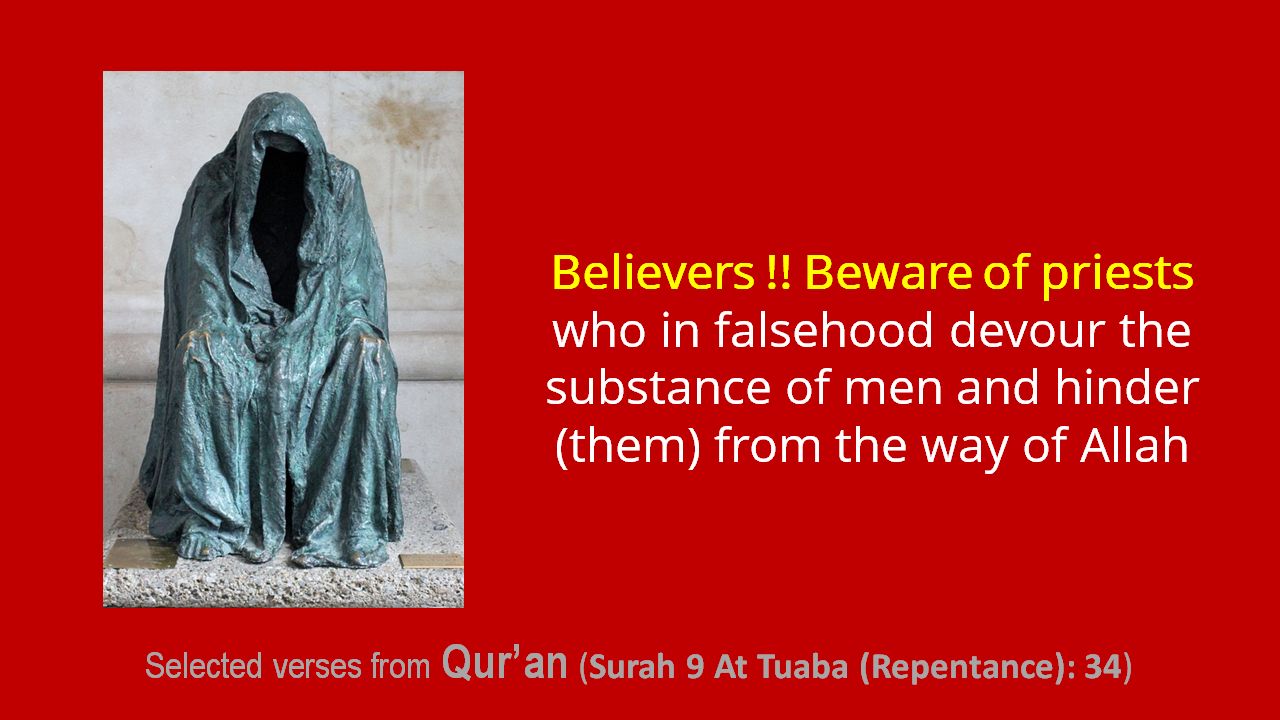
Believers !! Beware of anchorites who devour the substance of men and hinder (them) from the way of Allah

All Divine religions have been very simple and revealed in easy to understand languages so that even an illiterate could understand, if not all, but the central theme of a verse or a chapter. However, this has been most unfortunate that the religious men, priests, monks and  anchorites, since the revelation of Divine religions  have befooled the ordinary servants of God and made fortunes by robbing them by false information and misguiding them on paths that lead the servants of God away from God and to the wretched paths of the priests.

It is not only the Divine religions alone, but other man made religions too have been marred by these ills. The places of worships abound in heaps of wealth, gold and money artfully usurped by the religious men for their use. One would often find these priests filthy rich, of course their riches attributed to money of their followers.

Unfortunately, these ills have made their inroads in the religion of Islam, specially in countries like India, Bangladesh and Pakistan where priests, imams, and handlers of shrines of by gone religious men continue to rob their followers and live a richly life themselves. Recently, on the death of a so called scholar, it was found that the dead "good" man had fortunes worth billions. With no soure of income, how could head of an organization amass so much of wealth?

And this is despite the fact that Allah had warned the believers to be watchful of such priests and anchorites more than 1400 years ago when the religious men of Jewism and Christianity fed false information to their followers, devoured on their hard earned wealth and substance. And yet, mislead them to paths other than those leading to Allah so that their authority and greed is not compromised. What happens in shrines is no different. Poor men and women with low grade quality of faith come with their hard earned money so that their prayers are answered, so they are told. Had these so called priests been truthful, they would lead their followers closer to Allah by teaching them the real substance of religion rather than robbing them.

We share the 34th verse of Surah 9 At Tauba (The Repentance) which is based on the same theme as explained above.

يٰۤاَيُّهَا الَّذِيۡنَ اٰمَنُوۡۤا اِنَّ كَثِيۡرًا مِّنَ الۡاَحۡبَارِ وَالرُّهۡبَانِ لَيَاۡكُلُوۡنَ اَمۡوَالَ النَّاسِ بِالۡبَاطِلِ وَيَصُدُّوۡنَ عَنۡ سَبِيۡلِ اللّٰهِ​ؕ وَالَّذِيۡنَ يَكۡنِزُوۡنَ الذَّهَبَ وَالۡفِضَّةَ وَلَا يُنۡفِقُوۡنَهَا فِىۡ سَبِيۡلِ اللّٰهِۙ فَبَشِّرۡهُمۡ بِعَذَابٍ اَلِيۡمٍۙ‏ 
[9:34] O ye who believe! there are indeed many among the priests and anchorites who in falsehood devour the substance of men and hinder (them) from the way of Allah. And there are those who bury gold and silver and spend it not in the way of Allah: announce unto them a most grievous penalty.

Explaining the above said verse, one of the most enlightened scholars of the Muslim World Sayyid Abul Ala Maududi is of the opinion that these religious leaders are guilty of two sins. First, they devour the wealth of the common people by selling false decrees, and by taking bribes, gifts and presents on different pretexts. They invent religious regulations and rituals as tempt people to buy their salvations and fortunes in life from them and make deaths and marriages dependent on the payment of due `price' to these "monopolists" of Paradise. To add to this another sin, they debar the people from the Way of Allah by involving them into different sorts of deviations and by obstructing the way of every Righteous Mission with the obstacles of `learned' doubts and `pious' suspicions.

Muhammad Asad Explanation:
Most probably this is, in the first instance, an allusion to the wealth of the Jewish and Christian communities, and their misuse of this wealth. Some of the commentators, however, are of the opinion that the reference is wider, comprising all people, including Muslims, who hoard their wealth without spending anything thereof on righteous causes.

Yusuf Ali  Explanation
Bil-batili = in falsehood, i.e., by false means, pretences, or in false or vain things. This was strikingly exemplified in the history of Mediaeval Europe. Though the disease is apt to attack all peoples and organisations at all times. Priests got rich by issuing indulgences and dispensations; they made their office a stepping stone to worldly power and possessions. Even the Monastic Orders, which took vows of poverty for individuals grew rich with corporate property, until their wealth became a scandal, even among their own nations.

Misuse of wealth, property, and resources is frequently condemned, and in three ways: (1) do not acquire anything wrongfully or on false pretences; (2) do not hoard or bury or amass wealth for its own sake but use it freely for good, whether for yourself or for your neighbours; and (3) be particularly careful not to waste it for idle purposes, but only so that it may fructify for the good of the people.

Please listen to explanation of the ayat by eminent Muslim scholar Nouman Ali Khan:
May Allāh (سبحانه و تعالى‎) help us understand Qur'ān and follow the Sunnah of Prophet Muhammad ﷺ, which is embodiment of commandments of Allah contained in the  Qur'ān. May Allah help us to be like the ones He loves and let our lives be lived helping others and not making others life miserable or unlivable. May all our wrong doings, whether intentional or unintentional, be forgiven before the angel of death knocks on our door. 
وَمَا عَلَيۡنَاۤ اِلَّا الۡبَلٰغُ الۡمُبِيۡنُ‏ 
(36:17) and our duty is no more than to clearly convey the Message.”
That is Our duty is only to convey to you the message that Allah has entrusted us with. Then it is for you to accept it or reject it. We have not been made responsible to make you accept it forcibly, And if you do not accept it, we shall not be seized in consequence of your disbelief, You will yourselves be answerable for your actions on Day of Resurrection.

Reading the Qur'ān should be a daily obligation of a Muslim - Reading it with translation will make it meaningful. But reading its Exegesis / Tafsir will make you understand it fully. It will also help the Muslims to have grasp over social issues and their answers discussed in the Qur'an and other matter related to inter faith so  that they are able to discuss issues with Non Muslims with authority based on refences from Qur'an.

May Allah forgive me if my posts ever imply a piety far greater than I possess. I am most in need of guidance.

Note: When we mention God in our posts, we mean One True God, we call Allah in Islam, with no associates. Allah is the Sole Creator of all things, and that Allah is all-powerful and all-knowing. Allah has no offspring, no race, no gender, no body, and is unaffected by the characteristics of human life.

For more Selected Verses, please refer to our reference page: Selected Verses from the Qur'anYou may also refer to our Reference Pages  and Understanding Al Qur'an for knowing more about Islam and Qur'ān.
Photo | Tafsir References: | 1 | 2 | 3 | 4 | 5 | 6 |

An effort has been made to gather explanation / exegesis of the surahs of the Qur'ān from authentic sources and then present a least possible condensed explanation of the surah. In that the exegesis of the chapters of the Quran is mainly based on the "Tafhim al-Qur'an - The Meaning of the Qur'an" by one of the most enlightened scholars of the Muslim World Sayyid Abul Ala Maududi.  
In order to augment and add more explanation as already provided, additional input has been interjected from following sources: 
  • Towards Understanding the Quran
  • Tafsir Ibn Khatir
  • Muhammad Asad Translation
  • Javed Ahmad Ghamidi / Al Mawrid
  • Al-Quran, Yusuf Ali Translation
  • Verse by Verse Qur'an Study Circle
In addition the references of other sources which have been explored have also been given above. Those desirous of detailed explanations and tafsir (exegesis), may refer to these sites.

If you like Islam: My Ultimate Decision, and to keep yourself updated on all our latest posts to know more about Islam, follow us on Facebook

Please share this page to your friends and family members through Facebook, WhatsApp or any means on Social Media so that they can also be benefited by it and better understand Islam and the Qur'ān - Insha Allah (Allah Willing) you shall be blessed with the best of both worlds.

Sunday, 7 August 2022

When greeted upon, greet back in a better worded greeting

Whenever two persons meet, they always greet each other with some form of verbal or bodily gestures. The act of greeting has been in vogue since ages, perhaps since the dawn of mankind in the world. The form of greeting differ from culture to culture both in form and social intimacy. Generally the gestural greetings include a handshake, a salutation by waving hands. The verbal greetings are normally restricted from saying a hello to good mornings (or to be replaced by the time of the day) or good bye when parting.

When it comes to Muslims, same-sex people do not greet each other the same as do opposite sex. While same-sex people (men or women) will shake hands, kiss on the cheek and even hug multiple times, a man and woman greeting each other in public will not go further than bowing a little with right hand on the chest or at best a handshake.  

As for the verbal greetings, the Arabic greetings: As-salamu alaykum ٱلسَّلَامُ عَلَيْكُمْ (peace be upon you) is more comprehensive form of salutation than a mere hello or good morning, whereby a Muslim prays for the peace of his Muslim brother or sister. This salutation is often returned with Wa ʿalaykumu s-salām وَعَلَيْكُمُ ٱلسَّلَامُ - that is'and peace be upon you'. 

This has been customer since the advent of Islam and Muslims even today, whether they know Arabic or not, use these salutations worldwide. This practice is in line with the verse 86 of Surah 4. An Nisa (The Women) as quoted herein under:

وَاِذَا حُيِّيۡتُمۡ بِتَحِيَّةٍ فَحَيُّوۡا بِاَحۡسَنَ مِنۡهَاۤ اَوۡ رُدُّوۡهَا​ ؕ اِنَّ اللّٰهَ كَانَ عَلٰى كُلِّ شَىۡءٍ حَسِيۡبًا‏ 
(4:86) When you are greeted with a salutation then return it with a better one, or at least the same.114 Surely Allah takes good count of everything.

As mentioned before, the salutation came into being for Muslims to be courteous not only to each other but also to the non Muslims as well as a gesture of goodwill. The Muslims were specially exhorted to be very civil and polite to the non-Muslims because at that time their relations were strained on account of the conflict between them. In that state of tension, they were forewarned to be on their guard against incivility and impoliteness. They were, therefore, taught to be equally civil and polite to them when they greeted them respectfully. Nay, they should be even more civil and polite than their opponents.

Harsh behavior and harsh words do no good to anyone but they are specially unsuited to the work of those missionaries of Allah's Message, who have dedicated themselves to one day invite the world to the Truth and exerted themselves to reform the ways of the people. Such ill behavior may satisfy one's vanity, but it does great harm to one's mission.

However, readers may notice that while the believers are instructed to return the salutations in the same words as greeted upon, they are encouraged to use better words for a return greeting rather than a custom made reply. Generally the salutation is returned back with Wa ʿalaykumu s-salām wa-raḥmatu -llāhi wa-barakātuh  وَعَلَيْكُمُ ٱلسَّلَامُ وَرَحْمَةُ ٱللَّٰهِ وَبَرَكَاتُهُ - that is ' And peace be upon you, as well as the mercy of God and his blessings'.

The addition to the return greetings could be composed by the one being greeted in a manner to add more blessings for the one who initiated the greetings.
Javed Ahmed Ghamidi, an eminent Muslim scholar of the timeexplains: The actual words are: وَاِذَا حُيِّيْتُمْ بِتَحِيَّةٍ. The real meaning of حَيَّاهُ تَحِيَّةٍ is to pray for someone’s life. The supplicative expression حَيَّاكَ اللّٰهُ originates from them. It means: “May God prolong your life.” Since the word salām and other supplicative words of similar meaning have this connotation or are close to it, they are included in the general meaning of تَحِيَّة. (Amīn Aḥsan Iṣlāḥī, Tadabbur-i Qur’ān, vol. 2, 356)
Thus all Muslims must make it a habit to reciprocate a salutation of greeting with a better worded response so as to show one's willingness to be at peace with his greeter. In face such greetings should be more profusely be used when interacting with the non Muslims for it gives away the intrinsic message of peace to everyone. If such gestures are made to promote peace both within and without with a whole hearted approach, we may be able to add our share for promotion of peace and well being of the mankind.

Eminent Muslim scholar Nouman Ali Khan explains the above quoted verses as under:
May Allāh (سبحانه و تعالى‎) help us understand Qur'ān and follow the Sunnah of Prophet Muhammad ﷺ, which is embodiment of commandments of Allah contained in the  Qur'ān. May Allah help us to be like the ones He loves and let our lives be lived helping others and not making others life miserable or unlivable. May all our wrong doings, whether intentional or unintentional, be forgiven before the angel of death knocks on our door. 
وَمَا عَلَيۡنَاۤ اِلَّا الۡبَلٰغُ الۡمُبِيۡنُ‏ 
(36:17) and our duty is no more than to clearly convey the Message.”
That is Our duty is only to convey to you the message that Allah has entrusted us with. Then it is for you to accept it or reject it. We have not been made responsible to make you accept it forcibly, And if you do not accept it, we shall not be seized in consequence of your disbelief, You will yourselves be answerable for your actions on Day of Resurrection.

Reading the Qur'ān should be a daily obligation of a Muslim - Reading it with translation will make it meaningful. But reading its Exegesis / Tafsir will make you understand it fully. It will also help the Muslims to have grasp over social issues and their answers discussed in the Qur'an and other matter related to inter faith so  that they are able to discuss issues with Non Muslims with authority based on refences from Qur'an.

May Allah forgive me if my posts ever imply a piety far greater than I possess. I am most in need of guidance.

Note: When we mention God in our posts, we mean One True God, we call Allah in Islam, with no associates. Allah is the Sole Creator of all things, and that Allah is all-powerful and all-knowing. Allah has no offspring, no race, no gender, no body, and is unaffected by the characteristics of human life.

For more Selected Verses, please refer to our reference page: Selected Verses from the Qur'anYou may also refer to our Reference Pages: Understanding Al Qur'an and Important DOs and DON'Ts from Qur'an for knowing more about Islam and Qur'ān.
Photo | Tafsir References: | 1 | 2

An effort has been made to gather explanation / exegesis of the surahs of the Qur'ān from authentic sources and then present a least possible condensed explanation of the surah. In that the exegesis of the chapters of the Quran is mainly based on the "Tafhim al-Qur'an - The Meaning of the Qur'an" by one of the most enlightened scholars of the Muslim World Sayyid Abul Ala Maududi.  
In order to augment and add more explanation as already provided, additional input has been interjected from following sources: 
  • Towards Understanding the Quran
  • Tafsir Ibn Khatir
  • Muhammad Asad Translation
  • Javed Ahmad Ghamidi / Al Mawrid
  • Al-Quran, Yusuf Ali Translation
  • Verse by Verse Qur'an Study Circle
In addition the references of other sources which have been explored have also been given above. Those desirous of detailed explanations and tafsir (exegesis), may refer to these sites.

If you like Islam: My Ultimate Decision, and to keep yourself updated on all our latest posts to know more about Islam, follow us on Facebook

Please share this page to your friends and family members through Facebook, WhatsApp or any means on Social Media so that they can also be benefited by it and better understand Islam and the Qur'ān - Insha Allah (Allah Willing) you shall be blessed with the best of both worlds.
Saturday, 6 August 2022

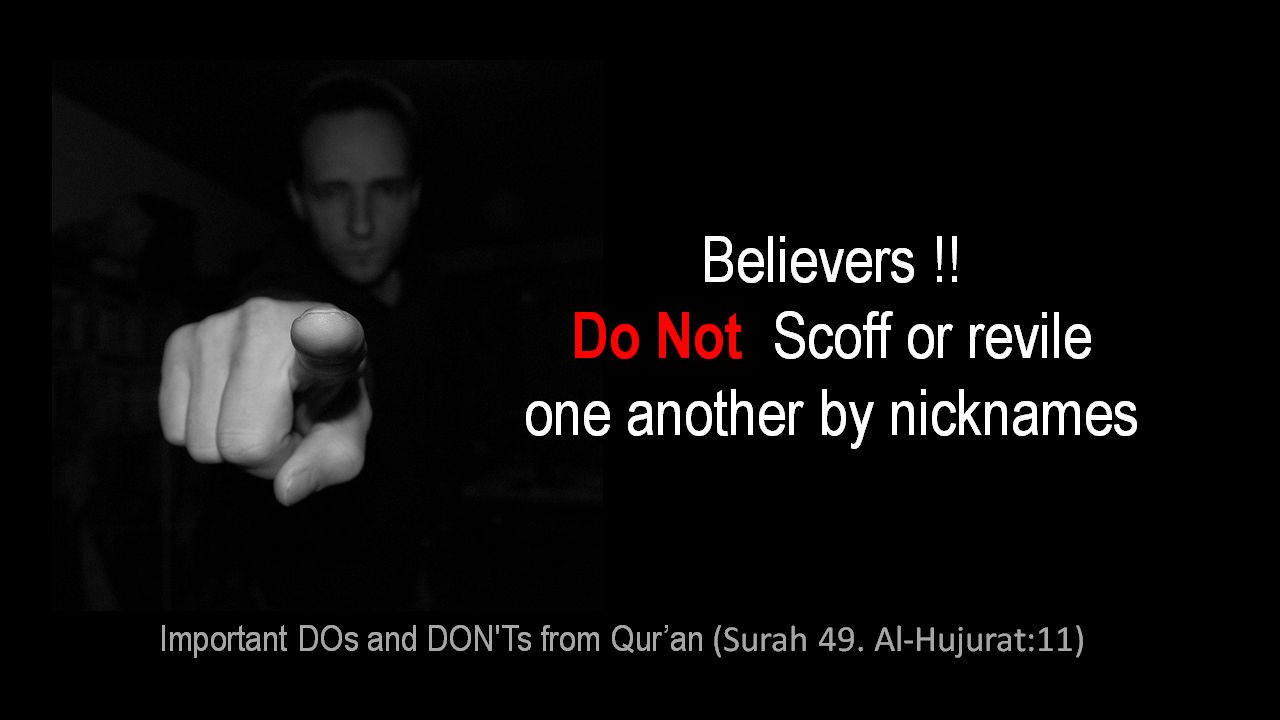
Believers !! Do Not Scoff or revile one another by nicknames (Important DOs and DON'Ts from Qur’an )

The man as individual and as part of a community has generally failed to establish an environ wherein everyone is respected with honour and dignity. We more often than not find people pointing fingers at others, even when their own character is blackened with sins and wrongdoings. Calling others with derogatory nicknames, scoffing others and using dirty slanders is but the norm. Even in lighter mood or in fun times, our tongues often slip and we use words that are usually fall under the downgraded categories.

Surah 49. Al Hujurat (The Private Apartments) is an exclusive chapter of Qur'an which deals with the social behaviour of the Muslims in a society with respect to other members of the community, even if not from Islam. The instructions contained in this chapter if adopted whole heartedly by the mankind, the very complexion of our outlook towards others would change and in the process the entire society would be reformed.

In our series of posts on Important DOs and DON'Ts from Qur'an, we share the 11th verse / ayat of  Surah 49. Al Hujurat (The Private Apartments) which commands believers (and even others from other religions, if they like to be reformed) which points towards two ills of the society: Scoffing and derogatory nicknames. In fact the preceding two verses after giving necessary instructions about the Muslim people's mutual fighting, the believers were made to realize that by virtue of the most sacred relationship of the faith they were brothers one to another, and they should fear God and try to keep their mutual relations right. Now, in the following two verses, they are being enjoined to avoid and shun those major evils which generally spoil the mutual relationships of the people in a society.  

يٰۤاَيُّهَا الَّذِيۡنَ اٰمَنُوۡا لَا يَسۡخَرۡ قَوۡمٌ مِّنۡ قَوۡمٍ عَسٰٓى اَنۡ يَّكُوۡنُوۡا خَيۡرًا مِّنۡهُمۡ وَلَا نِسَآءٌ مِّنۡ نِّسَآءٍ عَسٰٓى اَنۡ يَّكُنَّ خَيۡرًا مِّنۡهُنَّ​ۚ وَلَا تَلۡمِزُوۡۤا اَنۡفُسَكُمۡ وَلَا تَنَابَزُوۡا بِالۡاَلۡقَابِ​ؕ بِئۡسَ الِاسۡمُ الۡفُسُوۡقُ بَعۡدَ الۡاِيۡمَانِ​ ۚ وَمَنۡ لَّمۡ يَتُبۡ فَاُولٰٓـئِكَ هُمُ الظّٰلِمُوۡنَ‏
(49:11) Believers, let not a group (of men) scoff at another group, it may well be that the latter (at whom they scoff) are better than they; nor let a group of women scoff at another group, it may well be that the latter are better than they. And do not taunt one another, nor revile one another by nicknames. It is an evil thing to gain notoriety for ungodliness after belief. Those who do not repent are indeed the wrong-doers.

Slandering and taunting the people and harboring suspicions and spying on others are, in fact, the evils that cause mutual enmities and then lead to grave mischief. In this connection, from the commandments that are being given in the following verses and the explanations of these found in the Hadith a detailed law of libel can be compiled. The western law pertaining to libel in this regard is so defective that a person who sues another under this law may well cause some loss to his own honor. The Islamic law, on the contrary,, recognizes a basic honor for every person and gives nobody the right to attack it, no matter whether the attack is based on reality or not, and whether the person who has been attacked has a `reputation" of his own or not. Only the fact that a person has debased and humiliated the other person is enough to declare him a criminal unless, of course, it is proved. that the humiliation caused had a legal ground for it. 

Mocking does not only imply mocking with the tongue but it also includes mimicking somebody, making pointed references to him, laughing at his words, or his works, or his appearance, or his dress, or calling the people's attention to some defect or blemish in him so that others also may laugh at him. All this is included in mocking. What is actually forbidden is that one should make fun of and ridicule another, for under such ridiculing there always lie feelings of one's own superiority and the other's abasement and contempt, which are morally unworthy of a gentleman. Moreover, it hurts the other person, which causes mischief to spread in society. That is why it has been forbidden,
To make mention of the men and the women separately does not mean that it is lawful for the men to mock the women or the women to mock the men. The actual reason for making a separate mention of the two sexes is that Islam does not at all believe in mixed society. Ridiculing each other generally takes place in mixed gatherings and Islam does not permit that non-mahram males and females should meet in such gatherings and make fun of each other. Therefore, in a Muslim society it is inconceivable that the men would mock a woman, or the women would mock a man in an assembly.
The word lamz as used in the original is very comprehensive and applies to ridiculing, reviling, deriding, jeering, charging somebody or finding fault with him, and making him the target of reproach and blame by open or tacit references. As all such things also spoil mutual relationships and create bad blood in society, they have been forbidden. Instead of saying, “Do not taunt one another", it has been said "Do not taunt yourselves", which by itself shows that the one who uses taunting words for others, in fact, taunts his own self. Obviously, a person does not use invectives against others unless he himself is filled with evil feelings and is almost in a state of bursting like a volcano. Thus, tire one who nourishes such feelings has made his own self a nest of evils before he makes others a target, Then, when he taunts others, it means that he is inviting others to taunt him. It is a different matter that the other person may evade his attacks because of a gentle nature, but he himself has opened the door to mischief so that the other may treat him likewise.

" nor revile one another by nicknames " This Command requires that a person should not be called by a name or a title which may cause him humiliation, e.g. calling somebody a sinner or a hypocrite, or calling someone a lame or blind one, or one-eyed, or giving him a nickname containing a reference to some defect or blemish in him, or in his parents, or in his family, or calling a person a Jew or a Christian even after his conversion to Islam, or giving such a nickname to a person, or a family, or a community, or a group, which may bring condemnation or disgrace on it. Only those nicknames have been made an exception from this Command, which though apparently offensive, are not intended to condemn the persons concerned, but they rather serve as a mark of recognition for them. That is why the traditionists have allowed as permissible names like Suleman al-A`mash (the weak-eyed Suleman) and Wasil' al-Ahdab (the hunch-backed Wasil) among the reporters of the Hadith. If there are several men of the same name and a particular man among them may be recognized only by a particular title or nickname of his, the title or nickname can be used, even though the title by itself may be offensive. For instance, if there are several men called `Abdullah, and one of them is blind, he may be called Abdullah the blind, for his recognition. Likewise, those titles also are excluded from this Command, which though apparently offensive, are in fact, given out of love and the people who are called by those titles themselves approve them, like Abu Hurairah (father of the kitten) and Abu Turab (father of the dust). 
"It is very shameful for a believer that in spite of being a believer he should earn a name for using abusive language and for immodest behavior. If a disbeliever earns reputation for himself for mocking the people, or taunting them, or for proposing evil and offensive titles for others, it may not be a good reputation from the point of view of humanity, but it at least goes well with his disbelief. But if a person after affirming the Faith in Allah and His Messenger and the Hereafter earns reputation on account of these base qualities, it is simply regrettable.
What is forbidden is not conjecture as such but excessive conjecture and following every kind of conjecture, and the reason given is that some conjectures are sins. In order to understand this Command we should analyze and see what are the kinds of conjecture and what is the moral position of each.
One kind of conjecture is that which is morally approved and laudable, and desirable and praiseworthy from religious point of view, e.g. a good conjecture in respect of Allah and His Messenger and the believers and those people with whom one comes in common contact daily and concerning whom there may be no rational ground for having an evil conjecture.
The second kind of conjecture is that which one cannot do without in practical life, e.g. in a law court a judge has to consider the evidence placed before him and give his decision on the basis of the most probable conjecture, for he cannot have direct knowledge of the facts of the matter, and the opinion that is based on evidence is mostly based on the most probable conjecture and not on certainty. Likewise, in most cases when one or the other decision has to be taken, and the knowledge of the reality cannot possibly be attained, there is no way oat for men but to form an opinion on the basis of a conjecture.
The third kind of conjecture, which is although a suspicion, is permissible in nature, and it cannot be regarded as a sin. For instance, if there are clear signs and pointers in the character of a person (or persons), or in his dealings and conduct, on the basis of which he may not deserve to enjoy one's good conjecture, and there are rational grounds for having suspicions against him, the Shari `ah does not demand that one should behave like a simpleton and continue to have a good conjecture about him. The last limit of this lawful conjecture, however, is that one should conduct oneself cautiously in order to ward off any possible mischief from him; it is not right to take an action against him only on the basis of a conjecture.
The fourth kind of conjecture which is, in fact, a sin is that one should entertain a suspicion in respect of a person without any ground, or should start with suspicion in forming an opinion about others, or should entertain a suspicion about the people whose apparent conditions show that they are good and noble. Likewise, this also is a sin that when there is an equal chance of the evil and goodness in the word or deed of a person, one should regard it as only evil out of suspicion. For instance, if a gentleman while leaving a place of assembly picks up another one's shoes, instead of his own, and we form the opinion that he has done so with the intention of stealing the shoes, whereas this could be possible because of oversight as well, there is no reason for adopting the evil opinion instead of the good opinion except the suspicion.
This analysis makes it plain that conjecture by itself is not anything forbidden; rather in some cases and situations it is commendable, in some situations inevitable, in some permissible up to a certain extent and un-permissible beyond it, and in some cases absolutely unlawful. That is why it has not been enjoined that one should refrain from conjecture or suspicion altogether but what is enjoined is that one should refrain from much suspicion. Then, to make the intention of the Command explicit, it has been said that some conjectures are sinful. From this warning it follows automatically that whenever a person is forming an opinion on the basis of conjecture, or is about to take an action, he should examine the case and see whether the conjecture he is entertaining is not a sin, whether the conjecture is really necessary, whether there arc sound reasons for the conjecture, and whether the conduct one is adopting on the basis of the conjecture is permissible. Everyone who fears God will certainly take these precautions. To make one's conjecture free and independent of every such care and consideration is the pastime of only those people who are fearless of God and thoughtless of the accountability -of the Hereafter.

Yusuf Ali  Explanation
Mutual ridicule ceases to be fun when there is arrogance or selfishness or malice behind it. We may laugh with people, to share in the happiness of life: we must never laugh at people in contempt or ridicule. In many things they may be better than ourselves!

Defamation may consist in speaking ill of others by the spoken or written word, or in acting in such a way as to suggest a charge against some person whom we are not in a position to judge. A cutting, biting remark or taunt of sarcasm is included in the word lamaza. An offensive nickname may amount to defamation, but in any case there is no point in using offensive nicknames, or names that suggest some real or fancied defect. They ill accord with the serious purpose which Muslims should have in life. For example, even if a man is lame, it is wrong to address him as "O lame one!" It causes him pain, and it is bad manners. So in the case of the rude remark, "the black man".

Javed Ahmad Ghamidi Explanation:
( Believers! [It is the requisite of this brotherhood that] neither [your] men make fun of other men; it may well be that they are better than them ) Ie., better with regard to faith and deeds whose true weight will become evident from the scale of justice that will be set up on the Day of Judgement. This scale will tell if any deed has a speck of weight or that of a mountain. Things which they regarded as important will not have any weight on that scale. Thus their claim to racial and tribal superiority will prove absolutely weightless on it.

( nor should your women make fun of other women; )  Though the words لَا يَسْخَرْ قَوْمٌ مِّنْ قَوْمٍ were sufficient, yet the Qur’ān has mentioned women too alongside men. What was the reason for this? 
Imām Amīn Aḥsan Iṣlāḥī writes: … In the mention of both morality and immorality, the Qur’ān has specially mentioned women where they are emphatically urged to strive to gain high reward or to save them from some trial. Here it is this second case. The evil from which men are stopped here is found if not more in women then certainly not less than in men. Women who are conceited because they regard their family, lineage, financial situation or apparent looks to be superior, speak in very humiliating tones to women whom they regard inferior to themselves. (Amīn Aḥsan Iṣlāḥī, Tadabbur-i Qur’ān, vol. 7, 505)
( t may well be that they are better than them. And neither defame your own people )  The actual word used is لَمْز which means to blame someone and mock someone while gesturing with the eyes. Such poisonous sentences portray the jealousy and arrogance of the speaker. They are meant to discourage people and dent their mutual relationships to such an extent that they end up hating one another and becoming enemies of each other. Through this word, the Almighty has directed attention of people to the fact that those who blame any of their brothers in the words of Amīn Aḥsan Iṣlāḥī aim their arrows at their own chests and thereby wound them (Tadabbur-i Qur’ān, vol. 7, 507).

( nor give bad names to one another )  Calling people by bad names is not a trivial wrongdoing. This attitude is generally adopted to humiliate someone or some nation to the ultimate extent. The reason for this is that such names are easily memorized and produce very permanent and far-reaching results.The bad taste created by them continues for generations, the essential consequence of which is that people seldom remain well-wishers of one another and national unity is torn apart.

( [All these are wrongdoings and] after faith even the name of wrongdoing is evil. )  This style signifies exaggeration. 
Imām Amīn Aḥsan Iṣlāḥī writes: ... It is like saying: الشريركأسمه (even the word naughty is bad, let alone the badness of being naughty). Even in our language we say: “Sir! Even the name of it stinks.” (Amīn Aḥsan Iṣlāḥī, Tadabbur-i Qur’ān, vol. 7, 508)
Please listen to explanation of the ayat by eminent Muslim scholar Nouman Ali Khan:
May Allāh (سبحانه و تعالى‎) help us understand Qur'ān and follow the Sunnah of Prophet Muhammad ﷺ, which is embodiment of commandments of Allah contained in the  Qur'ān. May Allah help us to be cordial and respectful to others and let at no time others feel hurt by the bad use of our tongues, and that we should never deride one another. May we be like the ones He loves and let our lives be lived helping others and not making others life miserable or unlivable. May all our wrong doings, whether intentional or unintentional, be forgiven before the angel of death knocks on our door. 
وَمَا عَلَيۡنَاۤ اِلَّا الۡبَلٰغُ الۡمُبِيۡنُ‏ 
(36:17) and our duty is no more than to clearly convey the Message.”
That is Our duty is only to convey to you the message that Allah has entrusted us with. Then it is for you to accept it or reject it. We have not been made responsible to make you accept it forcibly, And if you do not accept it, we shall not be seized in consequence of your disbelief, You will yourselves be answerable for your actions on Day of Resurrection.

Reading the Qur'ān should be a daily obligation of a Muslim - Reading it with translation will make it meaningful. But reading its Exegesis / Tafsir will make you understand it fully. It will also help the Muslims to have grasp over social issues and their answers discussed in the Qur'an and other matter related to inter faith so  that they are able to discuss issues with Non Muslims with authority based on refences from Qur'an.

May Allah forgive me if my posts ever imply a piety far greater than I possess. I am most in need of guidance.

Note: When we mention God in our posts, we mean One True God, we call Allah in Islam, with no associates. Allah is the Sole Creator of all things, and that Allah is all-powerful and all-knowing. Allah has no offspring, no race, no gender, no body, and is unaffected by the characteristics of human life.

For more Selected Verses, please refer to our reference page: Selected Verses from the Qur'anYou may also refer to our Reference Pages: Understanding Al Qur'an and Important DOs and DON'Ts from Qur'an for knowing more about Islam and Qur'ān.
Photo | Tafsir References: | 1 | 2 | 3

An effort has been made to gather explanation / exegesis of the surahs of the Qur'ān from authentic sources and then present a least possible condensed explanation of the surah. In that the exegesis of the chapters of the Quran is mainly based on the "Tafhim al-Qur'an - The Meaning of the Qur'an" by one of the most enlightened scholars of the Muslim World Sayyid Abul Ala Maududi.  
In order to augment and add more explanation as already provided, additional input has been interjected from following sources: 
  • Towards Understanding the Quran
  • Tafsir Ibn Khatir
  • Muhammad Asad Translation
  • Javed Ahmad Ghamidi / Al Mawrid
  • Al-Quran, Yusuf Ali Translation
  • Verse by Verse Qur'an Study Circle
In addition the references of other sources which have been explored have also been given above. Those desirous of detailed explanations and tafsir (exegesis), may refer to these sites.

If you like Islam: My Ultimate Decision, and to keep yourself updated on all our latest posts to know more about Islam, follow us on Facebook

Please share this page to your friends and family members through Facebook, WhatsApp or any means on Social Media so that they can also be benefited by it and better understand Islam and the Qur'ān - Insha Allah (Allah Willing) you shall be blessed with the best of both worlds.

Twitter Delicious Facebook Digg Stumbleupon Favorites More