.
Showing posts with label Surah Al Hashr. Show all posts

Thursday, 19 March 2026

Al-Qurʾān: Overview and Selected verses from: Sürah Al Al-Ḥashr (The Gathering)

Surah Al-Hashr is the 59th chapter (sūrah) of the Qur'an, part of Juzʼ 28, and has 24 Ayahs (verses). The chapter is named al-hashr because the word hashr appears in verse 2. It is a Madinan surah that combines history, faith, politics, and spirituality. It takes its name from “al-Ḥashr” (gathering/exile), referring to a key historical event, and then draws timeless lessons about trust in Allah, unity, sincerity, and inner purification.

We have already shared the Tafseer / Exegesis of the Surah which can be read from links given below:

Herein under we will only present an overview of the Sūrah, for the scope of this post is to only to introduce the Sūrah and provide links to some of the selected verses from this Sūrah for selective reading / references. The following bird eye view includes the context, major themes and subjects and lessons that we can learn from this Sūrah, followed by references to  some of the selected verses already published.

Historical Context (Why it was revealed)
The surah was revealed after the exile of the Jewish tribe Banu Nadir from Medina. It so happened that Prophet Muhammad ﷺ had a treaty with Banu Nadir, but they broke the treaty and plotted to assassinate him. As a result, they were besieged and then expelled from Medina. This event is described as a “gathering” (ḥashr) because they were forced to leave collectively.

Main Themes of the Surah
  • Allah’s Power and Control (Verses 1–5)
    • The surah begins by showing that what happened was not due to military strength alone, but by Allah’s They thought their fortresses would protect them—but Allah came upon them from where they did not expect."
    • Lessons: (1) Human planning is limited, (2) Allah’s decree always prevails
  • Hypocrisy and False Alliances (Verses 11–17)
    • The surah exposes the behavior of the hypocrites in Medina who promised to support Banu Nadir, but abandoned them when the situation became serious.
    • They are compared to Shayṭān who tempts a person and then abandons him.
    • Lesson: (1) False friends disappear in times of crisis, (2) Reliance should be on Allah, not opportunistic alliances
  • Distribution of Wealth and Social Justice (Verses 6–10)
    • The surah discusses how war gains (fay’) were distributed among the poor emigrants (Muhājirūn) and the helpers in Medina (Anṣār).
    • It praises the Anṣār for their remarkable selflessness: “They prefer others over themselves even if they are in need.”
    • Lesson: (1) True faith produces generosity and sacrifice, (2) A healthy society is built on justice and care for others
  • Warning Against Forgetting Allah (Verse 19)
    • One of the most powerful verses: “And do not be like those who forgot Allah, so He made them forget themselves…”
    • Lesson: Forgetting Allah leads to: Loss of purpose, Moral confusion, and spiritual emptiness
    • This is a deep psychological insight.
  • The Majesty of the Qur’an (Verse 21)
    • “If We had sent down this Qur’an upon a mountain, you would have seen it humbled and splitting apart from the fear of Allah.”
    • Lesson: If even a mountain would crumble, how can a human heart remain unmoved? It calls us to reflect deeply on the Qur’an.
  • The Beautiful Attributes of Allah (Verses 22–24)
    • The surah ends with 15 powerful attributes of Allah for knowing Allah is the foundation of faith and transformation. These verses are often recited for spiritual reflection
Key Lessons for Us Today
  • Don’t Trust in Material Strength Alone Like Banu Nadir, people may rely on: wealth, power, and systems. But real security comes from Allah.
  • Beware of Hypocrisy and Empty Promises The surah teaches us to be sincere, avoid double standards and not rely on unreliable alliances
  • Build a Selfless Community The example of the Anṣār shows true believers care for others even in hardship and that generosity strengthens unity.
  • Never Lose Connection with Allah The warning in verse 19 is extremely relevant today: A person may have everything materially, but feel lost internally.  for his disconnection with Allah.
  • Reflect Deeply on the Qur’an The Qur’an is not meant to be read casually—it is meant to: transform hearts, reshape thinking and guide life decisions.
  • Know Allah Through His Names The ending teaches that true faith is built on معرفة (knowing Allah).
A Powerful Reflection
Surah Al-Hashr shows three types of people: (1) Those who trust in worldly power → they fail, (2) Hypocrites who deceive → they collapse morally, and True believers → they succeed through sincerity and sacrifice

In essence:Surah Al-Hashr is a complete guide for building a strong inner self and a strong community—based on faith, sincerity, trust in Allah, and care for others.
May Allāh (سبحانه و تعالى‎) help us understand Qur'ān and follow the Sunnah of Prophet Muhammad ﷺ, which is embodiment of commandments of Allah contained in the Qur'ān. May Allah help us to be like the ones He loves and let our lives be lived helping others and not making others' lives miserable or unlivable. May all our wrong doings, whether intentional or unintentional, be forgiven before the angel of death knocks on our door. 
وَمَا عَلَيۡنَاۤ اِلَّا الۡبَلٰغُ الۡمُبِيۡنُ‏ 
(36:17) and our duty is no more than to clearly convey the Message.”
That is Our duty is only to convey to you the message that Allah has entrusted us with. Then it is for you to accept it or reject it. We have not been made responsible for making you accept it forcibly, and if you do not accept it, we shall not be seized in consequence of your disbelief, you will yourselves be answerable for your actions on Day of Resurrection.

May Allah forgive me if my posts ever imply a piety far greater than I possess. I am most in need of guidance.

Reading the Qur'ān should be a daily obligation of a Muslim - Reading it with translation will make it meaningful. But reading its Exegesis / Tafsir will make you understand it fully. It will also help the Muslims to have grasp over social issues and their answers discussed in the Qur'an and other matter related to inter faith so that they are able to discuss issues with non-Muslims with authority based on refences from Qur'an.

Note: When we mention God in our posts, we mean One True God, we call Allah in Islam, with no associates. Allah is the Sole Creator of all things, and that Allah is all-powerful and all-knowing. Allah has no offspring, no race, no gender, no body, and is unaffected by the characteristics of human life.

You may also refer to our exclusive reference page: Selected verses from selected Surahs of Al-Qurʾān for compiled verses from other surahs.

For verses on Selected Subjects, please refer to our reference page: Selected Verses from Al Qur'an about a Specific Subject (Reference Page) to know more about what Qur'an says about specific subjects and our reference page: Selected Verses from the Qur'an

You may also refer to our Reference Pages  and Understanding Al Qur'an for knowing more about Islam and Qur'ān.
Photo | Reference: | 1 | 2 | 3 |

An effort has been made to gather explanation / exegesis of the surahs and selected verses of Al-Qurʾān from authentic sources and then present a least possible condensed explanation of the surah. In that the exegesis of the chapters of the Quran is mainly based on the "Tafhim al-Qur'an - The Meaning of the Qur'an" by one of the most enlightened scholars of the Muslim World Sayyid Abul Ala Maududi.  
    In addition, other sources which have been explored and views of other scholars have been incorporated while explaining meaning of a verse. Those desirous of detailed explanations and tafsir (exegesis), may refer to these sites. For expansion of meaning and themes / contextual background help from ChatGPT is also taken.

    Disclaimer: The material for this post has been collected from the references given above. If anyone differs with the material contained in this post, one may consult the references and their authors.  If someone has more material about the subject, he/she is most welcome to share in the comments box to make the post all encompassing.

    If you like Islam: My Ultimate Decision, and to keep yourself updated on all our latest posts to know more about Islam, follow us on Facebook. You may also refer to our Facebook  Group Islam: The Ultimate Truth for more on Islam and Da'wah.

    Please share this page to your friends and family members through Facebook, WhatsApp or any means on social media so that they can also be benefited by it and better understand Islam and the Qur'ān - Insha Allah (Allah Willing) you shall be blessed with the best of both worlds.

    A Powerful Metaphor in Al Qur'an about the power and weight of Divine Revelation

    There are a number o metaphors and parables in Al-Qurʾān that are used to explain some complex verses so that readers can easily comprehend the Divine wisdom contained in these verses. We have already shared some of these in our previous posts that can be accessed from our reference page on metaphors and parables, link given at the end of this post.

    Today, we share one of the most striking verses in Al Qur'an that appears in Surah Al-Hashr. In this verse the might and weight of Al Qur'an has been mentioned that if a huge creation like a mountain had the sense and knowledge that it had been made responsible and accountable, like man, before Allah Almighty, for its deeds, it would have trembled from the fear of it. But how heedless, senseless and thoughtless is the man, who understands the Quran, and has known the whole truth through it, yet he is neither seized by any fear nor feels worried as to what answer he would make to his God about the responsibilities that have been placed on him. On the contrary, when he reads the Quran, or hears it being read, he remains un-moved as if he were a lifeless and senseless stone, which is not supposed to hear and see and understand anything.

    This metaphor aims to shake human beings out of their heedlessness, forcing them to recognize the awesome power of the Divine Word and to fear Allah properly.

    The Verse Sürah Al-Hashr (59:21)

    لَوۡ اَنۡزَلۡنَا هٰذَا الۡقُرۡاٰنَ عَلٰى جَبَلٍ لَّرَاَيۡتَهٗ خَاشِعًا مُّتَصَدِّعًا مِّنۡ خَشۡيَةِ اللّٰهِ​ؕ وَتِلۡكَ الۡاَمۡثَالُ نَضۡرِبُهَا لِلنَّاسِ لَعَلَّهُمۡ يَتَفَكَّرُوۡنَ‏ 
    If We had sent down this Qur'an upon a mountain, you would have seen it humbled and splitting apart from fear of Allah. And these examples We present to people so that they may reflect.” (59:21)

    This verse contains one of the strongest metaphors in the Qur'an, inviting deep reflection about the power and weight of divine revelation. Let us unpack this verse to get to the core of its meaning as interpreted by eminent Muslim scholars of times.

    Why the Qur’an Mentions a Mountain
    A mountain represents something extremely strong and solid. Mountains are often symbols of stability, firmness, and immense strength. And this hypothetical comparison has been used to emphasize the heavy weight of the Quran’s message. If animate, hard rock could understand the gravity of the message, it would crumble. This imagery highlights the immense spiritual weight of the Qur'an.

    The “Weight” of Revelation
    The Qur'an itself states elsewhere that revelation is heavy and serious:

    Indeed, We will cast upon you a heavy word.” (73:5)

    The Prophet ﷺ sometimes experienced the physical intensity of revelation. Reports mention that when revelation came he would sweat even on a cold day, his camel would feel the weight and companions nearby could sense the gravity of the moment

    This shows that divine revelation carries profound spiritual and moral responsibility. Commenting on Ayah 21, eminent Muslim scholar Ibn Kathir wrote: “Allah the Exalted emphasizes the greatness of the Qur’an, its high status and of being worthy of making hearts humble and rent asunder upon hearing it, because of the true promises and sure threats that it contains."

    The Real Message of the Metaphor
    The verse is not simply describing mountains—it is speaking to human hearts.

    The meaning is: If a mountain, with its immense strength, would break under the impact of the Qur'an, then human hearts should certainly be moved by it. Yet many people read the Qur'an without reflection, hear its verses without emotional response and  treat it as routine recitation.

    Ibn Kathir notes that the metaphor serves as a rebuke to mankind:
    • Harder than Rocks: If a solid mountain would crumble from the fear of Allah, why do human hearts not soften when hearing the Quran?.
    • Lack of Reflection: Despite possessing intelligence and understanding Allah's commands, humans are often negligent and unmoved by the Quran, making their hearts "harder than stones".
    Thus this verse challenges believers to ask: Why are our hearts harder than mountains?

    Psychological Insight of the Verse
    The verse teaches an important spiritual principle: Reflection transforms the heart. The Qur'an repeatedly calls people to think deeply, not just recite. At the end of the verse Allah says: 
    These examples We present to people so that they may reflect.”

    Reflection leads to humility, awareness of Allah, moral transformation. Without reflection, even the most powerful message may leave the heart unchanged.

    A Spiritual Warning
    Many scholars say this verse quietly warns believers about spiritual hardness.

    The Qur'an describes hardened hearts elsewhere: “Then your hearts became hardened like stones, or even harder.” (2:74)

    This metaphor is aligned with Surah Al-Baqarah (2:74), where Allah states that some stones split asunder and water flows from them out of fear of Allah. A hardened heart that does not respond to guidance becomes emotionally and spiritually rigid. The Qur'an is meant to soften hearts, inspire repentance, and awaken conscience.

    Living the Lesson Today
    This verse encourages Muslims to approach the Qur'an differently. Instead of reading it quickly, one should: (1) Pause and reflect on meanings, (2) imagine the scenes described, and (3) connect verses to real life.

    Even reading a few verses with deep reflection can transform a person more than reading many pages without thought.

    A Beautiful Reflection by Scholars
    Some scholars say this verse shows three stages of spiritual awakening:
    • Humility – recognizing Allah’s greatness
    • Breaking of the ego – like the mountain splitting
    • Transformation – the heart becoming receptive to guidance
    The Qur'an is therefore not only a book of law or history—it is a book that reshapes the human heart.

    In summary, Surah Al-Hashr (59:21) teaches that:
    • The Qur'an carries immense spiritual power
    • Even a mountain would break under its weight
    • Human hearts should therefore be deeply moved by it
    • Reflection is essential for spiritual transformation
    The verse reminds believers that the Qur'an is meant to shake the soul, awaken conscience, and guide life.
    May Allāh (سبحانه و تعالى‎) help us understand Qur'ān and follow the Sunnah of Prophet Muhammad ﷺ, which is embodiment of commandments of Allah contained in the Qur'ān. May Allah help us to be like the ones He loves and let our lives be lived helping others and not making others' lives miserable or unlivable. May all our wrong doings, whether intentional or unintentional, be forgiven before the angel of death knocks on our door. 
    وَمَا عَلَيۡنَاۤ اِلَّا الۡبَلٰغُ الۡمُبِيۡنُ‏ 
    (36:17) and our duty is no more than to clearly convey the Message.”
    That is Our duty is only to convey to you the message that Allah has entrusted us with. Then it is for you to accept it or reject it. We have not been made responsible for making you accept it forcibly, and if you do not accept it, we shall not be seized in consequence of your disbelief, you will yourselves be answerable for your actions on Day of Resurrection.

    May Allah forgive me if my posts ever imply a piety far greater than I possess. I am most in need of guidance.

    Reading the Qur'ān should be a daily obligation of a Muslim - Reading it with translation will make it meaningful. But reading its Exegesis / Tafsir will make you understand it fully. It will also help the Muslims to have grasp over social issues and their answers discussed in the Qur'an and other matter related to inter faith so that they are able to discuss issues with non-Muslims with authority based on refences from Qur'an.

    Note: When we mention God in our posts, we mean One True God, we call Allah in Islam, with no associates. Allah is the Sole Creator of all things, and that Allah is all-powerful and all-knowing. Allah has no offspring, no race, no gender, no body, and is unaffected by the characteristics of human life.

    You may also refer to our exclusive reference pages: Most profound Metaphors and Parables in Al Qur'an and Selected Verses from Al Qur'an about a Specific Subject (Reference Page) to know more about what Qur'an says about specific subjects and our reference page: Selected Verses from the Qur'an

    You may refer to more Selected Verses from Sürah 59 Al Al-Ḥashr (The Gathering),  already published. You may also refer to our exclusive reference page: Selected verses from selected Surahs of Al-Qurʾān for compiled verses from other surahs.

    You may also refer to our Reference Pages  and Understanding Al Qur'an for knowing more about Islam and Qur'ān.
    Photo | Reference: | 1 | 2 | 3 |

    An effort has been made to gather explanation / exegesis of the surahs and selected verses of Al-Qurʾān from authentic sources and then present a least possible condensed explanation of the surah. In that the exegesis of the chapters of the Quran is mainly based on the "Tafhim al-Qur'an - The Meaning of the Qur'an" by one of the most enlightened scholars of the Muslim World Sayyid Abul Ala Maududi.  
      In addition, other sources which have been explored and views of other scholars have been incorporated while explaining meaning of a verse. Those desirous of detailed explanations and tafsir (exegesis), may refer to these sites. For expansion of meaning and themes / contextual background help from ChatGPT is also taken.

      Disclaimer: The material for this post has been collected from the references given above. If anyone differs with the material contained in this post, one may consult the references and their authors.  If someone has more material about the subject, he/she is most welcome to share in the comments box to make the post all encompassing.

      If you like Islam: My Ultimate Decision, and to keep yourself updated on all our latest posts to know more about Islam, follow us on Facebook. You may also refer to our Facebook  Group Islam: The Ultimate Truth for more on Islam and Da'wah.

      Please share this page to your friends and family members through Facebook, WhatsApp or any means on social media so that they can also be benefited by it and better understand Islam and the Qur'ān - Insha Allah (Allah Willing) you shall be blessed with the best of both worlds.

      Wednesday, 18 March 2026

      How Last Three Ayat / verses of Surah Hashr can shape our lives by knowing Who Allah is

      Knowing Allah through His attributes (Asma-ul-Husna) is a way of building a living relationship with Him, where every aspect of your life—fear, hope, patience, gratitude—is shaped by understanding who Allah truly is. These attributes allow believers to know, love, and obey Him, strengthening faith through understanding His perfection. These attributes build a personal connection, enhance worship, inspire good character, shape our lives and living by better knowing Who Allah is.

      These attributes are scattered all over Al Qur'an, appearing at places as correlation to context and the subject of the verse. We have already published all these attributes in our previous post with detailed run down on the meaning of these attributes and their effect on our lives. These can be accessed from our exclusive reference page: 99 Attributes of Allah. Also when we mention these attributes in this post, we provide individual links to each attribute when mentioned for easy access for detailed understanding.

      Here in this post, we share and explain the last three verses of Surah 59. Al Hashr which contain profound descriptions of Allah’s fifteen attributes and correlate these with our daily lives to know how by reflecting on these attributes we can better shape our lives. They summarize who Allah is, and that knowledge is the foundation of faith, worship, and inner peace.

      The Verses
      هُوَ اللّٰهُ الَّذِىۡ لَاۤ اِلٰهَ اِلَّا هُوَ​ ۚ عٰلِمُ الۡغَيۡبِ وَالشَّهَادَةِ​ ۚ هُوَ الرَّحۡمٰنُ الرَّحِيۡمُ‏ 
      (59:22) He is Allah: there is no god but He; the Knower of the unseen and the manifest, He is the Most Merciful, the Most Compassionate.

      هُوَ اللّٰهُ الَّذِىۡ لَاۤ اِلٰهَ اِلَّا هُوَ​ۚ اَلۡمَلِكُ الۡقُدُّوۡسُ السَّلٰمُ الۡمُؤۡمِنُ الۡمُهَيۡمِنُ الۡعَزِيۡزُ الۡجَـبَّارُ الۡمُتَكَبِّرُ​ؕ سُبۡحٰنَ اللّٰهِ عَمَّا يُشۡرِكُوۡنَ‏ 
      (59:23) He is Allah: there is no god but He: the King,36 the Holy, the All-Peace,39 the Giver of security, the Overseer, the Most Mighty, the Overpowering, the All-Great. Exalted be He from whatever they associate with Him.

      هُوَ اللّٰهُ الۡخَـالِـقُ الۡبَارِئُ الۡمُصَوِّرُ​ لَـهُ الۡاَسۡمَآءُ الۡحُسۡنٰى​ؕ يُسَبِّحُ لَهٗ مَا فِى السَّمٰوٰتِ وَالۡاَرۡضِ​ۚ وَهُوَ الۡعَزِيۡزُ الۡحَكِيۡمُ
      (59:24) He is Allah, the Planner, Executer and Fashioner of creation. His are the names most beautiful. Whatever is in the heavens and the earth extols His Glory. He is the Most Mighty, the Most Wise.

      These verses explain what kind of God He is, and what are His attributes, Who has sent this Quran to you, Who has placed these responsibilities on you, and before Whom you have to render an account of your deeds in the end. This mention of the divine attributes immediately after the above theme automatically gives man the feeling that he has not to deal with an ordinary being but with Almighty Allah Who has such and such attributes. Here, one should also understand that although in the Quran, the attributes of Allah Almighty have been stated in a unique way, which gives a clear concept of the divine Being, there are two places where the attributes of Allah have been mentioned in a most comprehensive way, in the verse of the Al Kursi (Al- Baqarah, Ayat 255) and in these verses of Surah Al-Hashr.

      What Makes These Verses Special?
      These verses uniquely gather many of Allah’s most beautiful names (Asma’ al-Husna) in one place, such as:
      • Al-`Alim (العليم) (The All-Knowing)
      • Ar Rahman (الرحمن)Ar Rahim (الرحيم) (The Most Merciful)
      • Al Malik (الملك) (The King)
      • Al Quddus (القدوس)(The Pure)
      • As Salam (السلام) (The Source of Peace)
      • Al 'Aziz (العزيز) (The Mighty)
      • Al Khaliq (الخالق)Al Bari' (البارئ)Al Musawwir (المصور)r (The Creator, Originator, Fashioner)
      Core Significance
      These verses help a believer to know Allah deeply, develop love and awe of Him, strengthen trust (tawakkul) and purify belief (Tawḥīd).

      In verse 22 above, it is mentioned that "the Knower of the unseen عٰلِمُ الۡغَيۡبِ وَالشَّهَادَةِ​ ۚ '. Some reading this part of the verse take it that Allah himself is unaware of things that are unseen. For their information, it is clarified that He knows whatever is hidden from the creatures as well as whatever is known and visible to them. Nothing of this universe is unknown to Him. He directly knows whatever has happened in the past, whatever exists at present and whatever will happen in the future. He does not stand in need of any means or medium of knowledge.

      Hadith About Their Virtue
      A well-known narration is reported in Jami` at-Tirmidhi: The Messenger of Allah ﷺ said:

      “Whoever recites the last three verses of Surah Al-Hashr in the morning, Allah appoints seventy thousand angels to send blessings upon him until evening; and if he dies that day, he dies as a martyr. And whoever recites them in the evening will have the same.”

      (Authenticity Note: Scholars have differed regarding the strength of this narration; many consider it weak (ḍa‘īf)).

      However, its meaning is supported by general principles: Remembering Allah brings immense reward, Reciting Qur'an, especially verses about Allah’s names, is highly virtuous. So scholars still encourage reciting these verses for reflection and remembrance, not relying solely on this specific reward.

      There is a Stronger General Hadith Connection with a very authentic principle reported in Sahih al-Bukhari and Sahih Muslim:

      “Allah has ninety-nine names; whoever enumerates (learns, understands, and lives by) them will enter Paradise.”

      Connection to These Verses
      The last verses of Surah Al-Hashr are among the best places in the Qur'an to learn many of these names together. So reflecting on them is a direct path to fulfilling this hadith.

      Spiritual Meanings of These Verses
      • Knowing Allah Leads to Faith When you read: (1) Allah is All-Knowing - you become more conscious of your actions, (2) Allah is Most Merciful - you gain hope, (3) Allah is Mighty - you develop trust and reliance
      • These Balance Fear and Hope 
        • These verses combine: (1) Power (Al-‘Azīz, Al-Jabbār), (2) Mercy (Ar-Raḥmān, Ar-Raḥīm)
        • This creates a balanced relationship with Allah - that is not despair or not overconfidence
      • These Shift Focus from Creation to Creator Instead of relying on people, wealth, status, one begins to rely on Allah as Al-Malik (The King) and Allah as Al-Mu’min (The Giver of Security).
      How to Spiritually Benefit from These Verses
      • Recite Them Daily (Morning/Evening) - Even if the specific hadith is weak. Regular recitation builds connection with Allah and strengthens remembrance (dhikr)
      • Reflect on One Name at a Time For example: 
        • When you feel anxious - reflect on As-Salām (Source of Peace)
        • When you feel weak - reflect on Al-‘Azīz (The Mighty)
        • When you sin - reflect on Ar-Raḥmān (The Merciful)
      • Turn the Names into Du‘a Make personal supplications like:
        • “O Allah, You are Al-‘Alīm, guide me.”
        • “O Allah, You are Ar-Raḥīm, have mercy on me.”
      • Recite with Presence, Not Just Tongue The real benefit comes when you pause, understand meanings,  connect them to your life. Even a few verses with reflection are more transformative than fast recitation.
      • A Deep Spiritual Insight These verses answer life’s biggest questions:
        • Who controls everything? - Allah (Al-Malik)
        • Who knows my struggles? - Allah (Al-‘Alīm)
        • Who can give me peace? - Allah (As-Salām)
        • Who created me? - Allah (Al-Khāliq)
      How these attributes can help us to Shape our Character 
      This is very important. When we try to connect to Allah by using His attributes, we know how using an appropriate attribute, we can ask Allah by mobilizing His correct attribute. From this we learn that if we can correlate our wishes and prayers based on the meaning of each attribute, we should also try to inculcate such qualities in our selves and be helpful to others, Like if we seek mercy from Allah, we should be merciful to our brethren. And if we seek forgiveness form Allah, let us try to forgive others too. In fact the meaning of each attribute if made part of our character, we will radiating love around us and people around will also try to emulate our new found character qualities.

      The Prophet ﷺ encouraged believers to reflect divine qualities in human form:
      • Allah is merciful - be merciful
      • Allah forgives - learn to forgive
      • Allah is just - act with justice
      When a person internalizes this, he develops inner peace, resilience and clarity of purpose

      In summary The last three verses of Surah Al-Hashr are significant because these present a powerful summary of Allah’s Names, strengthen faith, hope, and trust, and knowing Allah better than before. These then serve as a daily source of spiritual renewal. Wouldn't it be better to reflect on each attribute of Allah and reshape our character and lives accordingly?  Remember, these three verses are not just to be recited—they are meant to reshape how you see Allah, yourself, and the world.

      May Allāh (سبحانه و تعالى‎) help us understand Qur'ān and follow the Sunnah of Prophet Muhammad ﷺ, which is embodiment of commandments of Allah contained in the Qur'ān. May Allah help us to be like the ones He loves and let our lives be lived helping others and not making others' lives miserable or unlivable. May all our wrong doings, whether intentional or unintentional, be forgiven before the angel of death knocks on our door. 

      وَمَا عَلَيۡنَاۤ اِلَّا الۡبَلٰغُ الۡمُبِيۡنُ‏ 
      (36:17) and our duty is no more than to clearly convey the Message.”
      That is Our duty is only to convey to you the message that Allah has entrusted us with. Then it is for you to accept it or reject it. We have not been made responsible for making you accept it forcibly, and if you do not accept it, we shall not be seized in consequence of your disbelief, you will yourselves be answerable for your actions on Day of Resurrection.

      May Allah forgive me if my posts ever imply a piety far greater than I possess. I am most in need of guidance.

      Reading the Qur'ān should be a daily obligation of a Muslim - Reading it with translation will make it meaningful. But reading its Exegesis / Tafsir will make you understand it fully. It will also help the Muslims to have grasp over social issues and their answers discussed in the Qur'an and other matter related to inter faith so that they are able to discuss issues with non-Muslims with authority based on refences from Qur'an.

      You may refer to more Selected Verses from Sürah 59 Al Al-Ḥashr (The Gathering),  already published. You may also refer to our exclusive reference page: Selected verses from selected Surahs of Al-Qurʾān for compiled verses from other surahs.

      Photo | references: | 1 | 2 | 3 | 4 | 5 |

      For more Q&A about Understanding Islamplease refer to our reference page: Understanding Islam - Frequently asked Q&AYou may also refer to our refference page: Scholars' Viewpoint on important issue related to Islam to know more about Islam.

      If you like Islam: My Ultimate Decision, and to keep yourself updated on all our latest posts to know more about Islam, follow us on FacebookYou may also refer to our Facebook  Group Islam: The Ultimate Truth for more on Islam and Da'wah.

      Please share this page to your friends and family members through Facebook, WhatsApp or any means on Social Media so that they can also be benefited by it and better understand Islam and the Holy Qur'an - Insha Allah (Allah Willing) you shall be blessed with the best of both worlds.

      Monday, 17 October 2022

      Guidance from Surah Al Hashr (The Banishment / The Gathering)

      Surah Al Hashr (The Banishment / The Gathering) is the 59th chapter/surah of the Qur'an. We have already posted its summary and verse by verse exegesis / tafsir in our earlier posts. Today we share a lecture by prominent Muslim scholar/exegete Nouman Ali Khan in which he deliberates of the guidance that Surah Al Hashr provides us.

      Before we share the video, let us recapitulate the summary of the surah so that we draw maximum benefit from the scholarly presentation. The theme of the Surah is an appraisal of the battle against the Bani An Nadir. In this, on the whole, four things have been discussed.
      In the first four verses the world has been admonished to take heed of the fate that had just befallen the Bani an-Nadir. A major tribe which was as strong in numbers as the Muslims, whose people boasted of far more wealth and possession who were by no means ill equipped militarily and whose forts were well fortified could not stand siege even for a few Days, and expressed their readiness to accept banishment from their centuries old, well-established settlement even though not a single man from among them was slain. Allah says that this happened not because of any power possessed by the Muslims but because the Jews had tried to resist and fight Allah and His Messenger, and those who dare to resist the power of Allah, always meet with the same fate.
      In verse 5, the rule of the law of war that has been enunciated is: the destruction caused in the enemy territory for military purposes does not come under "spreading mischief in the earth."
      In vv 6-10 it has been stated how the lands and properties which come under the control of the Islamic State as a result of war or peace terms, are to be managed. As it was the first ever occasion that the Muslims took control of a conquered territory, the law concerning it was laid down for their guidance.
      In vv. 11-17 the attitude that the hypocrites had adopted on the occasion of the battle against the Bani an-Nadir has been reviewed and the causes underlying it have been pointed out.
      The whole of the last section (vv. 18-24) is an admonition for all those people who had professed to have affirmed the faith and joined the Muslim community, but were devoid of the true spirit of the faith. In it they have been told what is the real demand of the Faith, what is the real difference between piety and wickedness, what is the place and importance of the Quran which they professed to believe in, and what are the attributes of God in Whom they claimed to have believed.
      Now, please watch an enlightening video below by one of the most eminent scholars of present times, Nouman Ali Khan:
      Nouman Ali Khan, born to a Pakistani family, is an American Muslim speaker and Arabic instructor who founded the Bayyinah Institute for Arabic and Qur’anic Studies, after serving as an instructor of Arabic at Nassau Community College. He has been named one of the 500 most influential Muslims in the world by the Royal Islamic Strategic Studies Centre of Jordan.

      وَمَا عَلَيۡنَاۤ اِلَّا الۡبَلٰغُ الۡمُبِيۡنُ‏ 
      (36:17) and our duty is no more than to clearly convey the Message.”
      That is our duty to convey only to you the message that Allah has entrusted us with. Then it is for you to accept it or reject it. We have not been made responsible for making you accept it forcibly, and if you do not accept it, we shall not be seized in consequence of your disbelief, you will yourselves be answerable for your actions on Day of Resurrection.

      May Allāh (سبحانه و تعالى‎) help us understand Qur'ān and help us to act upon the commandments of Allah contained therein. May Allah help us to be like the ones He loves and let our lives be lived helping others and not making others' lives miserable or unlivable. May all our wrong doings, whether intentional or unintentional, be forgiven before the angel of death knocks on our door. 

      May Allah forgive me if my posts ever imply a piety far greater than I possess. I am most in need of guidance.

      Disclaimer: The views expressed in the video above are those of the scholar concerned. We have shared this view as added information in better understanding of Islam. The reader may or may not agree with the view owing to their own perception. If anyone differs with the material contained in this post, one may consult the references and their authors.  If someone has more material about the subject, he/she is most welcome to share in the comments box to make the post all encompassing.

      Photo Reference Summary: Tafhaim ul Qur'an

      You may refer to more Selected Verses from Sürah 59 Al Al-Ḥashr (The Gathering),  already published. You may also refer to our exclusive reference page: Selected verses from selected Surahs of Al-Qurʾān for compiled verses from other surahs.

      For more Scholarly views and videos, please read our reference page: Scholars' Viewpoint on Important Issues Related to IslamYou may also refer to our Reference Pages for knowing more about Islam and Quran.
      If you like Islam: My Ultimate Decision, and to keep yourself updated on all our latest posts to know more about Islam, follow us on Facebook

      Please share this page to your friends and family members through Facebook, Twitter, WhatsApp or any means on Social Media so that they can also be benefited by it and better understand Islam and the Holy Qur'an - Insha Allah (Allah Willing) you shall be blessed with the best of both worlds.

      Sunday, 16 October 2022

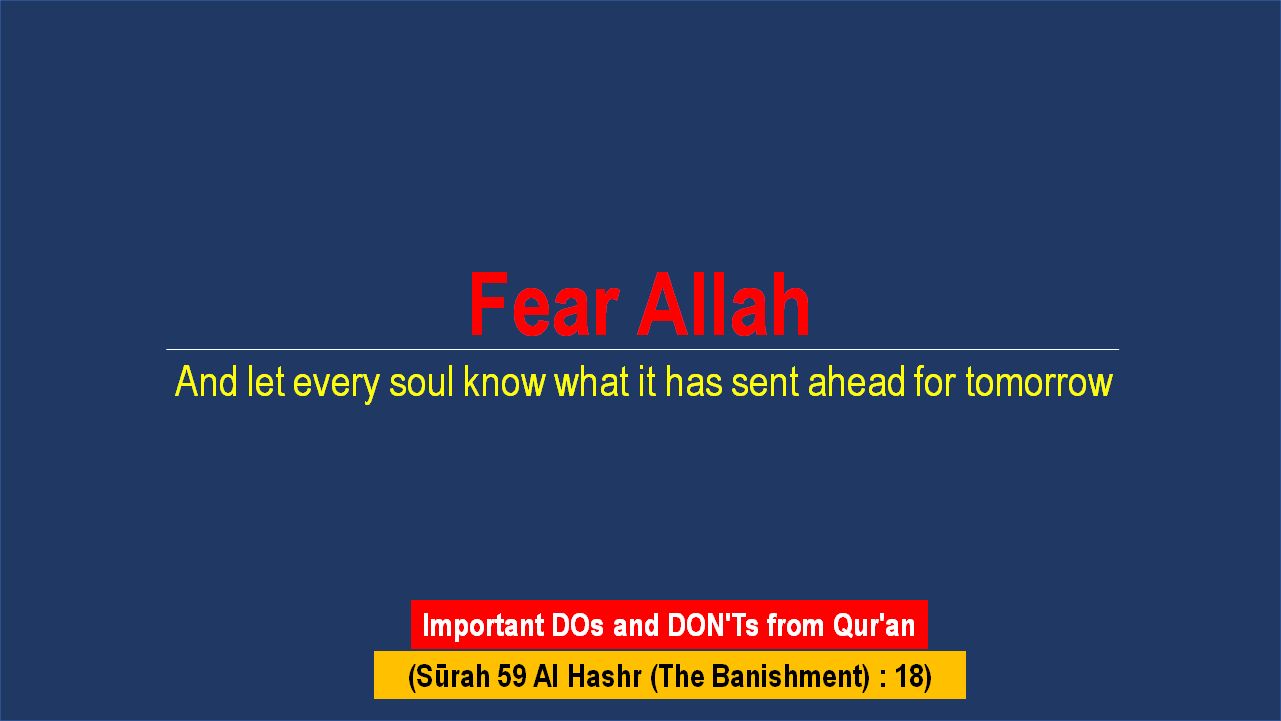
      Fear Allah and let every soul know what it has sent ahead for tomorrow

      Qur'an is a book of guidance for the mankind. It abounds in directives and commandments for man to walk on the straight path and never ever to disorientate itself for all disorientations are due to machinations of evil forces. Time and again it has been reminded to fear Allah, for those who fear Allah remain steady and do not lend ears to evil whispers. 

      Qur'an also reminds man to review his conduct sheet much too often to see what he has sent forward for the Day of Resurrection, which is any day tomorrow. If we keep track of our actions and ensure that these are in accordance with the teachings of Qur'an and Sunnah, we shall never have to worry about our fate tomorrow. But if we have not been fearing Allah and are engrossed in merrymaking, the 18th verse of Surah 59 Al Hashr (The Banishment) draws our attention to be cautioned lest it is too late to even review our actions.

      Note: The entire section of Surah Al Hashr from verses 18-24 is cautions to warn men and cautiones them that there is still time to review what they have sent forward and seek forgiveness of Allah lest the angel of death knocks at their door and there is no time to repent. Please read the exegesis / tafsir of Surah Al Hashr already posted to connect to the following verses correctly:

      يٰۤاَيُّهَا الَّذِيۡنَ اٰمَنُوۡا اتَّقُوا اللّٰهَ وَلۡتَـنۡظُرۡ نَـفۡسٌ مَّا قَدَّمَتۡ لِغَدٍ​ ۚ وَاتَّقُوا اللّٰهَ​ؕ اِنَّ اللّٰهَ خَبِيۡرٌۢ بِمَا تَعۡمَلُوۡنَ‏  
      (18) O you who have believed, fear Allah. And let every soul look to what it has put forth for tomorrow - and fear Allah. Indeed, Allah is Acquainted with what you do.
      It is a rule of the Qur'an that whenever the hypocritical Muslims are taken to task for their hypocrisy, they are given admonition also so that whoever of them has some life left in his conscience, may feel remorse for his conduct and attitude and may make an effort, out of the fear of Allah, to come out of the pit into which his worship of the self has thrown him. 

      " Fear Allah and let every person look to what he sends forward for the morrow " "For the morrow": for the Hereafter. That is, this whole worldly life is "today", whose "tomorrow" is the Day of Resurrection, which is going to follow it. Adopting this style Allah has, in a wise manner, made man understand the truth that just as that person is highly foolish, who gambles away his all for the enjoyment of today and does not realize whether tomorrow he would be left with anything to eat and a place of shelter or not, so is that person also only working for his own doom, who is too absorbed in making; his world to pay heed to the Hereafter, whereas the Hereafter is to follow this world just as today is to be followed by tomorrow, and there he would find nothing if he has sent nothing ahead for the morrow. Besides, the other wise point here is that every person has been appointed his own censor. Unless a person develops in himself the sense of what is good for him and what is evil, he cannot appreciate whether what he is doing will make his future in the Hereafter or mar it. And when this sense becomes active in himself, he will have to calculate and see for himself whether the way in which he is expending his time, his wealth, his energies and capabilities leads to Heaven or Hell. To do so is in his own interest; for if he does not do so he will ruin his own future itself.

      Yusuf Ali Explanation: The "fear of Allah" is akin to love; for it means the fear of offending Him or doing anything wrong that will forfeit His Good Pleasure. This is Taqwa, which implies self-restraint, guarding ourselves from all sin, wrong, and injustice, and the positive doing of good. See ii. 2:
      (ii:2) This is the Book; in it is guidance sure without doubt to those who fear Allah. 
      Taqwa and the verbs and nouns connected with the root, signify: (1) the fear of God which according to the writer of Proverbs (i.7) in the Old Testament is the beginning of Wisdom; (2) restraint, or guarding one's tongue, hand, and heart from evil; (3) hence righteousness, piety good conduct. All these ideas are implied; in the translation, only one or other of these ideas can be indicated according to the context. See also xivii 17; and ixxiv 56.
      The positive side of Taqwa, or "fear of Allah" (see last note) is here emphasized. It is not merely a feeling or an emotion: it is an act, a doing of things which become a preparation and provision for the Hereafter, - the next life, which may be described as "the morrow" in relation to the present Life, which is "to-day". A) The repetition emphasizes both sides of Taqwa: "let your soul fear to do wrong and let it do every act of righteousness; for Allah observes both your inner motives and your acts, and in His scheme of things everything will have its due consequences."

      Javed Ahmad Ghamidi Explanation: This refers to what he has done for the Day of Judgement. It is referred to by the word “tomorrow.” The purpose is to direct attention to its proximity as well as to its certainty.

      The words اِتَّقُوا اللّٰہَ (fear God) are repeated so that the importance of the matter is driven in the minds of the addressees.

      Having asked man to fear Allah and take a look at one's past which has been already recorded, there comes another caution in the next verse, the number 19, which tells man the fate ofthose who did not fear Allah and were forgotten by Allah:

      وَلَا تَكُوۡنُوۡا كَالَّذِيۡنَ نَسُوا اللّٰهَ فَاَنۡسٰٮهُمۡ اَنۡفُسَهُمۡ​ؕ اُولٰٓـئِكَ هُمُ الۡفٰسِقُوۡنَ‏ 
      (19) And be not like those who forgot Allah, so He made them forget themselves. Those are definitely disobedient.
      That is, forgetfulness of God inevitably leads to forgetfulness of one's own self. When man forgets that he is slave to the Almighty, he will inevitably form a wrong view of his position in the world, and his whole life will go wrong because of this basic error. Likewise, when he forgets that he is slave to nobody except Allah, he does not serve the one whose slave actually he is not. This also is a grave and all-pervading misunderstanding, which corrupts his whole life. Man's real position in the world is that of a slave; he is not free and self-sufficient; and he is slave of only One God, and is no one else's slave beside Him. The person who, in not know this truth, does not in fact know himself. And the person who in spite of knowing this, forgets it at any moment, may commit an act at that very moment, which a disbeliever, or a polytheist or a man forgetful of God only would commit. Man's remaining firm and steadfast on the right path entirely depends on his remembering God at all times. For as soon as he, becomes heedless of Him. he becomes heedless of himself and this very heedlessness turns him into sinfulness. 

      Javed Ahmad Ghamidi Explanation: This is a reference to the Jews from whom the Hypocrites received guidance and with whom they would connive to oppose Islam and the Muslims. The words فَاَنۡسٰہُمۡ اَنۡفُسَہُمۡ used for them point to a very important reality. 

      Imam Amin Ahsan Islahi has explained it thus: … Those who forget God become indifferent to their own good and evil and to their fate. All value, significance and majesty of life depends on understanding the reality that the Almighty has not given it to us to indulge in a few days of luxury; He has given it to us so that we spend it in obedience to Him and earn the eternal kingdom of heaven. This pinnacle can of course be achieved by someone who always keeps in mind that he has not been given life by chance; on the contrary, it is a blessing of a Gracious being and He has given it with a special purpose. If a person leads his life in accordance with this special purpose, it will be a great eternal reward for him, and if he forgets this, it will automatically become an eternal curse for him.(Amin Ahsan Islahi, Tadabbur-i Qur’an, vol. 8, 308)

      Having explained the above said verse in detail, you may now listen to explanation of the Ayat by eminent Muslim scholar Nouman Ali Khan:
      May Allāh (سبحانه و تعالى‎) help us understand Qur'ān and follow the Sunnah of Prophet Muhammad ﷺ, which is embodiment of commandments of Allah contained in the Qur'ān. May Allah help us to be like the ones He loves and let our lives be lived helping others and not making others' lives miserable or unlivable. May all our wrong doings, whether intentional or unintentional, be forgiven before the angel of death knocks on our door. 
      وَمَا عَلَيۡنَاۤ اِلَّا الۡبَلٰغُ الۡمُبِيۡنُ‏ 
      (36:17) and our duty is no more than to clearly convey the Message.”
      That is Our duty is only to convey to you the message that Allah has entrusted us with. Then it is for you to accept it or reject it. We have not been made responsible for making you accept it forcibly, And if you do not accept it, we shall not be seized in consequence of your disbelief, you will yourselves be answerable for your actions on Day of Resurrection.

      Reading the Qur'ān should be a daily obligation of a Muslim - Reading it with translation will make it meaningful. But reading its Exegesis / Tafsir will make you understand it fully. It will also help the Muslims to have grasp over social issues and their answers discussed in the Qur'an and other matter related to inter faith so that they are able to discuss issues with non-Muslims with authority based on refences from Qur'an.

      May Allah forgive me if my posts ever imply a piety far greater than I possess. I am most in need of guidance.

      Note: When we mention God in our posts, we mean One True God, we call Allah in Islam, with no associates. Allah is the Sole Creator of all things, and that Allah is all-powerful and all-knowing. Allah has no offspring, no race, no gender, no body, and is unaffected by the characteristics of human life.

      You may refer to more Selected Verses from Sürah 59 Al Al-Ḥashr (The Gathering),  already published. You may also refer to our exclusive reference page: Selected verses from selected Surahs of Al-Qurʾān for compiled verses from other surahs.

      For more DOs and Don'ts, please refer to our reference page: Important DOs and DON'Ts from Qur'anYou may also refer to our Reference Pages: Understanding Al Qur'an and  Selected Verses from the Qur'an for knowing more about Islam and Qur'ān.
      Photo | Tafsir References: | 1 | 2 | 3 | 4 | 5 | 6 | 7 | 8 | 9 | 

      An effort has been made to gather explanation / exegesis of the surahs of the Qur'ān from authentic sources and then present a least possible condensed explanation of the surah. In that the exegesis of the chapters of the Quran is mainly based on the "Tafhim al-Qur'an - The Meaning of the Qur'an" by one of the most enlightened scholars of the Muslim World Sayyid Abul Ala Maududi.  
      In order to augment and add more explanation as already provided, additional input has been interjected from following sources: 
      • Towards Understanding the Quran
      • Tafsir Ibn Khatir
      • Muhammad Asad Translation
      • Javed Ahmad Ghamidi / Al Mawrid
      • Al-Quran, Yusuf Ali Translation
      • Verse by Verse Qur'an Study Circle
      In addition, references of other sources which have been explored have also been given above. Those desirous of detailed explanations and tafsir (exegesis), may refer to these sites.

      If you like Islam: My Ultimate Decision, and to keep yourself updated on all our latest posts to know more about Islam, follow us on Facebook

      Please share this page to your friends and family members through Facebook, WhatsApp or any means on social media so that they can also be benefited by it and better understand Islam and the Qur'ān - Insha Allah (Allah Willing) you shall be blessed with the best of both worlds.

      Sunday, 23 May 2021

      Allah, there is no god but He - The Knower of the Unseen


      Many non Muslims are of the view that their God and Allah of Muslims are two different entities just to play a low on Muslims. Some even call Him the moon-god Allah. What they forget is that there has always been One True God all along since the eternity, Who is Living and Will never Die Out. The only difference is that Allah is the name of God in Arabic. Even in the Arabic translations of Bible, God is translated as Allah.

      In the last verses of Surah 59. Al Hashr, Allah Himself explains Who is He. There are about thirty five attributes of Allah which Allah Himself explains. We will share these verses one by one so that our readers may know Who really Allah is - His attributes cannot be equated with any deities that people may worship. This series of posts should be read in conjunction with our earlier series of posts on 99 Attributes of Allah.

      هُوَ اللّٰهُ الَّذِىۡ لَاۤ اِلٰهَ اِلَّا هُوَ​ ۚ عٰلِمُ الۡغَيۡبِ وَالشَّهَادَةِ​ ۚ هُوَ الرَّحۡمٰنُ الرَّحِيۡمُ‏ 
      ( 59: 22 )   He is Allah, other than whom there is no deity, Knower of the unseen and the witnessed. He is the Entirely Merciful, the Especially Merciful.
      These verses explain what kind of God He is, and what are His attributes, Who has sent this Qur'an to you, Who has placed these responsibilities on you, and before Whom you have to render an account of your deeds in the end. This mention of the Divine attributes immediately after the above theme automatically gives man the feeling that he has not to deal with an ordinary being but with Almighty Allah Who has such and such attributes. Here, one should also understand that although in the Qur'an the attributes of Allah Almighty have been stated in a unique way, which gives a clear concept of the Divine Bing there are two places where the attributes of Allah have been mentioned in a most comprehensive way, in the Verse of the Throne (Al-Baqarah: 255) and in these verses of Surah Al-Hashr. 

      " Allah: there is no god but He " That is, He is the One besides Whom none else has the rank, position, attributes and powers of Godhead so that he may be worshiped and served as god.
      " the Knower of the unseen and the manifest " That is, He knows whatever is hidden from the creatures as well as whatever is known and visible to them. Nothing of this universe is unknown to Him. He directly knows whatever has happened in the past, whatever exists at present and whatever will happen in the future : He does not stand in need of any means or medium of knowledge. 
      " He is the Most Merciful, the Most Compassionate " That is, He alone is the Being Whose mercy is limitless, which covers the whole universe and blesses and benefits everything a it. None else in the world is the bearer of such all-pervading, infinite mercy. The mercy of every other being, characterized by the ability of mercy, is partial and limited, and that quality too is not essentially its own, but bestowed by the Creator for a specific need and purpose. He has created the quality of mercy for some other creature. He has created it in order to make one creature a-means for the development and well-being of the other creature. This by itself is a proof that Allah's Mercy is infinite.

      Yusuf Ali  Explanation
      Here follows a passage of great sublimity, summing up the attributes of Allah. In this verse, we have the general attributes, which give us the fundamental basis on which we can form some idea of Allah. We start with the proposition that there is nothing else like Him. We think of His Unity; all the varying and conflicting forces in Creation are controlled by Him and look to Him, and we can never get a true idea of Him unless we understand the meaning of Unity. His knowledge extends to everything seen and unseen, present and future, near and far, in being and not in being: in fact these contrasts, which apply to our knowledge, do not apply to Him. His Grace and His Mercy are unbounded: see i. 1, and n. 19; and unless we realise these, we can have no true conception of our position in the working of His Will and Plan.

      Muhammad Asad Explanation:
      The term ash-shahadah (lit., "that which is [or "can be"] witnessed") is used in this and similar contexts as the exact antithesis of al-ghayb ("that which is beyond the reach of a created being's perception"). Thus, it circumscribes those aspects of reality which can be sensually or conceptually grasped by a created being.

      Qur'an Wiki:
      The rest of the surah is devoted to a long glorification of God, citing a number of His names and attributes. This serves as an aspect of the influence of the Qur'an on the universe. It is as if we see the universe as a person expressing this glorification with his mouth, and a vast kingdom echoing it in every corner. These attributes of God have clear effects on the very nature of the universe, its phenomena and interactions. As it offers this glorification, it testifies to the truth of these attributes and their effects.

      "He is Allah, other than whom there is no deity," This imprints on our consciousness the truth of God's oneness in belief, worship, action and life conduct from the beginning of creation to its final end. On the basis of this oneness a whole code of living is based, regulating our way of thinking, feeling, behaviour, relations with the universe and its living creatures, as well as relations with people.

      "Knower of the unseen and the witnessed." This divine attribute makes us clearly conscious of God's knowledge of everything, apparent or hidden. This awakes in our consciences the need to watch out, keeping God always in our thoughts, public and private. Thus, man will go about his life feeling that he is being watched by God and that he himself is on the watch for God's sake, realizing that he does not live alone, not even when he is in seclusion or locked alone with one other in private conversation. His actions will be coloured by this feeling that keeps him always on guard.

      "He is the Entirely Merciful, the Especially Merciful." Now a feeling of reassurance spreads within man's conscience as he feels the air of God's mercy spread over him. Feelings of awe and hope, fear and reassurance are well balanced within him. In the believer's concept, God does not chase His creatures, but watches them; He does not wish them harm, but loves that they should adhere to His guidance; He does not abandon them to struggle against evil without providing help for them.

      Please listen to explanation of the ayat by eminent Muslim scholar Nouman Ali Khan:
      May Allāh (سبحانه و تعالى‎) help us understand Qur'ān and follow the Sunnah of Prophet Muhammad ﷺ, which is embodiment of commandments of Allah contained in the Qur'ān. May Allah help us to be like the ones He loves and let our lives be lived helping others and not making others' lives miserable or unlivable. May all our wrong doings, whether intentional or unintentional, be forgiven before the angel of death knocks on our door. 
      وَمَا عَلَيۡنَاۤ اِلَّا الۡبَلٰغُ الۡمُبِيۡنُ‏ 
      (36:17) and our duty is no more than to clearly convey the Message.”
      That is Our duty is only to convey to you the message that Allah has entrusted us with. Then it is for you to accept it or reject it. We have not been made responsible for making you accept it forcibly, and if you do not accept it, we shall not be seized in consequence of your disbelief, you will yourselves be answerable for your actions on Day of Resurrection.

      May Allah forgive me if my posts ever imply a piety far greater than I possess. I am most in need of guidance.

      You may refer to more Selected Verses from Sürah 59 Al Al-Ḥashr (The Gathering),  already published. You may also refer to our exclusive reference page: Selected verses from selected Surahs of Al-Qurʾān for compiled verses from other surahs.

      For more Selected Verses, please refer to our reference page: Selected Verses from the Qur'anYou may also refer to our Reference Pages for knowing more about Islam and Qur'ān.
      Photo | Reference:  | 1 | 2 | 3 | 4 | 5 | 6 | 7 | 8 | 9 | 
      Reading the Qur'ān should be a daily obligation of a Muslim - Reading it with translation will make it meaningful. But reading its Exegesis / Tafsir will make you understand it fully.

      An effort has been made to gather explanation / exegesis of the surahs of the Qur'ān from authentic sources and then present a least possible condensed explanation of the surah. In that:
      • The plain translation has been taken from the Qur'ān officially published by the Kingdom of Saudi Arabia. [1]
      • The exegesis of the chapters of the Quran is mainly based on the "Tafhim al-Qur'an - The Meaning of the Qur'an" by one of the most enlightened scholars of the Muslim World Sayyid Abul Ala Maududi. [2]  
      In order to augment and add more explanation as already provided by [2], additional input has been interjected from following sources: 
      • Towards Understanding the Quran
      • Tafsir Ibn Khatir
      • Muhammad Asad Translation
      • Javed Ahmad Ghamidi / Al Mawrid
      • Al-Quran, Yusuf Ali Translation
      • Verse by Verse Qur'an Study Circle
      In addition the references of  other sources which have been explored have also been given above. Those desirous of detailed explanations and tafsir (exegesis), may refer to these sites.

      If you like Islam: My Ultimate Decision, and to keep yourself updated on all our latest posts to know more about Islam, follow us on Facebook

      Please share this page to your friends and family members through Facebook, WhatsApp or any means on Social Media so that they can also be benefited by it and better understand Islam and the Qur'ān - Insha Allah (Allah Willing) you shall be blessed with the best of both worlds.
      Twitter Delicious Facebook Digg Stumbleupon Favorites More