.

Saturday, 9 July 2022

Allah suffices me: there is no god but He

Faith in One True God is the very basis of Islam. None other than He is to be worshipped for He alone commands the entire universe being its sole Creator. Non Muslims may come up with any logic to justify their religion and faith, yet the truth can never be denied and it would ultimately prevail on their biased and artificial thoughts about the Creator and the Creation.

Whenever anyone embarks upon a journey to invite non-Muslims to Islam, he may come up with many counter arguments to his belief and may then turn away. The same situation was confronted by Prophet Muhammad ﷺ, the last of the all the messengers chosen by Allah to spread His Divine Commandments and perfect His religions into one last religion: Islam. And many a times the revered prophet ﷺ was dejected by the rigidity of the polytheists of his time. At such times, many a verse had been revealed unto him telling him to be steadfast in his mission and turn away from the polytheists and continue in his endeavours to find a new audience for the reality and truth would finally prevail. In Sha Allah.

In this regard we share today the last verse of Surah 9. At Tauba with the same theme:

فَاِنۡ تَوَلَّوۡا فَقُلۡ حَسۡبِیَ اللّٰہُ ۫٭ۖ لَاۤ اِلٰہَ اِلَّا ہُوَ ؕ عَلَیۡہِ تَوَکَّلۡتُ وَ ہُوَ رَبُّ الۡعَرۡشِ الۡعَظِیۡمِ
But if they turn away Say: "Allah sufficeth me: There is not god but He: On Him is my trust - He the Lord of the Throne (Of Glory) Supreme!  

Tafsir Ibn-Kathir
( فَإِن تَوَلَّوْاْ But if they turn away), from the glorious, pure, perfect and encompassing Law that you -- O Muhammad -- brought them, 

(فَقُلْ حَسْبِىَ اللَّهُ لا إِلَـهَ إِلاَّ هُوَ then say: "Allah is sufficient for me. There is no God but He,) Allah is sufficient for me, there is no deity worthy of worship except Him, and in Him I put my trust. 
Similarly, Allah said, ((He alone is) the Lord of the east and the west; there is no God but He. So take Him alone as a guardian.) [73:9].
Allah said next, (Verily, there has come unto you a Messenger from among yourselves ...) [9:128]'' until the end of the Surah It is recorded in the Sahih that Zayd bin Thabit said, "I found the last Ayah in Surah Bara'ah with Khuzaymah bin Thabit.'' This is the end of Surah Bara'ah, all praise is due to Allah.

(وَهُوَ رَبُّ الْعَرْشِ الْعَظِيمِ and He is the Lord of the Mighty Throne) He is the King and Creator of all things, and He is the Lord of the Mighty Throne (`Arsh), which is above all creation; all that is in and between the heavens and earths is under the Throne (`Arsh) and subservient to Allah's power. His knowledge encompasses all things, and His decision will certainly come to pass over all matters. He is the guardian of all things. 

Yusuf Ali Explanation:
But if the Message is rejected, he still proclaims the burning Faith of his heart, which is unquenchable. Allah is sufficient to all. To trust Him is to find the accomplishment of all spiritual desire. His grandeur is figured by a lofty Throne, supreme in glory! Thus, have we been led, through a notable incident in Al-Mustafa's earthly career, to truths of the highest spiritual import.

Explanation Qur'an Wiki:
The sūrah addresses the Prophet, showing him what attitude to take when people turn away from him and his message. It points to the source of power which gives him all the protection he needs. To Him belong all power, dominion, greatness and honour. His support is sufficient for everyone who seeks His patronage.

The sūrah which concentrates mainly on fighting and striving for God’s cause is thus concluded with the directive to rely on God alone, trust Him and seek His powerful support. After all “He is the Lord of the Mighty Throne.”

This sūrah outlines the final rulings on the permanent relations between the Muslim community and the outside world, as explained in our commentary on its various passages. Hence, we have to refer to its latest statements since these represent the final say on these relations. These statements must not be restricted or narrowed down in their applicability on the basis of earlier statements and rulings, which we described as provisional. In doing so, we have relied on the chronological order of the revelation of these verses and statements, and on the progress of the Islamic movement at the time of the Prophet, as well as the events marking that progress.

We have also been guided by our understanding of the nature of the Islamic message and its method of action which we have explained in our presentation of the sūrah and our commentary on its verses. This method of action is only understood by those who deal with this faith of Islam as a movement striving to establish itself in human life. As we have explained, the goal of that striving is to liberate mankind from submission to others so that they submit to God alone.

There is a wide gap between an understanding based on active striving and one based on academic study which is bound to ignore action. The first type of understanding looks at Islam as it conducts its direct confrontation with the system of jāhiliyyah, taking one step after another and moving from one stage to the next. It also looks at it as it proclaims its legislation to deal with the changing situation in its confrontation.

Moreover, these final laws and verdicts outlined in this last sūrah were actually revealed when the general situation of the Muslim community and the world around it required such legislation. Prior to that, when the situation required different rulings, these were given in earlier sūrahs to serve as provisional rulings.

When a new Muslim community emerges again and starts to strive for the establishment of this faith in human life, it may be appropriate for this community to apply the provisional rulings, provided that it remains well aware that these are only provisional. It should also be aware that it must strive to reach the stage when only the final rulings govern its relations with the world around it. God will certainly help that community and guide it on its way.

End note by Nouman Ali Khan:
Now that is the messenger. This word is not that of the messenger, but the word of Allah. The Surah began and ended in the same place. Whoever turned away from this message has nothing to do with Allah and his messenger ﷺ.  He, the Prophet Muhammad, is being told that if people turn away then you, who love them so much, tell them " Allah is enough for me."

Basically this is Prophet ﷺ declaring baraa from his own people if they turn away. This is at the end. In the beginning it was about disassociating from the people who do shirk. Now it is those who abandon the Prophet’s mission, those who stayed behind the messenger ﷺ. This is such a powerful ending. Allah (swt) challenges the Muslims. 

If this Surah can be summarized, one of its main concluding themes is loyalty to the mission of Allah’s messenger ﷺ  We as people have to feel a sense of loyalty that he ﷺ was on a mission and that mission is not over. Especially the immediate aspects of that mission if you look: Prophet ﷺ had already prepared a battalion to take over the Persians before he p assed. When he passed, that bat talion wasn’t cancelled. The Prophet ﷺ may not be with us. But his mission is. The chain of commanders was already set in place. Their loyalty was on to that. The hardest day on Ummah was the day of passing of Prophet ﷺ.
Aboobacker Siddeq (ra) says: “Whoever used to worship Mohammed, he ﷺ is dead. Allah is living He doesn’t die. And Allah’s word doesn’t die. Hence, the Prophet’s mission never dies.” The word of Allah keeps the mission of Allah going; t he mission that was charged to the messenger ﷺ.
May Allāh (سبحانه و تعالى‎) help us understand Qur'ān and follow the Sunnah of Prophet Muhammad ﷺ, which is embodiment of commandments of Allah contained in the Qur'ān. May Allah help us to be like the ones He loves and let our lives be lived helping others and not making others life miserable or unlivable. May all our wrong doings, whether intentional or unintentional, be forgiven before the angel of death knocks on our door. 
Note: When we mention God in our posts, we mean One True God, we call Allah in Islam, with no associates. Allah is the Sole Creator of all things, and that Allah is all-powerful and all-knowing. Allah has no offspring, no race, no gender, no body, and is unaffected by the characteristics of human life.

Reading the Qur'ān should be a daily obligation of a Muslim - Reading it with translation will make it meaningful. But reading its Exegesis / Tafsir will make you understand it fully. It will also help the Muslims to have grasp over social issues and their answers discussed in the Qur'an and other matter related to inter faith so that they are able to discuss issues with non-Muslims with authority based on refences from Qur'an.

May Allah forgive me if my posts ever imply a piety far greater than I possess. I am most in need of guidance.

For more Selected Verses, please refer to our reference page: Selected Verses from the Qur'anYou may also refer to our Reference Pages  and Understanding Al Qur'an for knowing more about Islam and Qur'ān.
Photo | Tafsir References: | 1 | 2 | 3

An effort has been made to gather explanation / exegesis of the surahs of the Qur'ān from authentic sources and then present a least possible condensed explanation of the surah. In that the exegesis of the chapters of the Quran is mainly based on the "Tafhim al-Qur'an - The Meaning of the Qur'an" by one of the most enlightened scholars of the Muslim World Sayyid Abul Ala Maududi.  
In order to augment and add more explanation as already provided, additional input has been interjected from following sources: 
  • Towards Understanding the Quran
  • Tafsir Ibn Khatir
  • Muhammad Asad Translation
  • Javed Ahmad Ghamidi / Al Mawrid
  • Al-Quran, Yusuf Ali Translation
  • Verse by Verse Qur'an Study Circle
In addition the references of other sources which have been explored have also been given above. Those desirous of detailed explanations and tafsir (exegesis), may refer to these sites.

If you like Islam: My Ultimate Decision, and to keep yourself updated on all our latest posts to know more about Islam, follow us on Facebook

Please share this page to your friends and family members through Facebook, WhatsApp or any means on Social Media so that they can also be benefited by it and better understand Islam and the Qur'ān - Insha Allah (Allah Willing) you shall be blessed with the best of both worlds.

Wednesday, 6 July 2022

Islam in Angola (Africa)

The African country of Angola is a predominantly Christian country with Islam being a minority religion. As of 2014 census, there are 195,000 Muslims in Angola, representing 1% of total population. The majority of Muslims belongs to Sunni Islam, who generally came from West Africa and the Middle East, though some are local reverts.

The Association of the Development of Islam in Angola is the primary proselytizing organization. Muslim Angolans are represented by the Supreme Council of Angolan Muslims of Luanda.

Despite the fact that Although Islam has ancient roots in Angola, the spread of Islam began in the 1990s as massive immigration took place from the West African countries of Mali, Senegal, and Guinea, among others, yet the state of Muslims is larger than pathetic for they remain unrecognised as Muslims by  the Angolan government.
As per a report published in 2019, “The former regime was not so open with Islam in particular and freedoms in general. Consequently, Muslims faced many challenges. One of the most controversial issues regarding religion is the Law on Religion.”
Since 2004, the law has determined that for a religion to be recognized by the state, it must have more than 100,000 members and a presence in over two-thirds of the nation’s territory. In addition, a religious group must submit a minimum of 60,000 signatures to the government to have its congregation legalized.
The non recognition of Islam as one of the religions is despite the fact that government has given legal status to 83 religious groups (all of them Christian) 


In view of the so called non recognition of Islam as one of the religions of the country, Muslims are facing lot of inconvenience in performing their religious rituals, specially the combined prayers. There are no official mosques. Yet, some Muslims obtained licenses to build commercial warehouses and then used the sites to build mosques, without obtaining legal permission or building licenses specifically for such places of religious worship. There are around 69 unregistered Mosques in the country (US Department of State 2021: 4; d’Orsi 2017).

Government officials have also stated that some practices allowed by Islam, such as polygamy, contradicted the constitution. And when the government in 2020, as a measure to prevent the spread of Covid-19, allowed only religious services on Saturdays and Sundays, this was felt as discriminatory to the Muslim community and their Friday services. The director of the Instituto Nacional para os Assuntos Religiosos (National Institute for Religious Affairs, INAR, the regulating body of ‘religious affairs’), called this a “a false problem” because the authorization only affected “legally recognized religions”. In other words, a banned religion had no rights anyway. [3]

However, a report published in 2021 says that despite lack of recognition, Muslims have a peaceful co-existence with the Christian community, which in the past was worse. even being partners of the Angolan State in some social works. But still, the Islamic communities face barriers in their daily loves, the result of the lack of recognition by the Angolan authorities.  [4]

Due to lack of legal entity the Muslims are unable to build a school, a hospital or orphan center or allowing some imam to preach to Angolan Muslims as there is no missionary visa. The report says that the religious activities, such as prayers and important dates for Muslims are easily respected in Angola, according to the new president of Consia.

I could not find latest status of Muslims as the reports available on the net are generally  five years or old.  I will try to update this post as and when some insight in life of Muslims in Angola is laid hands on. Meanwhile I would request input from any Angolan Muslim reading this post. Please leave your views in the comment box.

Disclaimer: The data for this post has been collected from the references as given below. If any one differs with the material contained in this post, one may consult the references and their authors.  If someone has more material about the subject, he/she is most welcome to share in the comments box to make the post all encompassing.

To know more about life of Muslims in other non Muslim countries, please visit our page: Islam and Life of Muslims in Non Muslim Countries

You may also refer to our Reference Pages for knowing more about Islam and Quran.
Photo  | Source(s) References: | 1 | 2 | 3 | 4 | 5 | 6 | 7 | 8 |

If you like Islam: My Ultimate Decision, and to keep yourself updated on all our latest posts to know more about Islam, follow us on Facebook

Please share this page to your friends and family members through Facebook, Twitter, WhatsApp or any means on Social Media so that they can also be benefited by it and better understand Islam and the Holy Qur'an - Insha Allah (Allah Willing) you shall be blessed with the best of both worlds.

Do not knowingly conceal the Truth

There cannot be any justice in this world if people lie, conceal the truth and confound the truth by overlaying it with falsehood. Every day, countless people tell a lie in their homes, offices, and even in courts. These ugly actions portray many innocents as criminals while the criminals get scot-free for they know the art of concealing  the truth  or even "means" to do so.  This is despite the fact that right from childhood, parents educate their children to speak the truth. Yet when they grow up in  a society where deceit and lying thrives unabated, they too fall into the trap and gradually start to conceal the truth in varying degrees.

This act of concealing the truth becomes more harmful when religious scholars, priests, cohens, pandits and imams conceal hidden meanings of their religion and try to deceive others even when they know the truth and feed incorrect information to their followers. This truth concealment breeds hatred for followers of other religions and become breeding grounds for violence against each other,

This very unfortunate that Islam is the most targeted Divine religion due to this heinous crime and has resulted into Islamophobia that has spread almost throughout the world and plagues the minds. The publishing of caricatures of revered prophet of Islam Muhammad ﷺ, burning of Qur'an publicly and snatching head-scarves from the heads of Muslim women, firing and barging into on masjids or even demolishing the places of worship or community centres has but become the daily business around the world. In India, Muslims are bound and forcibly made to drink urine of cow and chant prop Hindu slogans and tortured to denounce Islam.

The same was the situation when Islam was introduced in Makkah by Prophet Muhammad ﷺ and cohens tried to conceal the truth, though they knew what Islam was conveying the same message that their unadulterated scriptures said. And today even after more than 1400 years, we are still subjected to same hate and lying tactics.

We share today the 42nd verse of Surah 2. Al Baqarah (The Cow), that points towards concealment of truth:

وَلَا تَلۡبِسُوا الۡحَـقَّ بِالۡبَاطِلِ وَتَكۡتُمُوا الۡحَـقَّ وَاَنۡتُمۡ تَعۡلَمُوۡنَ‏ 
(2:42) Do not confound Truth by overlaying it with falsehood, nor knowingly conceal the Truth.
In order to understand this verse, it should be kept in mind that the Arabs were generally illiterate and uneducated people. As against them, education was common among the Jews, who had among them great scholars renowned even beyond Arabia. That is why the Arabs were overawed by the scholarship of the Jews, more so because their scholars and rabbis made a great show of their learning and piety and reinforced it with the practice of charms and amulets. The people of Madinah in particular were overawed by the learning of the Jews, for they were surrounded by big Jewish tribes and came in contact with them day and night. As a result, they were immensely influenced by them just as illiterate people usually are influenced by the neighbours who are more educated, more civilized and more religious in character.

Such were the conditions when the Holy Prophet upon whom be peace) presented himself as a Prophet and began to invite the people to Islam; naturally the illiterate Arabs turned to the Jews for guidance in this matter, and said: "You are the followers of a Prophet and possess a Book, so tell us what you think of this man and his teachings, who claims to be a Prophet." This question was repeatedly asked of the Jews by the people of Makkah, and when the Holy Prophet came to Madinah, here also many people visited the Jewish scholars again and again to ask them the same question. But their scholars never gave them the right answer. For they could not say that the doctrine of Tauhid that Muhammad (upon whom be Allah's peace and blessings) was preaching was wrong, nor that the knowledge which he imparted about the Prophets, scriptures, angels, and the Hereafter was wrong, nor that there was something wrong about the moral principles that he taught. They were neither ready to admit in plain words the righteousness of the teachings of the Holy Prophet; nor had they the courage to refute it openly; nor were they willing to profess the Truth candidly. 

Instead, they devised a subtle strategy to oppose it: they created one suspicion or the other about the Holy Prophet, his followers and his mission; they would concoct allegations against him and his followers and make false propaganda against them or raise frivolous objections so as to involve them in useless discussions. That is why they have been warned not to conceal the truth by covering it with falsehood, nor suppress it by spreading suspicions and by raising silly objections, nor mix it up with falsehood.

Tafsir Ibn-Kathir: The Prohibition of hiding the Truth and distorting It with Falsehood
Allah forbade the Jews from intentionally distorting the truth with falsehood and from hiding the truth and spreading falsehood, (And mix not truth with falsehood, nor conceal the truth while you know (the truth)). So Allah forbade them from two things; He ordered them to make the truth known, as well as explaining it. 

(while you know (the truth).) that the religion of Allah is Islam, and that Judaism and Christianity are innovations that did not come from Allah.''
 
(nor conceal the truth while you know (the truth).) means, "Do not hide the knowledge that you have of My Messenger and what he was sent with. His description, which you know about, can be found written in the Books that you have.''

It is possible that it means, "..although you know the tremendous harm that this evil will cause people, misguiding them and leading them to the Fire, because they will follow the falsehood that you mixed with the truth in your claims.''

Muhammad Asad Explanation:
By "overlaying the truth with falsehood" is meant the corrupting of the Biblical text, of which the Qur'an frequently accuses the Jews (and which has since been established by objective textual criticism), while the "suppression of the truth" refers to their disregard or deliberately false interpretation of the words of Moses in the Biblical passage, "The Lord thy God will raise up unto thee a prophet from the midst of thee, of thy brethren, like unto me; unto him ye shall hearken" (Deuteronomy xviii, 15), and the words attributed to God Himself, "I will raise them up a prophet from among thy brethren, like unto thee, and will put My words in his mouth" (Deuteronomy xviii, 18). The "brethren" of the children of Israel are obviously the Arabs, and particularly the musta'ribah ("Arabianized") group among them, which traces its descent to Ishmael and Abraham: and since it is to this group that the Arabian Prophet's own tribe, the Quraysh, belonged, the above Biblical passages must be taken as referring to his advent.

Explanation Qur'an Wiki:
The sūrah goes on to censure the Israelites for deliberately confusing truth with falsehood in order to create confusion, doubt and discord among the Muslims. “Do not overlay the truth with falsehood, nor knowingly suppress the truth.”

The Qur’ān abounds with reports of how the Jews of Madinah would seize every opportunity to antagonise its Muslims, create distractions and spread false ideas and malicious rumours among them. They had a notorious reputation, as we shall see, for causing division and making mischief within the Muslim community.

When someone hides the truth and knowledge. Abdullah ibn Mubarak said, إذا كتم العالم علمه ابتلي : إما بموت القلب أو ينسى أو يتبع السلطان "When a scholar hides his knowledge, he will be tested - either with the death of his heart, or he will forget [his knowledge] or he will follow the Rulers [i.e. he will become amongst the scholars of the government."  الْحَقَّ بِالْبَاطِلِ– The truth is there being clothed over with falsehood.
The application of this verse stands true even today when priests, pandits and cohens are busy labelling Islam with all sorts of derogatory slurs and trying their utmost to deter their people from embracing Islam. Yet, the miracle of Islam is more powerful than their machinations and is expanding at a much faster rate than all other religions. Many fear that by 2050 Islam may over take Christianity. and it will -In Sha Allah.
This verse is also applicable to all those Muslims who conceal the truth and lie for their worldly and personal gains. Bribes are business of the day and many Muslims indulge in asking bribes for even official works. Lawyers blatantly lie to cover up the truth to save their clients, despite knowing that their clients are criminals and they are helping them and thus framing the innocents. Muslims must know that one day they will be asked and punished for the lies they told to conceal the truth and on that day no one will save them from wrath of Allah. This verse is a wake up call, if we have the vision to comprehend it.

Please listen to explanation of the ayat by eminent Muslim scholar Nouman Ali Khan:

May Allāh (سبحانه و تعالى‎) help us understand Qur'ān and follow the Sunnah of Prophet Muhammad ﷺ, which is embodiment of commandments of Allah contained in the Qur'ān. May Allah help us to be like the ones He loves and let our lives be lived helping others and not making others life miserable or unlivable. May all our wrong doings, whether intentional or unintentional, be forgiven before the angel of death knocks on our door. 

Note: When we mention God in our posts, we mean One True God, we call Allah in Islam, with no associates. Allah is the Sole Creator of all things, and that Allah is all-powerful and all-knowing. Allah has no offspring, no race, no gender, no body, and is unaffected by the characteristics of human life.

Reading the Qur'ān should be a daily obligation of a Muslim - Reading it with translation will make it meaningful. But reading its Exegesis / Tafsir will make you understand it fully. It will also help the Muslims to have grasp over social issues and their answers discussed in the Qur'an and other matter related to inter faith so  that they are able to discuss issues with Non Muslims with authority based on refences from Qur'an.

May Allah forgive me if my posts ever imply a piety far greater than I possess. I am most in need of guidance.

For more Selected Verses, please refer to our reference page: Selected Verses from the Qur'anYou may also refer to our Reference Pages  and Understanding Al Qur'an for knowing more about Islam and Qur'ān.
Photo | Tafsir References: | 1 | 2 | 3 | 4

An effort has been made to gather explanation / exegesis of the surahs of the Qur'ān from authentic sources and then present a least possible condensed explanation of the surah. In that the exegesis of the chapters of the Quran is mainly based on the "Tafhim al-Qur'an - The Meaning of the Qur'an" by one of the most enlightened scholars of the Muslim World Sayyid Abul Ala Maududi.  
In order to augment and add more explanation as already provided, additional input has been interjected from following sources: 
  • Towards Understanding the Quran
  • Tafsir Ibn Khatir
  • Muhammad Asad Translation
  • Javed Ahmad Ghamidi / Al Mawrid
  • Al-Quran, Yusuf Ali Translation
  • Verse by Verse Qur'an Study Circle
In addition the references of other sources which have been explored have also been given above. Those desirous of detailed explanations and tafsir (exegesis), may refer to these sites.

If you like Islam: My Ultimate Decision, and to keep yourself updated on all our latest posts to know more about Islam, follow us on Facebook

Please share this page to your friends and family members through Facebook, WhatsApp or any means on Social Media so that they can also be benefited by it and better understand Islam and the Qur'ān - Insha Allah (Allah Willing) you shall be blessed with the best of both worlds.

Tuesday, 5 July 2022

Basic Articles of Faith

A few days back, a non Muslim friend asked me what do you Muslims really believe in? And I explained to him that we not only believe in One True God, called Allah in Arabic language, Who has no parallels or associates. And we do believe in all the prophets and divine books that have been reveled before the final divine book, The Quran.

To further my point, I narrated to him the 285th verse of the Surah Al Baqarah (The Cow) the second chapter of Quran, which embodies the basic articles of faith spelt out for the Muslims by Allah:

اٰمَنَ الرَّسُوۡلُ بِمَاۤ اُنۡزِلَ اِلَيۡهِ مِنۡ رَّبِّهٖ وَ الۡمُؤۡمِنُوۡنَ​ؕ كُلٌّ اٰمَنَ بِاللّٰهِ وَمَلٰٓـئِكَتِهٖ وَكُتُبِهٖ وَرُسُلِهٖ لَا نُفَرِّقُ بَيۡنَ اَحَدٍ مِّنۡ رُّسُلِهٖ​ وَقَالُوۡا سَمِعۡنَا وَاَطَعۡنَا​ غُفۡرَانَكَ رَبَّنَا وَاِلَيۡكَ الۡمَصِيۡرُ‏ 
The Messenger has believed in the Guidance which has been sent down to him from his Lord, and those who believe in the Messenger have also sincerely accepted the same. They all believe in Allah, His Angels, His Books and Messengers. And they say, "We do not discriminate against any of His Messengers. We have heard the Message and submitted to it. Our Lord, we look up to You for forgiveness, for to You we shall all return."

Sayyid Abul Ala Maududi explains that in this verse, the basic articles of Faith have been restated briefly. Belief in Allah, His Angels, His Books and in all of His Messengers without exception and discrimination against any and in the accountability to Him at the end of this life are the five basic articles of Faith. After the acceptance of these, the attitude for a Muslim is to submit obediently to each and every commandment of Allah. At the same time, he should not become vain on account of his good acts but should pray to Allah to forgive and show forbearance to him.

The famous 14th century scholar and exegetist Ibn-Kathir explains this verse saying that each of the believers believes that Allah is the One and Only and the Sustainer, there is no deity worthy of worship except Him and there is no Lord except Him. The believers also believe in all Allah's Prophets and Messengers, in the Books that were revealed from heaven to the Messengers and Prophets, who are indeed the servants of Allah. Further, the believers do not differentiate between any of the Prophets, such as, believing in some of them and rejecting others. Rather, all of Allah's Prophets and Messengers are, to the believers, truthful, righteous, and they were each guided to the path of righteousness, even when some of them bring what abrogates the Law of some others by Allah's leave. Later on, the Law of Muhammad, the Final Prophet and Messenger from Allah, abrogated all the laws of the Prophets before him. So the Last Hour will commence while Muhammad's Law remains the only valid Law, and all the while a group of his Ummah will always be on the path of truth, apparent and dominant.

Muhammad Asad Explanation: Lit., "we make no distinction between any of His apostles": these words are put, as it were, in the mouths of the believers. Inasmuch as all the apostles were true bearers of God's messages, there is no distinction between them, albeit some of them have been "endowed more highly than others" (see verse {253}).

Yousaf Ali explains this verse as under:
  • This Surah started with the question of Faith (ii 3-4), showed us various aspects of Faith and the denial of Faith, gave us ordinances for the new People of Islam as a community, and now rounds off the argument again with a confession of Faith and of its practical manifestation in conduct ("we hear and we obey"), and closes on a note of humility, so that we may confess our sins, ask for forgiveness, and pray for God's help and guidance.
  • It is not for us to make any distinction between one and another of God's apostles: we must honor them all equally, though we know that God in His wisdom sent them with different kinds of mission and gave them different degrees of rank.
  • When our faith and conduct are sincere, we realize how far from perfection we are, and we humbly pray to God for the forgiveness of our sins. We feel that God imposes no burden on us that we cannot bear, and with this realization in our hearts and in the confession of our lips, we go to Him and ask for His help and guidance.
Explanation Qur'an Wiki: The Qur’ān refers to that privileged community of believers who are the archetype of faith, and to all succeeding communities modelled on their example. This community is honoured by, and greatly appreciates, being mentioned in the same breath as God’s Messenger.

The Messenger’s faith springs directly from the revelations he receives from God, the ultimate truth. It is a degree of faith that cannot be described except by one who has experienced it; it remains beyond comprehension for those mortals who have not experienced divine revelation and is, therefore, totally unique and exclusive to God’s Messenger himself. That is why it is such an honour for ordinary believers to he mentioned side by side with God’s Messenger.

The sūrah defines the nature and parameters of this faith. It is a comprehensive and universal faith, commensurate with the far-reaching and historic role the Muslim community is destined to inherit and take on in the world. It is a commitment that identifies humanity, throughout its history, as being of only two main groups: the believers who represent the party of God, and the unbelievers who constitute the party of Satan.

“Each one of them believes in God...” According to Islam, belief in God is the foundation of a Muslim’s understanding of life, and of the code governing his life, morals, economic and all other activities. It means believing in God as the Supreme Being, the Lord of everything and the sole object of reverence and worship. He is the ultimate authority over man’s conscience and behaviour in every single aspect of his life.

God has no partners in His Godhead and Lordship over the world. He is the Creator and the active ruler of the whole cosmos, and no other power interferes with His organisation and running of the physical world or of life in it. He is the sole provider of life and sustenance for all creation. He is the only and ultimate cause of what befalls the world, without whose will and knowledge nothing, great or small, happens or comes into being in this world.

Nothing and no one but God Almighty should be adored and worshipped, in any sense of the word. God is the supreme authority to be obeyed, and all temporal authority is derived from Him, and from total adherence to His teachings and commands and the laws He lays down. An imperative of faith in God is submission to, and acceptance of, the principles and values He has set out for the moral, social, legal and economic spheres of life. Faith in this sense sets man free from control and manipulation by all other forces, powers and authorities, and from the fetters of obligation or submission to anyone or anything other than God Almighty.

“... and His angels...” This is an important aspect of belief in the unseen, the unknowable which lies beyond human perception or understanding, or, to use the Islamic term ghayb, as already discussed at the beginning of the sūrah. Man’s ability to perceive and accept a world above and beyond the physical world whose existence he can discern and verify sets him above the rest of creation and confers on him his human qualities. This belief puts into proper perspective man’s natural curiosity for what lies beyond the material physical world, which he instinctively and clearly perceives to exist. Without this clear perspective and vision, man resorts to myth and superstition, leading to imbalance and instability.

Angels are a fact of ghayb that humans cannot perceive by conventional sensory or intellectual means. But man has an instinctive urge to look beyond the world that he can see; and God, in His infinite wisdom, has seen to it that this natural and legitimate human urge is satisfied in order to save man the frustration and suffering he would otherwise inevitably encounter. There is sufficient evidence to show that those individuals and communities who have chosen to defy human nature and reject all notion of a world beyond have fallen victim to utterly farcical and fallacious superstitions that have blurred their vision, undermined their mental well-being, and turned their lives into a series of negative and destructive obsessions.

Like other aspects of ghayb, belief in the angels widens man’s perception and understanding of the world around him. It is no longer restricted to what he can see and feel, which is only a small part of reality. He feels safer in the company of these faithful creatures, fellow believers in God’s oneness, who pray constantly for man’s redemption, and in the comforting thought that they are there to help and guide him spiritually. Furthermore, the mere knowledge of this fact is a blessing from God to those who believe in Him and His angels.

“... and His books and His messengers. We make no distinction between any of His messengers.” According to the Islamic view, belief in God’s books and messengers follows logically and naturally from belief in God Himself. To believe in God is to believe in the truth of all that is revealed by Him, and in the honour and integrity of all the messengers He has commissioned, and in the unity of the source of the messages they have preached. A Muslim has no notion of discrimination between God’s messengers. They all preached Islam in various versions, suited to the circumstances of the communities they addressed. Muĥammad, (peace be upon him), was the last and final of those Prophets and messengers who has delivered the final, complete and universal version of Islam, which will remain valid for the rest of time.

The Muslim community, therefore, inherits the legacy of God’s religion on earth in its totality, which places a grave responsibility on Muslims. As bearers of God’s banner on earth, they are the custodians of the greatest gift to mankind. Their mission is to promote and establish the Islamic order, and to stand up to chauvinistic, oppressive and totalitarian ideologies of all kinds, whenever they are advocated, anywhere in the world.

The Muslim community, or ummah, is undoubtedly the legitimate heir to the greatest treasure of guidance, light, confidence and fulfilment, as well as certainty and knowledge, ever made available to mankind. Those deprived of its benefits and blessings might as well be living in darkness and confusion. Their life is inevitably plagued with scepticism, cynicism, unhappiness, spiritual suffering and deprivation.

The history of mankind has seen countless individuals and communities deprived of the sustenance and happiness of faith. The agony and miserable experiences of many a sensitive and troubled heart have been most eloquently and passionately preserved for posterity in poetry, literature and art. There are those, however, who are immune to religious faith and have no desire for knowledge beyond the material world. They go through life with little or no humanity, hardly better than animals. They eat and survive and fend for themselves ruthlessly. They oppress, tyrannize and corrupt others in order to further their own interests and desires. They are despised by God and by their fellow human beings.

Human societies deprived of the grace and blessings of faith in God are miserable despite their affluence, barren despite their wealth, and restive despite their apparent freedom, security and peace. There are, even today, obvious examples of such unfortunate societies, a fact denied only by the arrogant.

Those who truly believe in God and His angels, books and messengers, know well that they shall return to their Lord, and so they turn to Him in obedience and submission, seeking His mercy and forgiveness. “And they say, ‘We hear and we obey. Grant us Your forgiveness, our Lord; to You we shall all return.’“ 

This submission is an expression of their faith. They heed and obey every commandment received from God in affirmation of His oneness and in recognition of the validity of His order in every aspect of life. No submission can be sincere without adherence to God’s guidance and implementation of His rule in every sphere. Man’s faith cannot be complete if he turns his back on God’s teachings and seeks moral, social, economic or political guidance elsewhere. Faith is a quality firmly entrenched in man’s heart and is only given credence when expressed in actions.

With submission and obedience to the Lord comes a feeling of inadequacy and deficiency in paying one’s dues towards God. Thus believers appeal to the merciful God to overlook their failures and shortcomings: “... Grant us Your forgiveness, our Lord...”

The appeal for forgiveness follows the assertion of total submission and obedience. It is then followed by certainty in one’s fate here in this life and in the life to come. God’s word is the final and ultimate truth; everything shall return to Him; He is omnipotent; His will is done and His power unchallenged; His forgiveness, mercy and grace provide the way to escape punishment for sins we commit.

“To You we shall all return.” This statement implies belief in the hereafter, which, from the Islamic point of view, is another essential aspect of faith in God. Islam asserts that God has created man and made him His vicegerent on earth on the basis of a clear covenant encompassing all man’s activities on earth. Throughout his earthly existence man is on probation. When his probation is over, he shall be judged and made accountable for his actions. Thus belief in the Day of Judgement and man’s accountability for his deeds is a correlative of belief in God. This faith plays a central role in shaping and guiding a believer’s conscience and behaviour, and his perception of values and consequences in this life. A believer will live in obedience to God, promoting good and supporting the truth, regardless of whether the result of his endeavour in this world is happiness or suffering, gain or loss, victory or defeat, recompense or deprivation, or even death. The reward he seeks for passing the test of life is in the hereafter. Were the whole world to stand in opposition to him in this pursuit, and were his very life to be threatened, it would not dissuade him. He is dealing directly with God Almighty, fulfilling his obligation towards Him and looking forward to the reward He has in store for him.
 
This short Qur’ānic verse encapsulates the basic concept of the unity and integrity of the Islamic belief. It is a simple and clear belief in the unity of God, His angels, His books and messengers, with no distinction among those messengers whatsoever, based on total obedience and submission to God and an unshakeable faith in the Day of Judgement.
 
Such is Islam, a faith perfectly suited to epitomize the full and final divine message. It reflects the procession of faith which began with the creation of man and continued throughout the generations. It has been expounded and elucidated by messenger after messenger, according to the intellectual and social development of the recipient communities. With the Prophet Muhammad (peace be upon him), the message is brought to full maturity and its complete unity is declared, leaving man with the task of understanding its principles and details, and implementing it in his life. 
Islam is a religion that recognizes man as a unique being; neither animal nor inanimate, neither angelic nor Satanic. Islam takes a holistic, rather than a fragmented, view of man. It allows for his weaknesses as well as his strengths, treating him as an integrated being comprising a physical aspect with instincts, impulses and natural drives, and a discerning intellectual power, and a soul with spiritual passions and yearnings. It requires of man only such tasks as he is able to fulfil, maintaining that delicate balance between obligations and abilities, with fairness and without duress, satisfying the needs of body, mind and soul in perfect harmony. The corollary to that concept is man’s freedom to choose and bear full responsibility for his choice.
May Allāh (سبحانه و تعالى‎) help us understand Qur'ān and follow the Sunnah of Prophet Muhammad ﷺ, which is embodiment of commandments of Allah contained in the Qur'ān. May Allah help us to be like the ones He loves and let our lives be lived helping others and not making others life miserable or unlivable. May all our wrong doings, whether intentional or unintentional, be forgiven before the angel of death knocks on our door. 

May Allah forgive me if my posts ever imply a piety far greater than I possess. I am most in need of guidance.

Reading the Qur'ān should be a daily obligation of a Muslim - Reading it with translation will make it meaningful. But reading its Exegesis / Tafsir will make you understand it fully. It will also help the Muslims to have grasp over social issues and their answers discussed in the Qur'an and other matter related to inter faith so  that they are able to discuss issues with Non Muslims with authority based on refences from Qur'an.

Photo | References: | 1 | 2 | 3 | 4 | 5 | 6 |
For more Q&A about Understanding Islam, please refer to our reference page: Understanding Islam - Frequently asked Q&A

If you like Islam: My Ultimate Decision, and to keep yourself updated on all our latest posts to know more about Islam, follow us on FacebookYou may also refer to our Facebook  Group Islam: The Ultimate Truth for more on Islam and Da'wah.

Please share this page to your friends and family members through Facebook, WhatsApp or any means on Social Media so that they can also be benefited by it and better understand Islam and the Holy Qur'an - Insha Allah (Allah Willing) you shall be blessed with the best of both worlds.

Sunday, 3 July 2022

Traits of the Righteous

Qur'an is a book of guidance for those who seek guidance from it and have faith in Allah. The guidance is only available for those who not only have faith, walk on the straight path, Sirat e Mustaqeem, but also possess certain character traits. These traits have been spelt out at many places in the Qur'an and we have been sharing the relevant verses so that believers are reminded time and again and follow these traits.

The post today also spells out traits of the righteous as mentioned in the 35th verse of Surah 22, Al Hajj, shared herein under:

الَّذِيۡنَ اِذَا ذُكِرَ اللّٰهُ وَجِلَتۡ قُلُوۡبُهُمۡ وَالصّٰبِرِيۡنَ عَلٰى مَاۤ اَصَابَهُمۡ وَالۡمُقِيۡمِى الصَّلٰوةِ ۙ وَمِمَّا رَزَقۡنٰهُمۡ يُنۡفِقُوۡنَ‏  
Whose hearts shiver whenever Allah is mentioned, who patiently bear whatever affliction comes to them, who establish Prayer, and who spend (for good purposes) out of what We have provided them

Here fear of Allah means that the righteous always are on the look out of deviating from the guidelines provided to them in the Qur'an and are fearful of anger of Allah if they do so for this is tantamount to displeasing Allah by going against His commandments. Here instead of being fearful, the word "awe" should have been used as this combines a feeling of reverential respect mixed with fear or wonder.

Yusuf Ali explains that in this verse some qualities of Allah's devotees are mentioned here, in ascending order: 
  • (1) Humility before Allah makes them receptive, and prepares them to listen to Allah's Message;
  • (2) fear of Allah, which is akin to love, touches their heart, and penetrates through their inmost being; 
  • (3) they are not afraid of anything in mortal life; they take their trials patiently, and they go on in a course of righteousness with constancy; 
  • (4) their prayer now is not a matter of form, but a real communion with Allah, with a sense of confidence such as a faithful servant feels in the presence of a kind and loving master; and 
  • (5) gratitude to Allah, as shown by practical acts of charity to all fellow-creatures.
Ibn-Kathir describes the good provision (and who spend out of what We have provided for them.) which Allah has given them. They spend on their families and servants, and on the poor and needy; they treat people kindly while remaining within the limits set by Allah. This is in contrast to the hypocrites, who are the opposite of all this, as we have discussed in the Tafsir of Surah Bara'ah; to Allah be praise and blessings.

Muhammad Asad notes that Ar-rizq ("provision of sustenance") applies to all that may be of benefit to man, whether it be concrete (like food, property, offspring, etc.) or abstract (like knowledge, piety, etc.). The "spending on others" is mentioned here in one breath with God-consciousness and prayer because it is precisely in such selfless acts that true piety comes to its full fruition. It should be borne in mind that the verb anfaqa (lit., "he spent") is always used in the Qur'an to denote spending freely on, or as a gift to, others, whatever the motive may be.

Javed Ahmed Ghamidi notes that this style meant to urge and exhort should be kept in mind and so should be the relationship between the prayer and charity as without it the wisdom of religion cannot be understood.

Explanation Qur'an Wiki: The mere mention of God’s name stirs in them a feeling of awe that manifests itself in their actions. “Who patiently bear whatever befalls them.” They do not object to whatever happens to them by God’s will. They also “attend regularly to their prayer,” showing thus that they worship God as He wishes to be worshipped. Moreover, they do not grudgingly hold on to what they have. Rather, they “spend in charity out of what We provide for them.” Thus a close link is established between faith and worship rituals. The latter derive from faith and are manifestations of it. Hence, they are described as symbols set up by God. What is important in all this is that life itself derives its colour from faith, ensuring unity between beliefs and actions.

You may also read our previous posts which are interconnected to our present post:
May Allāh (سبحانه و تعالى‎) help us understand Qur'ān and help us to act upon the commandments of Allah contained therein. May Allah help us to be like the ones He loves and let our lives be lived helping others and not making others life miserable or unlivable. May all our wrong doings, whether intentional or unintentional, be forgiven before the angel of death knocks on our door. 

Note: When we mention God in our posts, we mean One True God, we call Allah in Islam, with no associates. Allah is the Sole Creator of all things, and that Allah is all-powerful and all-knowing. Allah has no offspring, no race, no gender, no body, and is unaffected by the characteristics of human life.

Reading the Qur'ān should be a daily obligation of a Muslim - Reading it with translation will make it meaningful. But reading its Exegesis / Tafsir will make you understand it fully. It will also help the Muslims to have grasp over social issues and their answers discussed in the Qur'an and other matter related to inter faith so  that they are able to discuss issues with Non Muslims with authority based on refences from Qur'an.

May Allah forgive me if my posts ever imply a piety far greater than I possess. I am most in need of guidance.

For more Selected Verses, please refer to our reference page: Selected Verses from the Qur'anYou may also refer to our Reference Pages  and Understanding Al Qur'an for knowing more about Islam and Qur'ān.
Photo | Tafsir References: | 1 | 2 | 3 | 4 | 5 | 6 |

An effort has been made to gather explanation / exegesis of the surahs of the Qur'ān from authentic sources and then present a least possible condensed explanation of the surah. In that the exegesis of the chapters of the Quran is mainly based on the "Tafhim al-Qur'an - The Meaning of the Qur'an" by one of the most enlightened scholars of the Muslim World Sayyid Abul Ala Maududi.  
In order to augment and add more explanation as already provided, additional input has been interjected from following sources: 
  • Towards Understanding the Quran
  • Tafsir Ibn Khatir
  • Muhammad Asad Translation
  • Javed Ahmad Ghamidi / Al Mawrid
  • Al-Quran, Yusuf Ali Translation
  • Verse by Verse Qur'an Study Circle
In addition the references of other sources which have been explored have also been given above. Those desirous of detailed explanations and tafsir (exegesis), may refer to these sites.

If you like Islam: My Ultimate Decision, and to keep yourself updated on all our latest posts to know more about Islam, follow us on Facebook

Please share this page to your friends and family members through Facebook, WhatsApp or any means on Social Media so that they can also be benefited by it and better understand Islam and the Qur'ān - Insha Allah (Allah Willing) you shall be blessed with the best of both worlds.
Saturday, 2 July 2022

How to perform Hajj: Step by Step Guide

Alhamdolillah, the most sacred Islamic month of  Dhuʻl-Hijjah " ذُو ٱلْحِجَّة " has dawned and many million lucky Muslims are heading towards sacred city of Makkah / Mecca, Saudi Arabia for the realization of life long dream of performing Hajj, the Pilgrimage. The Hajj rituals are spanned over six days between the eighth and 13th days of the month of  Dhuʻl-Hijjah.

Hajj is a unique occasion. Muslims from all over the world, coming from different cultures, speaking different languages come and perform the Hajj rituals together. No one is white or black, or wealthy ir poor, for everyone is clad in same two unstiched clothed, with one aim: To Please Allah and seek His forgiveness. Subhan Allah!!

Hajj, the fifth pillar of Islam, is mandatory religious duty for all adult able bodied Muslims that must be carried out at least once in their lifetime, provided they are physically and financially capable of undertaking the journey, and of supporting their family during their absence from home. Those despite financially capable of affording going yo Hajj, yet are incapable of undergoing the rigours of the journey and rather tough rituals of Hajj for almost a week, can ask some family friend or relative to perform Hajj on their behalf (called Hajj e Badal - Hajj on behalf) provided that particular person should have already performed his Hajj. 
Just a little brief about Ka'bah, the cubicle building clad in black cloth situated in the middle of the white marbled floor called Mutaf in Masjid Al Haram, Makkah, It is at the place where the tawaf, the anti-clockwise circumambulation arounds by performers of Hajj and Umra the Ka'bah, takes place. The foundations of Ka'bah were laid by Prophet Abraham (Ibraheem, may peace be upon him) with the help of his son Ismail in biblical times. It been a place of worship of Allah. 

Following two verse from Surah 22. Al Hajj mention God's commandment to Prophet Ibraheem (Abraham, peace be upon him) for building of Ka'bah and calling people to it for pilgrimage:

وَاِذۡ بَوَّاۡنَا لِاِبۡرٰهِيۡمَ مَكَانَ الۡبَيۡتِ اَنۡ لَّا تُشۡرِكۡ بِىۡ شَيۡـئًـا وَّطَهِّرۡ بَيۡتِىَ لِلطَّآئِفِيۡنَ وَالۡقَآئِمِيۡنَ وَ الرُّكَّعِ السُّجُوۡدِ‏ 

Call to mind when We assigned to Abraham the site of the House (Kabah), directing him: "Do not associate aught with Me" and "Keep My House pure for those who walk around it,45 and for those who stand and who bow down and who prostrate themselves (in worship), (Surah 22 Al Hajj :26) 

وَاَذِّنۡ فِى النَّاسِ بِالۡحَجِّ يَاۡتُوۡكَ رِجَالًا وَّعَلٰى كُلِّ ضَامِرٍ يَّاۡتِيۡنَ مِنۡ كُلِّ فَجٍّ عَمِيۡقٍ ۙ‏ 

(22:27) and publicly proclaim Pilgrimage for all mankind so that they come to you on foot and mounted on lean46 camels from every distant point 

But with times, idolaters put idols of their gods both inside and outside the cubicle until it was finally cleansed of all worldly gods by Prophet Muhammad ﷺ when he took over the city of Makkah. Since that day on, Ka'bah is the most sacred place of worship for the Muslims around the world. Prophet Muhammad ﷺ performed his only Hajj in 632 AD before his final departure from the world. 

Hajj is, put simply, complex. There are several different ways of performing it, and numerous schools of Islamic thought, between which lie many scholarly differences. Here is a breakdown of the steps included in performing hajj.  

Before 8th of Dhuʻl-Hijjah, when the Hajj formally commences, millions of pilgrims reach Makkah. However, be fore starting their journey, each pilgrim makes an intention to perform Hajj and assumes the state of Ihram. Ihram for men is two unstitched plain white clothe garments while for women it is any loose garments that are not revealing of woman's adornment, only keeping her face, hands and feet visible. The wearing of Iḥrām is must as all flights over fly the limits of Miqat " مِيْقَات ", a boundary around Makkah before which all pilgrims of either Umra or Hajj must be in sate of Ihram.  

After entering in the sate of Ihram, the intended Hajj pilgrims should continuously recite  Talbiyah " ٱلتَّلبِيَة ." It is a prayer invoked by the pilgrims as a conviction that they intend to perform the Hajj only for the glory of Allah. Talbiyah is repeatedly invoked during the Hajj, or pilgrimage, upon putting on the Ihram, so the pilgrims can purify and rid themselves of worldly concerns.

لَبَّيْكَ ٱللَّٰهُمَّ لَبَّيْكَ، لَبَّيْكَ لَا شَرِيكَ لَكَ لَبَّيْكَ، إِنَّ ٱلْحَمْدَ وَٱلنِّعْمَةَ لَكَ وَٱلْمُلْكَ لَا شَرِيكَ لَكَ

"Transliteration: labbayka -llāhumma labbayka, labbayka lā šarīka laka labbayka, ʾinna -l-ḥamda wa-n-niʿmata laka wa-l-mulka lā šarīka laka"

“Here I am [at your service] O God, here I am. Here I am [at your service]. You have no partners (other gods), here I am. To You alone is all praise and all excellence, and to You is all sovereignty. There is no partner to You.” 

Upon reaching Makkah, all pilgrims must perform Umra and then take of their Iḥrām and continue with their supplications and prayers till 8th of Dhuʻl-Hijjah.

Graphic representation of Hajj  rituals (Photo: Wikipedia/Source: Hajj1.ar.svg/Author AsceticRose

The Hajj Rituals: The Hajj rituals commence from 8th of Dhuʻl-Hijjah till 13th of Dhuʻl-Hijjah, Herein under the step by step guide to perform Hajj:

The Mina tent city (Photo: Wikipedia)

8th Dhuʻl-Hijjah
  • On the eighth of Dhuʻl-Hijjah , pilgrims reenter state of Iḥrām. Now they do not need to go to Miqat to enter into sate of Ihram. 
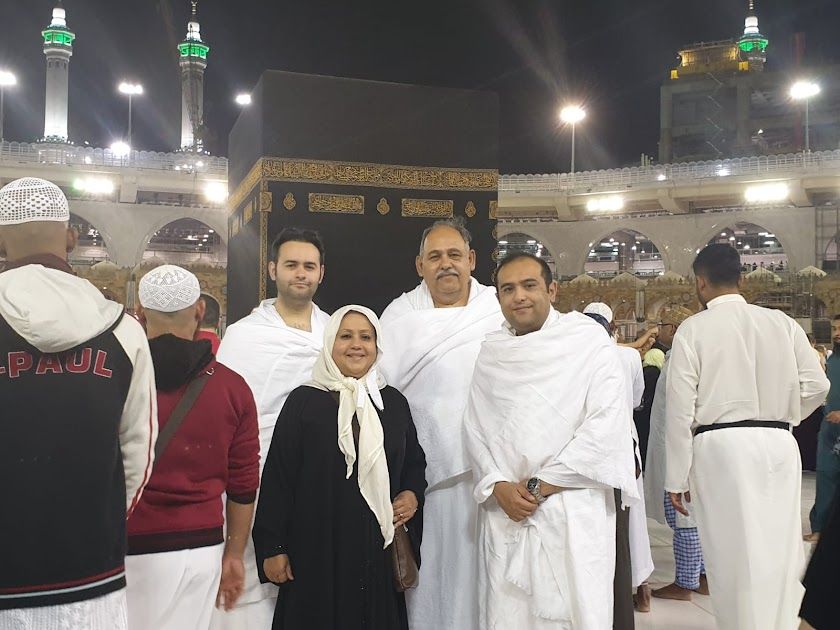
My family in state of Iḥrām, Alhamdolillah December 2021
  • From wherever they are in Makkah, they get into state of Iḥrām to commence the Hajj rituals.  From now they must adhere to the Hajj etiquettes which includes the following The same rules apply to all pilgrims when they are entering into state of Ihram before departing for Hajj/Umra from their homes or places where they assume state of Ihram)
  • Do not fight or quarrel with others.
  • Do not curse, talk sinfully or use any bad language.
  • Do not use perfume. This includes scented soaps, shampoos, wipes, lotions etc.
  • Do not cut, pluck or remove any hair or nails. (Broken nails can be removed).
  • Do not engage in any sexual activity.
  • Do not kill, hunt or help others hunt any animals.
  • Do not marry, propose or help others to marry.
  • Remember: The Ihram is a state of mind and, just like when you begin praying or fasting, certain things which would ordinarily be halal for you are now haram. 

  • On this day all pilgrims move to the camp city of Medina where elaborate arrangements of boarding and lodging of all pilgrims are extensively made. They may do so by foot (the 8 kilometer journey) or by buses and cars. The pilgrims will spend the day in Mina, only setting out the next morning at dawn. Most of the time in Mina is spent in prayer and remembering Allah.
9th Dhuʻl-Hijjah
  • This is the Hajj Day or the The Day of Arafat, which is considered one of the most important days, not just of Hajj, but of the Islamic calendar. 
  • On this day, the pilgrims will leave their tent city at Mina and move en masse to the Maidan e Arafat (The Arafat grounds). The distance from Mina to Arafat is 14.4 kilometer, which is again footed or reached in buses and cars. 
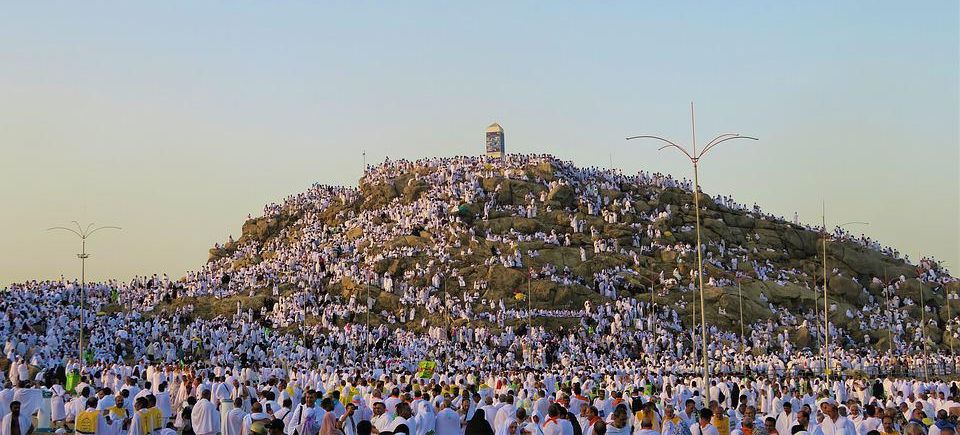
Jabal e Rehmat (Mount of Mercy) Photo
  • In the Maidan e Arafat, there is Mount Mercy which was the scene of the Prophet Muhammad’s final sermon.  
Masjid e Nimra, Maidan e Arafat (Photo: Mecca.net/source)
  • The pilgrims will stay here throughout the day and will attend to the Hajj Sermon which is made from the Masjid e Namra located in the same venue. Besides the entire day is spent in making reverent prayers, supplications and dua.
  • Elsewhere in the world, many Muslims choose to fast on this day.
  • After sunset, its time to move again, this time to Muzdalifah – a 9 km trip – where pilgrims will offer the Maghrab and Isha prayers combines and spend the rest of the night under the open sky with no tents on the ground. It is a strange experience staying under the stars sharing this beautiful night along with all other millions of pilgrims. 
  • During the stay here, usually men collect pebbles for the rites that follow on the 10th of Dhuʻl-Hijjah.
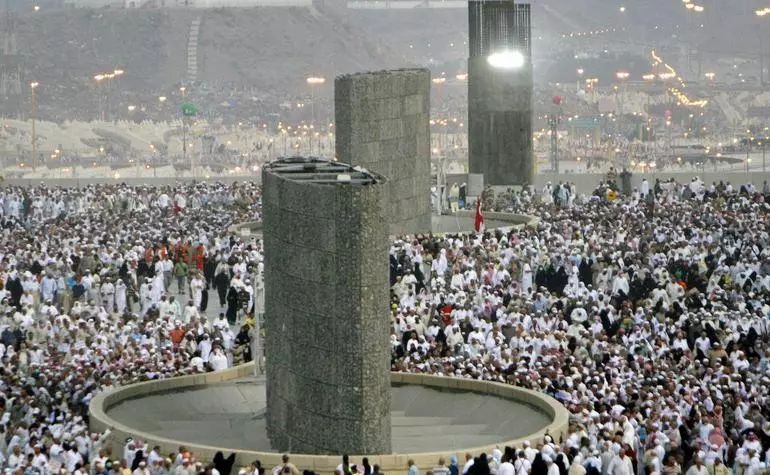
The pillars at Jamarat (Photo)
10th of Dhuʻl-Hijjah:
  • Just after the pre dawn prayer on the morning of the day, all pilgrims move back to Mina.
  • The 10th of Dhul-Hijjah is Eid al-Adha, a day celebrated by Muslims around the world as the greater of the two Muslim holidays.
  • On this day the pilgrims will perform the first rami, throwing seven pebbles at the largest of three columns known as Jamarat. This act is a symbolic stoning of the devil, based on historical tradition. God told Abraham to sacrifice his son, the story goes, as proof of faith. It is believed that at this spot in Mina, the devil appeared and tried to dissuade Abraham from heeding the command. Abraham responded by throwing stones to scare him off.
  • After casting their stones, pilgrims must perform the sacrifice. Completing the story, when Abraham went to sacrifice his son, he found God had placed a ram there to be slaughtered instead. It is better to do the slaughtering of the animal by oneself. However if due to rush or ill health one cannot so it himself, he can buy an animal for which a ticket is issued and the sacrifice of the animal is done under the government arrangement.
  • After the sacrifice, pilgrims trim or shave (men only) their hair and remove their ihram clothes.
  •  Many will then proceed to Makkah to perform tawaf and sa’ee, first circling the Kaaba seven times, then walking seven times between the hills of Safa and Marwa.
11-13th of Dhuʻl-Hijjah: On each day, they will again symbolically stone the devil – this time throwing seven pebbles at each of the three pillars. With the hardest part behind them, pilgrims will now spend the next two or three days in Mina.

When their time in Mina is finished, the pilgrims return to Makkah to perform the final circulation of the Kaaba, a “farewell” tawaf.
Majid e Nabavi (The Prophet's Mosque) - (Photo)

From here on, many return to their homes via Jeddah airport. However, many prefer to go to the city of Medinah, the final resting place of Prophet Muhammad at Masjid al Nabavi, the second holiest city in Islam. However, is not part of the pilgrimage. But along with the life time opportunity to be in the holy lands, how can someone miss out the second holiest place of Islam. Here many people offer 40 prayers in eight days as a ritual. Even otherwise being in the city of Medina is a great blessing for it has been the city where once our Prophet Muhammad  ﷺ established the first real Islamic state and from here the Islam spread to all nook and corners of the world.
May Allāh (سبحانه و تعالى‎) bless us the chance to perform Hajj and Umra, at least once in our life times to be close the holiest of places of Islam and pray for our forgiveness.
May Allah help us understand Qur'ān and help us to act upon the commandments of Allah contained therein. May Allah help us to be like the ones He loves and let our lives be lived helping others and not making others life miserable or unlivable. May all our wrong doings, whether intentional or unintentional, be forgiven before the angel of death knocks on our door. 

May Allah forgive me if my posts ever imply a piety far greater than I possess. I am most in need of guidance.

Reading the Qur'ān should be a daily obligation of a Muslim - Reading it with translation will make it meaningful. But reading its Exegesis / Tafsir will make you understand it fully. It will also help the Muslims to have grasp over social issues and their answers discussed in the Qur'an and other matter related to inter faith so that they are able to discuss issues with non-Muslims with authority based on refences from Qur'an.

Please refer to our page: Dhu al-Hijja (ذُو ٱلْحِجَّة): The month of Pilgrimage - The Hajj to know more about Dhu al-Hijja and Hajj.

Photo | Source references: | 1 | 2 | 3 | 4 | 5 |

For more Q&A about Understanding Islam, please refer to our reference page: Understanding Islam - Frequently asked Q&A

If you like Islam: My Ultimate Decision, and to keep yourself updated on all our latest posts to know more about Islam, follow us on Facebook

Please share this page to your friends and family members through Facebook, WhatsApp or any means on Social Media so that they can also be benefited by it and better understand Islam and the Holy Qur'an - Insha Allah (Allah Willing) you shall be blessed with the best of both worlds.

Twitter Delicious Facebook Digg Stumbleupon Favorites More