.

Monday, 25 July 2022

Do not boastfully claim yourselves to be purified - Allah knows those that are truly Godfearing

In out previous post, we talked of judging people by their character. Wonder why? Character is that hidden quality of man which only surfaces when man is put to test or when one start to dealing with others. Yet despite all microscopic analysis, men evade some of their hidden bad spots of their character. But can we hide ourselves from Allah, the All Knowing, Who knows what is under the bosom of a man.

No man, less the prophets of Allah, can boast of living a sin less life. The machinations of Evil are so strong that one way or the other one gets lured into his trap. However, those who are men of faith and are true believers when confronted with such an ugly situation, immediately repent and ask for forgiveness of Allah. But despite repenting, one may commit sins unknowingly and think himself of being above all lewdness and wrongdoing. Such people sometime tend to boast of their purity, but only Allah knows the truth. So one should stay as much away from sins and be aware of consequences of a boastful personality.

We share today the 32nd verse of Surah 53 An Najm, which points towards sins committed by men, yet they boast to be purified and upright. For such people Allah warns them by saying:  Allah knows those that are truly Godfearing.

اَلَّذِيۡنَ يَجۡتَنِبُوۡنَ كَبٰٓـئِرَ الۡاِثۡمِ وَالۡفوَاحِشَ اِلَّا اللَّمَمَ​ؕ اِنَّ رَبَّكَ وَاسِعُ الۡمَغۡفِرَةِ​ؕ هُوَ اَعۡلَمُ بِكُمۡ اِذۡ اَنۡشَاَكُمۡ مِّنَ الۡاَرۡضِ وَاِذۡ اَنۡتُمۡ اَجِنَّةٌ فِىۡ بُطُوۡنِ اُمَّهٰتِكُمۡ​ۚ فَلَا تُزَكُّوۡۤا اَنۡفُسَكُمۡ​ ؕ هُوَ اَعۡلَمُ بِمَنِ اتَّقٰى
(53:32) on those who avoid grave sins and shameful deeds,31 even if they may sometimes stumble into lesser offences. Surely your Lord is abounding in His Forgiveness. Very well is He aware of you since He produced you from the earth, and while you were still in your mothers' wombs and not yet born. So do not boastfully claim yourselves to be purified. He fully knows those that are truly Godfearing.

on those who avoid grave sins ) The sins are best explained in the 31st verse of Surah. 4An-Nisa. "(4:31) But if you avoid the major sins which you have been forbidden, We shall remit your (trivial) offences,53 and cause you to enter an honourable abode." (Read explanation of this verse from the Exegesis/Tafsir of Sura An Nisa/Part I)

and shameful deeds
 The word fawahish applies to all those acts whose abominable character is self-evident. In the Qur'an all extra-marital sexual relationships, sodomy, nudity, false accusations of unchastity, and taking as one's wife a woman who had been married to one's father, are specifically reckoned as 'shameful deeds' (fawahish). In Hadith, theft, taking intoxicating drinks and begging have been characterized as fawahish, as have many other brazenly indecent acts. Man is required to abstain from them both openly and in secret.
Allah prohibits three vices which ruin individuals and the society as a whole:
  • (1) The Arabic word fahsha applies to all those things that are immodest, immoral or obscene or nasty or dirty or vulgar, not fit to be seen or heard, because they offend against recognized standards of propriety or good taste, e.g. adultery, fornication, homosexuality, nakedness, nudity, theft, robbery, drinking, gambling, begging, abusive language and the like. Likewise it is indecent to indulge in giving publicity to any of these evils and to spread them, e.g. false propaganda, calumny, publicity of crimes, indecent stories, dramas, films, naked pictures, public appearance of womenfolk with indecent makeup, free mixing of sexes, dancing and the like.
  • (2) Munkar applies to all those evils which have always been universally regarded as evils and have been forbidden by all divine systems of law.
  • (3) Baghy applies to those vices that transgress the proper limits of decency and violate the rights of others, whether those of the Creator or His creation.
even if they may sometimes stumble into lesser offences ) The word lamam as found in the original is used for a small quantity of something, or its slight effect, or its mere closeness, or its existence for a short time. This word is used to express the sense that a person did not commit an act but was very near to committing it.
On the basis of its usages some commentators have taken the word lamam in the meaning of minor sins. Some others have taken it in the meaning that a person should practically reach very near a grave sin but -should desist from actually committing it. Still others take it in the sense of a person's remaining involved in a sin temporarily and then desisting from it. And according to some it implies that a person should think of, or wish, or intend to commit a sin but should rake no practical steps towards it. In this regard, the views of the Companions and their immediate followers are as follows:
Zaid bin Aslam and Ibn Zaid opine, and a saying of Hadrat 'Abdullah bin 'Abbas also is to the same effect, that it signifies those sins which the people had committed in the pre-Islamic days of ignorance, then alter embracing Islam they refrained from them.'
Another view of Ibn `Abbas is, and the same is also the view of Hadrat Abu Hurairah, Hadrat 'Abdullah bin 'Amr bin 'As, Mujahid, Hasan Basri and Abu Salih, that it implies a person's being involved in a grave sin or indecency temporarily, or occasionally, and then giving it up.
Hadrat 'Abdullah bin Mas'ud, Masruq and Sha'bi say, and the same also has been reported from Hadrat Abu Hurairah and Hadrat 'Abdullah bin `Abbas in authentic traditions, that this implies a person's approaching the very point of a grave sin and crossing all its preliminaries but then restraining himself at the final stage, e.g. a person goes out with the intention of stealing but refrains from it in the end, or has close association with other women, but refrains from committing adultery.
Hadrat 'Abdullah bin Zubair, `Ikrimah, Qatadah and Dahhak say that this signifies those minor sins for which no punishment has been prescribed in the world nor any threat of punishment held out in the Hereafter.
Said bin al-Musayyab says that this implies one's thinking of a sin in the mind but restraining oneself from committing it practically .
These arc the different explanations which have been reported in the traditions from the Companions and their immediate followers. The majority of the later commentators and doctors of law and jurists arc of the opinion that this verse and verse 31 of Surah An-Nisa classify sins into two main kinds: the major sins and the minor sins, and these two verses give man the hope that if he abstains from the major sins and open indecencies, Allah will overlook his minor errors. Although some distinguished scholars have also opined that no sin is minor and the disobedience of Allah is by itself a major sin, yet as stated by Imam Ghazali the distinction between the major and the minor sins is something which cannot be denied, for the sources of knowledge of the Shari'ah values and injunctions all point to this.

As for the question, what is the distinction between the major and the minor sins, and what kinds of sins are major and what kinds of them minor? we are satisfied that: "Every such act is a major sin which has been forbidden by a clear ordinance of the Divine Book and the Shari'ah of the Prophet, or for which Allah and His Messenger have prescribed a punishment in the world, or have held out a threat of punishment in the Hereafter, or have cursed the one guilty of committing it, or given the news of infliction of punishment on those guilty of committing it. " Apart from this class of sins all other acts which are disapproved by the Shari'ah, come under the definition of minor sins. Likewise, the mere desire for a major sin, or an intention to commit it, also is not a major sin but a minor sin; so much so that even crossing all the preliminaries of a major sin does not constitute a major sin unless one has actually committed it. However, even a minor sin becomes a major sin in case it is committed with a feeling of contempt for religion and of arrogance against Allah, and the one guilty of it does not consider the Shari`ah that has declared it an evil worthy of any attention and reverence. 

Surely your Lord is abounding in His Forgiveness ) That is, "The forgiveness for the one guilty of minor sins is not for the reason that a minor sin is no sin, but for the reason that Allah Almighty does not treat His servants narrow-mindedly and does not seize them on trifling faults; if the servants adopt piety and abstain from major sins and indecencies, He will not seize them for their minor errors and will forgive them magnanimously on account of His infinite mercy."

Muhammad Asad Explanation:
(As for those who avoid the [truly] grave sins and shameful deeds - even though they may sometimes stumble) Lit., "save for a touch [thereof]": a phrase which may be taken to mean "an occasional stumbling into sin" - i.e., not deliberately-followed by sincere repentance (Baghawi, Razi, Ibn Kathir).

(behold, thy Sustainer is abounding in forgiveness. He is fully aware of you) Sc., "and of your inborn weakness" - an implied echo of the statement that "man has been created weak" ( 4:28 ) and, therefore, liable to stumble into sinning. 

(when He brings you in to being out of dust,) Lit., "out of the earth"

(and when you are still hidden in your mothers' wombs: do not, then, consider yourselves pure - [for] He knows best as to who is conscious of Him.) I.e., "never boast about your own purity", but remain humble and remember that "it is God who causes whomever He wills to remain pure" ( 4:49 ).

Yusuf Ali  Explanation
Allah's attributes of Mercy and Forgiveness are unlimited. They come into action without our asking, but on our bringing our wills as offerings to Him. Our asking or prayer helps us to bring our minds and wills as offering to Him. That is necessary to frame our own psychological preparedness. it informs Allah of nothing, for He knows all.

As Allah knows our inmost being, it is absurd for us to justify ourselves either by pretending that we are better than we are or by finding excuses for our conduct. We must offer ourselves unreservedly such as we are: it is His Mercy and Grace that will cleanse us. If we try, out of love for Him, to guard against evil, our striving is all that He asks for.

Javed Ahmad Ghamdi Explanation:
good reward shall be given to them because of this attitude of theirs; for this a person’s intercession, exaltedness or superior lineage will be of no avail to anyone. It is essential to abstain from excesses committed against life, wealth and honour and from fornication; these are the major sins. Those who abstain from them are never satisfied on committing minor sins. However, if they stumble into a sin, the Almighty blesses them with the urge to repent and mend their ways and they purify themselves. The actual words used for this are: اِلَّا اللَّمَمَ. 

Imām Amīn Aḥsan Iṣlāḥī while explaining them writes: The words اِلْمَام and لَمَم mean to stay at place for a short period. The meaning of لَمَم ascribed to Mujāhid and Ibn ‘Abbās (rta) is that a person stumbles into a sin but then soon comes out of this state. What is meant is that it is not required of a person to lead a sinless life. A person may at times while succumbing to emotions and desires commit a sin; however, God requires of him that he should have such a vigilant sense of faith in him that a sin should not embrace his life so much that it becomes difficult for him to give it up; such should be the level of this vigilance that when a person trips into a sin, he reforms himself as soon as he realizes it. God will forgive people who lead such lives; vast is His mercy. (Amīn Aḥsan Iṣlāḥī, Tadabbur-i Qur’ān, vol. 8, 71)

They should realize who they are and what their status is. A creature first created from water and mud and then from a trivial drop of fluid does not deserve to think of himself as an elevated being and demand any privilege. This is said to them because the addressees were the custodians of the House of God and the progeny of Abraham (sws) and Ishmael (sws) and because of this had false notions the way Muslims of today have such false notions. These Muslims by regarding themselves to be a forgiven nation have forsaken all responsibilities related to their faith and deeds. 

Imām Amīn Aḥsan Iṣlāḥī writes: … The matter reached the extent that there were many families among them in which if a person was born he was thought to be guaranteed Paradise and there were many graveyards in which if a person was buried he was regarded to be worthy of the eternal kingdom regardless of his beliefs and deeds. (Amīn Aḥsan Iṣlāḥī, Tadabbur-i Qur’ān, vol. 8, 73)

Explanation Qur'an Wiki:
The surah then defines the ones who do good, earning a reward according to what is best. They are the ones "who avoid grave sins and shameful deeds, apart from casual indulgence." Grave sins are cardinal, and shameful deeds are those sins that represent serious transgression. Scholars differ as to the meaning of the Arabic word lamam, translated here as casual indulgence.

The verse concludes by the statement that God's requital of people's deeds is based on His knowledge of their inner thoughts throughout all stages of their lives: "He is Ally aware of you when He brings you into being out of the earth, and when you are still hidden in your mothers' wombs." His knowledge, then, precedes their own actions, as it is the knowledge of their true nature which they themselves do not even know. It is known only to God, their Creator. This knowledge was present when God originated them from the earth before they were brought into existence, and when they were still in their mothers' wombs, before they were brought into the light. It is the knowledge of their truth before it takes physical shape, and of their nature before it translates into action.

When we think of God's knowledge in this way, we realize that it is pointless, and indeed impudent for a man to tell Him about himself, trying to press his good points: "Do not, then, assert your own goodness. He knows best those who are truly God-fearing." He does not need for you to tell Him about yourselves, or to suggest how your deeds measure up. His knowledge is perfect, His measure accurate, His reward just, His judgement final, and to Him all creatures return.

You may listen to explanation of the ayat by eminent Muslim scholar Nouman Ali Khan:
May Allah (سبحانه و تعالى‎) help us understand Qur'ān and follow the Sunnah of Prophet Muhammad ﷺ, which is embodiment of commandments of Allah contained in the  Qur'ān. May Allah help us to be like the ones He loves and let our lives be lived helping others and not making others life miserable or unlivable. May all our wrong doings, whether intentional or unintentional, be forgiven before the angel of death knocks on our door. 

وَمَا عَلَيۡنَاۤ اِلَّا الۡبَلٰغُ الۡمُبِيۡنُ‏ 
(36:17) and our duty is no more than to clearly convey the Message.”
That is Our duty is only to convey to you the message that Allah has entrusted us with. Then it is for you to accept it or reject it. We have not been made responsible to make you accept it forcibly, And if you do not accept it, we shall not be seized in consequence of your disbelief, You will yourselves be answerable for your actions on Day of Resurrection.

Reading the Qur'ān should be a daily obligation of a Muslim - Reading it with translation will make it meaningful. But reading its Exegesis / Tafsir will make you understand it fully. It will also help the Muslims to have grasp over social issues and their answers discussed in the Qur'an and other matter related to inter faith so  that they are able to discuss issues with Non Muslims with authority based on refences from Qur'an.

May Allah forgive me if my posts ever imply a piety far greater than I possess. I am most in need of guidance.

Note: When we mention God in our posts, we mean One True God, we call Allah in Islam, with no associates. Allah is the Sole Creator of all things, and that Allah is all-powerful and all-knowing. Allah has no offspring, no race, no gender, no body, and is unaffected by the characteristics of human life.

For more Selected Verses, please refer to our reference page: Selected Verses from the Qur'anYou may also refer to our Reference Pages  and Understanding Al Qur'an for knowing more about Islam and Qur'ān.
Photo | Tafsir References: | 1 | 2 | 3 | 4 | 5 | 6 |

An effort has been made to gather explanation / exegesis of the surahs of the Qur'ān from authentic sources and then present a least possible condensed explanation of the surah. In that the exegesis of the chapters of the Quran is mainly based on the "Tafhim al-Qur'an - The Meaning of the Qur'an" by one of the most enlightened scholars of the Muslim World Sayyid Abul Ala Maududi.  
In order to augment and add more explanation as already provided, additional input has been interjected from following sources: 
  • Towards Understanding the Quran
  • Tafsir Ibn Khatir
  • Muhammad Asad Translation
  • Javed Ahmad Ghamidi / Al Mawrid
  • Al-Quran, Yusuf Ali Translation
  • Verse by Verse Qur'an Study Circle
In addition the references of other sources which have been explored have also been given above. Those desirous of detailed explanations and tafsir (exegesis), may refer to these sites.

If you like Islam: My Ultimate Decision, and to keep yourself updated on all our latest posts to know more about Islam, follow us on Facebook

Please share this page to your friends and family members through Facebook, WhatsApp or any means on Social Media so that they can also be benefited by it and better understand Islam and the Qur'ān - Insha Allah (Allah Willing) you shall be blessed with the best of both worlds.

Sunday, 24 July 2022

We must Judge People by their Character

We generally are in the habit of forming an opinion about others very quickly. Normally our judgement of someone's character is his regularity in offering prayers, giving away alms and charities and helping others. When we such people, we often treat them is pious and God fearing. But is it enough to judge a man's character? Perhaps not true always for many a times such people who are outwardly looking nice and pure, are often found to be otherwise from inside. The same story of Dr Jekyll and Mr. Hyde.

Before we proceed further, let us see what character really means:
The head of the matter is good character. With respect to Allah, good character means adhering to the sound creed (aqeedah) and performing acts of worship (ibadah). With respect to people, good character means being just, merciful, forgiving, kind, and patient in our interactions with others (mu'amalat).
  • Character is the mental and moral qualities distinctive to an individual.
  • Britannica Dictionary definition of CHARACTER: the way someone thinks, feels, and behaves : someone's personality — usually singular. He rarely shows his true character—that of a kind and sensitive person. This is a side of her character that few people have seen.
  • Character defines who we are. So when we judge someone else, we often judge them based on character. For example, when someone always seems to do the right thing, we classify him/her as a person of high ethical standards. Likewise, when someone is constantly negative, we consider him/her to have a pessimistic view.
Whenever Allah places a man on the pedestal of prophethood, the main criterion has always been character. The same was true for Prophet Muhammad when he was being blessed with the honour of prophethood, Allah said: And thou (standest) on an exalted standard of character (Surah 58. Al Qalam (The Pen)- verse 4)

Thus, while we select a person for any job, we must select him for his wealth, his outward appearance, attire or eloquence in speech. Instead, we should try to find his hidden character qualities which of course can be found out by series of tests. Though there are people who sometimes evade such tests and find inroads into a company, establishment or even as the premiers and presidents of the country.  However, they are exposed one day though at the cost of some heavy losses.
The Prophet Muhammad ﷺ is reported to have said: “The evilest in my nation are garrulous, braggarts, and pompous. The best of my nation is those with the best character.” “Verily, the believers with the most complete faith are those with the most excellent character and who are most kind to their families.”
In the personality of Prophet Muhammad ﷺ we find an excellent role model of character which was even accepted by his harshest of enemies. Before being given the prophethood, he was a merchant and no one ever raised a finger on his honesty and handling of their goods with even an iota of doubt of his honesty and fair handling. He was truthful, upright and extremely considerate. The Sunnah of Prophet Muhammad ﷺ is embodiment of character qualities which if followed in true letter and spirit, no Muslim would have failings in his life for following a true faith and confessing to Tawhid, and the Sunnah, one is unable to go wrong ever.

Having just introduced the basics of character, let us now watch an enlightening video below by one of the most eminent scholars of present times,  Wahiduddin Khan and see how he defines character for a true believer:
Wahiduddin Khan (1 January 1925 – 21 April 2021) was an Islamic scholar and peace activist known for having written a commentary on the Quran and having translated it into contemporary English and talking on issues related to Islam.

Having read and seen the video above, please take a reappraisal of yourself and gauge the strengths and weaknesses of your character. And if there are failings, do take corrective measures to remove them. Likewise select people of the highest level of integrity and character qualities so that they serve us as is the right of doing so.

May Allāh (سبحانه و تعالى‎) help us understand Qur'ān and help us to act upon the commandments of Allah contained therein. May Allah help us to be like the ones He loves and let our lives be lived helping others and not making others' lives miserable or unlivable. May all our wrong doings, whether intentional or unintentional, be forgiven before the angel of death knocks on our door. 

وَمَا عَلَيۡنَاۤ اِلَّا الۡبَلٰغُ الۡمُبِيۡنُ‏ 
(36:17) and our duty is no more than to clearly convey the Message.”
That is our duty to convey only to you the message that Allah has entrusted us with. Then it is for you to accept it or reject it. We have not been made responsible for making you accept it forcibly, and if you do not accept it, we shall not be seized in consequence of your disbelief, you will yourselves be answerable for your actions on Day of Resurrection.

May Allah forgive me if my posts ever imply a piety far greater than I possess. I am most in need of guidance.

Disclaimer: The views expressed in the video above are those of the scholar concerned. We have shared this view as added information in better understanding of Islam. The reader may or may not agree with the view owing to their own perception. If anyone differs with the material contained in this post, one may consult the references and their authors.  If someone has more material about the subject, he/she is most welcome to share in the comments box to make the post all encompassing.

For more Scholarly views and videos, please read our reference page: Scholars' Viewpoint on Important Issues Related to Islam.

You may also refer to our Reference Pages for knowing more about Islam and Quran.
If you like Islam: My Ultimate Decision, and to keep yourself updated on all our latest posts to know more about Islam, follow us on Facebook

Please share this page to your friends and family members through Facebook, Twitter, WhatsApp or any means on Social Media so that they can also be benefited by it and better understand Islam and the Holy Qur'an - Insha Allah (Allah Willing) you shall be blessed with the best of both worlds.

Misconceptions about form / timings of Salat / Saum / Moon sighting Answered

The form of religious rituals are sometimes differed due to personal interpretation of  Qur'anic verses, Sunnah and Hadith of Prophet Muhammad ﷺ. These differences and opinions are mostly in countries of Indian subcontinent, that is India, Pakistan and Bangladesh, than in Arabic speaking countries. Since the scholars of these countries gave out different opinions, there often arise differences in performance and the form of Salat / Namaz / Prayer, moon sighting and duration of the Saum (Fasting) during month of Ramadan and observing Hajj rituals etc. Such differences are often confusing for the reverts/those from other religions who have embraced Islam. Even these differences create lot of negative feelings among Muslims of some countries.

Here it should be remembered that more than the form of Salat/Prayer, the intention matters most. That is to say that one offers prayers as an Obligation imposed on the believers by Allah. Thus one should be more particular and concerned about standing in front of his Creator in humility rather than concentrating more on the form in which he prays. Therefore we must know what are the obligatory part of the Salat (which are agreed upon by all scholars of Islam, based on Sunnah of the Prophet Muhammad ﷺ) and non obligatory forms. It is generally the non obligatory forms on which there are differences of opinions by various schools of thought which do not necessarily impinge upon health of one's prayer.

Likewise there are differences of opinion on moon sighting. Since we in Islam follow the Calander based on lunar phases, it creates ripples in country, specially mention above, since instead of a central moon sighting authority the moon sighting is generally taken over by local bodies. Such decentralization then results in in the commencement of Saum (fasting), Eids and even start of other Islamic months. If like all other Muslim countries, scientific calculations methods are adopted, the differences can be averted.

Herein under, we share today a very informative discussion on all matter  regarding Salat, Saum, and moo sighting are very eloquently and logically answered by Professor Javed Ahmad Ghamidi, a Pakistani Muslim theologian, Quran scholar, Islamic modernist, exegete and educationist, on the subject. The video is in Urdu, but has English subtitles for those who cannot understand Urdu:
If the English captions are not automatically turned on, please put the caption on as under:
Press the wheel shaped icon (as shown by red arrow). When the menu opens, put ON the captions as shown by blue arrow. Thereafter, again press the wheel like icon to switch off the menu.

وَمَا عَلَيۡنَاۤ اِلَّا الۡبَلٰغُ الۡمُبِيۡنُ‏ 
(36:17) and our duty is no more than to clearly convey the Message.”
That is our duty to convey only to you the message that Allah has entrusted us with. Then it is for you to accept it or reject it. We have not been made responsible to make you accept it forcibly, And if you do not accept it, we shall not be seized in consequence of your disbelief, You will yourselves be answerable for your actions on Day of Resurrection.

May Allāh (سبحانه و تعالى‎) help us understand Qur'ān and help us to act upon the commandments of Allah contained therein. May Allah help us to be like the ones He loves and let our lives be lived helping others and not making others life miserable or unlivable. May all our wrong doings, whether intentional or unintentional, be forgiven before the angel of death knocks on our door. 

May Allah forgive me if my posts ever imply a piety far greater than I possess. I am most in need of guidance.

Disclaimer: The views expressed in the video above are that of the concerned scholar . We have shared these view as added information in better understanding of Islam. The reader may or may not agree with the view owing to their own perception. If any one differs with the material contained in this post, one may consult the references and their authors.  If someone has more material about the subject, he/she is most welcome to share in the comments box to make the post all encompassing.

Photo | 

For more Scholarly views and videos, please read our reference page: Scholars' Viewpoint on Important Issues Related to Islam.

You may also refer to our Reference Pages for knowing more about Islam and Quran.
If you like Islam: My Ultimate Decision, and to keep yourself updated on all our latest posts to know more about Islam, follow us on Facebook

Please share this page to your friends and family members through Facebook, Twitter, WhatsApp or any means on Social Media so that they can also be benefited by it and better understand Islam and the Holy Qur'an - Insha Allah (Allah Willing) you shall be blessed with the best of both worlds.

Saturday, 23 July 2022

Do not accept the Bribes in the matter of wicked system of life

Bribe, as described in dictionaries, is to dishonestly persuade (someone) to act in one's favour by a gift of money or other inducement. Since bribe is something to gain personal favours, it is thus a criminal and corrupt practice where an entity offers something of value to a corporate or public official in exchange for their cooperation in influencing a decision-making process, committing or allowing fraud against the official's organization, or otherwise violating their official duties.  

Islam does not allow obtaining personal favours facilitated by bribery and strictly cautions believers to stay away from it. The earliest commandment to this effect is found at the times of Prophet Suleiman (Solomon, peace be upon him) as mentioned in the 36th verse of Surah 27. An Naml (The ants). The background of this verse is when the revered prophet refused gratification from Queen of Saba. In fact the Queen has sent an envoy with the proposal of offering gifts so as to save her kingdom as she contended that "When the kings enter a country, they cause corruption in it and abase those of its people who are held in honour. This is what they want to do." (27:34). This was also to test the honesty of Prophet Suleiman. But the prophet plainly refused the offer as described in the 37th verse quoted below:
فَلَمَّا جَآءَ سُلَيۡمٰنَ قَالَ اَتُمِدُّوۡنَنِ بِمَالٍ فَمَاۤ اٰتٰٮنِۦَ اللّٰهُ خَيۡرٌ مِّمَّاۤ اٰتٰٮكُمۡ​ۚ بَلۡ اَنۡـتُمۡ بِهَدِيَّتِكُمۡ تَفۡرَحُوۡنَ‏  
(27:36) Now, when (the envoy of the Queen) came to Solomon, he said: "Do you want to aid me with wealth? Whatever Allah has granted me is much more than what He has given you. (Keep for yourselves) your gift in which you are exulting.
This sentence is not meant to express pride and vanity. What it means to say is this: "I have no desire for your wealth; I only desire that you should believe, or at least submit to a righteous system. if you agree to neither of these alternatives, it is not possible for me to accept the bribes of wealth and leave you tree in the, matter of a polytheistic and wicked system of life. What my Lord has given me is enough for me to cherish any desire for your wealth. 

Tafsir Ibn-Kathir
More than one of the scholars of Tafsir among the Salaf and others stated that she sent him a huge gift of gold, jewels, pearls and other things. It is apparent that Sulayman, peace be upon him, did not even look at what they brought at all and did not pay any attention to it, but he turned away and said, rebuking them:

("Will you help me in wealth'') meaning, `are you trying to flatter me with wealth so that I will leave you alone with your Shirk and your kingdom'

(What Allah has given me is better than what He has given you!) means, `what Allah has given to me of power, wealth and troops, is better than that which you have.'

(Nay, you rejoice in your gift!) means, `you are the ones who are influenced by gifts and presents; we will accept nothing from you except Islam or the sword.'

Muhammad Asad Explanation:
( Now when [the Queen's messenger] came unto Solomon, he said: "Do you people mean to add to my wealth? But that which God has given me) I.e., not only worldly wealth but also faith, wisdom and an insight into realities normally hidden from other men.

(  is [so much] better than all that He has given you! Nay, it is [only such as] you that would rejoice in this gift of yours!)  I.e., people who prize only material things and have no inkling of spiritual values.

Yusuf Ali  Explanation
Poor Bilqis! She thought she had arranged with womanly tact to conciliate Solomon, and at the same time pacify her warlike subjects! But the effect of the embassy with presents was the very opposite. Solomon took it as an insult that she should send her presents instead of her submission to the true Religion! He flung back the presents at her, as much as to say, "Let these baubles delight your own hearts! Allah has blessed me with plenty of worldly goods, and something infinitely better, viz.; His Light and Guidance! Why do you say nothing about that?"

Explanation Qur'an Wiki:
We see the queen’s emissaries delivering her gift to Solomon who takes them to task for thinking that they could buy his peace with money, seeking to divert him from calling on them to believe in God. He announced his final ultimatum, in clear and powerful terms. His answer derides money, scorning its use in a situation that involves advocacy of the faith, where it can be of no use. He has given me things that are far superior to wealth; namely, knowledge, prophethood and the service of the jinn and birds. No material thing, rich as it may be, holds any attraction for me: “Yet you rejoice with your own gift.” (Verse 36) Such worldly luxuries may please the likes of you who have no bond with God and who do not receive His gifts.
What we learn from this verse is that the glitter of gifts (behind which ulterior motive of bribery are hidden) should never be a choice for a true believer to accept. For if it is done, there are many chances that one would fall into a trap of illegally gratifying the one offering the gifts and turning things into his favour. This may have very serious consequences specially when it comes to the rulers of a country dealing with other countries. Weaker states my succumb to luring gifts and thus being trapped and sacrificing their own interest and serving the bigger nations for whom a few billions are good enough bait for the dishonest rulers. 
Likewise, the dishonest rulers would buy the people to support their unjust rule. Unfortunately we see these happening to many a Islamic countries today which are on one hand falling into the debt trap and at the same time lowering their guards to allow the materialization of interests of their masters.
May Allāh (سبحانه و تعالى‎) help us understand Qur'ān and follow the Sunnah of Prophet Muhammad ﷺ, which is embodiment of commandments of Allah contained in the  Qur'ān. May Allah help us to be like the ones He loves and let our lives be lived helping others and not making others life miserable or unlivable. May all our wrong doings, whether intentional or unintentional, be forgiven before the angel of death knocks on our door. 

وَمَا عَلَيۡنَاۤ اِلَّا الۡبَلٰغُ الۡمُبِيۡنُ‏ 
(36:17) and our duty is no more than to clearly convey the Message.”
That is Our duty is only to convey to you the message that Allah has entrusted us with. Then it is for you to accept it or reject it. We have not been made responsible for making you accept it forcibly, and if you do not accept it, we shall not be seized in consequence of your disbelief, you will yourselves be answerable for your actions on Day of Resurrection.

Reading the Qur'ān should be a daily obligation of a Muslim - Reading it with translation will make it meaningful. But reading its Exegesis / Tafsir will make you understand it fully. It will also help the Muslims to have grasp over social issues and their answers discussed in the Qur'an and other matter related to inter faith so that they are able to discuss issues with non-Muslims with authority based on refences from Qur'an.

May Allah forgive me if my posts ever imply a piety far greater than I possess. I am most in need of guidance.

Note: When we mention God in our posts, we mean One True God, we call Allah in Islam, with no associates. Allah is the Sole Creator of all things, and that Allah is all-powerful and all-knowing. Allah has no offspring, no race, no gender, no body, and is unaffected by the characteristics of human life.

For more Selected Verses, please refer to our reference page: Selected Verses from the Qur'anYou may also refer to our Reference Pages  and Understanding Al Qur'an for knowing more about Islam and Qur'ān.
Photo | Tafsir References: | 1 | 2 | 3 | 4 | 5 | 6 |

An effort has been made to gather explanation / exegesis of the surahs of the Qur'ān from authentic sources and then present a least possible condensed explanation of the surah. In that the exegesis of the chapters of the Quran is mainly based on the "Tafhim al-Qur'an - The Meaning of the Qur'an" by one of the most enlightened scholars of the Muslim World Sayyid Abul Ala Maududi.  
In order to augment and add more explanation as already provided, additional input has been interjected from following sources: 
  • Towards Understanding the Quran
  • Tafsir Ibn Khatir
  • Muhammad Asad Translation
  • Javed Ahmad Ghamidi / Al Mawrid
  • Al-Quran, Yusuf Ali Translation
  • Verse by Verse Qur'an Study Circle
In addition, references of other sources which have been explored have also been given above. Those desirous of detailed explanations and tafsir (exegesis), may refer to these sites.

If you like Islam: My Ultimate Decision, and to keep yourself updated on all our latest posts to know more about Islam, follow us on Facebook

Please share this page to your friends and family members through Facebook, WhatsApp or any means on social media so that they can also be benefited by it and better understand Islam and the Qur'ān - Insha Allah (Allah Willing) you shall be blessed with the best of both worlds.

Thursday, 21 July 2022

Signs of weak Faith (Eeman - إيمان )

Embracing Islam by reciting the Shahadah is the very first step to enter the fold of Islam. From hereafter begins a long journey to solidify one's faith bit by bit, reaching one mile stone after the other. But this is one arduous and difficult journey and enduring its rigours is not at all easy.

It is seen, more often that not, that the Satanic machinations are always at play, distracting one's path to success and making him weak and feeble both in character and faith. However, Allah has placed such a warning mechanism in one's brain that whenever one faulter, a warning is sounded. Many ignore such repeated warnings for the path of Evil is full of worldly attractions lewdness and entertainment, which are not at all advocated to be followed in Islam as these weaken one's faith and take him away from the righteous path.

So whoever, a believer finds following signs, he must immediately repent, ask for forgiveness and get back to his abandoned true path:
  • Skipping the daily obligatory and slowly and gradually abandoning these completely. This is the first sign that one has abandoned the truth and despite warning shots, he has committed himself in the worldly affairs or his job or family and making these as excuse not to offer prayers.
  • And when this happens, one finds no desire or inkling to read Qur'an. and he has distanced himself from two main pillars of Islam which bound a believer to his faith. Even listening to verses of Qur'an being recited make him feel uncomfortable and he switches over to listening to his favorite music.
  • When Salah and Qur'an are distanced, he also starts to neglect the Sunnah of the Prophet Muhammad ﷺ. Quite obviously if commandments of Allah do not move his heart, how could sunnah of the Prophet ﷺ?
  • This neglect follows by a state when committing a sin denudes him from the feeling of guilt. This in fact is the start of journey wherein the Evil forces start to have a grip over his thoughts and thus he indulges into many ills and sines like robing others of their rights, their wealth and property or even their happiness. He also falls into the deep well of things haram in Islam. 
  • Since by now he has lost sight of basic tenants of Islam, anyone doing a right thing or even asking him to do a right thing bores him and most of the time enrages him. He is then often found to be angry on petty things both at home and place of work. Such attitudes sometimes result in divorces, loss of job or use of violence which lead to persecution. 
  • Such persons are finally divorced from truth and honesty and fell into deep well of depression, irritation and a state of solitude.
  • When one is robbed of his Eeman or has a low level of Eeman, he feels happy to see others in crisis and does not feel the urge to help them, something which is the hallmark of all Muslims of strong belief and faith. Like letting a stone stay on the road way and then standing nearby to see if someone stumbles over it and falls so that he could rejoice at the misery of the brother in pain.
  • The fading away the differentiation between the Halal and Haram, the allowable and the forbidden. Many Muslims living in non Muslim countries do not mind eating pork, drinking wine or flesh of any animal on which name of Allah has not been said. 
  • A stage comes when he does not feel any response in him if he sees someone being hurt or being robbed of his essentials, for he himself is doing the same ingresses and not feeling an iota of guilt for not helping others, when he could, and indulging himself in things that are more often that not forbidden in Islam. Interest in all above fades away, he is fully engrossed in piling up wealth from all legal and illegal means and gaining power becomes his sole ambition. We have seen many politicians who robbed their countries and filled their coffers with ill gotten money. Not realizing that Qarun (Karoon) the once wealthiest man whose coffer keys were carried by dozens of camels,  fell to his knees and was buried into sand along with his wealth which could not save him from wrath  of Allah.
  • By now he is a man who is Muslim by name or faith just in name. And no good can be expected of him in promoting Islam and inviting others to Islam. In fact by now his personality and character is so tainted that no one would be ready to listen to him for they would know that a man who cannot protect his own faith, how can he ask others to be good or sincere. 
The above said factors that show a weak faith mainly stem from the following environs and conditions:
  • Living in non Muslim countries or while living in Muslim countries, keeping a company which is full of sins and haram things. Such environs are inviting and tempting and seeing everyone around not adhering to life as prescribed by Qur'an and Sunna he starts to drift away from basic Islamic tenants and slowly and gradually start to follow the un Islamic ways of life as of the surrounding or of his company and loses sight of Islam he once knew.
  • Living a life which constitute worldly pleasures. The outcome of the first is connected to the second. Losing sight of the end game when Day of Resurrection will be set and rewards and punishments will be awarded. The lewdness of worldly life is so attractive that one drifts and continues to drift away from Islamic teaching and way of life.
It is for such people that Allah says in Surah Al Hijr 15:3: “Leave them to eat and enjoy, and let them be preoccupied with (false) hope. They will come to know!
Pray that these weakness do not overpower us and our Eeman remains pure and clean from any pollution. And that we continue to hold tight the rope of Eeman and are always be on guard to beat back the onslaught of Evil forces. May Allāh (سبحانه و تعالى‎) help us understand Qur'ān and follow the Sunnah of Prophet Muhammad ﷺ, which is embodiment of commandments of Allah contained in the Qur'ān. May Allah help us to be like the ones He loves and let our lives be lived helping others and not making others life miserable or unlivable. May all our wrong doings, whether intentional or unintentional, be forgiven before the angel of death knocks on our door. 
The purpose of this post is awaken such believers from their artificial life3 and put them back to their faith. For it is our duty to gui

Seven Wonders of the Muslim World

Most of us grew up remembering and mugging up the famous seven wonders of the world and if you ask any student around the world about the seven wonder, he would instantly count back all these seven wonders. But if you ask someone what are the Seven Wonders of the Muslim World? The answer in most cases will be display of ignorance with blank eyes.

But the Muslim architecture is one of the richest trove of buildings that are spread around the world and leave one in awe when one get to see these from close quarters. In fact wherever Muslims went, they left behind a rich legacy of their architecture which attracts a large number of tourists from around the world and leave them mesmerized by the phenomenal Muslim architecture which has no parallel.

 Although Taj Mahal, the ivory-white marble mausoleum on the right bank of the river Yamuna in the Indian city of Agra, built by the Mughal emperor Shah Jahan build by Muslim emperor, ranks in the seven wonders of the world, it is a mere resting place of the queen Mumtaz Mahal of the Moghul emperor. 

But the Islamic architectural wonders that we are going to introduce today are places of worship of Muslims, which show the love of Muslims to their Creator One and the only God. These Islamic wonders are immensely rich in Muslim aspirations and are heavily carved with verses from Qur'an immaculately and in awe inspiring designs. Muslim architecture specifically include  minarets, muqarnas, arabesque, Islamic geometric motifs, pointed arch, multifoil arch, onion dome and pointed dome.

The seven wonders of Islamic world are:
The video below shows the wonderful architecture of places mentioned above and am sure this video would leave a lasting impression of the viewers about richness and aesthetical designs of these architectural wonders:
However, the wonders of Islamic world cannot be restricted to these seven only for each Islamic building is unique in design and abounds in novel ideas and structural designs which are spanned all over the world. You may visit the sites mentioned below to know more about Muslim architecture and their unique designs.

Photo | Reference: | 1 | 2

For more posts, please refer to our reference page: Islam and the rest of the WorldYou may also refer to our Reference Pages for knowing more about Islam and Qur'ān.

Reading the Qur'ān should be a daily obligation of a Muslim - Reading it with translation will make it meaningful. But reading its Exegesis / Tafsir will make you understand it fully. It will also help the Muslims to have grasp over social issues and their answers discussed in the Qur'an and other matter related to inter faith so  that they are able to discuss issues with Non Muslims with authority based on refences from Qur'an.

May Allāh (سبحانه و تعالى‎) help us understand Qur'ān and help us to act upon the commandments of Allah contained therein. May Allah help us to be like the ones He loves and let our lives be lived helping others and not making others life miserable or unlivable. May all our wrong doings, whether intentional or unintentional, be forgiven before the angel of death knocks on our door. 

May Allah forgive me if my posts ever imply a piety far greater than I possess. I am most in need of guidance.

If you like Islam: My Ultimate Decision, and to keep yourself updated on all our latest posts to know more about Islam, follow us on Facebook

Please share this page to your friends and family members through Facebook, WhatsApp or any means on Social Media so that they can also be benefited by it and better understand Islam and the Qur'ān - Insha Allah (Allah Willing) you shall be blessed with the best of both worlds.

Tuesday, 19 July 2022

Sabr: Patience with Perseverance - the best trait of a Muslim

Life is a complex living with generally smooth sailing, yet marred with tests and trials, up and down and many a challenges that rob one's peace of mind and makes one dejected and depressed. This could be loss of near and dar one, loss of property, wealth, position or a job. These are occasions when one is in extreme distress and does not, though momentarily, see any hope or light at the end of the tunnel. Some even lament "Why me!!"

Well, this is how life has been planned for us by Allah to test us in times of happiness and sorrow. Both these conditions are in fact a test for the man, specially for the true believers for sometimes their faith too wavers and they look towards the sky in distress, silently asking the why of bad times they are passing through. Cognizant of man's state of mind, Allah has asked the believers to be patient with perseverance for they do not the WHY and even do not know how better things in their  lives are planned, promises that those who face difficulty and yet persist on the right path, will be doubly rewarded for their faith in Allah and being patient.  

But do we really understand what Sabr really is. Jamal Badawi explains:
Typically people translate sabr as patience, which is an approximate meaning. Patience s is not a very good translation because it comes from the Latin origin which means suffering. Thus patience is understood in peoples minds as a passive type of suffering. The term sabr comes from the verb sabara which means to tie or bind. In other words it means to be tie down uncontrolled fears, weakness and human passion. There is no specific English word that expresses this meaning but some words that are close are perseverance, resolution, fortitude, self discipline and control. This quality is not passive but more active determined and dynamic. The term sabr (perseverance) in Islam has so many applications that are not limited to perseverance in cases of calamity or disaster. It does include fighting for justice or freedom, demolition of human tyranny unlike the negative passive term, patience.
Going by the above explanation we understand that the main difference between patience and perseverance is that patience is the ability to endure difficult situations without being annoyed or anxious, but perseverance is the quality of continuing with something even though it is difficult.

Thus believers are advised not only to overcome their grief but also continue enduring their grief and resultant difficulties with complete faith in Allah and never ever wavering from their true path for this is the stage when the Satanic machinations are at their prime to offset a believer and inculcate in his mind the feeling of abandonment. 

Thus under the distressful circumstance, a true believer must know that:
  • Whatever is happening or happened to us, we don't understand the WHY, yet we trust Allah without questioning.
  • That when in distress, we do not show our grief to people around us holding back our tears and being strong but cry when it's just Allah with us and beg Him for mercy to take us out from the grievous situation we are in.
  • Instead of being feeling low,  still manage to say Alhamdulillah.
  • Everything belongs to Allah which He has very graciously given to us. But if it is taken back, we need not lament for the taken back things was not ours anyway. Instead we should say:  Inna lillahi wa inna ilayhi raji'un (إِنَّا لِلّهِ وَإِنَّـا إِلَيْهِ رَاجِعونَ) - “Surely to Allah we belong and to Him we will all return.“
It is certainly difficult for a person to look at the tragedies of the world today and not feel helpless and sad. But believers are called to put their trust in their Lord, and not to fall into despair or hopelessness. You must continue to do what Allah has called to do: put trust in Him, perform good deeds, and stand as witnesses for justice and truth. This is how Allah advises a believer to exhibit sabr and perseverance in Qur'an:
  • "Seek Allah's help with patient perseverance and prayer. It is indeed hard except for those who are humble." (2:45)
  • "Oh you who believe! Seek help with patient perseverance and prayer, for God is with those who patiently persevere." (2:153)
  • "Be sure We shall test you with something of fear and hunger, some loss in goods, lives, and the fruits of your toil. But give glad tidings to those who patiently persevere. Those who say, when afflicted with calamity, 'To Allah we belong, and to Him is our return.' They are those on whom descend blessings from their Lord, and mercy. They are the ones who receive guidance." (2:155-157)
That is those who have faith in Allah in times of distress, Allah promises them good tidings and releif as is said in Surah 94 Al-Sharh:5-6:
فَاِنَّ مَعَ الۡعُسۡرِ يُسۡرًا ۙ‏ 
(94:5) Verily with every difficulty there is relief.
اِنَّ مَعَ الۡعُسۡرِ يُسۡرًا ؕ‏ 
(94:6) Verily with every difficulty there is relief.

The above quoted last verses of the Surah Al-Sharh were revealed when Prophet Muhammad (peace be upon him) was passing through some of the hard times of his life3 and these two repeated verses were revealed to tell him that with every hard ship comes the ease provided one faces the hardships with patience and perseverance. 

Yusuf Ali explains: This verse is repeated for extra emphasis. Whatever difficulties or troubles are encountered by men, Allah always provides a solution, a way out, a relief, a way to lead to ease and happiness, if we only follow His Path and show our Faith by patience and well-doing. The solution or relief does not merely come after the Difficulty: it is provided with it. I understand the definite article in al-'usr in a generic sense, and translate: "every difficulty". In xcii. 7, I have translated Yusr as Bliss, and in xcii. 10 'Usr as Misery.
The essence of all above is in fact a strong message for the believers to exhibit extreme sense of  Sabr (patience with perseverance) whenever in in testing and trying times for Allah is on the side of those who bow their heads to Allah in every state of happiness and despair and know that both happiness and distress are from Allah and his duty is to remain subservient to whatever comes from Allah. Such are the true believers and Muslims.
May Allāh (سبحانه و تعالى‎) help us understand Qur'ān and follow the Sunnah of Prophet Muhammad ﷺ, which is embodiment of commandments of Allah contained in the Qur'ān. May Allah help us to be like the ones He loves and let our lives be lived helping others and not making others life miserable or unlivable. May all our wrong doings, whether intentional or unintentional, be forgiven before the angel of death knocks on our door. 

May Allah forgive me if my posts ever imply a piety far greater than I possess. I am most in need of guidance.

Reading the Qur'ān should be a daily obligation of a Muslim - Reading it with translation will make it meaningful. But reading its Exegesis / Tafsir will make you understand it fully. It will also help the Muslims to have grasp over social issues and their answers discussed in the Qur'an and other matter related to inter faith so  that they are able to discuss issues with Non Muslims with authority based on refences from Qur'an.

Photo | references: | 1 | 2 | 3 | 4 |

You may read more posts on similar theme in our series of posts related to: Selected verses from Al-Qurʾān about Sabr   "صبر "   / Patience

For more Q&A about Understanding Islam, please refer to our reference page: Understanding Islam - Frequently asked Q&A

If you like Islam: My Ultimate Decision, and to keep yourself updated on all our latest posts to know more about Islam, follow us on Facebook

Please share this page to your friends and family members through Facebook, WhatsApp or any means on Social Media so that they can also be benefited by it and better understand Islam and the Holy Qur'an - Insha Allah (Allah Willing) you shall be blessed with the best of both worlds.

Monday, 18 July 2022

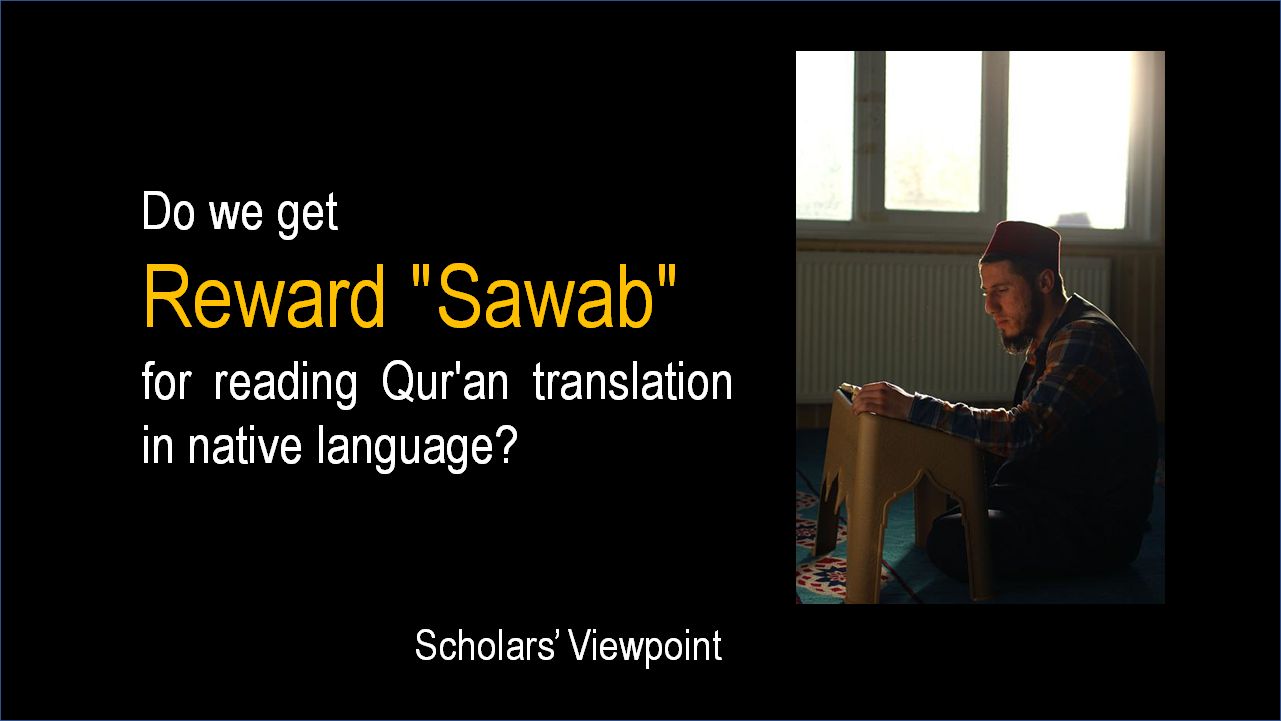
Do we get reward "Sawab" for reading Qur'an translation in native language?

Qur'an, the last of the Holy Scriptures revealed on to the last of the prophets Muhammad ﷺ, is in the Arabic language as all other scriptures are in languages of the people upon whom those were revealed.  Although Qur'an has been translated into almost all major spoken languages of the world, a doubt often exists in the minds of Muslims whose mother tongue is not Arabic that whether they will get reward "Sawab" in reading the translation in their native language or not.

This question has been very frequently asked from many a scholars and exegetes of Qur'an and all of them have been giving out their view point. Generally, it is believed by majority of the scholars that if a person who reads the Qur'an correctly, he has the reward of reading the Qur'an even if he reads it from a non-Arabic transcription.

But is reading Qur'an only for obtaining reward? Aren't we neglecting the badic purpose fot which Qur'an was revealed? Please listen to the view point of one of the eminent Muslim scholars of the present times, Javed Ahmed Ghamidi who answers the question in explicit words to clear many a doubt that exist in the minds of the non-Arabic speaking Muslims. We could give out the gist of the video, but it will be much better to listen to the scholar himself. The video is in Urdu, but has English subtitles for those who cannot understand Urdu:

Note: Please turn on the captions by clicking the wheel shaped icon if automatically English translation is not activated
Professor Javed Ahmad Ghamidi, a Pakistani Muslim theologian, Quran scholar, Islamic modernist, exegete and educationist, on the subject. 

Reading the Qur'ān should be a daily obligation of a Muslim - Reading it with translation will make it meaningful. But reading its Exegesis / Tafsir will make you understand it fully. It will also help the Muslims to have grasp over social issues and their answers discussed in the Qur'an and other matter related to inter faith so  that they are able to discuss issues with non-Muslims with authority based on refences from Qur'an.

May Allāh (سبحانه و تعالى‎) help us understand Qur'ān and help us to act upon the commandments of Allah contained therein. May Allah help us to be like the ones He loves and let our lives be lived helping others and not making others' lives miserable or unlivable. May all our wrong doings, whether intentional or unintentional, be forgiven before the angel of death knocks on our door. 

May Allah forgive me if my posts ever imply a piety far greater than I possess. I am most in need of guidance.

Disclaimer: The views expressed in the video above are those of the scholar concerned. We have shared this view as added information in better understanding of Islam. The reader may or may not agree with the view owing to their own perception. If anyone differs with the material contained in this post, one may consult the references and their authors.  If someone has more material about the subject, he/she is most welcome to share in the comments box to make the post all encompassing.

Photo | 
For more Scholarly views and videos, please read our reference page: Scholars' Viewpoint on Important Issues Related to Islam.

You may also refer to our Reference Pages for knowing more about Islam and Quran.
If you like Islam: My Ultimate Decision, and to keep yourself updated on all our latest posts to know more about Islam, follow us on Facebook

Please share this page to your friends and family members through Facebook, Twitter, WhatsApp or any means on social media so that they can also be benefited by it and better understand Islam and the Holy Qur'an - Insha Allah (Allah Willing) you shall be blessed with the best of both worlds.

Saturday, 16 July 2022

Say! Our duty is no more than to clearly convey the Message

Every Muslim and believer is entrusted with the scared task of conveying to others what he knows about Islam and calling them to join their faith. The same has been the mission of very messenger that Allah sent to the mankind in different timeframe and different localities. All invited the people of the time who were polytheists and idol worshippers to listen to what they have been told by their Creator and the Only One God and to convey to everyone in the listening range so that the message of God could reach them.

Unfortunately, many a people refused to listen to the messengers of God and ridiculed he messengers or they just looked like them and in most cases from noble yet poor families. Thus the rich and powerful just shrugged off and refused to listen to them. The same happened to Prophet Muhammad ﷺ when he tried to put across message of God to them. And as is always, the poor and the down trodden listened to their call and embraced the true faith and followed messengers of God.

But the rich and powerful as always refused to listen to the messengers and would sometimes put fingers in their ear lest some Divine words penetrate in their ears and make them accept the faith so professed. This was in addition to making the lives of prophets and messengers, who despite all odds continue to spread the Godly words. And when they refused to listen to them, the prophets a nd messengers were asked to tell them that  our duty is only to convey to you the message that Allah ha entrusted us with. Then it is for you to accept it or reject it. We have not been made responsible to make you accept it forcibly, And if you do not accept it, we shall not be seized in consequence of your disbelief, You will yourselves be answerable for your crimes.

The 17th verse of Surah 36. Ya Sin points towards in this direction:

وَمَا عَلَيۡنَاۤ اِلَّا الۡبَلٰغُ الۡمُبِيۡ
(36:17) and our duty is no more than to clearly convey the Message.”

Javed Ahmed Ghamidi notes that the implication of this verse is that after this the messengers will have done their duty. It is now their responsibility to accept or reject and they too shall have to bear the consequences.

Yusuf Ali explains the verse and says that the dusty and task of the messengers and prophets is not to force them but to convince them. It is to proclaim openly and clearly Allah's Law, which they were breaking,-to denounce their sins and to show them the better path. If they were obstinate, it was their own loss. If they were rebellious against Allah, the punishment rested with Allah.

Explanation Qur'an Wiki
Certain that they said nothing but the truth, and knowing the remit of the mission assigned to them, the messengers replied: “Our Lord knows that we have indeed been sent to you. Our only duty is to clearly deliver the message [entrusted to us].” (Verses 16- 17)

It is sufficient that God knows. The task assigned to God’s messengers is to deliver their message, and they did just that. People are then free to choose what they wish for themselves, and what burden their choices represent. Once the messengers have delivered their message, the matter is left to God to determine.

To my reckoning, the above said verse has summarized the entire six versed Surah. 109. Al Kafirun (The Disbelievers) in which the Prophet Muhammad ﷺ after having been dejected and disheartened from the negative attitude of the elite of the Makkan tribes, was finally asked to tell them that: 

لَـكُمۡ دِيۡنُكُمۡ وَلِىَ دِيۡنِ
(109:6) To you is your religion, and to me, my religion

The above quoted verses are of special significance to those Muslims who have taken upon the the task of Da'wah (inviting non Muslims to Islam) to only confine themselves to conveying the message of God and convince them with logic and reasoning as provided in the Qur'an and Sunnah of the Prophet Muhammad ﷺ  and no more. No one is to be coerced or forced into Islam. Instead, when all reasonings and logic fail to strike at their heart, they must leave by saying our duty is no more than to clearly convey the Message or To you is your religion, and to me, my religion.
May Allāh (سبحانه و تعالى‎) help us understand Qur'ān and follow the Sunnah of Prophet Muhammad ﷺ, which is embodiment of commandments of Allah contained in the Qur'ān. May Allah help us to be like the ones He loves and let our lives be lived helping others and not making others life miserable or unlivable. May all our wrong doings, whether intentional or unintentional, be forgiven before the angel of death knocks on our door. 
May Allah forgive me if my posts ever imply a piety far greater than I possess. I am most in need of guidance.

Note: When we mention God in our posts, we mean One True God, we call Allah in Islam, with no associates. Allah is the Sole Creator of all things, and that Allah is all-powerful and all-knowing. Allah has no offspring, no race, no gender, no body, and is unaffected by the characteristics of human life.

Reading the Qur'ān should be a daily obligation of a Muslim - Reading it with translation will make it meaningful. But reading its Exegesis / Tafsir will make you understand it fully. It will also help the Muslims to have grasp over social issues and their answers discussed in the Qur'an and other matter related to inter faith so  that they are able to discuss issues with Non Muslims with authority based on refences from Qur'an.

Photo | references: | 1 | 2 | 3 | 4 |

For more Q&A about Understanding Islam, please refer to our reference page: Understanding Islam - Frequently asked Q&A

If you like Islam: My Ultimate Decision, and to keep yourself updated on all our latest posts to know more about Islam, follow us on Facebook

Please share this page to your friends and family members through Facebook, WhatsApp or any means on Social Media so that they can also be benefited by it and better understand Islam and the Holy Qur'an - Insha Allah (Allah Willing) you shall be blessed with the best of both worlds.

Thursday, 14 July 2022

Islam in Uruguay

Uruguay is a country in South America and Montevideo is the largest city of the country and also its capital. As per 2019 estimate, it has a population of 3,518,552,mainly Christian dominant. Of this Muslims are a very tiny fraction, 0.02% or merely 1,000.  A significant Muslim population lives in Chuy, near the Brazilian border, as well as Rivera, Artigas and Montevideo.

There are three Islamic centers in Montevideo:
  • 1) Musallah Al Haazimi
  • 2) Egyptian Cultural Islamic Center
  • 3) Islamic Center Uruguay

Not very much information is available about life of Muslims living in Uruguay, may be because of its small number. I will appreciate if Muslims living in Uruguay add more information by entering their input in the comment column given at the end of the post.


Uruguay has no official religion; church and state are officially separated, and religious freedom is guaranteed. Due to secular nature of the Uruguay's constitution, Muslims are free to proselytize and build places of worship in the country. The Egyptian embassy in Monteviedeo provides a room for Friday prayers.
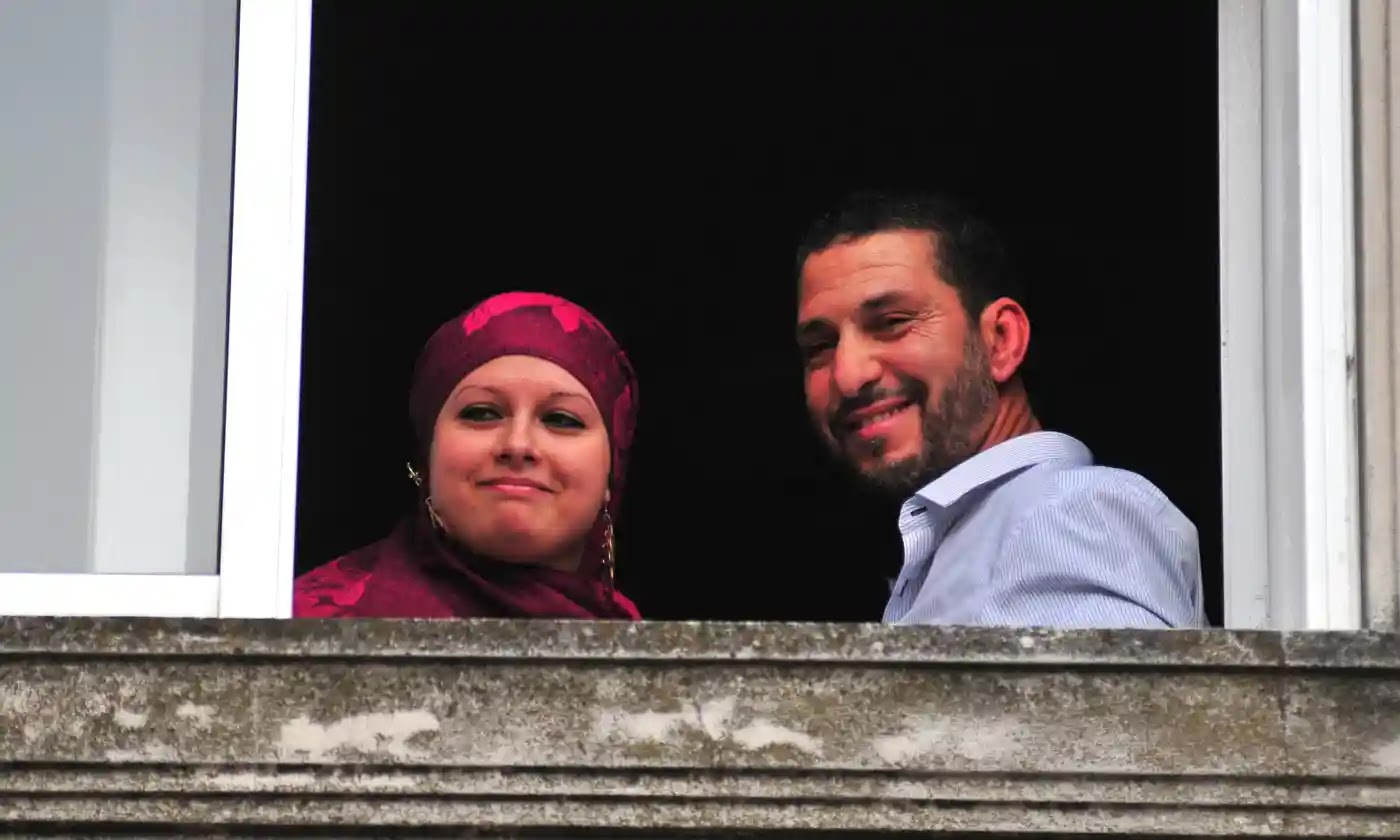
A news appeared some seven years ago that dAdel bin Muhammad El Ouerghi, a 50-year-old Tunisian, married Roma Blanco, a 24-year-old Uruguayan (photo above). The news was siginificant becasue the Tnisian was a former Guantanamo Bay detainee. He was married to Roma Blanco, a 24-year-old Uruguayan who converted to Islam. The union was the first of two weddings being organized by men resettled in the South American country. She said she converted to Islam four months ago and planned to take the name Samira. She and El Ouerghi met a month ago at a mosque. Blanco wore a light purple scarf and a violet jacket with gold-colored lacing. She also had henna designs on her hands, customary for Muslim women for the marriage ceremony.

Please watch a documentary on Islam in Uruguay:
Disclaimer: The data for this post has been collected from the references as given below. If any one differs with the material contained in this post, one may consult the references and their authors.  If someone has more material about the subject, he/she is most welcome to share in the comments box to make the post all encompassing.

To know more about life of Muslims in other non Muslim countries, please visit our page: Islam and Life of Muslims in Non Muslim Countries

You may also refer to our Reference Pages for knowing more about Islam and Quran.
Photo  | References: | 1 | 2 | 3 | 4 | 5 | 6 | 7 | 8 |
If you like Islam: My Ultimate Decision, and to keep yourself updated on all our latest posts to know more about Islam, follow us on Facebook

Please share this page to your friends and family members through Facebook, Twitter, WhatsApp or any means on Social Media so that they can also be benefited by it and better understand Islam and the Holy Qur'an - Insha Allah (Allah Willing) you shall be blessed with the best of both worlds.

Twitter Delicious Facebook Digg Stumbleupon Favorites More