Man has always been the focus of the evil and is so fragile that more often than not, he succumbs to the temptations of the evil. But when the act of evil is over, one is left morose and extremely lamenting at one's fouling. For such believers, Allah has never closed His doors of forgiveness, provided the sinner or the wrongdoers sincerely repent their action and seek Divine forgiveness.
We share a hadith attributed to Prophet Muhammad ﷺ today in which a meaningful invocation is mentioned to move Allah's countless blessings and seeking forgiveness. This Hadith is mentioned in Ṣaḥīḥ al-Bukhārī (Book 10 - Call to Prayers (Adhaan) كتاب الأذان / Chapter (149): Invocation before the Taslim باب الدُّعَاءِ قَبْلَ السَّلاَمِ) as Hadith 834, given herein under:
حَدَّثَنَا قُتَيْبَةُ بْنُ سَعِيدٍ، قَالَ حَدَّثَنَا اللَّيْثُ، عَنْ يَزِيدَ بْنِ أَبِي حَبِيبٍ، عَنْ أَبِي الْخَيْرِ، عَنْ عَبْدِ اللَّهِ بْنِ عَمْرٍو، عَنْ أَبِي بَكْرٍ الصِّدِّيقِ ـ رضى الله عنه ـ. أَنَّهُ قَالَ لِرَسُولِ اللَّهِ صلى الله عليه وسلم عَلِّمْنِي دُعَاءً أَدْعُو بِهِ فِي صَلاَتِي. قَالَ " قُلِ اللَّهُمَّ إِنِّي ظَلَمْتُ نَفْسِي ظُلْمًا كَثِيرًا وَلاَ يَغْفِرُ الذُّنُوبَ إِلاَّ أَنْتَ، فَاغْفِرْ لِي مَغْفِرَةً مِنْ عِنْدِكَ، وَارْحَمْنِي إِنَّكَ أَنْتَ الْغَفُورُ الرَّحِيمُ ".
Narrated by Abu Bakr As-Siddiq:
I asked Allah's Messenger (ﷺ) to teach me an invocation so that I may invoke Allah with it in my prayer. He told me to say, "Allahumma inni zalumtu nafsi zulman kathiran, Wala yaghfiru dh-dhunuba illa anta, fa ghfir li maghfiratan min `indika, wa r-hamni, innaka anta l-ghafuru r-rahim (O Allah! I have done great injustice to myself and none except You forgives sins, so bestow on me a forgiveness from You, and Have Mercy on me, You are the Forgiver, the Merciful).
Meaning of the supplication:
Acknowledgment of Sin and Injustice: "O Allah! I have done great injustice to myself": This part of the supplication shows humility and self-awareness, acknowledging that the individual has wronged themselves through their actions and sins. In Islam, sinning is seen as an injustice to oneself because it harms one's spiritual state and distances one from Allah.
Recognition of Allah’s Exclusive Ability to Forgive: "and none except You forgives sins": This emphasizes the belief that only Allah has the power to forgive sins. It reflects Tawheed (the oneness of Allah) and the understanding that ultimate forgiveness and mercy come solely from Him.
Plea for Forgiveness: "so bestow on me a forgiveness from You": The supplicant asks Allah for His divine forgiveness, recognizing their need for His mercy to cleanse their soul and rectify their wrongdoings.
Request for Mercy: "and have mercy on me": Along with forgiveness, the supplicant seeks Allah's mercy, which encompasses compassion, protection, and relief from the consequences of sins.
Attributes of Allah: "You are the Forgiver, the Merciful": This acknowledges two of Allah’s names and attributes: Al-Ghafur (the Forgiver) and Ar-Rahim (the Merciful). By invoking these names, the supplicant appeals to Allah’s infinite capacity to forgive and show mercy. Please click on the highlighted text to know the meaning of these attributes. (Al-Ghafur (الغفور) / Ar Rahim(الرحيم) )
Significance in Islamic Practice
Act of Repentance: This supplication is a form of Tawbah (repentance), where a believer turns to Allah, seeking forgiveness for their sins with sincere regret and a resolve not to return to those sins.
Spiritual Cleansing: Regularly reciting such supplications helps in spiritual cleansing and maintaining a close and humble relationship with Allah.
Reliance on Allah: It teaches reliance on Allah’s mercy and forgiveness, reinforcing the belief that no matter how great the sin, Allah’s mercy is greater.
This supplication is a beautiful and comprehensive prayer of repentance that captures the essence of seeking Allah’s forgiveness and mercy. It is an acknowledgment of one’s shortcomings and an appeal to Allah’s unparalleled capacity to forgive and show mercy. Regularly reciting such supplications can help believers maintain humility, seek continuous spiritual growth, and foster a deeper connection with Allah.
Let us first of all try our best not to fall prey to evil, for temptations to sin are always very lucrative. But if God forbids one does fall under the evil influence, one must immediately repent and seek Allah's forgiveness. Rest assured Allah is oft forgiving and extremely merciful.
May Allāh (سبحانه و تعالى) help us understand Qur'ān and follow the Sunnah of Prophet Muhammad ﷺ, which is embodiment of commandments of Allah contained in the Qur'ān. May Allah help us to be like the ones He loves and let our lives be lived helping others and not making others' lives miserable or unlivable. May all our wrong doings, whether intentional or unintentional, be forgiven before the angel of death knocks on our door.
وَمَا عَلَيۡنَاۤ اِلَّا الۡبَلٰغُ الۡمُبِيۡنُ
(36:17) and our duty is no more than to clearly convey the Message.”
That is Our duty is only to convey to you the message that Allah has entrusted us with. Then it is for you to accept it or reject it. We have not been made responsible for making you accept it forcibly, and if you do not accept it, we shall not be seized in consequence of your disbelief, you will yourselves be answerable for your actions on Day of Resurrection.
May Allah forgive me if my posts ever imply a piety far greater than I possess. I am most in need of guidance.
Reading the Qur'ān should be a daily obligation of a Muslim - Reading it with translation will make it meaningful. But reading its Exegesis / Tafsir will make you understand it fully. It will also help the Muslims to have grasp over social issues and their answers discussed in the Qur'an and other matter related to inter faith so that they are able to discuss issues with non-Muslims with authority based on refences from Qur'an.
Note: When we mention God in our posts, we mean One True God, we call Allah in Islam, with no associates. Allah is the Sole Creator of all things, and that Allah is all-powerful and all-knowing. Allah has no offspring, no race, no gender, no body, and is unaffected by the characteristics of human life.
Disclaimer: The material for this post has been collected from the references as given below. If anyone differs with the material contained in this post, one may consult the references and their authors. If someone has more material about the subject, he/she is most welcome to share in the comments box to make the post all encompassing.
Please share this page to your friends and family members through Facebook, WhatsApp or any means on Social Media so that they can also be benefited by it and better understand Islam and the Qur'ān - Insha Allah (Allah Willing) you shall be blessed with the best of both worlds.
Believers all over the world should consider themselves luck and blessed that they have found the month of Ramadan once again in their lives. It is the sacred month when the doors of paradise are opened and that of hell closed. So, whoever makes every endeavour to please Allah by his act of worship and good deeds will have enormous rewards. However, Prophet Muhammad ﷺ gave good tidings to those believers who spend their nights in offering voluntary prayers at night during this month.
This Hadith is mentioned in Ṣaḥīḥ al-Bukhārī (Book 31 - Praying at Night in Ramadaan (Taraweeh) كتاب صلاة التراويح / Chapter (1): The superiority of Nawafil at night in Ramadan باب فَضْلِ مَنْ قَامَ رَمَضَانَ) as Hadith 2008, given herein under:
حَدَّثَنَا يَحْيَى بْنُ بُكَيْرٍ، حَدَّثَنَا اللَّيْثُ، عَنْ عُقَيْلٍ، عَنِ ابْنِ شِهَابٍ، قَالَ أَخْبَرَنِي أَبُو سَلَمَةَ، أَنَّ أَبَا هُرَيْرَةَ ـ رضى الله عنه ـ قَالَ سَمِعْتُ رَسُولَ اللَّهِ صلى الله عليه وسلم يَقُولُ لِرَمَضَانَ " مَنْ قَامَهُ إِيمَانًا وَاحْتِسَابًا غُفِرَ لَهُ مَا تَقَدَّمَ مِنْ ذَنْبِهِ "
Narrated by Abu Huraira:
I heard Allah's Messenger (ﷺ) saying regarding Ramadan, "Whoever prayed at night in it (the month of Ramadan) out of sincere Faith and hoping for a reward from Allah, then all his previous sins will be forgiven."
After offering one's Traveeh prayers, one is left with just a few hours to rest before one awakens for the Suhoor, the early meal which is one of the pre-requisites for keeping the fast, for after the call for the pre-dawn prayers, one cannot eat or drink till the call of the evening prayer / the Maghrib. And if one still sacrifices his rest time and keeps himself on the praying mat to please Allah, he is promised immense reward for this sacrifice of his. It is matter of just 30 days and if one can make best use of his night by voluntary prayers, he is sure to be rewarded to an extent that he can never imagine and as promised "all his previous sins will be forgiven,"
May Allāh (سبحانه و تعالى) help us understand Qur'ān and follow the Sunnah / Hadith of Prophet Muhammad ﷺ, which is embodiment of commandments of Allah contained in the Qur'ān. May Allah help us to be like the ones He loves and let our lives be lived helping others and not making others' lives miserable or unlivable. May all our wrong doings, whether intentional or unintentional, be forgiven before the angel of death knocks on our door.
وَمَا عَلَيۡنَاۤ اِلَّا الۡبَلٰغُ الۡمُبِيۡنُ
(36:17) and our duty is no more than to clearly convey the Message.”
That is Our duty is only to convey to you the message that Allah has entrusted us with. Then it is for you to accept it or reject it. We have not been made responsible for making you accept it forcibly, and if you do not accept it, we shall not be seized in consequence of your disbelief, you will yourselves be answerable for your actions on Day of Resurrection.
May Allah forgive me if my posts ever imply a piety far greater than I possess. I am most in need of guidance.
Reading the Qur'ān should be a daily obligation of a Muslim - Reading it with translation will make it meaningful. But reading its Exegesis / Tafsir will make you understand it fully. It will also help the Muslims to have grasp over social issues and their answers discussed in the Qur'an and other matter related to inter faith so that they are able to discuss issues with non-Muslims with authority based on refences from Qur'an.
Note: When we mention God in our posts, we mean One True God, we call Allah in Islam, with no associates. Allah is the Sole Creator of all things, and that Allah is all-powerful and all-knowing. Allah has no offspring, no race, no gender, no body, and is unaffected by the characteristics of human life.
Disclaimer: The material for this post has been collected from the references as given below. If anyone differs with the material contained in this post, one may consult the references and their authors. If someone has more material about the subject, he/she is most welcome to share in the comments box to make the post all encompassing.
Please share this page to your friends and family members through Facebook, WhatsApp or any means on Social Media so that they can also be benefited by it and better understand Islam and the Qur'ān - Insha Allah (Allah Willing) you shall be blessed with the best of both worlds.
When prophets are confronted with people who do not listen to what Allah has ordained for them, they are ordained to tell them that whether they listen to them or not, it does not matter much for one day truth shall prevail. They are thus told to tell that Allah is sufficient for them, for it is the pleasure and guidance of Allah which is they seek for them and for those who believe in Allah.
The last verse (129th) of Surah 9. At Tauba (Repentance) is one such commandment from Allah for Prophet of Allah, Muhammad ﷺ, which tells the revered prophet to disregard the indifferent attitude of those who turn away from listening to him and tell them that even if they close their ears to what he says, Allah alone is sufficient for him and those who believe. It should be borne in mind that it is not the Prophet of Allah telling those who do not listen to him, but in fact these is a Divine Commandment which tells the Prophet Muhammad ﷺ that he is the messenger, and whoever turned away from this message has nothing to do with Allah and his messenger ﷺ.
This verse has thus become a sort of supplication for the believers to recite when they encounter difficulties, especially when extending invitation of Islam to the non-Muslims:
[9:129] Yet, if they should turn away, then tell them: "Allah is sufficient for me; there is no god but He. In Him I have put my trust. He is the Lord of the Mighty Throne."
Tafsir Ibn-Kathir:
(فَإِن تَوَلَّوْاْ but if they turn away), from the glorious, pure, perfect and encompassing Law that you -- O Muhammad -- brought them, (then say: فَقُلْ حَسْبِىَ اللَّهُ لا إِلَـهَ إِلاَّ هُوَ "Allah is sufficient for me. There is no God but He,) Allah is sufficient for me, there is no deity worthy of worship except Him, and in Him I put my trust.
Similarly, Allah said, (رَّبُّ الْمَشْرِقِ وَالْمَغْرِبِ لاَ إِلَـهَ إِلاَّ هُوَ فَاتَّخِذْهُ وَكِيلاً (He alone is) the Lord of the east and the west; there is no God but He. So, take Him alone as a guardian.) [73:9].
Allah said next, (Verily, there has come unto you a Messenger from among yourselves ...) [9:128]'' until the end of the Surah It is recorded in the Sahih that Zayd bin Thabit said, "I found the last Ayah in Surah Bara'ah with Khuzaymah bin Thabit.'' This is the end of Surah Bara'ah, all praise is due to Allah.
(وَهُوَ رَبُّ الْعَرْشِ الْعَظِيمِ and He is the Lord of the Mighty Throne) [9:129]. He is the King and Creator of all things, and He is the Lord of the Mighty Throne (`Arsh), which is above all creation; all that is in and between the heavens and earths is under the Throne (`Arsh) and subservient to Allah's power. His knowledge encompasses all things, and His decision will certainly come to pass over all matters. He is the guardian of all things.
Imam Ahmad recorded that Ibn `Abbas said that Ubayy bin Ka`b said, "The last Ayah revealed from the Qur'an was this Ayah, ( لَقَدْ جَاءكُمْ رَسُولٌ مِّنْ أَنفُسِكُمْ Verily, there has come unto you a Messenger from among yourselves. . . ) until the end of the Surah It is recorded in the Sahih that Zayd bin Thabit said, "I found the last Ayah in Surah Bara'ah with Khuzaymah bin Thabit . 'This is the end of Surah Bara'ah, all praise is due to Allah.
Yusuf Ali Explanation:
But if the Message is rejected, he still proclaims the burning Faith of his heart, which is unquenchable. Allah is sufficient to all. To trust Him is to find the accomplishment of all spiritual desires. His grandeur is figured by a lofty Throne, supreme in glory! Thus, have we been led, through a notable incident in Al-Mustafa's earthly career, to truths of the highest spiritual import.
Javed Ahmad Ghamidi Explanation:
Ie., if they are not being able to understand the Prophet’s earnest message that the favours of this world and the next which are hidden in his call to waging jihād for the cause of God at His behest, then he should not be concerned about them. He should clearly tell them that these are not his needs and that God is self-sufficient.
Tafsir Qur'an Wiki:
The Sūrah addresses the Prophet, showing him what attitude to take when people turn away from him and his message. It points to the source of power which gives him all the protection he needs. To Him belong all power, dominion, greatness and honour. His support is sufficient for everyone who seeks His patronage.
The Sūrah which concentrates mainly on fighting and striving for God’s cause is thus concluded with the directive to rely on God alone, trust Him and seek His powerful support. After all, “He is the Lord of the Mighty Throne.”
This Sūrah outlines the final rulings on the permanent relations between the Muslim community and the outside world, as explained in our commentary on its various passages. Hence, we have to refer to its latest statements since these represent the final say on these relations. These statements must not be restricted or narrowed down in their applicability on the basis of earlier statements and rulings, which we described as provisional. In doing so, we have relied on the chronological order of the revelation of these verses and statements, and on the progress of the Islamic movement at the time of the Prophet, as well as the events marking that progress.
We have also been guided by our understanding of the nature of the Islamic message and its method of action which we have explained in our presentation of the sūrah and our commentary on its verses. This method of action is only understood by those who deal with this faith of Islam as a movement striving to establish itself in human life. As we have explained, the goal of that striving is to liberate mankind from submission to others so that they submit to God alone.
There is a wide gap between an understanding based on active striving and one based on academic study which is bound to ignore action. The first type of understanding looks at Islam as it conducts its direct confrontation with the system of jāhiliyyah, taking one step after another and moving from one stage to the next. It also looks at it as it proclaims its legislation to deal with the changing situation in its confrontation.
Moreover, these final laws and verdicts outlined in this last sūrah were actually revealed when the general situation of the Muslim community and the world around it required such legislation. Prior to that, when the situation required different rulings, these were given in earlier sūrahs to serve as provisional rulings.
When a new Muslim community emerges again and starts to strive for the establishment of this faith in human life, it may be appropriate for this community to apply the provisional rulings, provided that it remains well aware that these are only provisional. It should also be aware that it must strive to reach the stage when only the final rulings govern its relations with the world around it. God will certainly help that community and guide it on its way.
Herein under, please listen to eminent Muslim scholar Nouman Ali Khan explaining the 129th verse of Surah 9 Al Tauba:
May Allāh (سبحانه و تعالى) help us understand Qur'ān and follow the Sunnah of Prophet Muhammad ﷺ, which is embodiment of commandments of Allah contained in the Qur'ān. May Allah help us to be like the ones He loves and let our lives be lived helping others and not making others' lives miserable or unlivable. May all our wrong doings, whether intentional or unintentional, be forgiven before the angel of death knocks on our door.
وَمَا عَلَيۡنَاۤ اِلَّا الۡبَلٰغُ الۡمُبِيۡنُ
(36:17) and our duty is no more than to clearly convey the Message.”
That is Our duty is only to convey to you the message that Allah has entrusted us with. Then it is for you to accept it or reject it. We have not been made responsible for making you accept it forcibly, and if you do not accept it, we shall not be seized in consequence of your disbelief, you will yourselves be answerable for your actions on Day of Resurrection.
Reading the Qur'ān should be a daily obligation of a Muslim - Reading it with translation will make it meaningful. But reading its Exegesis / Tafsir will make you understand it fully. It will also help the Muslims to have grasp over social issues and their answers discussed in the Qur'an and other matter related to inter faith so that they are able to discuss issues with non-Muslims with authority based on refences from Qur'an.
May Allah forgive me if my posts ever imply a piety far greater than I possess. I am most in need of guidance.
Note: When we mention God in our posts, we mean One True God, we call Allah in Islam, with no associates. Allah is the Sole Creator of all things, and that Allah is all-powerful and all-knowing. Allah has no offspring, no race, no gender, no body, and is unaffected by the characteristics of human life.
An effort has been made to gather explanation / exegesis of the surahs of the Qur'ān from authentic sources and then present a least possible condensed explanation of the surah. In that the exegesis of the chapters of the Quran is mainly based on the "Tafhim al-Qur'an - The Meaning of the Qur'an" by one of the most enlightened scholars of the Muslim World Sayyid Abul Ala Maududi.
In order to augment and add more explanation as already provided, additional input has been interjected from following sources:
Towards Understanding the Quran
Tafsir Ibn Khatir
Muhammad Asad Translation
Javed Ahmad Ghamidi / Al Mawrid
Al-Quran, Yusuf Ali Translation
Verse by Verse Qur'an Study Circle
In addition, references of other sources which have been explored have also been given below. Those desirous of detailed explanations and tafsir (exegesis), may refer to these sites.
Please share this page to your friends and family members through Facebook, WhatsApp or any means on social media so that they can also be benefited by it and better understand Islam and the Qur'ān - Insha Allah (Allah Willing) you shall be blessed with the best of both worlds.
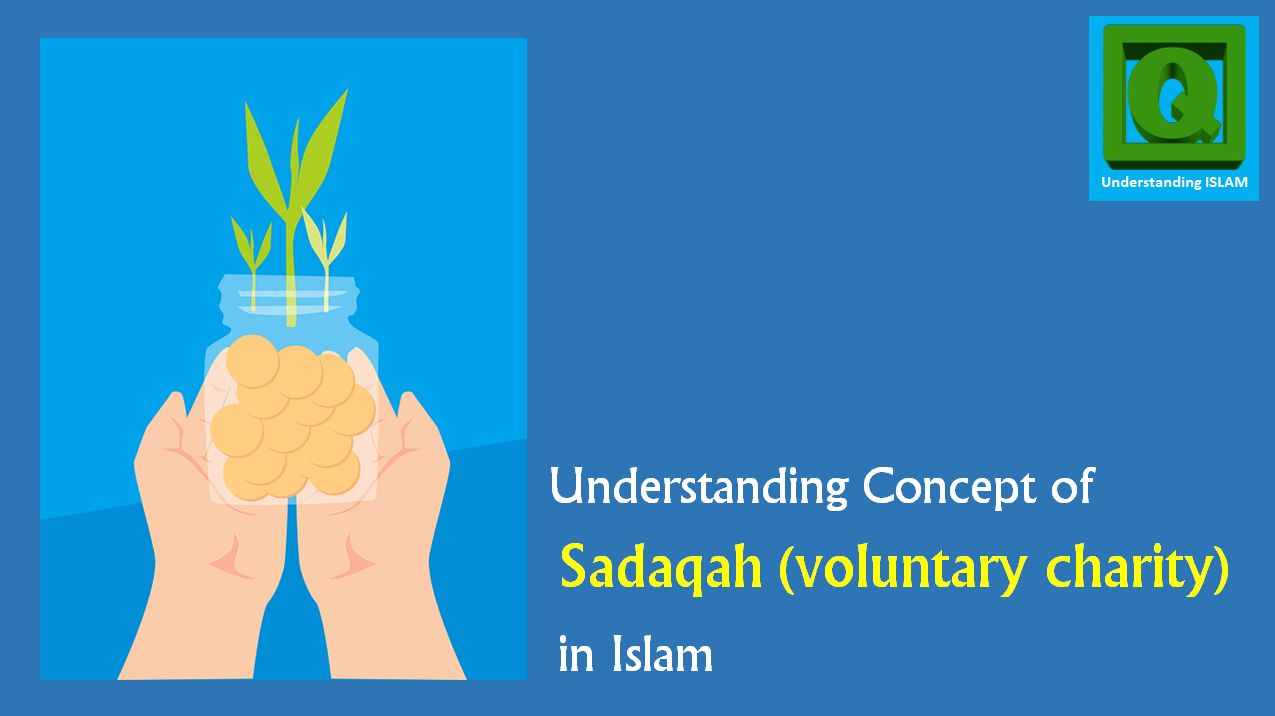
No two men are born equal in status and number of blessings including wealth. In fact, the balance tilts heavily on the part of the Have NOTs and while the rich and wealthy are in comparatively smaller i number as compared to the poor and the needy. The giving alms and charity is generally given out by the philanthropists and people with a God earing heart, Islam lays much emphasis on dolling out part of the wealth both as obligation (Zakat) and charity (Sadaqah) to help the needy and to strike a somewhat balance in an Islamic society.
We have already written many posts on Zakat and Sadaqah previously, today's post is restricted only to Sadaqah and its various forms, which otherwise is misunderstood to be restricted to monetary assistance or help only. Generally speaking, Sadaqah (Arabic: صدقة ] (plural ṣadaqāt صدقات) - (plural ṣadaqāt صدقات) can be translated as "voluntary charity or benevolence". But it is not restricted to monetary assistance only. As against Zakat (obligatory charity) which has a minimum fixed amoun to be paid on one's wealth held in one's possession over a period of one year, there are no upper and lower limits as far as Sadaqah is concerned. Thus, unlike Zakat, which is collected by the muhtasib (collector) or the government, Sadaqah is the discretion of an individual, who is free to give it to whom he considers most appropriate for it.
Understanding literally, the term 'Sadaqah' stems from the Arabic root word ‘sidq’ (s-d-q) ص د ق, which means sincerity and it is considered as a sign of sincere faith. The three-letter root of this word, S-D-Q, also means, "to speak the truth," "to be sincere," and "to fulfill one's promise." All of these aspects of honorable behavior indicate the links between generosity and a healthy society. [1]
Sadaqah thus leads to the purification of the benefactor. Allah says in Qur'an (Surat 63. Al-Munāfiqūn, verse 10): And spend [in the way of Allah from what We have provided you before death approaches one of you and he says, "My Lord, if only You would delay me for a brief term so I would give charity and be among the righteous."
Prophet Muhammad ﷺ too has highlighted the need of giving Sadaqah as been quoted in number of Hadiths:
"Save yourself from Hell-fire even by giving half a date-fruit in charity." (Sahi Bokhari: 1417)
Prophet Muhammad ﷺ also said “Sadaqah extinguishes sin as water extinguishes fire” (Hadith, Tirmidhi). He also said that Allah offers relief on the Day of Judgement for those who give sadaqa: “The believer's shade on the Day of Resurrection will be their charity” (Hadith, Tirmidhi).
The above quoted Hadiths clearly shows the importance of Sadaqah as by giving out even half a date in charity, one can save himself from the fire and chastisement of hell.
There are no specific days or times to give Sadaqat as being a voluntary act, one could give Sadaqah as and when someone is seen in distress. However, it has been narraed by Ka'b (may Allah be pleased with him) that the Prophet ﷺ said, “Giving Sadaqah on Friday is better than giving it on any other day of the week”.
Etiquette of giving Sadaqah: Since Sadaqah is purely a voluntary act and undertaken at individual level, following must be borne in mind so that the sole purpose of Sadaqah should only be to please Allah and no one else and be not be act of show off.
Sadaqah should be from one's legitimate possessions and property.
According to Qur'an 2:274 [Those who spend their wealth in charity day and night, secretly and openly—their reward is with their Lord, and there will be no fear for them, nor will they grieve.] It is better to offer Sadaqah in secret. Although it is better to give Sadaqah in private, it should only be given openly not to project one's benevolence but to encourage others to follow suit and help the needy.
Sadaqah should not be accompanied by reproaching the person who is given the Sadaqah. It is often seen men posing with the receiver and then displaying photos of acct of charity as a show off.
Sadaqah should be out of pure intentions for God.
Sadaqah should be from possessions you love: This is very important. give out a part form something you love the most. Sadaqah should not be from the throw aways or the not needed stuff.
Forms of Sadaqah: While giving out charity in cash is one of the major forms of Sadaqah, but should that mean that anyone who is already resource starved and in need of Sadaqah himself cannot give Sadaqah? This is the beauty of Islam that it provides umpteen opportunities to everyone to please Allah in number of forms even if one is empty pocketed, but not empty hearted. Herein under are some of the forms that fall under the category of Sadaqah besides alms and charity in cash:
If one sees one of his brethren in distress or comes across someone from whom one receives charity and has nothing to give in return, he should make a Dua/supplication for him. Praying for someone's benefit is one of the most liked actions of a believer by Allah. So let not any opportunity be slip by to please Allah by just thinking good of others and praying to ease out sufferings of someone. That is if we see people sick, or hit by natural calamities like floods and earthquakes, if we cannot help, we can pray for them.
Stopping the Evil: The world is not a level playing field for everyone. There are many hard to crack nuts that make the lives of others miserable and unlivable. Every believer must therefore try his best to stop the evil of the arrogant and wicked to save the weak and meek from their evil intentions and acts. If one cannot stop evil, at least he should in his heart condemn it. But that is the lowest level of faith.
One should be forthcoming in Easing the life of others. For example, if one comes across a hurdle or a blockage in a road or track that may obstruct one's free use of it, one should try to remove that obstruction.
One may be empty pocketed but may have knowledge, especially that of Qur'an and Hadith. Thus, one must spread whatever good knowledge one has to educate others, especially those who cannot afford formal schooling. Here it must be remembered that the knowledge so shared be with good intention and not to pollute someone's mind and thoughts like spreading porn material to disorient someone and put him on the evil path. The sharing of knowledge may be orally one to one or through speeches and lectures to larger audiences, through pen or audio/video lectures.
Helping someone who is in distress is one of the most noble casue and an act most liked by Allah. This may take form of solving problems of the poor by mobilizing our own resources as well as that of the community to ease others' sufferings. Or if one knows someone who help, request him to help the one in distress.
Noble Upbringing of one's children in an atmosphere as enunciated by Divine commandments in Qur'an and Hadiths of the Prophet of Allah.
Giving an appropriate Advice to someone in need of it is also a form of charity for just like removing an obstruction from the blocked way, a well-intended good advice may help someone to solve one's problem.
Greet everyone with a smile and positive framework of mind: Greeting others with a smile can have a very refreshing effect on others, especially when someone is down or in depression. Such a gesture may elevate one's spirits and bring him back to life. No matter how tired is one spouse after a hard day's work, when he/she enters the house, he/she must bear a wide smile for the waiting spouse and children - and so should the ones in the house so that both forget the hardships of the day and a healthy and happy evening befalls upon them.
Mutual respect is also a form of Sadaqah. No matter if one is less gifted or smaller in age, the others must be respected without any trace of arrogance or contempt.
Being part of others' happiness: Envy is one of the sins that can rob not only one's peace of mind when seeing others happy and contented, but can also break relations. Everyone has its share from Allah and no one can rob the others of what is destined for them. It is thus better to be part of the good times and happiness of others, while praying for good times for himself.
Forgive others much too often. If someone has harmed you, try not to strike back, but try to admonish in as soft and humble words as possible. Such attitudes can humble even the toughest of hearts and may melt them like wax of a candle.
Give time to your family and friends. We generally remain much too busy in our office commitments and other business activities. This robs us of time that we should have kept for our parents, wife and children and friends. Remember, time lost can never be made up. Our share of time for them brings happiness to our near and dear ones. Looking after one's family is advised in Qur'an and often stressed upon by the Prophet of Allah.
Patiance: Patiance is one the most difficult feats to accomplish, especially when one is hit with the hard times and misfortunes. But only those who have firm belief in Allah know that these are the testing times and something better is around the corner for Allah does not leave His believing servants in distress beyond their capacity to endure.
Please watch the video below which lists down 17 types of Sadaqat that cost nothing, but are much yielding both in blessing of Allah and rewards in the life of the Hereafter:
Let us not shy away from even very little acts of charity. Who knows even a smaller act on our part may become a matter of salvation on the Day of Resurrection and help us from the hellfire. But remember, whatever act or form of charity we undertake, it should be with the intention of pleasing Allah and no one else.
May Allāh (سبحانه و تعالى) help us understand Qur'ān and follow the Sunnah of Prophet Muhammad ﷺ, which is embodiment of commandments of Allah contained in the Qur'ān. May Allah help us to be like the ones He loves and let our lives be lived helping others and not making others' lives miserable or unlivable. May all our wrong doings, whether intentional or unintentional, be forgiven before the angel of death knocks on our door.
وَمَا عَلَيۡنَاۤ اِلَّا الۡبَلٰغُ الۡمُبِيۡنُ
(36:17) and our duty is no more than to clearly convey the Message.”
That is Our duty is only to convey to you the message that Allah has entrusted us with. Then it is for you to accept it or reject it. We have not been made responsible for making you accept it forcibly, and if you do not accept it, we shall not be seized in consequence of your disbelief, you will yourselves be answerable for your actions on Day of Resurrection.
May Allah forgive me if my posts ever imply a piety far greater than I possess. I am most in need of guidance.
Reading the Qur'ān should be a daily obligation of a Muslim - Reading it with translation will make it meaningful. But reading its Exegesis / Tafsir will make you understand it fully. It will also help the Muslims to have grasp over social issues and their answers discussed in the Qur'an and other matter related to inter faith so that they are able to discuss issues with non-Muslims with authority based on refences from Qur'an.
Note: When we mention God in our posts, we mean One True God, we call Allah in Islam, with no associates. Allah is the Sole Creator of all things, and that Allah is all-powerful and all-knowing. Allah has no offspring, no race, no gender, no body, and is unaffected by the characteristics of human life.
Please share this page to your friends and family members through Facebook, WhatsApp or any means on Social Media so that they can also be benefited by it and better understand Islam and the Holy Qur'an - Insha Allah (Allah Willing) you shall be blessed with the best of both worlds.
The long-awaited month of Ramdan - a month of fasting, is just a couple days from now. This is a special month in the lives of the believers in which Muslims willingly abstain from all otherwise Halal things for the sake of Allah.
We have already shared a lot of information about Fasting (Saum), the third pillar of Islam which can be read from our special reference page: Ramadan - A month of fasting and Blessings
Herein under, we are sharing four specific verses from Qur'an (Surah 2. Al Baqarah - The Cow) in which Allah has enjoined Fasting on Muslims, as was enjoined upon those who were before us. Which means that fasting has been enjoined on all those following the Divine religions. It is another thing that none of the followers of the other Divine religions observe fast as religiously as Muslims do. Even they have amended the rules of fasting and the abstain partially from eating and drinking during the day for their ease, and not to abstain totally to please their Lord as Muslims do.
(2:183) Believers! Fasting is enjoined upon you, as it was enjoined upon those before you, that you become God-fearing.
Islam proceeded step by step and by degrees in the imposition of its obligatory duties. The same was done in the case of Fast. At first the Holy Prophet (upon whom be peace) advised the Muslims to observe fasts only for three days in a month but this was not obligatory. Then in the second year of the Hijrah, this Command (v. 183) about fasting in the month of Ramadan was revealed. This, however, left an option for those who were able to fast but did not. They were required to feed one poor man as an expiation of one day's fast (v. 184). Then, later, the final commandment contained in the next verse (185) modified this, and the concession for able-bodied people was withdrawn, but retained for a sick person or wayfarer and by analogy for a pregnant or a suckling woman and for those old people who were not able to fast.
(2:184) Fasting is for a fixed number of days, and if one of you be sick, or if one of you be on a journey, you will fast the same number of other days later on. For those who are capable of fasting (but still do not fast) there is a redemption: feeding a needy man for each day missed. Whoever voluntarily does better than is required will find it better for him; and that you should fast is better for you, if you only know.
(2:185) During the month of Ramadan the Qur'an was sent down as a guidance to the people with Clear Signs of the true guidance and as the Criterion (between right and wrong). So those of you who live to see that month should fast it, and whoever is sick or on a journey should fast the same number of other days instead. Allah wants ease and not hardship for you so that you may complete the number of days required,186 magnify Allah for what He has guided you to, and give thanks to Him.
It has been left to the option of the individual to observe or not to observe fasts during a journey. Some of the Companions of the Holy Prophet observed fasts and some did not when they were on a journey with him and neither raised any objection against the other. The Holy Prophet himself sometimes observed fasts on a journey and sometimes did not. Once he saw people gathered round a man who had fallen to the ground and asked what was the matter with him. He was told that he had become too weak to stand on account of observing fasts; he remarked that it was no virtue to observe fasts in such a condition.
During war time, he used to issue orders for postponing the fasts. Hadrat 'Umar has related that they did not observe fasts twice during the month of Ramadan when they went to war under the command of the Holy Prophet: on the occasion of the battle of Badr and at the conquest of Makkah. Ibn 'Umar says that on the eve of the conquest of Makkah, the Holy Prophet declared, "As we are going to fight our enemy you should postpone your fasts so that you may conserve your strength to fight." 'There is no clear injunction from the Holy Prophet for the prescription of a minimum standard of distance for postponing the fasts. His Companions also differed in practice with regard to the standard. But it is obvious that the fast may be postponed for that distance which is commonly understood to be a journey and in which one begins to feel like one is on a journey.
There is a difference of opinion as to whether the people of a city, which is attacked by an enemy, can postpone the fast for the sake of Jihad, in spite of being the residents. Some scholars do not allow this. But Imam Ibn Taimiyyah has maintained with strong arguments that postponement of the fast under such circumstances is permissible.
Allah is so bountiful that He does not want to deprive His servants of the blessings of fasting. Therefore, He has not confined it to the month of Ramadan but has opened another way for its completion for those who fail to complete it during this month for genuine reasons. They should make up the deficiency by observing fast on other days in order to show their gratitude for the revelation of the Qur'an during the month of Ramadan.
It is clear from this verse that fasting in Ramadan has been prescribed not only as a form of worship and a training for piety, but also to show gratitude for the great blessing of the Revelation of the Qur'an during the month of Ramadan. And the best way to show gratitude for a favour is to fulfil the object for which it was bestowed and to prepare oneself for its completion as best as one can. The object for which Allah has bestowed the Qur'an upon us is to reveal His Will so that we may fulfil it ourselves and persuade others to do the same. Fasting provides the best training for the fulfilment of this object and is both a devotion and a sign of gratitude for the favour shown in the form of the Qur'an.
(2:187) It has been made lawful for you to go in to your wives during the night of the fast. They are your garment, and you are theirs. Allah knows that you used to betray yourselves and He mercifully relented and pardoned you. So, you may now associate intimately with your wives and benefit from the enjoyment Allah has made lawful for you, and eat and drink at night until you can discern the white streak of dawn against the blackness of the night; then (give up all that and) complete your fasting until night sets in.
There was also a misunderstanding about the timings of eating and drinking during Ramadan. Some people were of the opinion that eating and drinking was prohibited after the `Isha' (night) Prayer up to sunset of the next day. Others thought that one was permitted to eat and drink as long as one kept awake after the 'Isha' Prayer, but could not do so after one had fallen asleep; they were often put to great inconvenience on account of these notions of their own creation. In this verse their misunderstandings were removed and the duration of the period of fasting was fixed from the dawn of the morning to the sunset, and eating and drinking and intercourse with wives were permitted from sunset to dawn. Besides, the Holy Prophet instructed that a meal should be taken before dawn (of morning) as preparation for fasting.
Islam has set a standard of time for its practices which can be applied universally by people at every stage of civilization and in every part of the globe. That is why it does not fix the boundary lines of its religious practices by watches and clocks but by clear signs in the sky. This is a standard which can suit the people of every age and country, and can be set by watches between these prescribed bounds to suit their circumstances and convenience. But those people who do not understand its philosophy raise foolish objections. For example, they say that this standard cannot work near the Poles, because there the duration of the day and the night is of many months. They forget that even in the polar regions, the signs of morning and evening and midnight appear as regularly as in other places and the inhabitants regulate the tunings of work, play, sleep, etc. in accordance with the appearance of these signs. When there were no watches and clocks, the inhabitants of the Arctic Circle fixed their timings by these signs. Thus, when these signs can help them to fix the timings in other matters of life, they can also serve them to fix the timings of the Prayer and of the commencement and end of the Fast.
The aforesaid verses not only lay down the parameters of fasting, but also answer some of the queries that were raised when the Saum was made obligatory for the Muslims. May Allah help us to understand the simple and most practical religion of all - Islam and allow us to take advantage of the month of Ramadan and concessions given to us in fasting when traveling or being sick. Aameen.
We may now share an informative lecture by eminent Muslim scholar of present times, Nouman Ali Khan, who deliberates on the subject of How to have a right mindset in Ramadan:
May Allāh (سبحانه و تعالى) help us understand Qur'ān and follow the Sunnah of Prophet Muhammad ﷺ, which is embodiment of commandments of Allah contained in the Qur'ān. May Allah help us to be like the ones He loves and let our lives be lived helping others and not making others' lives miserable or unlivable. May all our wrong doings, whether intentional or unintentional, be forgiven before the angel of death knocks on our door.
وَمَا عَلَيۡنَاۤ اِلَّا الۡبَلٰغُ الۡمُبِيۡنُ
(36:17) and our duty is no more than to clearly convey the Message.”
That is Our duty is only to convey to you the message that Allah has entrusted us with. Then it is for you to accept it or reject it. We have not been made responsible for making you accept it forcibly, and if you do not accept it, we shall not be seized in consequence of your disbelief, you will yourselves be answerable for your actions on Day of Resurrection.
Reading the Qur'ān should be a daily obligation of a Muslim - Reading it with translation will make it meaningful. But reading its Exegesis / Tafsir will make you understand it fully. It will also help the Muslims to have grasp over social issues and their answers discussed in the Qur'an and other matter related to inter faith so that they are able to discuss issues with non-Muslims with authority based on refences from Qur'an.
May Allah forgive me if my posts ever imply a piety far greater than I possess. I am most in need of guidance.
Note: When we mention God in our posts, we mean One True God, we call Allah in Islam, with no associates. Allah is the Sole Creator of all things, and that Allah is all-powerful and all-knowing. Allah has no offspring, no race, no gender, no body, and is unaffected by the characteristics of human life.
May Allah show us the right path so that we do not go astray due to what man has interpreted verses of religious scriptures to suit their own religions and faith. Aameen.
Please share this page to your friends and family members through Facebook, WhatsApp or any means on social media so that they can also be benefited by it and better understand Islam and the Holy Qur'an - Insha Allah (Allah Willing) you shall be blessed with the best of both worlds.
Wealth has always dazzled man and he feels like amassing as much as he can. He then boastfully wears expensive clothes and lives a luxurious lifestyle, squandering his wealth which goes down the drain no sooner it is spent. But wise are those who spend their wealth which is not wasted away, rather it is stored as a reward for their lives in the hereafter. Do you know what wealth that is?
We share a hadith attributed to Prophet Muhammad ﷺ which tells about this wealth. This hadith is mentioned in Ṣaḥīḥ Muslim the Book (#55) of Zuhd and Softening of Hearts كتاب الزهد والرقائق ) as Hadith number # 2958a as under:
Mutarrif reported on the authority of his father: I came to Allah's Apostle (ﷺ) as he was reciting:" Abundance diverts you" (cii. 1). He said: The son of Adam claims: My wealth, my wealth. And he (the Holy Prophet) said: O son of Adam. Is there anything as your belonging except that which you consumed, which you utilized, or which you wore and then it was worn out or you gave as charity and sent it forward?
A similar hadith has been mentioned by Abu Huraira who reported Allah's Messenger ( صلی اللہ علیہ وسلم ) as saying: A servant says, My wealth. my wealth, but out of his wealth three things are only his: whatever he eats and makes use of or by means of which he dresses himself and it wears out or he gives as charity, and this is what he stored for himself (as a reward for the Hereafter), and what is beyond this (it is of no use to you) because you are to depart and leave it for other people.
As can be seen from the above quoted Hadith, it is part of the wealth of the man which he spends on charity which never gets wasted away and is in fact stored in his account as reward for his life in the Hereafter. So why not cash in the opportunity as long as we live to doll out an adequate part of our wealth in charity. This will not only earn us the prayers of those who are receiving our charity, but also a much-multiplied reward in the life of hereafter.
May Allāh (سبحانه و تعالى) help us understand Qur'ān and follow the Sunnah of Prophet Muhammad ﷺ, which is embodiment of commandments of Allah contained in the Qur'ān. May Allah help us to be like the ones He loves and let our lives be lived helping others and not making others' lives miserable or unlivable. May all our wrong doings, whether intentional or unintentional, be forgiven before the angel of death knocks on our door.
وَمَا عَلَيۡنَاۤ اِلَّا الۡبَلٰغُ الۡمُبِيۡنُ
(36:17) and our duty is no more than to clearly convey the Message.”
That is Our duty is only to convey to you the message that Allah has entrusted us with. Then it is for you to accept it or reject it. We have not been made responsible to make you accept it forcibly, And if you do not accept it, we shall not be seized in consequence of your disbelief, You will yourselves be answerable for your actions on Day of Resurrection.
May Allah forgive me if my posts ever imply a piety far greater than I possess. I am most in need of guidance.
Reading the Qur'ān should be a daily obligation of a Muslim - Reading it with translation will make it meaningful. But reading its Exegesis / Tafsir will make you understand it fully. It will also help the Muslims to have grasp over social issues and their answers discussed in the Qur'an and other matter related to inter faith so that they are able to discuss issues with non-Muslims with authority based on refences from Qur'an.
Note: When we mention God in our posts, we mean One True God, we call Allah in Islam, with no associates. Allah is the Sole Creator of all things, and that Allah is all-powerful and all-knowing. Allah has no offspring, no race, no gender, no body, and is unaffected by the characteristics of human life.
Disclaimer: The material for this post has been collected from the references as given below. If any one differs with the material contained in this post, one may consult the references and their authors. If someone has more material about the subject, he/she is most welcome to share in the comments box to make the post all encompassing.
Please share this page to your friends and family members through Facebook, WhatsApp or any means on Social Media so that they can also be benefited by it and better understand Islam and the Qur'ān - Insha Allah (Allah Willing) you shall be blessed with the best of both worlds.
The Bahamas, officially the Commonwealth of The Bahamas, is an island country within the Lucayan Archipelago of the West Indies in the North Atlantic. The archipelagic state consists of more than 3,000 islands, cays, and islets in the Atlantic Ocean, and is located north of Cuba and northwest of the island of Hispaniola (split between the Dominican Republic and Haiti) and the Turks and Caicos Islands, southeast of the U.S. state of Florida, and east of the Florida Keys. The capital is Nassau on the island of New Providence.
Bahamas is officially a predominately Christian country with a population of about 400,516 (2022 estimate). Of this, Muslims constitute a very marginal minority, something under 1,000. That is adherents of Islam represent even less than 1% of the population. The reason for this rather minuscule Muslim population is that Islam came to this part of the world until very recently. Although, Muslim presence in Bahamas can be noted during the Slave Period, but they could not establish a strong foothold on the Islands being literate and due to harshness and rigors of slavery.
The journey of Islam in the present times began somewhere in the 1960, a Bahamian named Bashan Saladin (formerly Charles Cleare) preached Islam and converted his home into a Mosque. In 1974, Dr. Munir Ahmad who returned from the US as a Dental Specialist and Mr. Mustafa khalil Khalfani joined hands to establish Islam in the country. They were later joined by Br. Faisal Abdurrahmaan Hepburn. After independence, more Bahamians converted to Islam while studying in the US. There are many Muslims here from India, Bangladesh and Pakistan, as well as from Turkey and Guyana, who have helped develop the Muslim community in The Bahamas. Many of these work in the Bahamas as doctors, businessmen and teachers.
The development of Islam in the Bahamas since 1970’s constitutes a very important era. Muslims in Bahamas feel that their fore fathers, who were brought here as slaves, were unable to practice their faith and consequently Islam never flourished. Conditions now are much more conducive for the growth and development of this faith which emphasizes the worship of one God alone and the finality of Prophethood with Muhammad, who established Islaam 1430 years ago in Arabia.
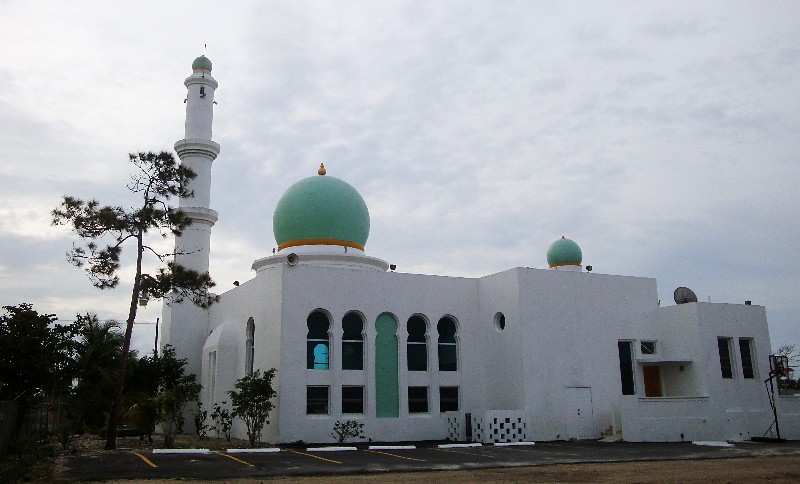
The small percentage of Muslims poses a huge challenge to those Muslims who are mostly converts on the island and are striving into live by the tenets of Islam every single day. In the Bahamas, there is one Masjid which is still in the process of being built to completion and an effort is made to have the adhan called for each salat daily. In 1978 when Jamaat-Ul-Islam, the Revolutionary Islamic Movement, was formed and Br. Mustapha Khalil Khalafani was chosen as its leader, the Muslims established Jamaat- Ul-Islam Mosque in Nassau operated by Jamaat Management Consultancy Limited owned by Brother Faisal Abdurrahman Hepburn.
The Mosque rests on two acres of land, white in color with three domes (one large and two small) and one tall minaret. It is surrounded by newly planted trees, a colorful courtyard and a parking lot. Women area is separated by a perforated wooden partisan. The five daily prayers are performed punctually in congregation. Over 60 people attend the Friday sermon and prayer. Other activities include brothers and sisters study circle as well as children’s Sunday school.
On a question in Quora whether there are Muslims in Bahamas, there was an answer by Nan Bowe Hilaire which stated: Yes, there are Muslims in the Bahamas. It’s a good size community there are about 300 maybe more by now. I even went to school with a girl whose family was Muslim she was the only Muslim in the entire school and was well love and respected, in the Bahamas even though there are many religions and some, of course, are more popular than others (Baptist, Catholic) everyone is really open-minded about different religions.
Although, Islam in Nassau is growing with a strong foundation for increasing the Dawa work in the area. Muslims in The Bahamas are still being ignored or marginalized in many ways however primarily because they are still a very small minority. The Bahamas is an excellent travel destination for all people. Also, it welcomes Muslims by offering a wide range of halal food.
The Muslim community is actively involved in social work and other civic activities. The community has made its voice heard on a range of topics, from crime in society to correcting the negative image of Islam and Muslims in the media. The community has work in presenting Islam as a viable alternative to various social ills. The community has also joined hands with the government in socially oriented activities. When the Government established the National Social development council, the community immediately cashed the opportunity to make a contribution. The Council was an amalgamation of civic bodies coming together to tackle the social problems of the nation. The Council was expected to establish commissions to deal with issues such as crime in society, teenage pregnancies, domestic abuse.
I could not get a video on the life of Muslims and their way of life and cultural activities. However, am sharing the video below which gives an insight in the establishment of Islam in the Bahamas by the key figures mentioned earlier in the post:
Disclaimer: The data for this post has been collected from the references given below. If anyone differs with the material contained in this post, one may consult the references and their authors. If someone has more material about the subject, he/she is most welcome to share in the comments box to make the post all encompassing.
Please share this page to your friends and family members through Facebook, Twitter, WhatsApp or any means on social media so that they can also be benefited by it and better understand Islam and the Holy Qur'an - Insha Allah (Allah Willing) you shall be blessed with the best of both worlds.
Since the day Adam fell prey to the Satanic machination and disobeyed his Lord, the tug of war between good and evil continues. The pushes and pulls get weaker in favour of righteousness and since the luring in by evil forces is more lucrative. Even the very pious are afraid of falling prey to evil forces and have always been supplicating for seeking refuge from them.
Although prophets are Divinely shielded from Satan and its machination, yet they have always been invoking the blessing of Divine protection from the menace of evil. Prophet Muhammad ﷺ too has been seeking protection from evil.
A supplication of Prophet Muhammad ﷺ has been mentioned in Jami` at-Tirmidhi (Book # 48 Chapters on Supplication كتاب الدعوات عن رسول الله صلى الله عليه وسلم / Chapter # 126 The Supplication of Umm Salamah باب دُعَاءِ أُمِّ سَلَمَةَ ) as Hadith number # 3591 wherein he is been reported have made a supplication to seek refuge from evil as appended below:
حَدَّثَنَا سُفْيَانُ بْنُ وَكِيعٍ، حَدَّثَنَا أَحْمَدُ بْنُ بَشِيرٍ، وَأَبُو أُسَامَةَ عَنْ مِسْعَرٍ، عَنْ زِيَادِ بْنِ عِلاَقَةَ، عَنْ عَمِّهِ، قَالَ كَانَ النَّبِيُّ صلى الله عليه وسلم يَقُولُ " اللَّهُمَّ إِنِّي أَعُوذُ بِكَ مِنْ مُنْكَرَاتِ الأَخْلاَقِ وَالأَعْمَالِ وَالأَهْوَاءِ " . قَالَ هَذَا حَدِيثٌ حَسَنٌ غَرِيبٌ . وَعَمُّ زِيَادِ بْنِ عِلاَقَةَ هُوَ قُطْبَةُ بْنُ مَالِكٍ صَاحِبُ النَّبِيِّ صلى الله عليه وسلم
Ziyad bin `Ilaqah narrated from his uncle, that he said: “[The Prophet (ﷺ)] used to say: ‘O Allah, I seek refuge in You from evil character, evil actions, and evil desires (Allāhumma innī a`ūdhu bika min munkarātil-akhlāqi wal-a`māli wal-ahwā’).’”
We will be sharing a post in time about how isolation tempts a man to sinning and one gets lured in by the evil. May Allah protect us and provide us refuge from evil, evil company and evil desires. Ameen
May Allāh (سبحانه و تعالى) help us understand Qur'ān and follow the Sunnah of Prophet Muhammad ﷺ, which is embodiment of commandments of Allah contained in the Qur'ān. May Allah help us to be like the ones He loves and let our lives be lived helping others and not making others' lives miserable or unlivable. May all our wrong doings, whether intentional or unintentional, be forgiven before the angel of death knocks on our door.
وَمَا عَلَيۡنَاۤ اِلَّا الۡبَلٰغُ الۡمُبِيۡنُ
(36:17) and our duty is no more than to clearly convey the Message.”
That is Our duty is only to convey to you the message that Allah has entrusted us with. Then it is for you to accept it or reject it. We have not been made responsible for making you accept it forcibly, and if you do not accept it, we shall not be seized in consequence of your disbelief, you will yourselves be answerable for your actions on Day of Resurrection.
May Allah forgive me if my posts ever imply a piety far greater than I possess. I am most in need of guidance.
Reading the Qur'ān should be a daily obligation of a Muslim - Reading it with translation will make it meaningful. But reading its Exegesis / Tafsir will make you understand it fully. It will also help the Muslims to have grasp over social issues and their answers discussed in the Qur'an and other matter related to inter faith so that they are able to discuss issues with non-Muslims with authority based on refences from Qur'an.
Note: When we mention God in our posts, we mean One True God, we call Allah in Islam, with no associates. Allah is the Sole Creator of all things, and that Allah is all-powerful and all-knowing. Allah has no offspring, no race, no gender, no body, and is unaffected by the characteristics of human life.
Disclaimer: The material for this post has been collected from the references as given below. If anyone differs with the material contained in this post, one may consult the references and their authors. If someone has more material about the subject, he/she is most welcome to share in the comments box to make the post all encompassing.
Please share this page to your friends and family members through Facebook, WhatsApp or any means on Social Media so that they can also be benefited by it and better understand Islam and the Qur'ān - Insha Allah (Allah Willing) you shall be blessed with the best of both worlds.