.

Friday, 26 May 2023

Backbiting and slandering - The worst acts of a believer (Hadith Prophet Muhammad ﷺ)

The 104th chapter of Qur'an, Surah Al Humazah begins with the warning for the slanderers, mockers and backbiters. The very first verse of the Sūrah al-Humazah begins with two words “Humazat il- Lumazah” which together mean the same: The slanderers. While the first word means slanderers who hurt others by word of mouth, the second word means slanderers who hurt others by action. These are Traducers, the Backbiters, the Mockers and many such similar qualities of man which ultimately result into his destruction and have him taken to the fire of hell where he is "crushed" forever.

The same is the theme of the Hadith attributed to Prophet Muhammad ﷺ being shared today. The Hadith is mentioned in Sunan Abi Dawud (Book # General Behavior (Kitab Al-Adab) كتاب الأدب / Chapter # 40 Regarding backbiting (al-ghibah ) باب فِي الْغِيبَةِ) as Hadith number # 4874, shared as under:

حَدَّثَنَا عَبْدُ اللَّهِ بْنُ مَسْلَمَةَ الْقَعْنَبِيُّ، حَدَّثَنَا عَبْدُ الْعَزِيزِ، - يَعْنِي ابْنَ مُحَمَّدٍ - عَنِ الْعَلاَءِ، عَنْ أَبِيهِ، عَنْ أَبِي هُرَيْرَةَ، أَنَّهُ قِيلَ يَا رَسُولَ اللَّهِ مَا الْغِيبَةُ قَالَ ‏"‏ ذِكْرُكَ أَخَاكَ بِمَا يَكْرَهُ ‏"‏ ‏.‏ قِيلَ أَفَرَأَيْتَ إِنْ كَانَ فِي أَخِي مَا أَقُولُ قَالَ ‏"‏ إِنْ كَانَ فِيهِ مَا تَقُولُ فَقَدِ اغْتَبْتَهُ وَإِنْ لَمْ يَكُنْ فِيهِ مَا تَقُولُ فَقَدْ بَهَتَّهُ ‏"‏‏.‏
Abu Hurairah said:
The Messenger of Allah (ﷺ) was asked: Messenger of Allah! What is back-biting? He replied: It is saying something about your brother which he would dislike. He was asked again: Tell me how the matter stands if what I say about my brother is true? He replied: If what you say of him is true, you have slandered him, and if what you say of him is not true, you have reviled him.

Grade: Sahih (Al-Albani)

The Hadith quoted above clearly cautions the believers never to say anything of his brother, that is brother in Islam, which he dislikes. And even if one says something true about his brother, it is tantamount to slandering. That is either one should have the courage to say something about a brother right in his presence or stay quiet. And if someone has something bad to say about someone, it is desirable that he should avoid doing it and can tell the person in public so that he can make amends or extend his viewpoint to clarify his position. 
May Allāh (سبحانه و تعالى‎) help us understand Qur'ān and follow the Sunnah of Prophet Muhammad ﷺ, which is embodiment of commandments of Allah contained in the Qur'ān. May Allah help us to be like the ones He loves and let our lives be lived helping others and not making others' lives miserable or unlivable. May all our wrong doings, whether intentional or unintentional, be forgiven before the angel of death knocks on our door. 
وَمَا عَلَيۡنَاۤ اِلَّا الۡبَلٰغُ الۡمُبِيۡنُ‏ 
(36:17) and our duty is no more than to clearly convey the Message.”
That is Our duty is only to convey to you the message that Allah has entrusted us with. Then it is for you to accept it or reject it. We have not been made responsible for making you accept it forcibly, and if you do not accept it, we shall not be seized in consequence of your disbelief, you will yourselves be answerable for your actions on Day of Resurrection.

May Allah forgive me if my posts ever imply a piety far greater than I possess. I am most in need of guidance.

Reading the Qur'ān should be a daily obligation of a Muslim - Reading it with translation will make it meaningful. But reading its Exegesis / Tafsir will make you understand it fully. It will also help the Muslims to have grasp over social issues and their answers discussed in the Qur'an and other matter related to inter faith so that they are able to discuss issues with non-Muslims with authority based on refences from Qur'an.

Note: When we mention God in our posts, we mean One True God, we call Allah in Islam, with no associates. Allah is the Sole Creator of all things, and that Allah is all-powerful and all-knowing. Allah has no offspring, no race, no gender, no body, and is unaffected by the characteristics of human life.

Please refer to our reference page: Sunnah and Hadith of Prophet Muhammad ﷺ to know more about sunnah of Prophet of Allah. You may also refer to our Reference Pages for knowing more about Islam and Qur'ān.

Disclaimer: The material for this post has been collected from the references as given below. If anyone differs with the material contained in this post, one may consult the references and their authors.  If someone has more material about the subject, he/she is most welcome to share in the comments box to make the post all encompassing.

If you like Islam: My Ultimate Decision, and to keep yourself updated on all our latest posts to know more about Islam, follow us on Facebook

Please share this page to your friends and family members through Facebook, WhatsApp or any means on social media so that they can also be benefited by it and better understand Islam and the Qur'ān - Insha Allah (Allah Willing) you shall be blessed with the best of both worlds.

Wednesday, 24 May 2023

Islam in Congo

The Democratic Republic of the Congo, also known as Congo-Kinshasa and formerly known as Zaire, is a country in Central Africa. With a population of around 112 million, the Democratic Republic of the Congo is dominated by with various Christian denominations and sects. Islam was first introduced to the Congo basin from the East African coast during 19th century and remains largely concentrated in parts of Eastern Congo, notably in Maniema Province. Though estimates vary, it is generally believed that between one and 10 percent of the country's population identify as Muslim. [1] However, other estimates put the ratio of Muslims about 10-15%. [2]

Until the 1920s the Muslim presence was not felt strongly in the country which, since the 19th century, had been a Belgian colony. Since then, the Muslim presence in the country has been manifesting itself through the NGOs and Quranic schools that have been founded. But this time the domination of the educational system by Christian and colonial powers acted as a disincentive to Muslim involvement in public life and has always kept them away. Years of Belgian colonial rule not only saw restrictions on Muslim worship, but Muslim children were expelled from schools, force-fed pork, and people were forced to eat and drink during Ramadan. [2]

The independence in 1960 resulted into more oppression for and discrimination against Muslims instead of more freedom. The existing political and military conflicts in the areas where they lived contributed to the further marginalization of the Muslim minority. 

The Muslim minority has been in dire straits since the uprising affecting the eastern parts of the country, especially since 2010. Having been targeted by the government on account of accusations of collaborating with armed opposition groups, some Muslims have had to flee their homes and migrate to other regions. The existence of armed groups from the Muslim minority, such as the Allied Democratic Forces of Islam(ADF-Nalu), who have been involved in the events, has brought misery upon ordinary Muslims, despite their disengagement from the conflict. While mosques in the country have become a target for attacks, the problem of security still waits to be solved. [2] 


Muslims today form a sizeable minority in Congo of today. The highest concentration of Muslims is in Maniema Province and especially its cities of Kasongo and Kindu where they represent 80–90 percent and 25 percent of the population respectively. Besides indigenous Muslims, the population also includes immigrants from Lebanon, India, Pakistan and other parts of the African continent. The vast majority of Muslims in the country identify themselves as Sunni, following the Maliki school of jurisprudence (fiqh). Congolese Muslims are frequently divided between conservative Sufis and Reformists (Salafists) as well as along local ethnic, geographical, and generational lines.

Congolese Muslims are represented at a national level by the Islamic Community of the Democratic Republic of the Congo (Communauté islamique du République démocratique du Congo, or Comico) which succeeded the Islamic Community of Zaire (Communauté islamique du Zaïre, Comiza) founded in the 1970s. However, Muslims have little political influence in national politics and are underrepresented in its institutions. Of the 450 MPs in parliament, only three are there to represent the Muslim minority. However, if representation was given in proportion relation to their numbers, there would need to be at least 65-70 Muslim MPs. [2]

As of today, while the majority of Muslims in the warn-torn areas is low to miserable, while Muslim minority living in the capital city of Kinshasa and in other urban centers seems unaffected that of the war-torn areas. Urban centers, where the central authority is powerful, are the primary destinations of migrants.

The religious education of Muslim children is almost non-existant as most Muslim schools are not Qur’anic and are open to children of other faiths. One of the few academic studies of Congolese Muslim schools noted that they may employ non-Muslim teachers and apart from religious teaching were not noticeably different from any other Congolese school. Muslims parents who want a more rigorous Qur’anic education for their children tend to arrange it as an extra-curricular activity. All of which seems to indicate that Islam in the Democratic Republic of Congo is neither orthodox nor closed, and despite their near invisibility in demographic and development studies, has a lot to offer in national reconstruction. [3]
The plight of Muslims is worse and threatening due to the civil war, syas Imam of Beni, Musa Angwandi, is the leader of approximately 35,000 Muslims in Beni Territory. He says the community is very stressed, they are accused of things they haven’t done and he is afraid that if they are further intimidated they may take things into their own hands. During one of my many forays into the bush I see an abandoned mosque near Eringeti and when I ask the reason why it is no longer used I am told that the worshippers were chased away and pigs heads were left on the steps. As is so often the case with Congo stories, deeper digging reveals that this was less a tale of religious scapegoating and was more likely a manifestation of local political skirmishes.[3]
To ease the sufferings of the Congolese Muslims, former Libyan leader Muammar Gaddafi financed proliferation of mosques in the greater North Kivu covering Butembo and Beni on to Ituri, regions which have seen growth of a Muslim community from the late 1980s and early 90s. It is here the UN Peace Keeping continegent from Pakistan has been based sine late 1990s and have had their influence on the growth of Islam. Pakistani contingent has built number of mosques in greater north Kivu and Ituri regions.
Pakistan troops in Bukavu, south Kivu [Photo]

The internal strife among the Muslim community is a bane for the community as a whole. The armed groups do not show mercy and many a killing has been reported. 
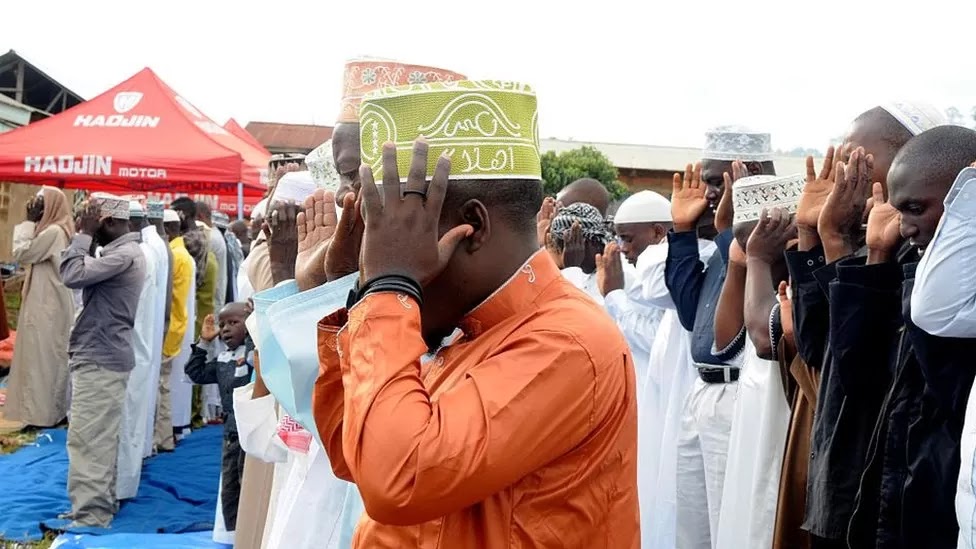
Muslims offering prayers [Photo: Getty Images/BBC]

In May 2021, a senior Muslim cleric in eastern Democratic Republic of Congo was shot dead while praying in the main mosque in Beni city. The cleric was a strong critic of Islamic militancy in the region, Reuters news agency reports. Eastern DR Congo has been badly hit by instability, including attacks claimed by the Islamic State (IS) group. Many armed groups operate in eastern DR Congo, a legacy of the conflicts that gripped the region in the 1990s.
However, despite being underrepresented in the media and politically, the Muslim community in the Congo seems to be expanding and shows a stronger desire to exist on the political and social scene. The fragile stability of the region pushes the inhabitants to organize themselves so as not to create misunderstandings. The association “ Islamic Dynamics for the Fight against Terrorism in the Great Lakes Region ” was created to respond to extremism and the stigmatization of Muslims. This structure pleads with the Congolese government, which is mainly non-Muslim. During our discussion, the Sheikh sighs and notes the lack of representativeness of the population of Muslim faith in the DRC: “Out of 26 provinces of the country, no governor is Muslim. In the general assembly, 540 deputies, only two Muslims ”. [4]
A study group as reported by alohanews Meeting with Muslims in a mosque in Goma

Muslims who, like elsewhere, are fighting against stigmatization following a painfully heavy global context to bear. Redefining themselves, asserting themselves, being represented, so many battles that Muslims are struggling to lead in Europe as well. A country historically weakened by the thirst for power, the slave trade, colonization... but which continues to believe in hope. The Congolese have in common a bloody history and present. However, various testimonies lean towards the desire to build together with a view to social peace. A slim hope that everyone dreams of. 

When would peace prevail in Congo, one is not very sure. But the effect of overall violence has permeated into the Muslim community as well and adversly affecting their lives.

PS: I could not find any video reflecting how Muslims celebrate their festivals and normal life in Congo. Will add as and when I find one. All videos on YouTube are about violence and conflicts.

Disclaimer: The data for this post has been collected from the references given below. If anyone differs with the material contained in this post, one may consult the references and their authors.  If someone has more material about the subject, he/she is most welcome to share in the comments box to make the post all encompassing.

To know more about life of Muslims in other non-Muslim countries, please visit our Reference Page: Islam and Life of Muslims in Non Muslim Countries

You may also refer to our Reference Pages for knowing more about Islam and Quran.
Photo | References: | 1 | 2 | 3 | 4 | 
If you like Islam: My Ultimate Decision, and to keep yourself updated on all our latest posts to know more about Islam, follow us on Facebook

Please share this page to your friends and family members through Facebook, Twitter, WhatsApp or any means on social media so that they can also be benefited by it and better understand Islam and the Holy Qur'an - Insha Allah (Allah Willing) you shall be blessed with the best of both worlds.

Tuesday, 23 May 2023

Compiled verses on specific subjects from Qur'an: Repentance and Seeking Divine Forgiveness

Man is born to err and make mistakes. Even prophets, who were chosen ones at times erred, the example of Adam and Eve to quote one of many such incidents. The momentarily derailment from the Straight Path as spelt out by Lord of the Universe is more often than not is immediately felt by those whose hearts kindles with Divine light. 

The Qur'an and Hadith abound in verses and directives for making amends no sooner any deviation from Divine Path takes place. God has on guided His servants time and again, and again to return to him immediately after making a mistake, or committing a sin or hurting someone, and repent and seek the Divine forgiveness.

وَسَارِعُوۡۤا اِلٰى مَغۡفِرَةٍ مِّنۡ رَّبِّكُمۡ وَجَنَّةٍ عَرۡضُهَا السَّمٰوٰتُ وَالۡاَرۡضُۙ اُعِدَّتۡ لِلۡمُتَّقِيۡنَۙ‏ 
(3:133) And hasten to the forgiveness of your Lord and to a Paradise as vast as the heavens and the earth, prepared for the God-fearing.

The above quoted verse is one of the many verses in Qur'an wherein Allah encourages His servants to come to him repenting his sin or misdeed and seek His forgiveness. And the Lord, so merciful and kind, promises that He will forgive His servants provided they truly repent not to repeat their evil act and seek forgiveness. 

We have already shared many compiled verses on specific subjects so that our readers have easy access to these for instant reference. This new page is being added on the subject of Repentance and Seeking Divine Forgiveness. The verses from Qur;an so far compiled are as under:
The previous pages encompassing compiled verses on specific subjects are as under:
May Allāh (سبحانه و تعالى‎) help us understand Qur'ān and follow the Sunnah of Prophet Muhammad ﷺ, which is embodiment of commandments of Allah contained in the Qur'ān. May Allah help us to be like the ones He loves and let our lives be lived helping others and not making others' lives miserable or unlivable. May all our wrong doings, whether intentional or unintentional, be forgiven before the angel of death knocks on our door. 
وَمَا عَلَيۡنَاۤ اِلَّا الۡبَلٰغُ الۡمُبِيۡنُ‏ 
(36:17) and our duty is no more than to clearly convey the Message.”
That is Our duty is only to convey to you the message that Allah has entrusted us with. Then it is for you to accept it or reject it. We have not been made responsible for making you accept it forcibly, and if you do not accept it, we shall not be seized in consequence of your disbelief, you will yourselves be answerable for your actions on Day of Resurrection.

Reading the Qur'ān should be a daily obligation of a Muslim - Reading it with translation will make it meaningful. But reading its Exegesis / Tafsir will make you understand it fully. It will also help the Muslims to have grasp over social issues and their answers discussed in the Qur'an and other matter related to inter faith so that they are able to discuss issues with non-Muslims with authority based on refences from Qur'an.

May Allah forgive me if my posts ever imply a piety far greater than I possess. I am most in need of guidance.

Note: When we mention God in our posts, we mean One True God, we call Allah in Islam, with no associates. Allah is the Sole Creator of all things, and that Allah is all-powerful and all-knowing. Allah has no offspring, no race, no gender, no body, and is unaffected by the characteristics of human life.

Please refer to our Reference Page: Selected Verses from Al Qur'an about a Specific Subject for compiled verses on more specific subjects.

In addition, for more Selected Verses, please refer to our reference page: Selected Verses from the Qur'anYou may also refer to our Reference Pages and Understanding Al Qur'an for knowing more about Islam and Qur'ān.
An effort has been made to gather explanation / exegesis of the surahs of the Qur'ān from authentic sources and then present a least possible condensed explanation of the surah. In that the exegesis of the chapters of the Quran is mainly based on the "Tafhim al-Qur'an - The Meaning of the Qur'an" by one of the most enlightened scholars of the Muslim World Sayyid Abul Ala Maududi.  
In order to augment and add more explanation as already provided, additional input has been interjected from the following sources: 
  • Tafsir Ibn Khatir
  • Muhammad Asad Translation
  • Yusuf Ali Translation
  • Translation Javed Ahmad Ghamidi / Al Mawrid
  • Qur'an Wiki
  • Verse by Verse Qur'an Study Circle
  • Towards Understanding the Quran
If you like Islam: My Ultimate Decision, and want to keep yourself updated on all our latest posts to know more about Islam, follow us on Facebook

Please share this page to your friends and family members through Facebook, WhatsApp or any means on social media so that they can also be benefited by it and better understand Islam and the Qur'ān - Insha Allah (Allah Willing) you shall be blessed with the best of both worlds.

Monday, 22 May 2023

Prophetic Supplication (Dua / دُعا) - attributed to Prophet Zechariah for Goodly and Pious Offspring

One of the greatest blessings of Allah is pious and goodly offspring, something that is the earnest desire of every parent. The pious and obedient offspring act as the light of their parents' eyes, especially as they age. But if the offspring turn out to be rude, arrogant and disrespectful, the whole life of parents turns into misery and living becomes a bane.  

Even prophets have been mentioned in Qur'an and other Divine Scriptures supplicating for goodly offspring. Today we share the 38th verse of Surah 3. Al-i'Imran: 38 in which Prophet Zechariah (زَكَرِيَّا علي السلام) has been mentioned supplicating to the Lord of the universe for grant of goodly offspring. 

It may be mentioned here that the birth of Mariam (Mary, the mother of Jesus), of Yahya (John the Baptist), the precursor of Jesus, and of Jesus, the prophet of Israel, whom Israel rejected, occurred in that order chronologically, and are told in that order. They are all inter-connected. Zakariya prayed for no ordinary son. He and his wife were past the age of parenthood. Seeing the growth of Mary, he prayed for some child from Allah, - "from Thee, a progeny that is pure". To his surprise, he is given a son in the flesh, ushered in by a special Sign. Details in the explanation of the verse below:

هُنَالِكَ دَعَا زَكَرِيَّا رَبَّهٗ​ ​ۚ قَالَ رَبِّ هَبۡ لِىۡ مِنۡ لَّدُنۡكَ ذُرِّيَّةً طَيِّبَةً​ ​ ۚ اِنَّكَ سَمِيۡعُ الدُّعَآءِ‏ 
(3:38) Then Zechariah prayed to his Lord: 'O Lord! Grant me from Yourself out of Your grace the gift of a goodly offspring, for indeed You alone heed all Prayers.'

Tafsir Ibn-Kathir: (The Supplication of Zakariyya, and the Good News of Yahya's Birth):
When Zechariah, also spelt Zakariyya, who had Maryam (Mary, mother of Jesus) under his care, saw that Allah provided sustenance for Maryam, when he visited her in her seclusion, by giving her the fruits of winter in summer and the fruits of summer in winter, he was eager to have a child of his own. By then, Zakariyya had become an old man, his bones feeble and his head full of gray hair. His wife was an old woman who was barren. Yet, he still supplicated to Allah and called Him in secret. 

Since Zechariah was special to God, his supplication was immediately accepted and an angel appeared right there at the place of his supplication and broke him the good news of a son being born to him. This mentioned right in the next verse:

فَنَادَتۡهُ الۡمَلٰٓـئِكَةُ وَهُوَ قَآئِمٌ يُّصَلِّىۡ فِى الۡمِحۡرَابِۙ اَنَّ اللّٰهَ يُبَشِّرُكَ بِيَحۡيٰى مُصَدِّقًۢا بِكَلِمَةٍ مِّنَ اللّٰهِ وَسَيِّدًا وَّحَصُوۡرًا وَّنَبِيًّا مِّنَ الصّٰلِحِيۡنَ‏ 
(3:39) As he stood praying in the sanctuary, the angels called out to him: 'Allah gives you good tidings of Yahya (later John the Baptist), who shall confirm a command of Allah, shall be outstanding among men, utterly chaste, and a Prophet from among the righteous.'

(3:40) Zechariah (flabbergasted by such news and) exclaimed: 'My Lord! How shall I have a son when old age has overtaken me and my wife is barren?' He said: Thus, shall it be; Allah does what He wills.' and thus God granted Zechariah a son despite his old age and despite the barrenness of his wife. Thus, Yahya was born just six months before Jesus (peace be upon him). Yahya was born a son, destined to be a chaste leader and Prophet.

The purpose of sharing this supplication is for those who married people who for some reason lose hope of having an offspring born to them. If one sincerely prays with complete faith in Allah, the supplication never goes unanswered. And as is evident from the verses stated above, the most appropriate time to draw near the angels and to invoke and supplicate before the Almighty is that of the prayer.

We must never lose hope and get dejected if our supplications do not materialize for Allah knows the best for us. Waiting is just part of the Divine tests that are given to gauge the firmness of faith of His servants. Pray that we are never put to test and that Allah grants our wishes for us to be ever grateful to Him.
May Allāh (سبحانه و تعالى‎) help us understand Qur'ān and follow the Sunnah of Prophet Muhammad ﷺ, which is embodiment of commandments of Allah contained in the Qur'ān. May Allah help us to be like the ones He loves and let our lives be lived helping others and not making others' lives miserable or unlivable. May all our wrong doings, whether intentional or unintentional, be forgiven before the angel of death knocks on our door. 
وَمَا عَلَيۡنَاۤ اِلَّا الۡبَلٰغُ الۡمُبِيۡنُ‏ 
(36:17) and our duty is no more than to clearly convey the Message.”
That is Our duty is only to convey to you the message that Allah has entrusted us with. Then it is for you to accept it or reject it. We have not been made responsible for making you accept it forcibly, and if you do not accept it, we shall not be seized in consequence of your disbelief, you will yourselves be answerable for your actions on Day of Resurrection.

Reading the Qur'ān should be a daily obligation of a Muslim - Reading it with translation will make it meaningful. But reading its Exegesis / Tafsir will make you understand it fully. It will also help the Muslims to have grasp over social issues and their answers discussed in the Qur'an and other matter related to inter faith so that they are able to discuss issues with non-Muslims with authority based on refences from Qur'an.

May Allah forgive me if my posts ever imply a piety far greater than I possess. I am most in need of guidance.

Note: When we mention God in our posts, we mean One True God, we call Allah in Islam, with no associates. Allah is the Sole Creator of all things, and that Allah is all-powerful and all-knowing. Allah has no offspring, no race, no gender, no body, and is unaffected by the characteristics of human life.

For more Selected Verses, please refer to our reference page: Selected Invocations / Dua " دُعا " from the Qur'anYou may also refer to our Reference Pages for knowing more about Islam and Qur'ān.
Photo | Reference: | 1 | 2 | 3 |
Reading the Qur'ān should be a daily obligation of a Muslim - Reading it with translation will make it meaningful. But reading its Exegesis / Tafsir will make you understand it fully.

An effort has been made to gather explanation / exegesis of the surahs of the Qur'ān from authentic sources and then present a least possible condensed explanation of the surah. In that the exegesis of the chapters of the Quran is mainly based on the "Tafhim al-Qur'an - The Meaning of the Qur'an" by one of the most enlightened scholars of the Muslim World Sayyid Abul Ala Maududi.  

In order to augment and add more explanation as already provided, additional input has been interjected from following sources: 
  • Towards Understanding the Quran
  • Tafsir Ibn Khatir
  • Muhammad Asad Translation
  • Javed Ahmad Ghamidi / Al Mawrid
  • Al-Quran, Yusuf Ali Translation
  • Verse by Verse Qur'an Study Circle
In addition, references of other sources which have been explored have also been given above. Those desirous of detailed explanations and tafsir (exegesis), may refer to these sites.

If you like Islam: My Ultimate Decision, and to keep yourself updated on all our latest posts to know more about Islam, follow us on Facebook

Please share this page to your friends and family members through Facebook, WhatsApp or any means on social media so that they can also be benefited by it and better understand Islam and the Qur'ān - Insha Allah (Allah Willing) you shall be blessed with the best of both worlds.
Sunday, 21 May 2023

The grave consequences of committing suicide (Hadith Prophet Muhammad ﷺ)

Death by suicide, that is the act of intentionally causing one's own death, is one of the leading attempts to end one's life. As per a report published by the World Health Organization [1], more than 700 000 people die due to suicide every year. Suicide is the fourth leading cause of death among 15–29-year-olds. As per Wikipedia [2], the reasons of committing suicide are many, some of which may be due to:
Mental disorders (including depression, bipolar disorder, schizophrenia, personality disorders, anxiety disorders), physical disorders (such as chronic fatigue syndrome), and substance abuse (including alcoholism and the use of and withdrawal from benzodiazepines) are risk factors. Some suicides are impulsive acts due to stress (such as from financial or academic difficulties), relationship problems (such as breakups or divorces), or harassment and bullying.
Every suicide is a tragedy that affects families, communities and entire countries and has long-lasting effects on the people left behind. However, no matter what the reason for ending one's life may be, Islam strictly prohibits such acts for life is a gift of Allah and it is only He Who has the right to take it away, for every man is born fir a reason. And when that reason is accomplished, the natural death occurs. Thus, any attempt on one's life with an intention of ending is strictly forbidden. 

Prophet Muhammad ﷺ has also warned believers from taking their lives and has spelt the consequences of such an act. This Hadith is mentioned in Ṣaḥīḥ al-Bukhārī  (Book 76 - Medicine كتاب الطب / Chapter 56: The taking of poison and treating with it باب شُرْبِ السُّمِّ، وَالدَّوَاءِ بِهِ، وَبِمَا يُخَافُ مِنْهُ وَالْخَبِيثِ ) as Hadith 5778, given herein under:

حَدَّثَنَا عَبْدُ اللَّهِ بْنُ عَبْدِ الْوَهَّابِ، حَدَّثَنَا خَالِدُ بْنُ الْحَارِثِ، حَدَّثَنَا شُعْبَةُ، عَنْ سُلَيْمَانَ، قَالَ سَمِعْتُ ذَكْوَانَ، يُحَدِّثُ عَنْ أَبِي هُرَيْرَةَ ـ رضى الله عنه ـ عَنِ النَّبِيِّ صلى الله عليه وسلم قَالَ ‏ "‏ مَنْ تَرَدَّى مِنْ جَبَلٍ فَقَتَلَ نَفْسَهُ، فَهْوَ فِي نَارِ جَهَنَّمَ، يَتَرَدَّى فِيهِ خَالِدًا مُخَلَّدًا فِيهَا أَبَدًا، وَمَنْ تَحَسَّى سَمًّا فَقَتَلَ نَفْسَهُ، فَسَمُّهُ فِي يَدِهِ، يَتَحَسَّاهُ فِي نَارِ جَهَنَّمَ خَالِدًا مُخَلَّدًا فِيهَا أَبَدًا، وَمَنْ قَتَلَ نَفْسَهُ بِحَدِيدَةٍ، فَحَدِيدَتُهُ فِي يَدِهِ، يَجَأُ بِهَا فِي بَطْنِهِ فِي نَارِ جَهَنَّمَ خَالِدًا مُخَلَّدًا فِيهَا أَبَدًا ‏"‏‏.

Narrated by Abu Huraira:
The Prophet (ﷺ) said, "Whoever purposely throws himself from a mountain and kills himself, will be in the (Hell) Fire falling down into it and abiding therein perpetually forever; and whoever drinks poison and kills himself with it, he will be carrying his poison in his hand and drinking it in the (Hell) Fire wherein he will abide eternally forever; and whoever kills himself with an iron weapon, will be carrying that weapon in his hand and stabbing his `Abdomen with it in the (Hell) Fire wherein he will abide eternally forever."
Although ones who commit suicide are generally seem to be so depressed and for many other reasons as mentioned above, yet the main reason for any believer to attempt ending his life is lack of faith in his Creator. No life is perfect - it has its ups and down, but that does not mean that when is confronted with situations that rob him of his comfort, wealth and health, one should decide to end his life. In fact, such grave situations in one's life are the Divine tests to see whether one has unflinching faith in one's Creator or otherwise. Those with weak faith and heart often fall prey to the desire to commit suicide, while those who are hit against the wall for any reason but remain steadfast, come out of their bad days and find a meaning to their existence and life. 
“And do not kill yourselves,” declares Quran (nor kill one another). “Allah is, without a doubt, most merciful to you” (Surah al‐Nisa, 4:29).
There is another Hadith in which Prophet Muhammad ﷺ has been quoted as saying: 
"Amongst the nations before you there was a man who got a wound, and growing impatient (with its pain), he took a knife and cut his hand with it and the blood did not stop till he died. Allah said, 'My Slave hurried to bring death upon himself so I have forbidden him (to enter) Paradise.' " (Sahih Bukhari: 3469)

The crime of committing suicide is so grave that the Prophet of Allah even refrained from attending the funeral of a person who ended his life. It is mentioned that the Prophet (S.A.W.) refrained from offering the Janazah (funeral prayer) for one who had committed suicide, as a punishment to him and so as to discourage others from doing what he had done. But he gave the people permission to offer the Janazah for him.

‘(The dead body) of a person who had killed himself with a broad-headed arrow was brought before the Messenger of Allah (S.A.W.), but he did not offer prayers for him.’ (Sahih Muslim: 978) 

However, this does not mean that we should not pray and make Dua for the mercy and forgiveness of the person who committed suicide. We must make prayers because the person who committed suicide highly needs it as it is a major sin, though this does not take him outside of Islam. It is subject to the will of Allah on the Day of Resurrection, if He wills, He will forgive it, and if He wills, He will punish for it.  Remember, when we do commit suicide, we are leaving it without permission from Allah. This is why it is haram in Islam.[3]

So let us, brothers and sisters in Islam, be steadfast in every adverse circumstance and have faith in Allah for one never knows when one is relieved of his bad times, provided he qualifies the test, and his bad days are replaced with happiness and blessings. Let our lives be respected and protected from our hurried decisions  

May Allāh (سبحانه و تعالى‎) help us understand Qur'ān and follow the Sunnah of Prophet Muhammad ﷺ, which is embodiment of commandments of Allah contained in the Qur'ān. May Allah help us to be like the ones He loves and let our lives be lived helping others and not making others' lives miserable or unlivable. May all our wrong doings, whether intentional or unintentional, be forgiven before the angel of death knocks on our door. 
وَمَا عَلَيۡنَاۤ اِلَّا الۡبَلٰغُ الۡمُبِيۡنُ‏ 
(36:17) and our duty is no more than to clearly convey the Message.”
That is Our duty is only to convey to you the message that Allah has entrusted us with. Then it is for you to accept it or reject it. We have not been made responsible for making you accept it forcibly, and if you do not accept it, we shall not be seized in consequence of your disbelief, you will yourselves be answerable for your actions on Day of Resurrection.

May Allah forgive me if my posts ever imply a piety far greater than I possess. I am most in need of guidance.

Reading the Qur'ān should be a daily obligation of a Muslim - Reading it with translation will make it meaningful. But reading its Exegesis / Tafsir will make you understand it fully. It will also help the Muslims to have grasp over social issues and their answers discussed in the Qur'an and other matter related to inter faith so that they are able to discuss issues with non-Muslims with authority based on refences from Qur'an.

Note: When we mention God in our posts, we mean One True God, we call Allah in Islam, with no associates. Allah is the Sole Creator of all things, and that Allah is all-powerful and all-knowing. Allah has no offspring, no race, no gender, no body, and is unaffected by the characteristics of human life.

Please refer to our reference page: Sunnah and Hadith of Prophet Muhammad ﷺ to know more about sunnah of Prophet of Allah. You may also refer to our Reference Pages for knowing more about Islam and Qur'ān.

Disclaimer: The material for this post has been collected from the references as given below. If anyone differs with the material contained in this post, one may consult the references and their authors.  If someone has more material about the subject, he/she is most welcome to share in the comments box to make the post all encompassing.
Photo | Resource references: | 1 | 2 | 3 | Source of Hadith

If you like Islam: My Ultimate Decision, and to keep yourself updated on all our latest posts to know more about Islam, follow us on Facebook

Please share this page to your friends and family members through Facebook, WhatsApp or any means on social media so that they can also be benefited by it and better understand Islam and the Qur'ān - Insha Allah (Allah Willing) you shall be blessed with the best of both worlds.

Saturday, 20 May 2023

Allah accepts repentance soon after committing a sin - but not so late when angel of death arrives

Every maker of a machine knows what faults it inherently possesses and how these are to be rectified as faults occur in the due course of its usage. Likewise, when Lord of the universe created man, He was cognizance of the inherent weakness of His creation - falling prey to evil. And this ability was soon demonstrated when Adm and Eve disobeyed the Divine Command of not eating the fruit of a forbidden tree enticed by the Devil. 

And Allah had fixed a chip inside to instantly recognize their folly of committing a sin and immediately, not waiting a second later for one never knows when the angel of death may arrive. And so did Adam and Eve did and immediately repented and were forgiven. In the backdrop of this inherent weakness of man, Qur'an abounds in verse in which Allah promises man to repent their sins no sooner these are committed and seek Divine forgiveness, so that they may be forgiven. Many of these verses are shared under the heading: Forgiveness/Repentance in our series of posts on Selected verses from Qur'an.

Today we share another verse from Qur'an, the 17th verse of Surah 4. An Nisa (The Women), with a add on verse that makes the two verses complimenting.

إِنَّمَا ٱلتَّوْبَةُ عَلَى ٱللَّهِ لِلَّذِينَ يَعْمَلُونَ ٱلسُّوٓءَ بِجَهَـٰلَةٍ ثُمَّ يَتُوبُونَ مِن قَرِيبٍ فَأُو۟لَـٰٓئِكَ يَتُوبُ ٱللَّهُ عَلَيْهِمْ ۗ وَكَانَ ٱللَّهُ عَلِيمًا حَكِيمًا
(4:17) Allah accepts only the repentance of those who do evil in ignorance and foolishness and repent soon afterwards; it is they to whom Allah will forgive and Allah is Ever All-Knower, All-Wise.

Muhammad Asad is of the view that the expression min qarib, which here implies nearness in time, could also be rendered as "soon", i.e., soon after having committed the evil deed; most of the classical commentators however, hold that in this context it denotes the time before the actual approach of death. This interpretation is borne out by the next verse.

Javed Ahmad Ghamidi explains that the actual word is: جَهَالَة. Though it also means “ignorance” it is predominantly used to mean committing a sin or some mischief while being overwhelmed by emotions. Thus, in Arabic it generally occurs as an opposite of self-control (ḥilm) instead of knowledge (‘ilm).

Tafsir Ibn-Kathir: (Repentance is accepted until one faces death)

Allah states that He accepts repentance of the servant who commits an error in ignorance and then repents, even just before he sees the angel who captures the soul, before his soul reaches his throat. Mujahid and others said, "Every person who disobeys Allah by mistake, or intentionally is ignorant, until he refrains from sin.' Qatadah said that Abu Al-`Aliyah narrated that the Companions of the Messenger of Allah used to say, "Every sin that the servant commits, he commits out of ignorance.' `Abdur-Razzaq narrated that, Ma`mar said that Qatadah said that, the Companions of the Messenger of Allah agreed that every sin that is committed by intention or otherwise, is committed in ignorance.' Ibn Jurayj said, "Abdullah bin Kathir narrated to me that Mujahid said, `Every person who disobeys Allah (even willfully), is ignorant while committing the act of disobedience.'' Ibn Jurayj said, "`Ata' bin Abi Rabah told me something similar.' Abu Salih said that Ibn `Abbas commented, "It is because of one's ignorance that he commits the error.' 
`Ali bin Abi Talhah reported that Ibn `Abbas said about the Ayah, (ثُمَّ يَتُوبُونَ مِن قَرِيبٍ and repent soon (afterwards)), "Until just before he (or she) looks at the angel of death.''
Ad-Dahhak said, "Everything before death is `soon (afterwards).'''
Al-Hasan Al-Basri said about the Ayah, (ثُمَّ يَتُوبُونَ مِن قَرِيبٍ and repent soon afterwards), "Just before his last breath leaves his throat.'' `Ikrimah said, "All of this life is `soon (afterwards).''

 Imam Ahmad recorded that Ibn `Umar said that the Messenger said, (إِنَّ اللهَ يَقْبَلُ تَوْبَةَ الْعَبْدِمَالَمْ يُغَرْغِر Allah accepts the repentance of the servant as long as the soul does not reach the throat.) This Hadith was also collected by At-Tirmidhi and Ibn Majah, and At-Tirmidhi said, "Hasan Gharib''. By mistake, Ibn Majah mentioned that this Hadith was narrated through `Abdullah bin `Amr. 

However, what is correct is that `Abdullah bin `Umar bin Al-Khattab was the narrator. Allah said, (فَأُوْلَـئِكَ يَتُوبُ اللَّهُ عَلَيْهِمْ وَكَانَ اللَّهُ عَلِيماً حَكِيماً It is they to whom Allah will forgive and Allah is Ever All-Knower, All-Wise.) Surely, when hope in continued living diminishes, the angel of death comes forth and the soul reaches the throat, approaches the chest and arrives at the state where it is being gradually pulled out, then there is no accepted repentance, nor a way out of that certain end. 

Hence Allah's statements (the 18th verse): 

وَلَيْسَتِ التَّوْبَةُ لِلَّذِينَ يَعْمَلُونَ السَّيِّئَـتِ حَتَّى إِذَا حَضَرَ أَحَدَهُمُ الْمَوْتُ قَالَ إِنِّى تُبْتُ الاٌّنَ
(And of no effect is the repentance of those who continue to do evil deeds until death faces one of them and he says: "Now I repent,'') 
As also:
فَلَمَّا رَأَوْاْ بَأْسَنَا قَالُواْ ءَامَنَّا بِاللَّهِ وَحْدَهُ
(So, when they saw Our punishment, they said: "We believe in Allah Alone...'') [40:84]
Allah decided that repentance shall not be accepted from the people of the earth when the sun rises from the west, as Allah said,

يَوْمَ يَأْتِى بَعْضُ ءَايَـتِ رَبِّكَ لاَ يَنفَعُ نَفْسًا إِيمَانُهَا لَمْ تَكُنْ ءَامَنَتْ مِن قَبْلُ أَوْ كَسَبَتْ فِى إِيمَـنِهَا خَيْرًا
(The day that some of the signs of your Lord do come, no good will it do to a person to believe then, if he believed not before, nor earned good through his faith.) [6:158] 
Allah said, (وَلاَ الَّذِينَ يَمُوتُونَ وَهُمْ كُفَّارٌ nor of those who die while they are disbelievers.) Consequently, when the disbeliever dies while still a disbeliever and polytheist, his sorrow and repentance shall not avail him. If he were to ransom himself, even with the earth's fill of gold, it would not be accepted by him.
Ibn `Abbas, Abu Al-`Aliyah and Ar-Rabi` bin Anas said that the Ayah: (وَلاَ الَّذِينَ يَمُوتُونَ وَهُمْ كُفَّارٌ nor of those who die while they are disbelievers), was revealed about the people of Shirk. 
Imam Ahmad recorded that Usamah bin Salman said that Abu Dharr said that the Messenger of Allah said, (إِنَّ اللهَ يَقْبَلُ تَوْبَةَ عَبْدِهِ أَوْ يَغْفِرُ لِعَبْدِهِ مَالَمْ يَقَعِ الْحِجَاب Allah accepts the repentance of His servant, or forgives His servant, as long as the veil does not drop.) They asked, "And what does the drop of the veil mean '' He said, (أَنْ تَخْرُجَ النَّفْسُ وَهِيَ مُشْرِكَة When the soul is removed while one is a polytheist.) 
Allah then said, (أُوْلَـئِكَ أَعْتَدْنَا لَهُمْ عَذَاباً أَلِيماً (For them We have prepared a painful torment), torment that is severe, eternal and enormous.

The purpose of sharing the 17th and the 18th verses of Surah An Nisa is to stress upon the need of committing a sin, and then repenting AS EARLY AS POSSIBLE for no one knows when his time is up in this world. The warning is stern that when when the time of death arrives then no repentance shall be accepted and from then on one will plunge into darkness and finally the hellfire. 
May Allāh (سبحانه و تعالى‎) help us understand Qur'ān and follow the Sunnah of Prophet Muhammad ﷺ, which is embodiment of commandments of Allah contained in the Qur'ān. May Allah help us to be like the ones He loves and let our lives be lived helping others and not making others' lives miserable or unlivable. May all our wrong doings, whether intentional or unintentional, be forgiven before the angel of death knocks on our door. 
وَمَا عَلَيۡنَاۤ اِلَّا الۡبَلٰغُ الۡمُبِيۡنُ‏ 
(36:17) and our duty is no more than to clearly convey the Message.”
That is Our duty is only to convey to you the message that Allah has entrusted us with. Then it is for you to accept it or reject it. We have not been made responsible for making you accept it forcibly, and if you do not accept it, we shall not be seized in consequence of your disbelief, you will yourselves be answerable for your actions on Day of Resurrection.

Reading the Qur'ān should be a daily obligation of a Muslim - Reading it with translation will make it meaningful. But reading its Exegesis / Tafsir will make you understand it fully. It will also help the Muslims to have grasp over social issues and their answers discussed in the Qur'an and other matter related to inter faith so that they are able to discuss issues with non-Muslims with authority based on refences from Qur'an.

May Allah forgive me if my posts ever imply a piety far greater than I possess. I am most in need of guidance.

Note: When we mention God in our posts, we mean One True God, we call Allah in Islam, with no associates. Allah is the Sole Creator of all things, and that Allah is all-powerful and all-knowing. Allah has no offspring, no race, no gender, no body, and is unaffected by the characteristics of human life.

For more Selected Verses, please refer to our reference page: Selected Verses from the Qur'anYou may also refer to our Reference Pages  and Understanding Al Qur'an for knowing more about Islam and Qur'ān.
Photo | Tafsir References: | 1 | 2 | 3

An effort has been made to gather explanation / exegesis of the surahs of the Qur'ān from authentic sources and then present a least possible condensed explanation of the surah. In that the exegesis of the chapters of the Quran is mainly based on the "Tafhim al-Qur'an - The Meaning of the Qur'an" by one of the most enlightened scholars of the Muslim World Sayyid Abul Ala Maududi.  
In order to augment and add more explanation as already provided, additional input has been interjected from the following sources: 
  • Tafsir Ibn Khatir
  • Muhammad Asad Translation
  • Yusuf Ali Translation
  • Translation Javed Ahmad Ghamidi / Al Mawrid
  • Qur'an Wiki
  • Verse by Verse Qur'an Study Circle
  • Towards Understanding the Quran
In addition, references of other sources which have been explored have also been given above. Those desirous of detailed explanations and tafsir (exegesis), may refer to these sites.

If you like Islam: My Ultimate Decision, and to keep yourself updated on all our latest posts to know more about Islam, follow us on Facebook

Please share this page to your friends and family members through Facebook, WhatsApp or any means on social media so that they can also be benefited by it and better understand Islam and the Qur'ān - Insha Allah (Allah Willing) you shall be blessed with the best of both worlds.

Wednesday, 17 May 2023

A treasure from the treasures of Paradise (Hadith Prophet Muhammad ﷺ)

It is human nature to praise someone superior either out of love or to obtain attention and rewards in return. But how unfortunate of us Muslims that we seldom remember the Lord of the universe in words or attributes befitting Allah's self. At many a place in Qur'an and even Hadiths of Prophet Muhammad ﷺ the need to remember Allah with all its attributes to show our love and faith in Him. 

Today, we share a Hadith of Prophet Muhammad ﷺ in which he emphasizes the need to remember Allah in words that the revered prophet of Allah said that these words are treasure from the treasure of Paradise. 

This Hadith is mentioned Jami` at-Tirmidhi  (Book # 48 Chapters on Supplication كتاب الدعوات عن رسول الله صلى الله عليه وسلم / Chapter # 130 The Virtue Of: “There Is No Might or Power Except by Allah” باب فَضْلِ لاَ حَوْلَ وَلاَ قُوَّةَ إِلاَّ بِاللَّهِ ) as Hadith number # 3601, given herein under:

حَدَّثَنَا أَبُو كُرَيْبٍ، حَدَّثَنَا أَبُو خَالِدٍ الأَحْمَرُ، عَنْ هِشَامِ بْنِ الْغَازِ، عَنْ مَكْحُولٍ، عَنْ أَبِي هُرَيْرَةَ، قَالَ قَالَ لِي رَسُولُ اللَّهِ صلى الله عليه وسلم ‏"‏ أَكْثِرْ مِنْ قَوْلِ لاَ حَوْلَ وَلاَ قُوَّةَ إِلاَّ بِاللَّهِ فَإِنَّهَا كَنْزٌ مِنْ كُنُوزِ الْجَنَّةِ ‏"‏ ‏.‏ قَالَ مَكْحُولٌ فَمَنْ قَالَ لاَ حَوْلَ وَلاَ قُوَّةَ إِلاَّ بِاللَّهِ وَلاَ مَنْجَا مِنَ اللَّهِ إِلاَّ إِلَيْهِ ‏.‏ كَشَفَ عَنْهُ سَبْعِينَ بَابًا مِنَ الضُّرِّ أَدْنَاهُنَّ الْفَقْرُ ‏"‏ ‏.‏ قَالَ أَبُو عِيسَى هَذَا حَدِيثٌ لَيْسَ إِسْنَادُهُ بِمُتَّصِلٍ ‏.‏ مَكْحُولٌ لَمْ يَسْمَعْ مِنْ أَبِي هُرَيْرَةَ

Abu Hurairah said:
“The Messenger of Allah (ﷺ) said to me: ‘Be frequent in saying: “There is no might or power except by Allah, (Lā ḥawla wa lā quwwata illā billāh).” For verily, it is a treasure from the treasures of Paradise.’”

And verily, these words, in the form of a supplication, show our firm faith that there is no power mightier than Allah and none can overstep His unchallengeable status. We should, more often than not, repeat this supplication as much as we can for Allah loves those who praise Him in words worthy of His status. This supplication also instills in our faith the conviction that none other than Allah can help or harm us. Therefore, we must never bow in front of the worldly masters for they too are nothing but the blessings bestowed upon them by Allah.
May Allāh (سبحانه و تعالى‎) help us understand Qur'ān and follow the Sunnah of Prophet Muhammad ﷺ, which is embodiment of commandments of Allah contained in the Qur'ān. May Allah help us to be like the ones He loves and let our lives be lived helping others and not making others' lives miserable or unlivable. May all our wrong doings, whether intentional or unintentional, be forgiven before the angel of death knocks on our door. 
وَمَا عَلَيۡنَاۤ اِلَّا الۡبَلٰغُ الۡمُبِيۡنُ‏ 
(36:17) and our duty is no more than to clearly convey the Message.”
That is Our duty is only to convey to you the message that Allah has entrusted us with. Then it is for you to accept it or reject it. We have not been made responsible for making you accept it forcibly, and if you do not accept it, we shall not be seized in consequence of your disbelief, you will yourselves be answerable for your actions on Day of Resurrection.

May Allah forgive me if my posts ever imply a piety far greater than I possess. I am most in need of guidance.

Reading the Qur'ān should be a daily obligation of a Muslim - Reading it with translation will make it meaningful. But reading its Exegesis / Tafsir will make you understand it fully. It will also help the Muslims to have grasp over social issues and their answers discussed in the Qur'an and other matter related to inter faith so that they are able to discuss issues with non-Muslims with authority based on refences from Qur'an.

Note: When we mention God in our posts, we mean One True God, we call Allah in Islam, with no associates. Allah is the Sole Creator of all things, and that Allah is all-powerful and all-knowing. Allah has no offspring, no race, no gender, no body, and is unaffected by the characteristics of human life.

Please refer to our reference page: Sunnah and Hadith of Prophet Muhammad ﷺ to know more about sunnah of Prophet of Allah. You may also refer to our Reference Pages for knowing more about Islam and Qur'ān.

Disclaimer: The material for this post has been collected from the references as given below. If anyone differs with the material contained in this post, one may consult the references and their authors.  If someone has more material about the subject, he/she is most welcome to share in the comments box to make the post all encompassing.

If you like Islam: My Ultimate Decision, and to keep yourself updated on all our latest posts to know more about Islam, follow us on Facebook

Please share this page to your friends and family members through Facebook, WhatsApp or any means on social media so that they can also be benefited by it and better understand Islam and the Qur'ān - Insha Allah (Allah Willing) you shall be blessed with the best of both worlds.

Twitter Delicious Facebook Digg Stumbleupon Favorites More