.

Thursday, 1 June 2023

Reward beyond all reckoning for those who Fear Allah and Persevere

Faith (Tawakal) and fear of Allah is central to the belief of all Muslims. Rather it should be central to the belief of all who follow any of the four Divine Scriptures. But this faith should only be in One True God without any associates. When unshakable, unwavering and unshrinking faith in One True God develops in the heart of a believer, then whatever befalls on him is accepted as will of Allah and one willingly perseveres. 

Such a level of perseverence gives solace in the face of dangers and induces an unflinching will and determination to endure what may come one's way. Perseverance instills a higher degree of patience in the heart of a true beleiver and induces the staying power and determination that opens means of ultimate success and prosperity.

This is the central idea of the 10th verse of Surah 39 Al Zumar, The Troops, as is being shared herein under:

قُلۡ يٰعِبَادِ الَّذِيۡنَ اٰمَنُوا اتَّقُوۡا رَبَّكُمۡ​ ؕ لِلَّذِيۡنَ اَحۡسَنُوۡا فِىۡ هٰذِهِ الدُّنۡيَا حَسَنَةٌ ​ ؕ وَاَرۡضُ اللّٰهِ وَاسِعَةٌ ​ ؕ اِنَّمَا يُوَفَّى الصّٰبِرُوۡنَ اَجۡرَهُمۡ بِغَيۡرِ حِسَابٍ‏ 
(39:10) Tell them (O Prophet): “O you servants of Mine who believe, have fear of your Lord. A good end awaits those who did good in this world. Allah's earth is spacious. Verily those who persevere shall be granted their reward beyond all reckoning.
(Tell them (O Prophet): “O you servants of Mine who believe, have fear of your Lord) That is, do not rest content with belief but follow it up with piety and fear of God. Act according to what Allah has enjoined and avoid what He has forbidden and live in the world fearing His accountability.

(A good end awaits those who did good in this world) Good and well-being both of this world and of the Hereafter. 

(Allah's earth is spacious) That is, "If one city, territory or land has become difficult for the worshipers of Allah, they may emigrate to another place where they may not have to face any such hardship. " 

(Verily those who persevere shall be granted their reward beyond all reckoning.) "Those. . . measure": Those who brave all kinds of hardships and persecutions in following the way of God-worship and piety but do not abandon the way of the Truth. This also includes those people who emigrate to other countries and experience hardships in the foreign land for the sake of religion and faith, and those also who continue to face every kind of temptation and calamity firmly and patiently in the land where they are being persecuted." 

Yusuf Ali Explanation:  
The fear of Allah has also been mentioned right in the opening of the Surah 2 Al Baqarah (The Cow):
(This is the Book; in it is guidance sure without doubt to those who fear Allah.) Taqwa and the verbs and nouns connected with the root, signify: (1) the fear of God which according to the writer of Proverbs (i.7) in the Old Testament is the beginning of Wisdom; (2) restraint, or guarding one's tongue, hand, and heart from evil; (3) hence righteousness, piety good conduct. All these ideas are implied; in the translation, only one or other of these ideas can be indicated according to the context. See also xivii 17; and ixxiv 56.

Fear of Allah is also mentioned in the 60th verse of Surah 23. Al-Muminun:
(And those who dispense their charity with their hearts full of fear because they will return to their Lord) Their hearts are full of reverence for Allah and fear lest their charity or their hearts be not good enough for acceptance before their Lord; for they have the certainty of a future life, in which they will stand before the Judgment Seat. They fear for their own worthiness, but they hope in Faith.

Tafsir Qur'an Wiki:
To fear God means to have a sensitive heart and to look up to Him cautiously and with apprehension, hope, wary lest one should incur His displeasure and keen to earn His pleasure. It is seen in the bright picture drawn in the previous verse of a devout worshipper, full of humility. “Those who do good in this world will have a good reward.” What a great reward: a good deed in this present life, which is short and flimsy, is repaid with something good in the life to come, which is everlasting. This is certainly an act of God’s grace. He knows man’s weakness and small effort, so He repays him generously and takes care of him.

“Wide is God’s earth.” Your love of your land where you have relatives and friends should not prevent you from seeking a different abode if your own area is hostile to your faith and you cannot do well there. To stick to your place of habitat in such a case could present an opening for Satan. It could become a form of attributing equals to God, even though it might not be felt in this way. This is a fine point indicating that polytheism can subtly creep into our hearts. It is given within the context of belief in God’s oneness and fearing Him. It should be seen as evidence of the source of the Qur’ān. No one can deal in this way with the human heart except the One who created it and knows what has an effect on it and how.

God, the Creator of mankind, knows that leaving one’s land is hard. It involves abandoning one’s relatives and the people with whom one has close ties, leaving the place where one can easily find work and earn a living, to go to a new place where one is a stranger. This is not an easy thing for anyone. Hence, the Sūrah refers here to patience in adversity and how it is generously rewarded by God: “Those who are patient in adversity will be given their reward in full, beyond reckoning.” Thus, God’s servants feel His care and are touched as they see that when they have to undertake something hard God turns to them with care and grace. He opens for them what compensates for land, country, family and relatives, giving them a reward without count. All praise is due to God who knows all that affects a human heart and is fully aware of every thought that finds its way into his mind.
May Allāh (سبحانه و تعالى‎) help us understand Qur'ān and follow the Sunnah of Prophet Muhammad ﷺ, which is embodiment of commandments of Allah contained in the Qur'ān. May Allah help us to be like the ones He loves and let our lives be lived helping others and not making others' lives miserable or unlivable. May all our wrong doings, whether intentional or unintentional, be forgiven before the angel of death knocks on our door. 
وَمَا عَلَيۡنَاۤ اِلَّا الۡبَلٰغُ الۡمُبِيۡنُ‏ 
(36:17) and our duty is no more than to clearly convey the Message.”
That is Our duty is only to convey to you the message that Allah has entrusted us with. Then it is for you to accept it or reject it. We have not been made responsible for making you accept it forcibly, and if you do not accept it, we shall not be seized in consequence of your disbelief, you will yourselves be answerable for your actions on Day of Resurrection.

Reading the Qur'ān should be a daily obligation of a Muslim - Reading it with translation will make it meaningful. But reading its Exegesis / Tafsir will make you understand it fully. It will also help the Muslims to have grasp over social issues and their answers discussed in the Qur'an and other matter related to inter faith so that they are able to discuss issues with non-Muslims with authority based on refences from Qur'an.

May Allah forgive me if my posts ever imply a piety far greater than I possess. I am most in need of guidance.

Note: When we mention God in our posts, we mean One True God, we call Allah in Islam, with no associates. Allah is the Sole Creator of all things, and that Allah is all-powerful and all-knowing. Allah has no offspring, no race, no gender, no body, and is unaffected by the characteristics of human life.

For more Selected Verses, please refer to our reference page: Selected Verses from the Qur'anYou may also refer to our Reference Pages  and Understanding Al Qur'an for knowing more about Islam and Qur'ān.
Photo | Tafsir References: | 1 | 2 | 3 | 4 | 5 | 6 |

An effort has been made to gather explanation / exegesis of the surahs of the Qur'ān from authentic sources and then present a least possible condensed explanation of the surah. In that the exegesis of the chapters of the Quran is mainly based on the "Tafhim al-Qur'an - The Meaning of the Qur'an" by one of the most enlightened scholars of the Muslim World Sayyid Abul Ala Maududi.  
In order to augment and add more explanation as already provided, additional input has been interjected from the following sources: 
  • Tafsir Ibn Khatir
  • Muhammad Asad Translation
  • Yusuf Ali Translation
  • Translation Javed Ahmad Ghamidi / Al Mawrid
  • Qur'an Wiki
  • Verse by Verse Qur'an Study Circle
  • Towards Understanding the Quran
In addition, references of other sources which have been explored have also been given above. Those desirous of detailed explanations and tafsir (exegesis), may refer to these sites.

If you like Islam: My Ultimate Decision, and to keep yourself updated on all our latest posts to know more about Islam, follow us on Facebook

Please share this page to your friends and family members through Facebook, WhatsApp or any means on social media so that they can also be benefited by it and better understand Islam and the Qur'ān - Insha Allah (Allah Willing) you shall be blessed with the best of both worlds.

Wednesday, 31 May 2023

How to arrest the spread of Immorality (Hadith Prophet Muhammad ﷺ)

Immorality is one of the biggest threats to humanity. Despite cautions in all Divine Scriptures, the spread of immorality is increasing at a very rapid pace in present times as compared to times a century ago. Complete disregard to the basic ethics and modesty, man and woman indulge into acts of immorality in societies where free interaction of both genders is a norm. Revealing clothes and no fear of sin brings both genders intimately bring them closer, which finally culminates in unlawful sex and lewdness.

In Qur'an, Islam cautions both man woman to lower down their gaze and protect their body parts of shame. For women, there is an additional directive that they should cover their contours so as no to induce enticement in men.

Today we share a Hadith, attributed to Prophet Muhammad ﷺ which lays down clear barriers between man and woman unless lawfully married to each other. The same goes for lesbians and gays.

This Hadith is quoted in Ṣaḥīḥ Muslim "The Book (#3) of Menstruation - كتاب الحيض   / Chapter # 17 The prohibition of looking at `awrah / باب تَحْرِيمِ النَّظَرِ إِلَى الْعَوْرَاتِ ‏) as Hadith number # 338a as under:

حَدَّثَنَا أَبُو بَكْرِ بْنُ أَبِي شَيْبَةَ، حَدَّثَنَا زَيْدُ بْنُ الْحُبَابِ، عَنِ الضَّحَّاكِ بْنِ عُثْمَانَ، قَالَ أَخْبَرَنِي زَيْدُ بْنُ أَسْلَمَ، عَنْ عَبْدِ الرَّحْمَنِ بْنِ أَبِي سَعِيدٍ الْخُدْرِيِّ، عَنْ أَبِيهِ، أَنَّ رَسُولَ اللَّهِ صلى الله عليه وسلم قَالَ ‏ "‏ لاَ يَنْظُرُ الرَّجُلُ إِلَى عَوْرَةِ الرَّجُلِ وَلاَ الْمَرْأَةُ إِلَى عَوْرَةِ الْمَرْأَةِ وَلاَ يُفْضِي الرَّجُلُ إِلَى الرَّجُلِ فِي ثَوْبٍ وَاحِدٍ وَلاَ تُفْضِي الْمَرْأَةُ إِلَى الْمَرْأَةِ فِي الثَّوْبِ الْوَاحِدِ ‏"‏ ‏.‏

'Abd al-Rahman, the son of Abu Sa'id al-Khudri, reported from his father: The Messenger of Allah (ﷺ) said: 
A man should not see the private parts of another man, and a woman should not see the private parts of another woman, and a man should not lie with another man under one covering, and a woman should not lie with another woman under one covering.
The above said Hadith clearly lays down the limits of revealing of oneself, whether between same gender or the opposite. Likewise, lying down of two people whether of the same gender or the opposite is strictly prohibited. It is also advised that when brothers and sisters are in the growing age, they should not be allowed to sleep in the same bed. It is disturbing to see that such acts of immorality are also creeping into Muslim societies as well and giving rise to illicit relations.

It was narrated that ‘Abdullah ibn ‘Amr said: The Messenger of Allah (blessings and peace of Allah be upon him) said: “The Hour will not begin until you copulate in the street like donkeys.”
Remember, the sin of immorality spreads; it is contagious and cancerous. It spreads like leprosy. Nothing justifies such sins. And anybody who has an understanding of the scriptures and loves God should not entertain such debased lifestyle. Sex is only permitted between a husband and wife and not singles. On the other hand, married couples should not have sex outside the matrimonial home. Sexual immorality is one of the dangerous sins that saps energy and makes a mess of one’s spiritual life. 
If we follow the instructions of Qur'an and Hadith, we can cleanse our societies from the ills of immorality and lewdness.
May Allāh (سبحانه و تعالى‎) help us understand Qur'ān and follow the Sunnah of Prophet Muhammad ﷺ, which is embodiment of commandments of Allah contained in the Qur'ān. May Allah help us to be like the ones He loves and let our lives be lived helping others and not making others' lives miserable or unlivable. May all our wrong doings, whether intentional or unintentional, be forgiven before the angel of death knocks on our door. 
وَمَا عَلَيۡنَاۤ اِلَّا الۡبَلٰغُ الۡمُبِيۡنُ‏ 
(36:17) and our duty is no more than to clearly convey the Message.”
That is Our duty is only to convey to you the message that Allah has entrusted us with. Then it is for you to accept it or reject it. We have not been made responsible for making you accept it forcibly, and if you do not accept it, we shall not be seized in consequence of your disbelief, you will yourselves be answerable for your actions on Day of Resurrection.

May Allah forgive me if my posts ever imply a piety far greater than I possess. I am most in need of guidance.

Reading the Qur'ān should be a daily obligation of a Muslim - Reading it with translation will make it meaningful. But reading its Exegesis / Tafsir will make you understand it fully. It will also help the Muslims to have grasp over social issues and their answers discussed in the Qur'an and other matter related to inter faith so that they are able to discuss issues with non-Muslims with authority based on refences from Qur'an.

Note: When we mention God in our posts, we mean One True God, we call Allah in Islam, with no associates. Allah is the Sole Creator of all things, and that Allah is all-powerful and all-knowing. Allah has no offspring, no race, no gender, no body, and is unaffected by the characteristics of human life.

Please refer to our reference page: Sunnah and Hadith of Prophet Muhammad ﷺ to know more about sunnah of Prophet of Allah. You may also refer to our Reference Pages for knowing more about Islam and Qur'ān.

Disclaimer: The material for this post has been collected from the references as given below. If anyone differs with the material contained in this post, one may consult the references and their authors.  If someone has more material about the subject, he/she is most welcome to share in the comments box to make the post all encompassing.
Photo | Source of Hadith Resource references: | 1 | 2 |

If you like Islam: My Ultimate Decision, and to keep yourself updated on all our latest posts to know more about Islam, follow us on Facebook

Please share this page to your friends and family members through Facebook, WhatsApp or any means on social media so that they can also be benefited by it and better understand Islam and the Qur'ān - Insha Allah (Allah Willing) you shall be blessed with the best of both worlds.

Tuesday, 30 May 2023

How to be Grateful

Today, we share a beautiful scholarly lecture on how to be grateful. But before we share the video, let us take a self-appraisal: Are we grateful or ungrateful? While the reasons of being in either of the two states, as we shall enumerate in the post, a simple litmus test shows us in which boat do we sail and that is how many times we say: Alhamdulillah (ٱلْحَمْدُ لِلَّٰهِ, al-Ḥamdu lillāh - an Arabic phrase meaning "praise be to God", or simple "thank God").

Well, in most cases, we would find that whether we confess or not, we are generally ungrateful. Instead of acknowledging what we have, we are mostly worried about what we do not have. We are always comparing our state with others and lamenting look how rich, affluent, well dressed a particular man is. How the other person has a big car and a house that I don't have. In fact, it is the greed that resides in ourselves, something that develops over a period of time since our childhood when we did not have much. Or even if we had much, we still envied others in our schools or neighborhood who had better cellphones, better glittering cars and expensive watches etc.
People who are ungrateful tend to be characterized by an excessive sense of self-importance, arrogance, vanity, and an unquenchable need for admiration and approval. Narcissists reject the ties that bind people into relationships of reciprocity. They expect special favors and feel no need to pay back or pay forward.
And while being self-possessive, we seldom compare others with us. That is the mood point. There are billions of people around the world who do not have what we have. We see people suffer from hunger, shattered by wars and natural calamities, living in make shift shelters in ghettos. This all happens and we see it while we are better placed than them. But instead of feeling the pain and suffering of others and thanking what we have, we still long for more to be better than those who are better than us.

This is the state of ungratefulness and ingratitude, which is known as (Arabic) کُفر النّعمة, kufr al-niʿma), that is not acknowledging the Divine blessings. This is among great sins in Islam. It refers to abusing the blessings and is against being grateful for the blessings. In the Qur'an and hadiths, ingratitude is criticized and considered as a type of disbelief.

And when we are ungrateful, we fail to concentrate on the good aspects of our life, leaving us resentful and even angry. We tend to find what is amiss in our lives. And this state of ingratitude and ungratefulness tend to give us heartburn and cause us to be explosive in our attitudes.

We never care what God has given us. We instead care what God has not given us. Allah says in Qur'an:
“And He has given you whatever you have asked Him; and if you count Allah's blessings, you are unable to number them. Verily, man is very unjust, very ungrateful.” “And if you count Allah's blessings, you are unable to number them.

If we start to take stock of what we have as compared to what people do not have, we will become grateful to God for having made us better than others. And we must make an endeavour to make the lives of others better by giving out whatever is extra to our needs. That is how Islam teaches us to be humble and grateful rather than arrogant and proud for being better than others.

This is just the premise to the very informative lecture by renowned Muslim scholar Nauman Ali Khan which is being shared as under:
Nouman Ali Khan, born to a Pakistani family, is an American Muslim speaker and Arabic instructor who founded the Bayyinah Institute for Arabic and Qur’anic Studies, after serving as an instructor of Arabic at Nassau Community College. He has been named one of the 500 most influential Muslims in the world by the Royal Islamic Strategic Studies Centre of Jordan.

وَمَا عَلَيۡنَاۤ اِلَّا الۡبَلٰغُ الۡمُبِيۡنُ‏ 
(36:17) and our duty is no more than to clearly convey the Message.”
That is our duty to convey only to you the message that Allah has entrusted us with. Then it is for you to accept it or reject it. We have not been made responsible for making you accept it forcibly, and if you do not accept it, we shall not be seized in consequence of your disbelief, you will yourselves be answerable for your actions on Day of Resurrection.

May Allāh (سبحانه و تعالى‎) help us understand Qur'ān and help us to act upon the commandments of Allah contained therein. May Allah help us to be like the ones He loves and let our lives be lived helping others and not making others' lives miserable or unlivable. May all our wrong doings, whether intentional or unintentional, be forgiven before the angel of death knocks on our door. 

May Allah forgive me if my posts ever imply a piety far greater than I possess. I am most in need of guidance.

Disclaimer: The views expressed in the video above are those of the scholar concerned. We have shared this view as added information in better understanding of Islam. The reader may or may not agree with the view owing to their own perception. If anyone differs with the material contained in this post, one may consult the references and their authors.  If someone has more material about the subject, he/she is most welcome to share in the comments box to make the post all encompassing.

Photo | 
For more Scholarly views and videos, please read our reference page: Scholars' Viewpoint on Important Issues Related to Islam.

You may also refer to our Reference Pages for knowing more about Islam and Quran.
If you like Islam: My Ultimate Decision, and to keep yourself updated on all our latest posts to know more about Islam, follow us on Facebook

Please share this page to your friends and family members through Facebook, Twitter, WhatsApp or any means on social media so that they can also be benefited by it and better understand Islam and the Holy Qur'an - Insha Allah (Allah Willing) you shall be blessed with the best of both worlds.

Sunday, 28 May 2023

Supplication (Dua / دُعا) for faith in Allah Attributed to Prophet Shu'ayb شعيب علي السلام in Qur'an

All prophets through the history have had a very uncomfortable journey of their lives when embarked upon to invite their people to the righteous path as commanded by Allah, the One and Only Ture God. Yet despite their relentless efforts, people generally did not listen to them, mocked them and made their lives uncomfortable to utter miserable for try to "distract' them by telling them that the faith they followed of their forefathers was untrue.

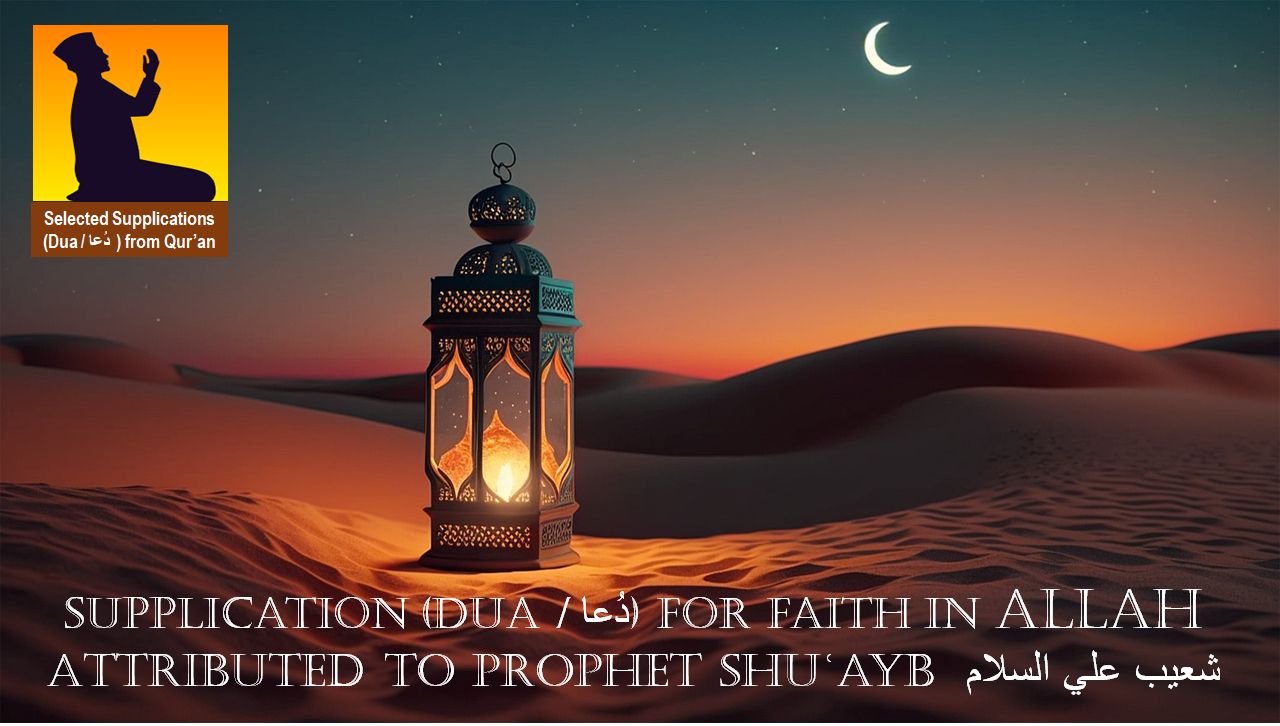
We have already shared supplications made by prophets in our series of posts on Selected Invocations / Dua " دُعا " from Quran under the sub head of Prophetic Supplications. Today we share yet another prophetic supplication attributed to Prophet Shu'ayb  شعيب علي السلام, also spelt as Shuaib, Shoaib or Shuayb. Prophet Shu'ayb was an ancient Midianite Nabi (Prophet) in Islam, and the most revered prophet in the Druze faith. He is traditionally identified with the Biblical Jethro, Moses' father-in-law. Shuaib is mentioned in the Quran a total of 11 times. He is believed to have lived after Ibrahim (Abraham), and Muslims believe that he was sent as a prophet to a community: the Midianites, who are also known as the Aṣḥāb al-Aykah ("Companions of the Wood"), since they used to worship a large tree. [1]

Before sharing the selected verse from Qur'an that exhibits firm and unflinching faith of Prophet Shuaib in Allah, let us present the translation of the verses before the 88th verse of Surah 11. Hud that led to the proclamation of his faith in Allah despite the heedlessness of his people:
(11:84) And to (the people of) Midian We sent their brother Shu'ayb. He said: 'My people! Serve Allah; you have no god other than Him. And do not diminish the measure and weight. Indeed, I see that you are prospering now, but I fear for you the chastisement of an encompassing day in the future.
(11:85) My people! Give full measure and weight with justice, do not diminish the goods of others, and do not go about creating corruption in the land.
(11:86) The gains that Allah lets you retain are better for you, if you indeed believe. In any case, I have not been appointed a keeper over you.
(11:87) They replied: 'O Shu'ayb! Does your Prayer enjoin upon you that we should forsake the deities whom our forefathers worshipped, or that we should give up using our wealth as we please?97 Do you fancy that you, and only you, are forbearing and right-directed?'
To the most unreasonable response from his people, Prophet Shu'ayb responded as under, showing his unflinching faith in Allah no matter how his people reacted to his invitation:

قَالَ يٰقَوۡمِ اَرَءَيۡتُمۡ اِنۡ كُنۡتُ عَلٰى بَيِّنَةٍ مِّنۡ رَّبِّىۡ وَرَزَقَنِىۡ مِنۡهُ رِزۡقًا حَسَنًا​ ؕ وَمَاۤ اُرِيۡدُ اَنۡ اُخَالِفَكُمۡ اِلٰى مَاۤ اَنۡهٰٮكُمۡ عَنۡهُ​ ؕ اِنۡ اُرِيۡدُ اِلَّا الۡاِصۡلَاحَ مَا اسۡتَطَعۡتُ​ ؕ وَمَا تَوۡفِيۡقِىۡۤ اِلَّا بِاللّٰهِ​ ؕ عَلَيۡهِ تَوَكَّلۡتُ وَاِلَيۡهِ اُنِيۡبُ‏ 
(11:88) Shu'ayb said: 'My people! What do you think? If I stand on clear evidence from my Lord, and He has also provided me with a handsome provision from Himself- (should I be ungrateful to Him and share your error and iniquity?) Nor do I desire to act contrary to what I admonish you. I desire nothing but to set things right as far as I can. My success is not but through Allah. In Him have I put my trust, and to Him do I always turn.
Here (rizq) implies two things: provision of the knowledge of the Truth and provision of the necessities of life from Allah. In the first sense, it refers to the same thing that has been declared in this Surah by Prophets Muhammad, Noah and Salih (Allah's peace be upon them all), that is, "Allah bestowed on me by revelation that knowledge of the Truth, which I already had gained by making keen observations of my own self and of the phenomena of Nature. Therefore, I cannot be a party to your evil creeds and unlawful practices." In the second sense, it is the answer to this taunt of theirs: "Indeed you are the only generous and righteous person left in the land!" It meant, so to say, this: "When my Lord has bestowed on me both the knowledge of the Truth and the good and lawful provisions of life, your taunts cannot turn this favor into disfavor. Therefore, I cannot be so ungrateful to Him as to declare your deviations to be the truth and your unlawful practices lawful." 

That is, "It is a proof of the truth of my claim that I myself practice what I preach to you. For instance, if I had forbidden you to visit the shrines of gods and goddesses but had myself become the guardian of some such shrine, you would have been justified in bringing this charge against me that I was preaching the Doctrine of Tauhid merely for the sake of ruining the "business" of others in order to make room for my own trade. Likewise, if I had prohibited the use of unlawful means for you but had myself applied the same in my own trade, you would have been justified in charging me with preaching honesty merely for winning good reputation for the prosperity of my own trade; But you yourselves are a witness to this that I myself abstain from those evils which I forbid you to practice and I keep myself pure from those blemishes of which I desire to cleanse you and I follow the way to which I invite you. All this is a clear proof that I believe in the truth of the Message I am conveying to you." 

Yusuf Ali, one of the most learned scholars of Islam whose exegesis of Qur'an is considered as one of the best, notes that Shu'ayb's answer is gentle and persuasive, First, he would ask them not to fly into a passion but satisfy themselves that he had a mission from Allah, and was working in the discharge of his mission: he was not merely finding fault with them. Secondly, though he was a poor man, he asked them to note that he was happy and comfortable: Allah had given him good sustenance, material and spiritual, as from Himself, though he did not resort to the sort of tricks which they considered necessary for their prosperity. Thirdly, if he forbade them anything he wished to apply the same standards to himself. Fourthly, all the advice which he is giving them is for their own good, which he desires to advance to the utmost of his powers. Fifthly, he is humble for himself; he would not set himself up to be their teacher or guide, or expect to be obeyed; the success of any of his efforts on their behalf must come from Allah's grace; will they not therefore turn to Allah, so that Allah's grace can heal them?

Tafsir Qur'an Wiki:
Shu`ayb, fully confident of the truth of his message, and aware of his people’s ignorance and short-sightedness, does not let their sarcasm affect him. On the contrary, he seeks to inform them politely that he takes his stand on clear evidence from his Lord, which he feels in his innermost heart. He explains to them that he is fully confident of the truth of what he advocates because his knowledge far exceeds theirs. When he calls on them to stick to honest dealings, the effects of such honesty also apply to him since he is a businessman. He is after no personal gain which he seeks to realize for himself. He does not intend to do behind their backs what he has forbidden them so that he enjoys a market free from competition. His call is one of reform which includes himself. The path he enjoins them to follow will not cause them any losses, as they mistakenly think.
 
It is, then, the general reform of society which Shu`ayb is after. It is a reform which brings benefit to every individual and every community. Some may think that to adhere to moral values and implement the divine law may make them lose some chances which may be open to them, or lose some gain which they would otherwise achieve. But implementing the divine law can only make them lose evil gains and wicked opportunities. It compensates them with goodly gains and lawful provisions. It also establishes a society which is characterized by the co-operation of its individuals. It is a society which is free from grudges, treachery and selfish quarrels.

So, my dear brothers and sisters in Islam, stay firm as much as you can before the people who do not respond to your viewpoint (about Islam) and do not get derailed by their negative onslaught. And if they are least responsive, then you may tell them that all you say is because of your true faith in Allah, the One and the Only God. And that you do not need any reward from them for Our success is not but through Allah. In Him have I put my trust, and to Him do I always turn.
May Allāh (سبحانه و تعالى‎) help us understand Qur'ān and follow the Sunnah of Prophet Muhammad ﷺ, which is embodiment of commandments of Allah contained in the Qur'ān. May Allah help us to be like the ones He loves and let our lives be lived helping others and not making others' lives miserable or unlivable. May all our wrong doings, whether intentional or unintentional, be forgiven before the angel of death knocks on our door. 
وَمَا عَلَيۡنَاۤ اِلَّا الۡبَلٰغُ الۡمُبِيۡنُ‏ 
(36:17) and our duty is no more than to clearly convey the Message.”
That is Our duty is only to convey to you the message that Allah has entrusted us with. Then it is for you to accept it or reject it. We have not been made responsible for making you accept it forcibly, and if you do not accept it, we shall not be seized in consequence of your disbelief, you will yourselves be answerable for your actions on Day of Resurrection.

Reading the Qur'ān should be a daily obligation of a Muslim - Reading it with translation will make it meaningful. But reading its Exegesis / Tafsir will make you understand it fully. It will also help the Muslims to have grasp over social issues and their answers discussed in the Qur'an and other matter related to inter faith so that they are able to discuss issues with non-Muslims with authority based on refences from Qur'an.

May Allah forgive me if my posts ever imply a piety far greater than I possess. I am most in need of guidance.

Note: When we mention God in our posts, we mean One True God, we call Allah in Islam, with no associates. Allah is the Sole Creator of all things, and that Allah is all-powerful and all-knowing. Allah has no offspring, no race, no gender, no body, and is unaffected by the characteristics of human life.

For more Selected Verses, please refer to our reference page: Selected Invocations / Dua " دُعا " from the Qur'anYou may also refer to our Reference Pages for knowing more about Islam and Qur'ān.
Photo | Reference: | 1 | 2 | 3 | 4 | 5
Reading the Qur'ān should be a daily obligation of a Muslim - Reading it with translation will make it meaningful. But reading its Exegesis / Tafsir will make you understand it fully.

An effort has been made to gather explanation / exegesis of the surahs of the Qur'ān from authentic sources and then present a least possible condensed explanation of the surah. In that the exegesis of the chapters of the Quran is mainly based on the "Tafhim al-Qur'an - The Meaning of the Qur'an" by one of the most enlightened scholars of the Muslim World Sayyid Abul Ala Maududi.  

In order to augment and add more explanation as already provided, additional input has been interjected from following sources: 
  • Towards Understanding the Quran
  • Tafsir Ibn Khatir
  • Muhammad Asad Translation
  • Javed Ahmad Ghamidi / Al Mawrid
  • Al-Quran, Yusuf Ali Translation
  • Verse by Verse Qur'an Study Circle
In addition, references of other sources which have been explored have also been given above. Those desirous of detailed explanations and tafsir (exegesis), may refer to these sites.

If you like Islam: My Ultimate Decision, and to keep yourself updated on all our latest posts to know more about Islam, follow us on Facebook

Please share this page to your friends and family members through Facebook, WhatsApp or any means on social media so that they can also be benefited by it and better understand Islam and the Qur'ān - Insha Allah (Allah Willing) you shall be blessed with the best of both worlds.
Believers!! Do you seek the pomp and glitter of the world?

Man is always tempted to the glitter and pomp and show of the world. No matter how good a believer may one be, yet he is bound to slip and fell into the trap of worldly amusement, not thinking that such distracting means take him away from the remembrance of Allah, which is more yielding in blessings and bounties one can ever imagine. It is far better to sit with people who wield radiance of Islam and keep others on the righteous path rather than those who distract one's thoughts and entice them to lewdness of life.

This is the very theme of 28th verse of Surah 18 Al Khaf (The people of the cave) which cautions believers to always be remembering their Lord, day and night so that the evil spell does not engulf them into the glitters of the worldly life and disarray their orientation from remembrance of Allah.

This verse is also for those who keep exclusive company of their own kind and forget about the poor and remain oblivious to their needs and happiness. That is our leaders who by and large remain aloof about the problems of the poor and shy away from having any contact with them. The same way the Quraish of Makkah wanted our revered prophet Muhammad ﷺ to leave his poor companions (by worldly standards) and befriend with the elite of Makkah.

وَاصۡبِرۡ نَـفۡسَكَ مَعَ الَّذِيۡنَ يَدۡعُوۡنَ رَبَّهُمۡ بِالۡغَدٰوةِ وَالۡعَشِىِّ يُرِيۡدُوۡنَ وَجۡهَهٗ​ وَلَا تَعۡدُ عَيۡنٰكَ عَنۡهُمۡ​ ۚ تُرِيۡدُ زِيۡنَةَ الۡحَيٰوةِ الدُّنۡيَا​ ۚ وَ لَا تُطِعۡ مَنۡ اَغۡفَلۡنَا قَلۡبَهٗ عَنۡ ذِكۡرِنَا وَاتَّبَعَ هَوٰٮهُ وَكَانَ اَمۡرُهٗ فُرُطًا‏ 
(18:28) Keep yourself content with those who call upon their Lord, morning and evening, seeking His pleasure, and do not let your eyes pass beyond them. Do you seek the pomp and glitter of the world? Do not follow him whose heart We have caused to be heedless of Our remembrance, and who follows his desires, and whose attitude is of excess.
Though these words have also been addressed to the Holy Prophet, they are really meant for the chiefs of the Quraish. According to a Tradition related by Ibn `Abbas, the chiefs of the Quraish would say to the Holy Prophet that they considered it below their dignity to sit with such people as Bilal, Suhaib, 'Ammar, Khabbab, Ibn-Mas`ud and the like who generally remained in his company: and that if he should send them away, they would be willing to attend his meetings in order to learn about his Message. At this Allah revealed this verse: "And keep yourself whole-heartedly content with those who pray to their Lord morning and evening in order to win His approval and do not turn your attention away from them: (Do you desire to discard these sincere but poor people so that the chiefs of the Quraish, the well-to-do people, should come and sit near you?)" This was meant to warn the chiefs of the Quraish to this effect: "Your wealth, your pomp and show of which you are so proud, has no value at all in the sight of Allah and His Messenger; nay, those poor people are really more worthy in their sight, for they are sincere and always remember Allah." The same was the attitude of the chiefs of Prophet Noah's people, who said, "And we see also that none but the meanest and the shallowest of our people have become your followers. " .... (Noah replied,) "I am not going to drive away those who have believed in me, nor can I say about those whom you disdain, `Allah has not bestowed any good on them'. . . " (XXI: vv. 27, 29, 31)  

That is, "Do not yield to what he says, nor submit to him, nor fulfill his desire, nor follow his bidding." 

The original Arabic text may also mean, "Who discards the truth, breaks all moral limits and rushes on headlong." But in both cases, it comes to this: "The one, who is neglectful of Allah and becomes a slave of his lust, inevitably transgresses all limits and becomes a victim of immoderation. Therefore, the one who submits to him will also follow the same way and wander about in deviation after him.

Tafsir Ibn-Kathir
(And keep yourself patiently with those who call on their Lord morning and afternoon, seeking His Face;) meaning, sit with those who remember Allah, who say "La Ilaha Illallah'', who praise Him, glorify Him, declare His greatness and call on Him, morning and evening, all the servants of Allah, whether rich or poor, strong or weak. It was said that this was revealed about the nobles of Quraysh when they asked the Prophet to sit with them on his own, and not to bring his weak Companions with him, such as Bilal, `Ammar, Suhayb, Khabbab and Ibn Mas`ud. 

They wanted him to sit with them on his own, but Allah forbade him from doing that, and said, (And turn not away those who invoke their Lord, morning and afternoon.) Allah commanded him to patiently content himself with sitting with those people (the weak believers), and said: 
(And keep yourself patiently with those who call on their Lord morning and afternoon...) Imam Muslim recorded in his Sahih that Sa`d bin Abi Waqqas who said: "There was a group of six of us with the Prophet. The idolators said, `Tell these people to leave so they will not offend us.' There was myself, Ibn Mas`ud, a man from Hudayl, Bilal and two other men whose names I have forgotten. Allah's Messenger thought to himself about whatever Allah willed he should think about, then Allah revealed:
(And turn not away those who invoke their Lord, morning and afternoon.) Only Muslim reported this; excluding Al-Bukhari.

(And let not your eyes overlook them, desiring the pomp and glitter of the life of the world;) Ibn `Abbas said, ` (this means) do not favor others over them, meaning do not seek the people of nobility and wealth instead of them.'

(And obey not him whose heart We have made heedless of Our remembrance) means, those who are distracted by this world from being committed to the religion and from worshipping their Lord.

(And whose affair (deeds) has been lost.) means, his actions and deeds are a foolish waste of time. Do not obey him or admire his way or envy what he has. 

As Allah says elsewhere:(And strain not your eyes in longing for the things We have given for enjoyment to various groups of them, the splendor of the life of this world, that We may test them thereby. But the provision of your Lord is better and more lasting.) 20:131﴾

Yusuf Ali Explanation:  
Cf. vi. 52. The true servants of Allah are those whose hearts are turned to Him morning, noon, and night, and who seek not worldly gain, but Allah's Grace, Allah's own Self, His Presence and nearness. Even if they are poor in this world's goods, their society gives far more inward and spiritual satisfaction than worldly grandeur or worldly attractions.

For those who stray from Allah's path, Allah's Grace is ever anxious: it seeks to reclaim them and bring them back to the path. If such a one resists, and follows his own lusts, a point is reached when his case becomes hopeless. Allah's Grace does not then reach him, and he is abandoned to his pride and insolence. Beware of following the example or advice of such a one or seeking his society, or hankering after his wretched idols.

Tafsir Qur'an Wiki:
And contain yourself in patience with those who call on their Lord morning and evening, seeking His countenance. Let not your eyes pass beyond them in quest of the beauties of the life of this world. Pay no heed to any whose heart We have left to be negligent of all remembrance of Us because he had always followed his own desires, and whose case has gone beyond all bounds.
Say: ‘The truth [has now come] from your Lord. Let him who wills, believe in it, and let him who wills, reject it.’ (Verses 28-29)
The same applies to us in our practical daily life. We have friends who are always luring us into the pomp and show of the world as they have no fear of the consequences and want to enjoy their lives in complete tangent to the path of Allah. This is normally so for the rich and affluent people who have plenty to squander and this take their friends along, who willingly accompany them. And on the opposite, there are God fearing believers who are all the time evading such company of people and are even trying to persuade them to the rmembrance of Allah. This is seldom heeded to. 

Such is the life since time immemorial and the rich and famous enjoyed killing of people in the arenas of dark days, something that still continues. Unfortunately, more and more beleivers are succumbing to the worldly galore and forgetting the remembrance of Allah. Rich people of affluent Muslim lands book entire hotels for a few or planes are booked for hunting birds. Likewise, casinos are opening in Muslim countries which are attracting younger lot of the affluent and taking them away from the simple yet reward yielding life. Only if we can understand!!

May Allāh (سبحانه و تعالى‎) help us understand Qur'ān and follow the Sunnah of Prophet Muhammad ﷺ, which is embodiment of commandments of Allah contained in the Qur'ān. May Allah help us to be like the ones He loves and let our lives be lived helping others and not making others' lives miserable or unlivable. May all our wrong doings, whether intentional or unintentional, be forgiven before the angel of death knocks on our door. 
وَمَا عَلَيۡنَاۤ اِلَّا الۡبَلٰغُ الۡمُبِيۡنُ‏ 
(36:17) and our duty is no more than to clearly convey the Message.”
That is Our duty is only to convey to you the message that Allah has entrusted us with. Then it is for you to accept it or reject it. We have not been made responsible for making you accept it forcibly, and if you do not accept it, we shall not be seized in consequence of your disbelief, you will yourselves be answerable for your actions on Day of Resurrection.

Reading the Qur'ān should be a daily obligation of a Muslim - Reading it with translation will make it meaningful. But reading its Exegesis / Tafsir will make you understand it fully. It will also help the Muslims to have grasp over social issues and their answers discussed in the Qur'an and other matter related to inter faith so that they are able to discuss issues with non-Muslims with authority based on refences from Qur'an.

May Allah forgive me if my posts ever imply a piety far greater than I possess. I am most in need of guidance.

Note: When we mention God in our posts, we mean One True God, we call Allah in Islam, with no associates. Allah is the Sole Creator of all things, and that Allah is all-powerful and all-knowing. Allah has no offspring, no race, no gender, no body, and is unaffected by the characteristics of human life.

For more Selected Verses, please refer to our reference page: Selected Verses from the Qur'anYou may also refer to our Reference Pages  and Understanding Al Qur'an for knowing more about Islam and Qur'ān.
Photo | Tafsir References: | 1 | 2 | 3 | 4

An effort has been made to gather explanation / exegesis of the surahs of the Qur'ān from authentic sources and then present a least possible condensed explanation of the surah. In that the exegesis of the chapters of the Quran is mainly based on "Tafhim al-Qur'an - The Meaning of the Qur'an" by one of the most enlightened scholars of the Muslim World Sayyid Abul Ala Maududi.  
In order to augment and add more explanation as already provided, additional input has been interjected from the following sources: 
  • Tafsir Ibn Khatir
  • Muhammad Asad Translation
  • Yusuf Ali Translation
  • Translation Javed Ahmad Ghamidi / Al Mawrid
  • Qur'an Wiki
  • Verse by Verse Qur'an Study Circle
  • Towards Understanding the Quran
In addition, references of other sources which have been explored have also been given above. Those desirous of detailed explanations and tafsir (exegesis), may refer to these sites.

If you like Islam: My Ultimate Decision, and to keep yourself updated on all our latest posts to know more about Islam, follow us on Facebook

Please share this page to your friends and family members through Facebook, WhatsApp or any means on social media so that they can also be benefited by it and better understand Islam and the Qur'ān - Insha Allah (Allah Willing) you shall be blessed with the best of both worlds.

Friday, 26 May 2023

Backbiting and slandering - The worst acts of a believer (Hadith Prophet Muhammad ﷺ)

The 104th chapter of Qur'an, Surah Al Humazah begins with the warning for the slanderers, mockers and backbiters. The very first verse of the Sūrah al-Humazah begins with two words “Humazat il- Lumazah” which together mean the same: The slanderers. While the first word means slanderers who hurt others by word of mouth, the second word means slanderers who hurt others by action. These are Traducers, the Backbiters, the Mockers and many such similar qualities of man which ultimately result into his destruction and have him taken to the fire of hell where he is "crushed" forever.

The same is the theme of the Hadith attributed to Prophet Muhammad ﷺ being shared today. The Hadith is mentioned in Sunan Abi Dawud (Book # General Behavior (Kitab Al-Adab) كتاب الأدب / Chapter # 40 Regarding backbiting (al-ghibah ) باب فِي الْغِيبَةِ) as Hadith number # 4874, shared as under:

حَدَّثَنَا عَبْدُ اللَّهِ بْنُ مَسْلَمَةَ الْقَعْنَبِيُّ، حَدَّثَنَا عَبْدُ الْعَزِيزِ، - يَعْنِي ابْنَ مُحَمَّدٍ - عَنِ الْعَلاَءِ، عَنْ أَبِيهِ، عَنْ أَبِي هُرَيْرَةَ، أَنَّهُ قِيلَ يَا رَسُولَ اللَّهِ مَا الْغِيبَةُ قَالَ ‏"‏ ذِكْرُكَ أَخَاكَ بِمَا يَكْرَهُ ‏"‏ ‏.‏ قِيلَ أَفَرَأَيْتَ إِنْ كَانَ فِي أَخِي مَا أَقُولُ قَالَ ‏"‏ إِنْ كَانَ فِيهِ مَا تَقُولُ فَقَدِ اغْتَبْتَهُ وَإِنْ لَمْ يَكُنْ فِيهِ مَا تَقُولُ فَقَدْ بَهَتَّهُ ‏"‏‏.‏
Abu Hurairah said:
The Messenger of Allah (ﷺ) was asked: Messenger of Allah! What is back-biting? He replied: It is saying something about your brother which he would dislike. He was asked again: Tell me how the matter stands if what I say about my brother is true? He replied: If what you say of him is true, you have slandered him, and if what you say of him is not true, you have reviled him.

Grade: Sahih (Al-Albani)

The Hadith quoted above clearly cautions the believers never to say anything of his brother, that is brother in Islam, which he dislikes. And even if one says something true about his brother, it is tantamount to slandering. That is either one should have the courage to say something about a brother right in his presence or stay quiet. And if someone has something bad to say about someone, it is desirable that he should avoid doing it and can tell the person in public so that he can make amends or extend his viewpoint to clarify his position. 
May Allāh (سبحانه و تعالى‎) help us understand Qur'ān and follow the Sunnah of Prophet Muhammad ﷺ, which is embodiment of commandments of Allah contained in the Qur'ān. May Allah help us to be like the ones He loves and let our lives be lived helping others and not making others' lives miserable or unlivable. May all our wrong doings, whether intentional or unintentional, be forgiven before the angel of death knocks on our door. 
وَمَا عَلَيۡنَاۤ اِلَّا الۡبَلٰغُ الۡمُبِيۡنُ‏ 
(36:17) and our duty is no more than to clearly convey the Message.”
That is Our duty is only to convey to you the message that Allah has entrusted us with. Then it is for you to accept it or reject it. We have not been made responsible for making you accept it forcibly, and if you do not accept it, we shall not be seized in consequence of your disbelief, you will yourselves be answerable for your actions on Day of Resurrection.

May Allah forgive me if my posts ever imply a piety far greater than I possess. I am most in need of guidance.

Reading the Qur'ān should be a daily obligation of a Muslim - Reading it with translation will make it meaningful. But reading its Exegesis / Tafsir will make you understand it fully. It will also help the Muslims to have grasp over social issues and their answers discussed in the Qur'an and other matter related to inter faith so that they are able to discuss issues with non-Muslims with authority based on refences from Qur'an.

Note: When we mention God in our posts, we mean One True God, we call Allah in Islam, with no associates. Allah is the Sole Creator of all things, and that Allah is all-powerful and all-knowing. Allah has no offspring, no race, no gender, no body, and is unaffected by the characteristics of human life.

Please refer to our reference page: Sunnah and Hadith of Prophet Muhammad ﷺ to know more about sunnah of Prophet of Allah. You may also refer to our Reference Pages for knowing more about Islam and Qur'ān.

Disclaimer: The material for this post has been collected from the references as given below. If anyone differs with the material contained in this post, one may consult the references and their authors.  If someone has more material about the subject, he/she is most welcome to share in the comments box to make the post all encompassing.

If you like Islam: My Ultimate Decision, and to keep yourself updated on all our latest posts to know more about Islam, follow us on Facebook

Please share this page to your friends and family members through Facebook, WhatsApp or any means on social media so that they can also be benefited by it and better understand Islam and the Qur'ān - Insha Allah (Allah Willing) you shall be blessed with the best of both worlds.

Wednesday, 24 May 2023

Islam in Congo

The Democratic Republic of the Congo, also known as Congo-Kinshasa and formerly known as Zaire, is a country in Central Africa. With a population of around 112 million, the Democratic Republic of the Congo is dominated by with various Christian denominations and sects. Islam was first introduced to the Congo basin from the East African coast during 19th century and remains largely concentrated in parts of Eastern Congo, notably in Maniema Province. Though estimates vary, it is generally believed that between one and 10 percent of the country's population identify as Muslim. [1] However, other estimates put the ratio of Muslims about 10-15%. [2]

Until the 1920s the Muslim presence was not felt strongly in the country which, since the 19th century, had been a Belgian colony. Since then, the Muslim presence in the country has been manifesting itself through the NGOs and Quranic schools that have been founded. But this time the domination of the educational system by Christian and colonial powers acted as a disincentive to Muslim involvement in public life and has always kept them away. Years of Belgian colonial rule not only saw restrictions on Muslim worship, but Muslim children were expelled from schools, force-fed pork, and people were forced to eat and drink during Ramadan. [2]

The independence in 1960 resulted into more oppression for and discrimination against Muslims instead of more freedom. The existing political and military conflicts in the areas where they lived contributed to the further marginalization of the Muslim minority. 

The Muslim minority has been in dire straits since the uprising affecting the eastern parts of the country, especially since 2010. Having been targeted by the government on account of accusations of collaborating with armed opposition groups, some Muslims have had to flee their homes and migrate to other regions. The existence of armed groups from the Muslim minority, such as the Allied Democratic Forces of Islam(ADF-Nalu), who have been involved in the events, has brought misery upon ordinary Muslims, despite their disengagement from the conflict. While mosques in the country have become a target for attacks, the problem of security still waits to be solved. [2] 


Muslims today form a sizeable minority in Congo of today. The highest concentration of Muslims is in Maniema Province and especially its cities of Kasongo and Kindu where they represent 80–90 percent and 25 percent of the population respectively. Besides indigenous Muslims, the population also includes immigrants from Lebanon, India, Pakistan and other parts of the African continent. The vast majority of Muslims in the country identify themselves as Sunni, following the Maliki school of jurisprudence (fiqh). Congolese Muslims are frequently divided between conservative Sufis and Reformists (Salafists) as well as along local ethnic, geographical, and generational lines.

Congolese Muslims are represented at a national level by the Islamic Community of the Democratic Republic of the Congo (Communauté islamique du République démocratique du Congo, or Comico) which succeeded the Islamic Community of Zaire (Communauté islamique du Zaïre, Comiza) founded in the 1970s. However, Muslims have little political influence in national politics and are underrepresented in its institutions. Of the 450 MPs in parliament, only three are there to represent the Muslim minority. However, if representation was given in proportion relation to their numbers, there would need to be at least 65-70 Muslim MPs. [2]

As of today, while the majority of Muslims in the warn-torn areas is low to miserable, while Muslim minority living in the capital city of Kinshasa and in other urban centers seems unaffected that of the war-torn areas. Urban centers, where the central authority is powerful, are the primary destinations of migrants.

The religious education of Muslim children is almost non-existant as most Muslim schools are not Qur’anic and are open to children of other faiths. One of the few academic studies of Congolese Muslim schools noted that they may employ non-Muslim teachers and apart from religious teaching were not noticeably different from any other Congolese school. Muslims parents who want a more rigorous Qur’anic education for their children tend to arrange it as an extra-curricular activity. All of which seems to indicate that Islam in the Democratic Republic of Congo is neither orthodox nor closed, and despite their near invisibility in demographic and development studies, has a lot to offer in national reconstruction. [3]
The plight of Muslims is worse and threatening due to the civil war, syas Imam of Beni, Musa Angwandi, is the leader of approximately 35,000 Muslims in Beni Territory. He says the community is very stressed, they are accused of things they haven’t done and he is afraid that if they are further intimidated they may take things into their own hands. During one of my many forays into the bush I see an abandoned mosque near Eringeti and when I ask the reason why it is no longer used I am told that the worshippers were chased away and pigs heads were left on the steps. As is so often the case with Congo stories, deeper digging reveals that this was less a tale of religious scapegoating and was more likely a manifestation of local political skirmishes.[3]
To ease the sufferings of the Congolese Muslims, former Libyan leader Muammar Gaddafi financed proliferation of mosques in the greater North Kivu covering Butembo and Beni on to Ituri, regions which have seen growth of a Muslim community from the late 1980s and early 90s. It is here the UN Peace Keeping continegent from Pakistan has been based sine late 1990s and have had their influence on the growth of Islam. Pakistani contingent has built number of mosques in greater north Kivu and Ituri regions.
Pakistan troops in Bukavu, south Kivu [Photo]

The internal strife among the Muslim community is a bane for the community as a whole. The armed groups do not show mercy and many a killing has been reported. 
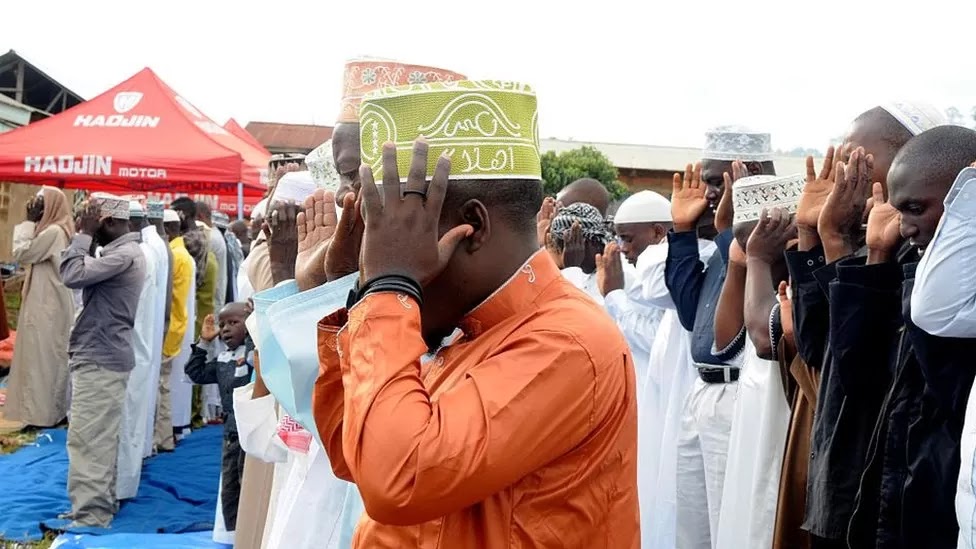
Muslims offering prayers [Photo: Getty Images/BBC]

In May 2021, a senior Muslim cleric in eastern Democratic Republic of Congo was shot dead while praying in the main mosque in Beni city. The cleric was a strong critic of Islamic militancy in the region, Reuters news agency reports. Eastern DR Congo has been badly hit by instability, including attacks claimed by the Islamic State (IS) group. Many armed groups operate in eastern DR Congo, a legacy of the conflicts that gripped the region in the 1990s.
However, despite being underrepresented in the media and politically, the Muslim community in the Congo seems to be expanding and shows a stronger desire to exist on the political and social scene. The fragile stability of the region pushes the inhabitants to organize themselves so as not to create misunderstandings. The association “ Islamic Dynamics for the Fight against Terrorism in the Great Lakes Region ” was created to respond to extremism and the stigmatization of Muslims. This structure pleads with the Congolese government, which is mainly non-Muslim. During our discussion, the Sheikh sighs and notes the lack of representativeness of the population of Muslim faith in the DRC: “Out of 26 provinces of the country, no governor is Muslim. In the general assembly, 540 deputies, only two Muslims ”. [4]
A study group as reported by alohanews Meeting with Muslims in a mosque in Goma

Muslims who, like elsewhere, are fighting against stigmatization following a painfully heavy global context to bear. Redefining themselves, asserting themselves, being represented, so many battles that Muslims are struggling to lead in Europe as well. A country historically weakened by the thirst for power, the slave trade, colonization... but which continues to believe in hope. The Congolese have in common a bloody history and present. However, various testimonies lean towards the desire to build together with a view to social peace. A slim hope that everyone dreams of. 

When would peace prevail in Congo, one is not very sure. But the effect of overall violence has permeated into the Muslim community as well and adversly affecting their lives.

PS: I could not find any video reflecting how Muslims celebrate their festivals and normal life in Congo. Will add as and when I find one. All videos on YouTube are about violence and conflicts.

Disclaimer: The data for this post has been collected from the references given below. If anyone differs with the material contained in this post, one may consult the references and their authors.  If someone has more material about the subject, he/she is most welcome to share in the comments box to make the post all encompassing.

To know more about life of Muslims in other non-Muslim countries, please visit our Reference Page: Islam and Life of Muslims in Non Muslim Countries

You may also refer to our Reference Pages for knowing more about Islam and Quran.
Photo | References: | 1 | 2 | 3 | 4 | 
If you like Islam: My Ultimate Decision, and to keep yourself updated on all our latest posts to know more about Islam, follow us on Facebook

Please share this page to your friends and family members through Facebook, Twitter, WhatsApp or any means on social media so that they can also be benefited by it and better understand Islam and the Holy Qur'an - Insha Allah (Allah Willing) you shall be blessed with the best of both worlds.

Twitter Delicious Facebook Digg Stumbleupon Favorites More