.

Wednesday, 13 April 2022

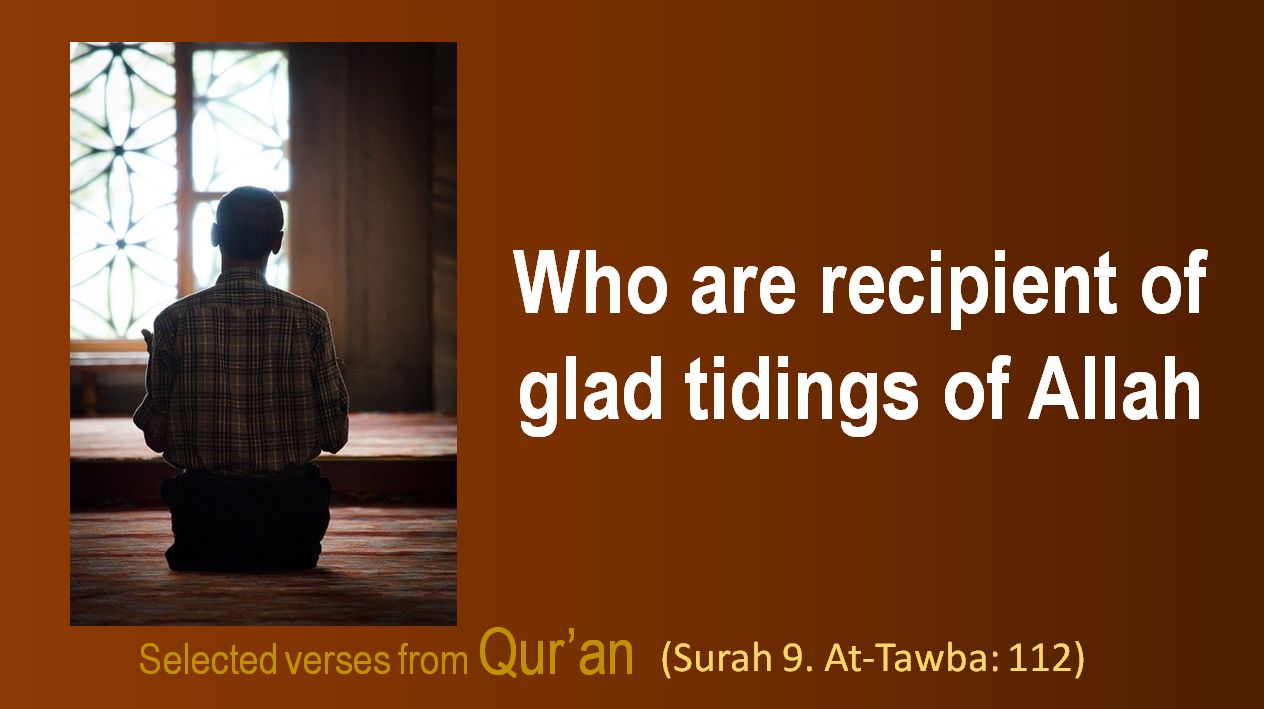
Who are recipient of glad tidings of Allah

The month of Ramdan 2022/1443 has entered its second part, which is considered to be the part of seeking mercy and forgiveness from Allah from ones sins and wrong doings. Allah knows that His servants will be liable to worldly lewdness and Satanic machinations. That is why He has left open the door of His merch for those who realize their wrong doings, yet repent their actions and invoke Allah's countless mercies for forgiveness. And this has been promised by Allah at many places in Qur'an:
 “And hasten to forgiveness from your Lord, and a Garden the extensiveness of which is the heavens and the earth, prepared for those who guard against evil. (Surah 3. Ali 'Imran:132) 
Will they not turn to Allah and seek His forgiveness, and Allah is oft-forgiving, Merciful? Surah 5 Al-Ma'idah:74)

Prophet Muhammad ﷺ has been quoted as saying ( reported by Abu Huraira (RA), “Whoever observes fasts during the month of Ramadan out of sincere faith, and hoping to attain Allah’s rewards, then all his past sins will be forgiven.” – Sahih Bukhari 2: 37

So we have this blessed month of Ramadan and lucky will be those whose prayers, supplications and invocations will be accepted and whose repentances will be accepted and thus forgiven.

Today we share the 112th verse of Surah 9. At Tawba in which Allah asks His Prophet  ﷺ to give glad tidings to those who will be blessed and will have greater rewards both in this world and in the hereafter. So let us try to be among those in this Ramdan and even after this blessed month is over to be in continuous pursuit to be in the list of those who will be the recipient of glad tidings of Allah. And the verse is appended and explained below:

اَلتَّاۤـئِبُوۡنَ الۡعٰبِدُوۡنَ الۡحٰمِدُوۡنَ السّاۤـئِحُوۡنَ الرّٰكِعُوۡنَ السّٰجِدُوۡنَ الۡاٰمِرُوۡنَ بِالۡمَعۡرُوۡفِ وَالنَّاهُوۡنَ عَنِ الۡمُنۡكَرِ وَالۡحٰـفِظُوۡنَ لِحُدُوۡدِ اللّٰه ِ​ؕ وَبَشِّرِ الۡمُؤۡمِنِيۡنَ‏ 

[9:112] Those who constantly turn to Allah in repentance, who constantly worship Him, who celebrate His praise, who go about the world to serve His cause, who bow down to Him, who prostrate themselves before Him, who enjoin what is good and forbid what is evil, and who keep the limits set by Allah. Announce glad tidings to such believers.

The abovesaid eight traits are of those who will be given Allah's glad tidings. We invariable exhibit all these traits but have no consistency and tend to sway away and lose our way to please Allah. 

We are to rejoice that by giving up such small things as ourselves and our possessions we are to be rewarded with such a great thing as the eternal life of felicity. The truly righteous, whose lives in various aspects are described in this verse, do so rejoice. The good news is to be proclaimed to all Believers, including the weakest among us, so that they may profit by that example.

Let us now see how some of the eminent Muslim scholars explain this verse and how can we make an endeavour to be among the blessed:

Sayyid Abul Ala Maududi

(Those who constantly turn to Allah in repentance) The Arabic word (atta-i-bun) literally means "those who repent" . But in the context it occurs it implies "those who possess repentance as their permanent characteristic", that is, they repent over and over again. Moreover, the literal meaning of (taubah) is "to turn to" or "to turn back" . Therefore its explanatory translation will be "....those who turn back to Allah over and over again" . This is the first and foremost characteristic of a true Believer because even a true Believer is liable to forget the bargain he makes with Allah by which he sells his life and property to Him. As this matter does not concern his sense organs but pertains to his mind and heart, he is liable to forget that these things are not really his property but they belong to Allah. Therefore, even the true believer occasionally forgets the bargain, and behaves in a way as if he were their owner. But as soon as he becomes conscious of this transitory lapse and realizes that he had violated the terms of his agreement, he feels sorry and ashamed of his conduct and turns to his God, begs His pardon and renews the terms of the bargain with Him, and pledges his allegiance to Him after every slip of its violation. This kind of repentance alone is the guarantee that one will always come back to one's Faith: otherwise it is not possible for man because of the inherent human weaknesses, to observe strictly and deliberately the terms of the bargain without ever falling a prey to negligence and error. That is why Allah says in praise of the true Believer that ".....he turns back to Allah over and over again" and not that "he never slips into error after making the bargain of obedience and service to Him" . And this is the greatest excellence that man can accomplish. Let us now consider the wisdom of placing this characteristics first in the list of the characteristics of the true Believers. It is to admonish those who had been guilty of crimes after the profession of their Faith, They have been told in v. III that the true Believers are those who sell their lives and property to Allah. After this they are being told that if they sincerely intend to become true Believers they should first of all create in themselves this characteristic and at once turn to Allah without showing any obduracy so that they should not deviate further into error.

(who constantly worship Him, who celebrate His praise, who go about the world to serve His cause) Some commentators are of the opinion that here (Assn `ihun) means " . . . those who observe fast" . As this is not the lexical meaning of the word but only its figurative sense, which has been based on an unauthentic tradition attributed to the Holy Prophet, we are of the opinion that there is no need to depart from its lexical meanings, that is,".....move about in the land (for His sake...,... "). For here the Arabic word does not mean merely to "...move about in the land" but "move about in the land for the sake of noble and high aims, e.g. to propagate Islam, to do Jihad, to emigrate from those places where the unbelievers are in power, and to reform the people, to seek True Knowledge, to earn a lawful livelihood and the like" . This characteristic of the Believers has been especially mentioned here to reprove those who had not gone forth to Jihad, in spite of their claim that they were "Believers" . They have been admonished that a true Believer is the one who goes forth into the land to raise high His Word, and exerts his utmost to fulfill the implications of his Faith, and not the one who stays behind when he is called upon to move about in the land.

(who bow down to Him, who prostrate themselves before Him, who enjoin what is good and forbid what is evil, and who keep the limits set by Allah.) That is those who "strictly observe the limits prescribed by Allah . . . . . " in regard to the Articles of the Faith, worship-morality, social behavior, culture, economics, politics, judiciary, peace and war- in short, in all the aspects of their individual and collective lives. They neither transgress these limits in order to follow their lusts nor invent laws nor replace the Divine Law by other laws. They establish these limits and prevent their violations. Hence, the true Believers are those who not only strictly observe the limits prescribed by Allah, but also do their very best to establish them and safeguard them so as to prevent their violation to the best of their powers and capabilities.

Javed Ahmad Ghamidi Explanation: The inchoative (mubtadā’) is suppressed here. The actual construction would be: هُمْ التائبون. Here the attributes which every true believer should have so that he is able to decide the requisites of faith and the attitude which is regarded as disbelief and hypocrisy are explained to the hypocrites. Imām Amīn Aḥsan Iṣlāḥī writes:

Of the various components of the character of believers that are mentioned here, the first one is penitence. It means “turning to God.” The first step that a person should do in worshipping and obeying God is that instead of wandering about in satanic ways he turns to his Lord and shows determination in treading the straight path. It is this penitence that gets hold of him in every task. Whenever he deviates from the straight path, it is penitence that comes to his rescue and sets him back on the straight path.

After penitence, worship is mentioned. It is the greatest right of God imposed on the person who turns towards God. And since there is no one else except God Who has this right, hence no one else should have a share in this worship nor in obedience because obedience is a natural requisite of worship. After worship, gratitude is mentioned because it is the essence of all forms of worship. This is precisely why rituals like the prayer and the zakāh ... are manifestations of gratitude to God and an acknowledgement of His favours. If the sentiments of gratitude and acknowledgement of favours are not deeply engendered in a person, he is not able to befittingly worship God nor is His worship braced with its true spirit.

After this, exertion is mentioned ... It is a comprehensive expression of all efforts, exercises and struggles which a person undertakes to reform his inner and outer self, to understand and teach religion and to disseminate and spread it with fervour and altruism and for whose cause he sacrifices the pleasures and comforts of his life without any hesitation.

After that, the prayer is mentioned. The expression used to refer to it is الرّٰكِعُوۡنَ السّٰجِدُوۡنَ. Wherever the prayer is mentioned in this manner in the Qur’ān, it does not merely refer to the obligatory prayer. It also alludes to the ones offered in seclusion. It is these prayers which protect all the attributes mentioned earlier and it is they who enliven and nurture the exertion for the cause of God called sayāḥah by the Qur’ān.

After this, forbidding from evil and urging towards virtue is mentioned. The attributes stated earlier refer to individual reform. Now the collective conduct of people is clarified: they enjoin virtue and forbid vice. They are not unconcerned with the right and wrong of others and in fact have great concern in them to reform others, and according to their capacity try to set right wrongs.

At the end, the bounds of God are mentioned. This in fact is an expression of piety. This is a reference to an attribute which is the most comprehensive: in other words, these people remain very vigilant in every phase of life to abide by the bounds set by God and not to cross them. Neither do they themsleves dare to break any limit nor, as far as they are can, permit others to do so. (Amīn Aḥsan Iṣlāḥī, Tadabbur-i Qur’ān, vol. 3, 647) 

Qur'an Wiki:

The first of these qualities is that they “turn to God in repentance.” They appeal to Him for forgiveness, regretting any slip they may make and resolving to turn to Him and follow His guidance in their future days. They will not revert to sin. They will endeavour to do only good actions in order to make their repentance a reality. It is then a means of purging themselves of the effects of temptation and of mending their ways so that they can earn God’s acceptance.

Who worship and praise Him.” They submit and dedicate their worship to Him alone, acknowledging that He is God, the only Lord. This is a basic quality of theirs which is manifested by their worship, and also by their dedicating all their actions and statements to the pursuit of God’s pleasure. Their worship, then, is meant as a practical confirmation of their belief in God’s oneness. They praise God acknowledging His grace which He bestows on them. They praise Him continuously, in times of happiness and in times of adversity. When they are happy they praise God for His blessings, and when they go through difficult times they praise Him because they know that the difficulty is a test which they need to pass. They realize that God will show them His mercy when they prove their metal by going through the test with their faith unshaken. True praise is not that expressed only in times of ease and happiness. It is the praise genuinely expressed in times of adversity, recognizing that God, the Just and Merciful, would not put a believer through a trial unless it is eventually for his own good. A believer may not know that at the time, but God certainly knows it.

Who contemplate [God and His creation.]”  The meaning of the Arabic term which is translated here in this fashion is not readily apparent. There are several interpretations of what it means.

Some people suggest that it refers to those who leave their homes to support God’s cause, while others suggest that it refers to those who strive hard for its triumph. Other scholars suggest that it refers to those who travel in pursuit of knowledge, and still others say that it refers to people who fast. We feel that the interpretation we have chosen is closer to its meaning. It is in reference to such a quality that God says elsewhere in the Qur’ān: “In the creation of the heavens and the earth, and in the succession of night and day, there are indeed signs for men endowed with insight, who remember God when they stand, sit and lie down, and reflect on the creation of the heavens and the earth: ‘Our Lord, You have not created all this in vain. Limitless are You in Your glory. Guard us, then, against the torment of the fire.’” (3: 190-191) The quality of contemplation and reflection is better suited to the context here. With repentance, worship and praising of God comes the quality of reflecting on God and His dominion which will inevitably lead to turning to Him, acknowledging His wisdom manifested in all His creation. The contemplation and reflection are not meant for their own sake or for gaining more knowledge of the world around us, but they should be made the basis on which human society is built.

Who bow down and prostrate themselves.” They attend to their prayers which becomes an essential part of their life. Praying is thus made one of their distinctive characteristics.

Who enjoin the doing of what is right and forbid the doing of what is wrong.”  When a Muslim community that conducts its life in accordance with God’s law is established, making clear that it submits to God and no one else, then the quality of enjoining the doing of what is right and forbidding what is wrong is seen to be fully operative within this community. It addresses any errors of implementation of, or deviation from, the code of living God has revealed. But when there is no Islamic community which gives supremacy to the implementation of God’s law, then this quality of enjoining what is right should be addressed totally to the most important thing, which is acceptance of God’s oneness, submission to His authority and the establishment of a truly Islamic community.

Similarly, the forbidding of what is wrong should also address the greatest wrong, namely, submission to authorities other than God’s through enforcing laws that are at variance with His law. Those who responded to the Prophet Muhammad (peace be upon him) and believed in his message, migrated, and strove to establish the Muslim state that implements God’s law and a Muslim community that is governed on its basis. When this was achieved, they continued to enjoin what is right and forbid what is wrong, addressing matters that related to the details of worship or violation of the Islamic code of living. They never spent any time addressing these details before the establishment of the Islamic state and its Muslim community, because these details only arose as a later and practical development. The concept of doing what is right and forbidding what is wrong must be understood in the light of reality. No matter of detail, whether right or wrong, need be addressed before the basic and essential one is completed, as happened when the first Islamic community came into being.

And keep within the limits set out by God.” That is to say, they make sure of the implementation of God’s law in their own life and in the life of the community, and they resist anyone who tries to forestall it. Like the previous one, this quality can only work in a Muslim community governed by God’s law in all its affairs. By definition, such a community acknowledges God’s sovereignty as the only God, Lord and Legislator, and rejects any authority which seeks to implement laws that are not revealed by God. Efforts must concentrate first of all on the establishment of such a community. Only when it comes into being, will those who “keep within the limits set out by God” have their rightful place in it, as happened in the first Islamic community.

Such is the Islamic community with whom God has made this deal, and such are its distinctive qualities: repentance brings a human being back to God’s way, stops him from committing sin and motivates him to do what is right; worship maintains a close relationship with God and sets the winning of His pleasure as people’s aim; praising God in times of happiness and in adversity is a manifestation of total submission to Him alone and complete trust in His justice and wisdom; reflecting on God’s attributes and the signs that indicate His wisdom and perfection of creation; enjoining what is right and forbidding what is wrong to expand people’s role so as to ensure that the whole community is set on the right course; and keeping within the limits set out by God to ensure their implementation and to prevent any violation.

Such is the believing community which is bound by a deal with God which guarantees heaven in return for their lives and property which they sell to God. It thus implements a rule that has been in force since the start of the divine faith, and the revelation of God’s first message to mankind. The deal means fighting for God’s cause with the aim of making His word supreme, killing those who stand in opposition to God’s message or falling as martyrs in the continuing battle between the truth and falsehood, Islam and jāhiliyyah, God’s law and tyranny, divine guidance and error.

Life is not all play, or all enjoyment and eating as animals eat. Nor is it cheap, humble safety and comfort. True living means doing what is necessary in support of the truth, striving for the cause of goodness, the achievement of victory for God’s cause or sacrificing one’s life for that, and then earning God’s pleasure and admittance into heaven. This is the true life which the believers are called upon to seek: “Believers, respond to the call of God and the Messenger when he calls you to that which will give you life.” (8: 24) 

May Allah help us understand Qur'ān and help us to act upon the commandments of Allah contained therein. Aameen.

For more Selected Verses, please refer to our reference page: Selected Verses from the Qur'anYou may also refer to our Reference Pages for knowing more about Islam and Qur'ān.
Photo | Reference: | 1 | 2 | 3 | 4 | 5 |
Reading the Qur'ān should be a daily obligation of a Muslim - Reading it with translation will make it meaningful. But reading its Exegesis / Tafsir will make you understand it fully.

An effort has been made to gather explanation / exegesis of the surahs of the Qur'ān from authentic sources and then present a least possible condensed explanation of the surah. In that the exegesis of the chapters of the Quran is mainly based on the "Tafhim al-Qur'an - The Meaning of the Qur'an" by one of the most enlightened scholars of the Muslim World Sayyid Abul Ala Maududi.  
In order to augment and add more explanation as already provided, additional input has been interjected from following sources: 
  • Towards Understanding the Quran
  • Tafsir Ibn Khatir
  • Muhammad Asad Translation
  • Javed Ahmad Ghamidi / Al Mawrid
  • Al-Quran, Yusuf Ali Translation
  • Verse by Verse Qur'an Study Circle
In addition the references of other sources which have been explored have also been given above. Those desirous of detailed explanations and tafsir (exegesis), may refer to these sites.

If you like Islam: My Ultimate Decision, and to keep yourself updated on all our latest posts to know more about Islam, follow us on Facebook

Please share this page to your friends and family members through Facebook, WhatsApp or any means on Social Media so that they can also be benefited by it and better understand Islam and the Qur'ān - Insha Allah (Allah Willing) you shall be blessed with the best of both worlds.

Tuesday, 12 April 2022

What is Faith in Allah's Plan (Scholars' Viewpoint)

Faith in Allah is the hallmark of any believer who enters the fold of Islam. But when a believer is tested in try conditions, it is generally seen that his faith start to waver and one falls victim to the machinations of the Satan.

Let us dwell on faith a bit before you reach to the end of the post where we have shared a wonderful lecture on Faith in Allah by eminent scholar, preacher and linguist Nouman Ali Khan.
“Faith” (al-iman) in the Arabic language means to affirm something and to comply with it. Ibn Taymiyyah writes (Majmu’ Al-Fatawa 7/638): It is understood that faith is affirmation and not merely belief. Affirmation includes the words of the heart, which is belief, and the actions of the heart, which is compliance.
So, when we talk of faith in Islam, we mean to believe in Allah, to affirm His truth, and to submit to His commands. Thus, faith in Islam is belief in the Unity of God or Tawheed. This is expressed in the primary Kalimah (Word) of Islam as: “Laa ilaaha illallaah", meaning: “There is no one worthy of worship but Allah.”

The six pillars of faith are to believe and affirm the following:
  • Allah,
  • His angels,
  • His messengers,
  • His books,
  • The Day of Judgment,
  • Providence.
That means that when we lay our full trust in Allah based on our faith in Him, the wonders and secrets of our life start to unfold. We come to know that life is not aimless nor it has any destination.  Everything that takes place around us or even with us is part of an overall plan designed, architectured and run none by Allah. Therefore, we must ponder on ever important milestone of our lives, "Was this was my part of Allah's overall plan?" If the answers come from our heart as negative, then we should continue to pursue still large goals and higher milestones to fit ourselves in to Allah's plan.

And remember, the day our part in Allah's plan has been performed, our journey to our permanent abode would commence. Nothing to be afraid of for death has to come to every living being.

My late father, may Allah be pleased with him, was a very realistic, logical man with an unflinching faith and trust in Allah. He would always analyze his life and often say: I have lived a long life and I wonder why I am still alive for I have passed through many a milestone of my life and always succeeded. Yet I am still alive. May be my test or my part in Allah's plan is yet to come. And yes, that part in Allah's plan did come when my mother suddenly fell seriously ill and was bed ridden for four years. And there was my father looking after her and tendering her all by himself with an extreme sense of love and devotion. And then the fateful day came when my mother took her heavenly flight one summer day. After her burials rituals were over, one day he confides with me that you know all along I have been telling you that my part in Allah's plan hasn't come - and it did come finally with the ailment of your mother and now that she is gone, I know for sure that there is nothing more for me in Allah's plan. And he sure was damn right for just after ten months, he passed away peacefully while talking to a group of his friends.

For me this is the best example of having unflinching faith in Allah's plan.

Please watch the video below on the issue by Nouman Ali Khan, born to a Pakistani family, is an American Muslim speaker and Arabic instructor who founded the Bayyinah Institute for Arabic and Qur’anic Studies, after serving as an instructor of Arabic at Nassau Community College. He has been named one of the 500 most influential Muslims in the world by the Royal Islamic Strategic Studies Centre of Jordan.

وَمَا عَلَيۡنَاۤ اِلَّا الۡبَلٰغُ الۡمُبِيۡنُ‏ 
(36:17) and our duty is no more than to clearly convey the Message.”
That is our duty to convey only to you the message that Allah has entrusted us with. Then it is for you to accept it or reject it. We have not been made responsible for making you accept it forcibly, and if you do not accept it, we shall not be seized in consequence of your disbelief, you will yourselves be answerable for your actions on Day of Resurrection.

May Allāh (سبحانه و تعالى‎) help us understand Qur'ān and help us to act upon the commandments of Allah contained therein. May Allah help us to be like the ones He loves and let our lives be lived helping others and not making others' lives miserable or unlivable. May all our wrong doings, whether intentional or unintentional, be forgiven before the angel of death knocks on our door. 

May Allah forgive me if my posts ever imply a piety far greater than I possess. I am most in need of guidance.

Disclaimer: The views expressed in the video above are those of the scholar concerned. We have shared this view as added information in better understanding of Islam. The reader may or may not agree with the view owing to their own perception. If anyone differs with the material contained in this post, one may consult the references and their authors.  If someone has more material about the subject, he/she is most welcome to share in the comments box to make the post all encompassing.

Photo | References: | 1 | 2 | 

For more Scholarly views and videos, please read our reference page: Scholars' Viewpoint on Important Issues Related to Islam.

You may also refer to our Reference Pages for knowing more about Islam and Quran.
If you like Islam: My Ultimate Decision, and to keep yourself updated on all our latest posts to know more about Islam, follow us on Facebook

Please share this page to your friends and family members through Facebook, Twitter, WhatsApp or any means on social media so that they can also be benefited by it and better understand Islam and the Holy Qur'an - Insha Allah (Allah Willing) you shall be blessed with the best of both worlds.

Monday, 11 April 2022

Justice in Islam: Stand firmly for justice even though it be against the rich or poor

Justice is always portrayed as a blindfolded woman holding the balanced scale  expressing the belief that justice is blind and it doesn't differentiate between who is wronged and who did the wrong. However, it is often seen the despot or the affluent who usually wrong the poor have the backstage reins of justice in their hands and their advocates, well paid and deep pocketed,  over power the representatives of the poor and have the case decided in their favour.

Due to this disparity, the world is plagued with injustices, whether at individual, community, society or even at national and global level. Before advent of Islam, this was the norm and is still the norm even in some of the Muslim countries for we have departed from the teachings of Islam and consider this world as our only abode and usurp the rights of others to make us strong and positional. 

Let us see what is the importance of justice in Islam? The Divine Commandments in the Qur'an lay pronounce justice to be a supreme virtue. It is a basic objective of Islam to the degree that it stands next in order of priority to belief in God's exclusive right to worship (Tawheed) and the truth of Prophet Muhammad's (peace be upon him) prophethood ﷺ. So unless those sitting on the high chairs of justice are well conversant with the importance of justice and the penalty for not ensuring justice as clearly enunciated in the many verses of Qur'an.
It is not enough for believers to uphold justice themselves: they are expected to be its standard-bearers. They are supposed not merely to practice justice in their own dealings but to strive for its triumph. They have to do all within their power to ensure that injustice is eradicated and replaced by equity and justice. A true believer is required to be the pillar supporting the establishment of right and justice.
The testimony of the believers should be solely for the sake of God. Their testimony should not be biased in favour of any of the parties concerned, they should not use any opportunity for personal aggrandizement, and they should not seek to please anyone but God.

And this what the 135th verse of Surah 4. An Nisa is all about:

يٰۤـاَيُّهَا الَّذِيۡنَ اٰمَنُوۡا كُوۡنُوۡا قَوَّامِيۡنَ بِالۡقِسۡطِ شُهَدَآءَ لِلّٰهِ وَلَوۡ عَلٰٓى اَنۡفُسِكُمۡ اَوِ الۡوَالِدَيۡنِ وَالۡاَقۡرَبِيۡنَ​ ؕ اِنۡ يَّكُنۡ غَنِيًّا اَوۡ فَقِيۡرًا فَاللّٰهُ اَوۡلٰى بِهِمَا​ فَلَا تَتَّبِعُوا الۡهَوٰٓى اَنۡ تَعۡدِلُوۡا ​ۚ وَاِنۡ تَلۡوٗۤا اَوۡ تُعۡرِضُوۡا فَاِنَّ اللّٰهَ كَانَ بِمَا تَعۡمَلُوۡنَ خَبِيۡرًا‏ 

(4:135) O ye who believe! stand out firmly for justice as witnesses to Allah even as against yourselves or your parents or your kin and whether it be (against) rich or poor: for Allah can best protect both. Follow not the lusts (of your hearts) lest ye swerve and if ye distort (justice) or decline to do justice verily Allah is well-acquainted with all that ye do.

Tafsir Ibn-Kathir: Commanding Justice and Conveying the Witness for Allah: Allah commands His believing servants to stand up for justice and fairness and not to deviate from it, right or left. They should not fear the blame of anyone or allow anyone to prevent them from doing something for the sake of Allah. They are also required to help, support and aid each other for Allah's sake. 

Allah's statement:

 (شُهَدَآءِ للَّ as witnesses to Allah) is similar to His statement, (وَأَقِيمُواْ الشَّهَـدَةَ لِلَّهِ And establish the testimony for Allah). Testimony should be delivered precisely, for the sake of Allah, thus making the testimony correct, truly just, and free of alterations, changes or deletions. 

This is why Allah said, (even though it be against yourselves,) meaning, give correct testimony, and say the truth when you are asked about it, even if harm will effect you as a consequence. Indeed, Allah shall make a way out and give relief for those who obey Him in every matter. 

Allah's statement, 

(or your parents, or your kin,) means, even if you have to testify against your parents and kin, do not compromise for their sake. Rather, give the correct and just witness even if they are harmed in the process, for the truth presides above everyone and is preferred to everyone. 

(be he rich or poor, Allah is a better Protector to both.) means, do not favor someone (in your testimony) because he is rich, or feel pity for him because he is poor, for Allah is their caretaker, a better Protector of them than you, and has better knowledge of what is good for them. 

Allah's statement, (So follow not the lusts, lest you may avoid justice;) means, let not desire, lust or the hatred you have against others, lure you into injustice in your affairs. Rather, stand for justice in all situations. 

Allah said; (And let not the enmity and hatred of others make you avoid justice. Be just: that is nearer to piety) when the Prophet sent `Abdullah bin Rawahah to collect the tax on the fruits and produce of the Jews of Khaybar, they offered him a bribe so that he would go easy on them. He said; "By Allah! I have come to you from the dearest of the creation to me (Muhammad), and you are more hated by me than an equivalent number of apes and swine. However, my love for him (the Prophet ) and hatred for you shall not prevent me from being just with you.'' On that, they said, "This (justice) is the basis which the heavens and earth were created. '' We will mention this Hadith later in Surat Al-Ma'idah (chapter 5) Allah willing. 

Allah's statement afterwards, (and if you Talwu or Tu`ridu) means, "Distort your testimony and change it'', according to Mujahid and several others among the Salaf. Talwu, includes distortion and intentional lying. For instance, Allah said, (And verily, among them is a party who Yalwuna (distort) the Book with their tongues (as they read)). Tu`ridu, includes hiding and withholding the testimony. 

Allah said, (Who hides it, surely, his heart is sinful) 

The Prophet said, (The best witness is he who discloses his testimony before being asked to do so.) 

Allah then warned, (Verily, Allah is Ever Well-Acquainted with what you do.) and will reward or punish you accordingly.

Yusuf Ali  Explanation: Some people may be inclined to favour the rich, because they expect something from them. Some people may be inclined to favour the poor because they are generally helpless. Partiality in either case is wrong. Be just, without fear of favour. Both the rich and the poor are under Allah's protection as far as their legitimate interests are concerned, but they cannot expect to be favoured at the expense of others. And He can protect their interests far better than any man.

Qur'an Wiki: Here we see the wise Qur’ānic method of educating the Muslim community in full operation, preparing the addressees for their difficult duties: “Be ever steadfast in upholding equity, bearing witness to the truth for the sake of God, even though it be against yourselves, or your parents and kin. Whether the person concerned be rich or poor, God’s claim takes precedence over [the claims of] either of them.” (Verse 135) The trust they have been assigned is to maintain justice, in its absolute sense, in every situation. It is the sort of fairness which prevents aggression and oppression anywhere on earth. It guarantees justice between people, giving everyone, Muslim or non-Muslim, their rights. In their entitlement to justice, all people, believers and unbelievers, are equal in God’s sight, as we have seen in the incident involving the Jewish man in Madinah. Similarly, relative and stranger, friend and foe, poor and rich are treated with absolute equality.

“Be ever steadfast in upholding equity, bearing witness to the truth for the sake of God.” (Verse 135) This is something to be done, dealing directly with God and for His sake. It is not for the sake of anyone else for or against whom a testimony is given. Nor is it to serve the interests of any individual, group or community. It is not something that takes into account the circumstances of any particular case. It is a testimony given for God’s sake, free of any desire, prejudice, interest or consideration.

 “Even though it be against yourselves, or your parents and kin.” (Verse 135) At this point, the Qur’ānic method of education tries to place a person firstly in opposition to himself and secondly against his feelings towards his parents and kin. This is a very difficult task, much more difficult than stating it verbally or understanding its significance theoretically. To put this into practice is totally different from having a mental picture of what it involves. It is only the person who tries to do it practically that can understand its difficulty. Nevertheless, the Qur’ānic method prepares the hearts of believers for this hard task, because it must be put into effect: the rule must be stated and human individuals must abide by it.

“Do not, then, follow your own desires, lest you swerve from justice.” (Verse 135) Desires are of different types, some of which have already been mentioned. Love of oneself, one’s immediate family and other relatives is one type of desire, as is sympathy with a poor person when giving testimony or arbitrating. Being courteous or hostile to a rich person is another type of desire. In a situation of being a witness or making judgement, taking sides with one’s clan, tribe, community, nation or motherland is one desire, as is taking sides against one’s enemies, even though they are enemies to our faith. Desires have many other forms and God prohibits that we be influenced by any one of them in such a way that we deviate from truth and justice. 

The verse concludes with a clear warning against twisting the truth in one’s testimony: “If you distort [the truth] or decline to do justice, then [know that] God is indeed aware of all that you do.” (Verse 135) It is sufficient for a believer to remember that God sees what he does to realize the seriousness of this warning and to tremble at what it means. We must not forget that this is addressed to people who really do believe.

The commandments of Alah are very clear, but it is we who try to find loopholes to get free of a difficult time by hook or crook. Unless our judges and advocates have full knowledge and implications of Quranic verses with a caution that every make and break effort is being watched by none other than Allah.

May Allah help us understand Qur'ān and help us to act upon the commandments of Allah contained therein. Aameen.

For more Selected Verses, please refer to our reference page: Selected Verses from the Qur'anYou may also refer to our Reference Pages for knowing more about Islam and Qur'ān.
Photo | Reference: | 1 | 2 | 3 | 4 |
Reading the Qur'ān should be a daily obligation of a Muslim - Reading it with translation will make it meaningful. But reading its Exegesis / Tafsir will make you understand it fully.

An effort has been made to gather explanation / exegesis of the surahs of the Qur'ān from authentic sources and then present a least possible condensed explanation of the surah. In that the exegesis of the chapters of the Quran is mainly based on the "Tafhim al-Qur'an - The Meaning of the Qur'an" by one of the most enlightened scholars of the Muslim World Sayyid Abul Ala Maududi.  
In order to augment and add more explanation as already provided, additional input has been interjected from following sources: 
  • Towards Understanding the Quran
  • Tafsir Ibn Khatir
  • Muhammad Asad Translation
  • Javed Ahmad Ghamidi / Al Mawrid
  • Al-Quran, Yusuf Ali Translation
  • Verse by Verse Qur'an Study Circle
In addition the references of other sources which have been explored have also been given above. Those desirous of detailed explanations and tafsir (exegesis), may refer to these sites.

If you like Islam: My Ultimate Decision, and to keep yourself updated on all our latest posts to know more about Islam, follow us on Facebook

Please share this page to your friends and family members through Facebook, WhatsApp or any means on Social Media so that they can also be benefited by it and better understand Islam and the Qur'ān - Insha Allah (Allah Willing) you shall be blessed with the best of both worlds.

Sunday, 10 April 2022

Don't be dejected if your Dua / Supplication is not answered - Know how Dua works

The desires, problems and sufferings of man are endless. One may desire things which others have and he doesn't and makes a supplication to Allah for fulfillment of his desires. But when this supplication is not answered, he get dejected for he thinks that there has been something wrong which may have done in the past because of which his dua is not answered or he perhaps did not make a invocation as it should  have been.

Likewise, if someone is poor or sick or in some turmoil, he besieges Allah to end his sufferings. Again here all duas and supplications may not get answered. Sometimes one's lifetime passes away in utter poverty or illness and despite all his supplications, his situation remains unchanged. Naturally a man has a limited knowledge and he cannot fathom the realities unknown to him, so he loses heart in praying and get into depression.

Then there is a person who when sees someone in despair or bad times, he supplicates that he may not get into such a situation ever. Yet despite his dua, he finds him in the same sufferings and bad times for which he made a supplication to be saved off.

So what in fact is the philosophy behind acceptance or negation of our supplications?

This all happens because man is impatient and he wants that his supplications should be immediately answered. If we look back, even the  prophets have undergone test and trials, like Prophet Yaqoob wept for years for the loss of his son Yusuf or when Prophet Noah saw his son drowning he made a dua for his safety but it was not granted. Prophet Abraham (Ibraheem) prayed for his father but was asked not to for he was an infidel.

Or the example of Maryam (Mary) when she was told that she would bear a child, which came as a shock to her and she prayed that she would rather die than bearing a child when she had been chaste all along. But against her wishes and dua, a son was born to her who rose to be a prophet (Eesa/Jesus).

So all above shows that man does not know what is good or bad for him and his wishes and supplications may or may not be answered for Allah has His own plans.

Prophet Muhammad ﷺ is reported to have said,
"Make du'a to God in a state that you are certain that your du'a will be responded to, and know that God does not respond to a du'a that originates from a negligent, inattentive heart" — Hadith narrated by al-Tirmidhi and al-Hakim from Abu-Hurayrah
There are many factors that may lead to acceptance of one's supplications. These are:
  • Faith: Nothing moves without an unflinching faith in Allah. Unless one has firm and solid faith, how can he expect his supplications be answered?
  • Patiance: Allah rejects supplications if the worshipper is hasty or does not have patience.
  • Purity: One must have a pure and clean heart to make a dua. A person who is sinful or has haraam income and food may not qualify for acceptance of his duas.
  • Good intentions: One has to make a dua with good intention for a good cause. A person's Dua will continue to be answered so long as he does not pray for something sinful or for the breaking of family ties, for a person's Dua will continue to be answered so long as he does not pray for something sinful or for the breaking of family ties." Narrated by Muslim.
  • Unconditional Dua: One should never place conditions to the acceptance of his dua. Propeht Muhammad ﷺ is reported to have said: "Let not any one of you say, 'O Allah, forgive me if You will, O Allah, have mercy on me if You will.' Let him be resolute in the matter, whilst knowing that no one can compel Allah to do anything." — Narrated by al-Bukhari and Muslim
You may like to a lecture by eminent Muslim scholar Nouman Ali Khan on How Duaa Works:
May Allah help us understand Qur'ān and help us to act upon the commandments of Allah contained therein. Aameen.

For more Selected Verses, please refer to our reference page: Selected Invocations / Dua " دُعا " from the Qur'anYou may also refer to our Reference Pages for knowing more about Islam and Qur'ān.
Photo | Reference: | 1 | 2 | 3 |
Reading the Qur'ān should be a daily obligation of a Muslim - Reading it with translation will make it meaningful. But reading its Exegesis / Tafsir will make you understand it fully.

An effort has been made to gather explanation / exegesis of the surahs of the Qur'ān from authentic sources and then present a least possible condensed explanation of the surah. In that the exegesis of the chapters of the Quran is mainly based on the "Tafhim al-Qur'an - The Meaning of the Qur'an" by one of the most enlightened scholars of the Muslim World Sayyid Abul Ala Maududi.  

In order to augment and add more explanation as already provided, additional input has been interjected from following sources: 
  • Towards Understanding the Quran
  • Tafsir Ibn Khatir
  • Muhammad Asad Translation
  • Javed Ahmad Ghamidi / Al Mawrid
  • Al-Quran, Yusuf Ali Translation
  • Verse by Verse Qur'an Study Circle
In addition the references of  other sources which have been explored have also been given above. Those desirous of detailed explanations and tafsir (exegesis), may refer to these sites.

If you like Islam: My Ultimate Decision, and to keep yourself updated on all our latest posts to know more about Islam, follow us on Facebook

Please share this page to your friends and family members through Facebook, WhatsApp or any means on Social Media so that they can also be benefited by it and better understand Islam and the Qur'ān - Insha Allah (Allah Willing) you shall be blessed with the best of both worlds.

Saturday, 9 April 2022

Recitation of Qur'an with understanding adds more to Barakah in Ramadan

The month of Ramdan is a month of total blessings and Barakah. We are lucky to be alive today to be benefitted from the blessings of this sacred month and add to our Barakah. In our previous post we deliberated how Charity adds to Barakah in Ramdan. Today we will talk of how recitation of Qur'an with understanding adds more to Barakah in this month of Ramdan.

It has been attributed to Abdullah bin Umer that Prophet Muhammad ﷺ is said to have said: Saum (fast) and Qur'an adds to forgiveness of a believer. Saum on one hands claims that O' my Lord, I restrained your believer the entire day from eating and drinking and all things otherwise halal to him, so listen to my recommendation and bless him. On the other hand, Qur'an claims that I kept him awake at nigh  let him recite me despite he was weak after the day long hardships of fasting. So bless him. And the two recommendations will be immediately accepted.

The recitation of the Quran in Ramadan assumes a special significance as Qur'an was revealed   to the Prophet (PBUH) in this month and has since became a source of complete guidance for us. 

شَهرُ رَمَضانَ الَّذي أُنزِلَ فيهِ القُرآنُ هُدًى لِلنّاسِ وَبَيِّناتٍ مِنَ الهُدىٰ وَالفُرقانِ
“The month of Ramadan [is that] in which was revealed the Qur'an, a guidance for the people and clear proofs of guidance and criterion” (Surah Al-Baqarah, 2:185) 

Thus the recitation of Quran in Ramadan brings about the pleasure of Allah because Allah sees that his creation is not only reading His words but also understanding them without the interruption and barrier of the shaytaan, which is locked up during the month.

It is said that every good deed performed during this month has multiplied effects and rewards. So anyone who recites even a letter from Qur'an, will be rewarded. It has been attributed to Sayyidatina Aishah:

مَن قَرَأَ حَرْفًا مِنْ كِتَابِ اللَّهِ فَلَهُ بِهِ حَسَنَةٌ وَالْحَسَنَةُ بِعَشْرِ أَمْثَالِهَا لاَ أَقُولُ الم حَرْفٌ وَلَكِنْ أَلِفٌ حَرْفٌ وَلاَمٌ حَرْفٌ وَمِيمٌ حَرْفٌ ‏
Whoever recites a letter from Allah's Book, then he receives the reward from it, and the reward of ten the like of it. I do not say that Alif Lam Mim is a letter, but Alif is a letter, Lam is a letter and Mim is a letter (Sunan At-Tirmizi)

Although most of us do not recite the Qur'an in other months of the year, unknowingly due to the blessings of this month, we start to recite Qur'an and most of the Muslims complete recitation of one complete Qur'an during this month. This is the exclusive blessing of this month that we feel close to Qur'an and recite it day and night. Even if we are not able to complete one Qur'an, we must make an endeavour to recite as much as we can. And if we also try to understand it and also try to act upon what has been read, it will add much more Barakh to us than any other part of the year. Remember “Everybody has to start somewhere. So take the start right now and be among the blessed.” 

You now listen to an informative lecture by the eminent Muslim scholar Nouman Ali Khan in which he emphasis the fact that Ramadan is the month of Qur'an:
May Allah help us to understand the simple and most practical religion of all by reciting Qur'an as much as we can with understanding so that our lives can be steered towards the righteous path. We must also take advantage of the month of Ramadan and concessions given to us in fasting when traveling or being sick. May Allah accept all our ibadah and Qur'an recitation. Aameen.

To know more about fasting and importance of month of Ramadan, please consult our reference page: Ramadan - A month of fasting and Blessings. You may also refer to our Reference Pages for knowing more about Islam and Qur'ān.

May Allah show us the right path so that we do not go astray due to what man has interpreted verses of religious scriptures to suit their own religions and faith. Aameen.

Photo | Reference: | 1 | 2 |
If you like Islam: My Ultimate Decision, and to keep yourself updated on all our latest posts to know more about Islam, follow us on Facebook

Please share this page to your friends and family members through Facebook, WhatsApp or any means on Social Media so that they can also be benefited by it and better understand Islam and the Holy Qur'an - Insha Allah (Allah Willing) you shall be blessed with the best of both worlds.

Whole hearted Charity adds more to Barakah in Ramadan

In one of our previous posts we talked of how to add to Barakah during the month of Ramadan and listed a number of actions that aids us in getting Barakah and multiplied blessings from Allah. The first action after keeping fast (Saum) and offering prayers and Tarawih was giving out charity more than we have do in other months of the years. We will now dwell more on to it in this post.

Allah encourages Muslims to give out charity profusely for it is a goodly loan to Allah for which the rewards are in abundance. Who is it that would loan Allah a goodly loan so He will multiply it for him and he will have a noble reward? [Quran 57:11]

Hadrat Abdullah bin Abbas is quoted to have said that our Prophet Muhammad ﷺ used to be in the forefronts to help the poor and needy and dishing out whatever he had to help them. He ﷺ also used to free some of the prisoners during the month of Ramdan as an act of charity.
Ibn ‘Abbas narrates, saying, “The Messenger of Allah (صلى الله عليه وسلم) was the most generous person, and he would be at his most generous in Ramadan because Jibril would come to him every night and he would study the Qur’an with him. Truly, when Allah’s Messenger (صلى الله عليه وسلم) would meet Gabriel, he would be more generous than a fleeting wind.” [Agreed Upon]
Although Prophet Muhammad ﷺ was otherwise very kind hearted and helpful, but during the month of Ramadan his kindness to the poor would increase manifold. For releasing prisoners imprisoned on petty cases used to get his special attention. Sometimes He ﷺ would pay their debts for their release. He ﷺ would set prisoners on parole so that they could go home and spend the month of Ramdan with their families. The Prophet ﷺ is said to have said that even one piece of date is charity for someone who hasn't eaten for days. And following Him ﷺ, his companions used to help the poor to their utmost.
Dishing out charity and helping the poor keeps calamity away and ensures our needs will always be met: “Those who spend in charity will be richly rewarded” (Quran 57:10). Indeed, wealth does not decrease by giving in charity, but rather, grows and is purified, increasing also the individual's barakah (blessings and spiritual strength)

The Prophet Muhammad said: “The best charity is giving water to drink.”  We should thus donate charity for installation of hand pumps in areas where regular water supply is not available, thus helping the poor and giving them access to clean drinking water.  With every drop of clean water drank, blessings will come your way, Insha'Allah. 

We should follow the life and sunnah of our beloved Prophet ﷺ and must help the poor the year round, but more so in the month of Ramdan for not only it add to Barakah, but also allows the poor to fulfill their daily needs during the month of Ramadan. 

Some of the forms of charity in Ramdan are Fidya for missing fasts in Ramadan and Kaffarah, a penalty fee are also paid during the month by observant Muslims. It is said that the rewards of giving charity during Ramadan are multiplied by 70 and the reward for any righteous act during Laylatul Qadr is equivalent to having performed the same act every day for over 83 years!

You may read more about the importance of charity as mentioned in many verses of Qur'an from our page: Selected verses from Qur'an under the heading Charity.

You may like to listen to a short lecture by eminent Muslim scholar Dr Waheeduddin Ahmed in which he emphasizes the importance of intention of giving charity for intention has to be very pure - not for personal gains or show off but the earnest desire to help others as directed by Allah:
May Allah help us to understand the simple and most practical religion of all - Islam and allow us to take advantage of the month of Ramadan and concessions given to us in fasting when traveling or being sick. Aameen.

To know more about fasting and importance of month of Ramadan, please consult our reference page: Ramadan - A month of fasting and Blessings. You may also refer to our Reference Pages for knowing more about Islam and Qur'ān.

May Allah show us the right path so that we do not go astray due to what man has interpreted verses of religious scriptures to suit their own religions and faith. Aameen.

Photo
If you like Islam: My Ultimate Decision, and to keep yourself updated on all our latest posts to know more about Islam, follow us on Facebook

Please share this page to your friends and family members through Facebook, WhatsApp or any means on Social Media so that they can also be benefited by it and better understand Islam and the Holy Qur'an - Insha Allah (Allah Willing) you shall be blessed with the best of both worlds.

Wednesday, 6 April 2022

Do not Fear none But Allah - If you truly believe

Muslims dominated the many parts of the world including the entire present day Spain and most parts of Europe under the Ottoman Empire till it collapsed in the early 20th century. Their success story was unflinching faith in Allah and thus in their won capabilities. But as their faith started to wane and was replaced with the fear of their enemies, their hold on their empires also started to loosen up and they lost lands they had conquered with their sweat and blood for over many centuries.
Muslims once faced such hard times but it was faith in Allah that made them victorious as in Battle of Yarmuk when Muslim army beat the Byzantines, though greatly outnumbered. The Battle of the Yarmuk is regarded as one of the most decisive battles in military history, and it marked the first great wave of early Muslim conquests. The result of the battle was a complete Muslim victory that ended Byzantine rule in Syria.
Today we see Muslim world if not physically but subjugated mentally by non Muslims and are suffering from foreign invasions and losing their natural wealth. See how Iraq, Syria, Libya and Afghanistan were invaded and virtually destroyed with their natural treasures like oil pumped out by the invading forces. And the irony is that that when a Muslims country is invaded, the other Muslim countries look the other way and let havouc wreaked on their brethren.

We share a verse from Surah 3. Surah 3. Al-i'Imran: (verse 175) which encourages Muslims not to be afraid of rumours and strength and might of their enemies and nor listen to the rumours  deliberately infused in their mind so that they lose hope and courage. They are instead asked to have total and complete faith in Allah ofr it is only then that they can overpower their enemies.

اِنَّمَا ذٰلِكُمُ الشَّيۡطٰنُ يُخَوِّفُ اَوۡلِيَآءَهٗ فَلَا تَخَافُوۡهُمۡ وَخَافُوۡنِ اِنۡ كُنۡتُمۡ مُّؤۡمِنِيۡنَ‏ 
(3:175) It was Satan who suggested to you the fear of his allies. Do not fear them; fear Me, if you truly believe.
This refers to the terrifying rumours which were being spread in Al-Madinah. On the occasion of his return from Uhd, Abu Sufyan had challenged the Muslims to a fight the following year at Badr. But when the time approached, he could not find courage on account of the famine that was raging in Makkah. So in order to save face, he tried to shift on to the Muslims the responsibility for the postponement. Accordingly, he sent a special spy to Al-Madinah to terrify them by spreading rumours that the Quraish were making great preparations for war and collecting such a large army as could defeat any army in Arabia. This device of Abu Sufyan succeeded in producing the desired panic. When the Holy Prophet made an appeal to the Muslims to meet the Quraish in combat at Badr, it failed to produce any encouraging response. So much so that the Messenger of Allah had to declare before the gathered assembly, "I will go to the combat all alone, if none else is willing to go." It was then that 1,500 devotees volunteered to accompany him, and he reached Badr with them. From the other side,Abu Sufyan left Makkah with an army of 2,000 men. But after two days' journey, he told his men that it did not appear to suit them to have a fight that year, and that they would come next year for it. Accordingly, he returned to Makkah with his men. The Holy Prophet, however, waited for him at Badr for eight days. During these days, his Companions did profitable business with a trading party. Then he came to know that the disbelievers had gone back to Makkah, and he returned to Al Madinah.

Tafsir Ibn-Kathir
(It is only Shaytan that suggests to you the fear of his friends,) meaning, Shaytan threatens you with his friends and tries to pretend they are powerful and fearsome. 

Allah said next, (so fear them not, but fear Me, if you are indeed believers.) meaning, "If Shaytan brings these thoughts to you, then depend on Me and seek refuge with Me. Indeed, I shall suffice you and make you prevail over them.'' 

Similarly, Allah said, 
(Is not Allah Sufficient for His servant Yet they try to frighten you with those besides Him!) [39: 36], until, (Say: "Sufficient for me is Allah; in Him those who trust must put their trust.'') [39:38]. 
(So fight you against the friends of Shaytan; ever feeble indeed is the plot of Shaytan.) ﴿4:76﴾ and (They are the party of Shaytan. Verily, it is the party of Shaytan that will be the losers!) [58:19],
(Allah has decreed: 
"Verily, it is I and My Messengers who shall be the victorious.'' Verily, Allah is All-Powerful, All-Mighty.) [58:21] and
(Verily, Allah will help those who help His (cause).) [22:40] and
(O you who believe! If you help (in the cause of) Allah, He will help you) [47:7], and,
(Verily, We will indeed make victorious Our Messengers and those who believe, in this world's life and on the Day when the witnesses will stand forth. The Day when their excuses will be of no profit to wrongdoers. Theirs will be the curse, and theirs will be the evil abode.) [40:51,52]

Qur'an Wiki: Finally, the passage concludes with explaining the reason behind fear. It is Satan who tries to depict his allies as a source of might. The believers must be on their guard never to entertain any fear of Satan or his allies. They must fear God alone, the Almighty Who overpowers all forces: “It is but Satan who prompts people to fear his allies: so, have no fear of them, but fear Me if you are truly believers.” 

It serves Satan’s purpose to show his allies as powerful and mighty, able to inflict harm on, and cause benefit to others. By doing so, he has the chance to spread evil and corruption on earth. People will surrender to his allies and allow them to do whatever they want. No one will contemplate standing up to them or foiling their evil purpose. When evil appears to be too powerful and people are paralysed by fear, then Satan’s allies can accomplish what he wants of them. Thus, right appears to be wrong and wrong is shown to be right. Evil and corruption become widespread while truth and justice are suppressed. The evildoers make deities of themselves to perpetuate the suppression of goodness and to protect evil. When no one is able to stand up to them, evil becomes triumphant while the truth is overshadowed and forgotten. Satan is a deceptive sorcerer who hides behind his allies while at the same time causing people to fear his allies. But God exposes him as he truly is, without cover. The believers are made aware of Satan’s scheming. Thus, they can be on their guard and they have no fear of him or his allies. 

Both Satan and his allies are too weak to be feared by any believer who relies on his Lord and has His support. The only power to be feared is the one which truly can cause harm and benefit. That is God’s power, feared by those who believe in God. By fearing God alone they are the most powerful of all people. No other force can stand up to them. Hence, God instructs the believers in these words: “It is but Satan who prompts people to fear his allies: so, have no fear of them, but fear Me if you are truly believers.” 

Please listen to explanation of the ayat by eminent Muslim scholar Nouman Ali Khan:
May Allah help us to have total faith in Allah which can be bolstered by understanding Qur'ān and acting upon the commandments of Allah contained therein. Aameen.

For more Selected Verses, please refer to our reference page: Selected Verses from the Qur'anYou may also refer to our Reference Pages for knowing more about Islam and Qur'ān.
Photo | Reference: | 1 | 2 | 3
Reading the Qur'ān should be a daily obligation of a Muslim - Reading it with translation will make it meaningful. But reading its Exegesis / Tafsir will make you understand it fully.

An effort has been made to gather explanation / exegesis of the surahs of the Qur'ān from authentic sources and then present a least possible condensed explanation of the surah. In that the exegesis of the chapters of the Quran is mainly based on the "Tafhim al-Qur'an - The Meaning of the Qur'an" by one of the most enlightened scholars of the Muslim World Sayyid Abul Ala Maududi.  
In order to augment and add more explanation as already provided, additional input has been interjected from following sources: 
  • Towards Understanding the Quran
  • Tafsir Ibn Khatir
  • Muhammad Asad Translation
  • Javed Ahmad Ghamidi / Al Mawrid
  • Al-Quran, Yusuf Ali Translation
  • Verse by Verse Qur'an Study Circle
In addition the references of other sources which have been explored have also been given above. Those desirous of detailed explanations and tafsir (exegesis), may refer to these sites.

If you like Islam: My Ultimate Decision, and to keep yourself updated on all our latest posts to know more about Islam, follow us on Facebook

Please share this page to your friends and family members through Facebook, WhatsApp or any means on Social Media so that they can also be benefited by it and better understand Islam and the Qur'ān - Insha Allah (Allah Willing) you shall be blessed with the best of both worlds.

Twitter Delicious Facebook Digg Stumbleupon Favorites More