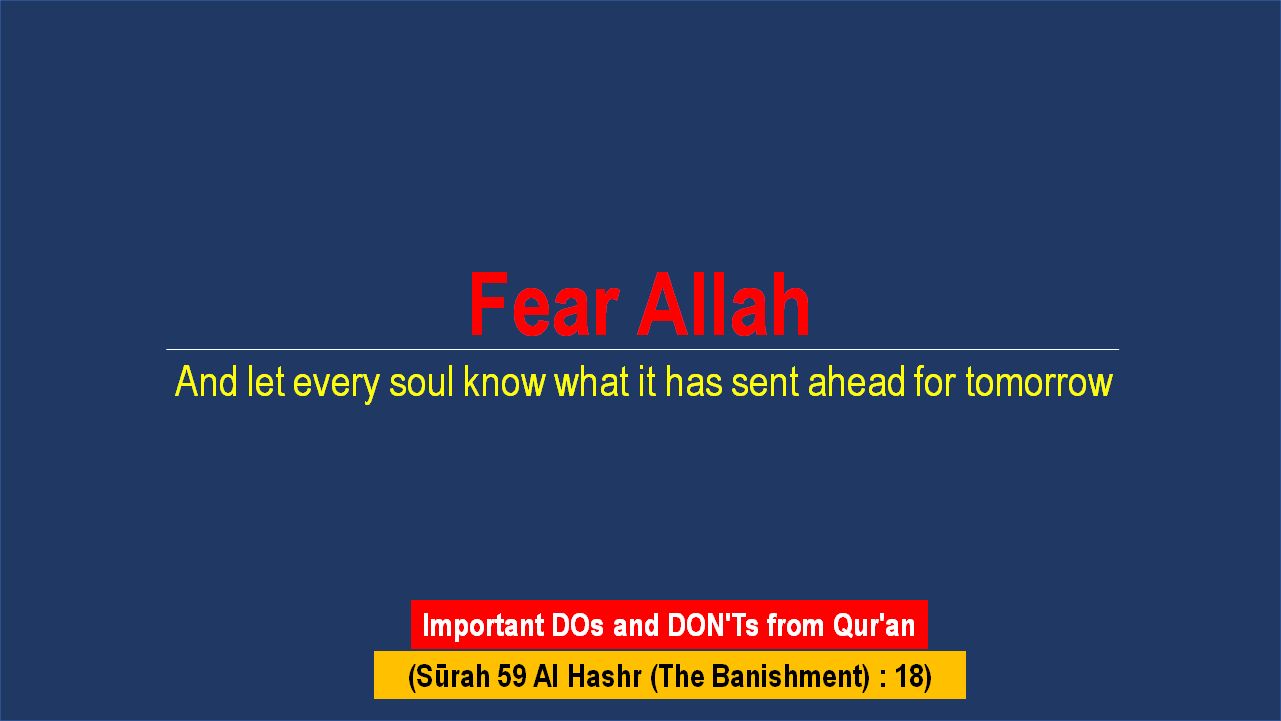
Before we share the video, let us recapitulate the summary of the surah so that we draw maximum benefit from the scholarly presentation. The theme of the Surah is an appraisal of the battle against the Bani An Nadir. In this, on the whole, four things have been discussed.
In the first four verses the world has been admonished to take heed of the fate that had just befallen the Bani an-Nadir. A major tribe which was as strong in numbers as the Muslims, whose people boasted of far more wealth and possession who were by no means ill equipped militarily and whose forts were well fortified could not stand siege even for a few Days, and expressed their readiness to accept banishment from their centuries old, well-established settlement even though not a single man from among them was slain. Allah says that this happened not because of any power possessed by the Muslims but because the Jews had tried to resist and fight Allah and His Messenger, and those who dare to resist the power of Allah, always meet with the same fate.
In verse 5, the rule of the law of war that has been enunciated is: the destruction caused in the enemy territory for military purposes does not come under "spreading mischief in the earth."
In vv 6-10 it has been stated how the lands and properties which come under the control of the Islamic State as a result of war or peace terms, are to be managed. As it was the first ever occasion that the Muslims took control of a conquered territory, the law concerning it was laid down for their guidance.
In vv. 11-17 the attitude that the hypocrites had adopted on the occasion of the battle against the Bani an-Nadir has been reviewed and the causes underlying it have been pointed out.
The whole of the last section (vv. 18-24) is an admonition for all those people who had professed to have affirmed the faith and joined the Muslim community, but were devoid of the true spirit of the faith. In it they have been told what is the real demand of the Faith, what is the real difference between piety and wickedness, what is the place and importance of the Quran which they professed to believe in, and what are the attributes of God in Whom they claimed to have believed.
Now, please watch an enlightening video below by one of the most eminent scholars of present times, Nouman Ali Khan:
Nouman Ali Khan, born to a Pakistani family, is an American Muslim speaker and Arabic instructor who founded the Bayyinah Institute for Arabic and Qur’anic Studies, after serving as an instructor of Arabic at Nassau Community College. He has been named one of the 500 most influential Muslims in the world by the Royal Islamic Strategic Studies Centre of Jordan.
وَمَا عَلَيۡنَاۤ اِلَّا الۡبَلٰغُ الۡمُبِيۡنُ
(36:17) and our duty is no more than to clearly convey the Message.”
That is our duty to convey only to you the message that Allah has entrusted us with. Then it is for you to accept it or reject it. We have not been made responsible for making you accept it forcibly, and if you do not accept it, we shall not be seized in consequence of your disbelief, you will yourselves be answerable for your actions on Day of Resurrection.
May Allāh (سبحانه و تعالى) help us understand Qur'ān and help us to act upon the commandments of Allah contained therein. May Allah help us to be like the ones He loves and let our lives be lived helping others and not making others' lives miserable or unlivable. May all our wrong doings, whether intentional or unintentional, be forgiven before the angel of death knocks on our door.
May Allah forgive me if my posts ever imply a piety far greater than I possess. I am most in need of guidance.
Disclaimer: The views expressed in the video above are those of the scholar concerned. We have shared this view as added information in better understanding of Islam. The reader may or may not agree with the view owing to their own perception. If anyone differs with the material contained in this post, one may consult the references and their authors. If someone has more material about the subject, he/she is most welcome to share in the comments box to make the post all encompassing.
You may refer to more Selected Verses from Sürah 59 Al Al-Ḥashr (The Gathering), already published. You may also refer to our exclusive reference page: Selected verses from selected Surahs of Al-Qurʾān for compiled verses from other surahs.
For more Scholarly views and videos, please read our reference page: Scholars' Viewpoint on Important Issues Related to Islam. You may also refer to our Reference Pages for knowing more about Islam and Quran.
If you like Islam: My Ultimate Decision, and to keep yourself updated on all our latest posts to know more about Islam, follow us on Facebook
Follow @IslamUltimate
Please share this page to your friends and family members through Facebook, Twitter, WhatsApp or any means on Social Media so that they can also be benefited by it and better understand Islam and the Holy Qur'an - Insha Allah (Allah Willing) you shall be blessed with the best of both worlds.