.

Thursday, 20 October 2022

Prophetic Supplication attributed to Prophet Musa (Moses, AS) as mentioned in Qur'an

Propets of Allah ever sine the first of prophets, have been supplicating on behalf of their people so that they are not subjected to the Divine wrath. It must be seen that none of the prophets prayed or supplicated for own forgiveness for they were sent for the well being of the commuities and ultimately the mankind. That is the pecularity of all prophets of Allah.

Today we share the 155th verse from Surah 7. Al Aaraf (The Heights) in which Prophet Musa (Moses, peace be upon him) supplicated to Allah to forgive them all. It may be added that verses 152-156 are about the worshippers of the calf incurred the wrath of Allah. For compelte reference to the context, please read our earlier post on exegeis / tafsir of Surah Al Aaraf  (Part III). Herein under, the explanation of only the selected text/supplication is given:

وَاخۡتَارَ مُوۡسٰى قَوۡمَهٗ سَبۡعِيۡنَ رَجُلًا لِّمِيۡقَاتِنَا​ ۚ فَلَمَّاۤ اَخَذَتۡهُمُ الرَّجۡفَةُ قَالَ رَبِّ لَوۡ شِئۡتَ اَهۡلَـكۡتَهُمۡ مِّنۡ قَبۡلُ وَاِيَّاىَ​ ؕ اَ تُهۡلِكُنَا بِمَا فَعَلَ السُّفَهَآءُ مِنَّا ۚ اِنۡ هِىَ اِلَّا فِتۡنَـتُكَ ؕ تُضِلُّ بِهَا مَنۡ تَشَآءُ وَتَهۡدِىۡ مَنۡ تَشَآءُ ​ؕ اَنۡتَ وَلِيُّنَا فَاغۡفِرۡ لَـنَا وَارۡحَمۡنَا​ وَاَنۡتَ خَيۡرُ الۡغَافِرِيۡنَ‏ 
(7:155) And out of his people Moses singled out seventy men for Our appointment. Then, when violent shaking seized them, he addressed his Lord: 'Had You willed, O my Lord, You could have destroyed them and me long ago. Will You destroy us for what the fools amongst us did? That was nothing but a trial from You whereby You mislead whom You will and guide whom You will. You alone are our guardian. Forgive us, then, and have mercy upon us. You are the best of those who forgive.
The seventy delegates were summoned to Mt. Sinai so that they should present themselves before their Lord, and on behalf of the community beg forgiveness for the sin of calf-worship that was committed by the Israelites, and to renew the covenant of obedience to Him. The Bible and the Talmud do not mention this, though the Bible says that Moses was summoned to Mt. Sinai so that he should be given new tablets for those that were broken, when he had thrown them down. (Exodus chapter 34). 

Every occasion of trial is very decisive for the people: it separates like a winnow useful from the useless out of a mixed mass. On such decisive occasions, the one who comes out successful in the trial does so only by Divine guidance and help, and the one who fails in the test becomes unsuccessful because he is deprived of Divine guidance and help. Though one gets Allah's guidance and help in accordance with certain Divine Laws, which are based on absolute wisdom and justice, anyway the fact is that one's success or failure in the trial depends entirely on Divine guidance and help. 

Tafsir Ibn-Kathir
(أَنتَ وَلِيُّنَا فَاغْفِرْ لَنَا وَارْحَمْنَا وَأَنتَ خَيْرُ الْغَـفِرِينَ "You are our protector, so forgive us and have mercy on us: for You are the best of those who forgive.''), pertains to (Allah's) covering the mistake and not punishing for the sin. Whenever mercy is mentioned along with forgiveness ﴿such as in Musa's supplication to Allah﴾, it includes the hope that Allah does not permit one to fall into that act again.

(وَأَنتَ خَيْرُ الْغَـفِرِينَ "for You are the best of those who forgive,'') for none except You can forgive the sin. 

Yusuf Ali  Explanation: 
Moses was guiltless, but he identifies himself with his whole people, and intercedes with Allah on their behalf. He recognises that it was a trial, in which some of his people failed to stand the test. Such failure was worthy of punishment. But he pleads for mercy for such as erred from weakness and not from contumacy, and were truly repentant, although all who erred were in their several degrees worthy of punishment.

Tafsir Qur'an Wiki:
Those seventy men were the best among them. The way the choice is expressed in Arabic makes them stand out from the whole community of Israelites. Nevertheless, what happened to this choice group? They were seized by a violent trembling and dropped unconscious. The reason for this, as mentioned in another sūrah, was that they asked Moses to show them God so that they would believe him and accept the law He has given them in the tablets. This is typical of the nature of the Children of Israel. It applies to all of them, whether good or bad, in different measures. The most singular thing is that they should make such a request when they were supposed to declare their repentance and seek God’s forgiveness.
 
Moses, on the other hand, turned to his Lord imploring Him to bestow His forgiveness and mercy, declaring his total submission to Him: “When they were seized by violent trembling, he said: ‘My Lord, had it been Your will, You could have destroyed them, and myself too, long ago.’“ (Verse 155) That is the mark of total submission to God’s power. Moses makes sure to declare his own submission as he addresses his supplication to God to forgive his people, end their test and to spare them from destruction because of the deed perpetrated by some fools among them: “Would You destroy us because of what the weak- minded among us have done?” (Verse 155) Moses puts his appeal in a questioning form to emphasize his request that God does not destroy them. It is as if he is saying: my Lord, Your grace makes it absolutely unlikely that You should destroy us on account of what some fools among us have done. “This is only a trial You have ordained, whereby You allow to go astray whom You will, and You guide aright whom You will.” (Verse 155)
 
Thus, Moses declares his understanding of what was taking place, that it was all a trial. In every trial, God guides those who understand its nature and recognize it as a test. He also lets those who ignore it to go deeper into error. Moses reiterates his recognition as a prelude to an appeal to God for His help to enable him and his people to pass the trial successfully: “You alone are our guardian.” (Verse 155) Give us your help so that we pass the test, and earn Your forgiveness and Your grace: “Grant us, then, forgiveness and bestow mercy on us. You are the best of all those who do forgive.” (Verse 155)

You may listen to eminent Muslim scholar Nouman Ali Khan explaining verse 155:
May Allāh (سبحانه و تعالى‎) help us understand Qur'ān and help us to act upon the commandments of Allah contained therein. May Allah help us to be like the ones He loves and let our lives be lived helping others and not making others' lives miserable or unlivable. May all our wrong doings, whether intentional or unintentional, be forgiven before the angel of death knocks on our door. 

May Allah forgive me if my posts ever imply a piety far greater than I possess. I am most in need of guidance.

For more Selected Verses, please refer to our reference page: Selected Invocations / Dua " دُعا " from the Qur'anYou may also refer to our Reference Pages for knowing more about Islam and Qur'ān.
Photo | Reference: | 1 | 2 | 3 | 4 |
Reading the Qur'ān should be a daily obligation of a Muslim - Reading it with translation will make it meaningful. But reading its Exegesis / Tafsir will make you understand it fully.

An effort has been made to gather explanation / exegesis of the surahs of the Qur'ān from authentic sources and then present a least possible condensed explanation of the surah. In that the exegesis of the chapters of the Quran is mainly based on the "Tafhim al-Qur'an - The Meaning of the Qur'an" by one of the most enlightened scholars of the Muslim World Sayyid Abul Ala Maududi.  

In order to augment and add more explanation as already provided, additional input has been interjected from following sources: 
  • Towards Understanding the Quran
  • Tafsir Ibn Khatir
  • Muhammad Asad Translation
  • Javed Ahmad Ghamidi / Al Mawrid
  • Al-Quran, Yusuf Ali Translation
  • Verse by Verse Qur'an Study Circle
In addition, references of other sources which have been explored have also been given above. Those desirous of detailed explanations and tafsir (exegesis), may refer to these sites.

If you like Islam: My Ultimate Decision, and to keep yourself updated on all our latest posts to know more about Islam, follow us on Facebook

Please share this page to your friends and family members through Facebook, WhatsApp or any means on social media so that they can also be benefited by it and better understand Islam and the Qur'ān - Insha Allah (Allah Willing) you shall be blessed with the best of both worlds.

Tuesday, 18 October 2022

Prophetic Warning for those giving forged statement and being false witness

Today we share a very important Hadith of Prophet Muhammad ﷺ which is an eye opener for many of us for we are part of this henious crime: False witness and forged statement.

In our courts, everyday buy-out people appear as false witnesses and submit forged statements to mislead the courts and despite having deliberately forged documents and buying false witnesses win their cases and innocent go to prisons. Just look around and read the proceedings of any court and you will find criminnals walking out as free men while innocent ushering into prison vans and taken into custody.

Prophet Muhammad ﷺ has sternly warned against forging documents to one's own nefit and bribing people to appear as false witnesses to solidify their cases.

Narrated Abu Bakra:
حَدَّثَنِي إِسْحَاقُ، حَدَّثَنَا خَالِدٌ الْوَاسِطِيُّ، عَنِ الْجُرَيْرِيِّ، عَنْ عَبْدِ الرَّحْمَنِ بْنِ أَبِي بَكْرَةَ، عَنْ أَبِيهِ ـ رضى الله عنه ـ قَالَ قَالَ رَسُولُ اللَّهِ صلى الله عليه وسلم ‏"‏ أَلاَ أُنَبِّئُكُمْ بِأَكْبَرِ الْكَبَائِرِ ‏"‏‏.‏ قُلْنَا بَلَى يَا رَسُولَ اللَّهِ‏.‏ قَالَ ‏"‏ الإِشْرَاكُ بِاللَّهِ، وَعُقُوقُ الْوَالِدَيْنِ ‏"‏‏.‏ وَكَانَ مُتَّكِئًا فَجَلَسَ فَقَالَ ‏"‏ أَلاَ وَقَوْلُ الزُّورِ وَشَهَادَةُ الزُّورِ، أَلاَ وَقَوْلُ الزُّورِ وَشَهَادَةُ الزُّورِ ‏"‏‏.‏ فَمَا زَالَ يَقُولُهَا حَتَّى قُلْتُ لاَ يَسْكُتُ‏.‏
Allah's Messenger (ﷺ) said thrice, "Shall I not inform you of the biggest of the great sins?" We said, "Yes, O Allah's Messenger (ﷺ)" He said, "To join partners in worship with Allah: to be undutiful to one's parents." The Prophet (ﷺ) sat up after he had been reclining and added, "And I warn you against giving forged statement and a false witness; I warn you against giving a forged statement and a false witness." The Prophet kept on saying that warning till we thought that he would not stop.

Does not this Hadith sounds warning bells for all those who call them believers, and yet indulge in actions that may nullify their acts of piety. Let us be careful from now on and be very cautious against appearing fro someone as a false witness or help someone in forging documents, or even doing all this for ourselves, to win a case in this world. But what about the highest ever court on the Day of Resurrection when such forgeries and false witnesses will not help and ultimate truth will reveal . And no culprit will evade punishment as they did in their worldly life.

Reference: Sahih al-Bukhari (Good Manners and Form (Al-Adab) - كتاب الأدب ) / Hadith 5976
May Allāh (سبحانه و تعالى‎) help us understand Qur'ān and follow the Sunnah of Prophet Muhammad ﷺ, which is embodiment of commandments of Allah contained in the Qur'ān. May Allah help us to be like the ones He loves and let our lives be lived helping others and not making others' lives miserable or unlivable. May all our wrong doings, whether intentional or unintentional, be forgiven before the angel of death knocks on our door.  
وَمَا عَلَيۡنَاۤ اِلَّا الۡبَلٰغُ الۡمُبِيۡنُ‏ 
(36:17) and our duty is no more than to clearly convey the Message.”
That is Our duty is only to convey to you the message that Allah has entrusted us with. Then it is for you to accept it or reject it. We have not been made responsible to make you accept it forcibly, And if you do not accept it, we shall not be seized in consequence of your disbelief, You will yourselves be answerable for your actions on Day of Resurrection.

May Allah forgive me if my posts ever imply a piety far greater than I possess. I am most in need of guidance.

Reading the Qur'ān should be a daily obligation of a Muslim - Reading it with translation will make it meaningful. But reading its Exegesis / Tafsir will make you understand it fully. It will also help the Muslims to have grasp over social issues and their answers discussed in the Qur'an and other matter related to inter faith so that they are able to discuss issues with non-Muslims with authority based on refences from Qur'an.

Note: When we mention God in our posts, we mean One True God, we call Allah in Islam, with no associates. Allah is the Sole Creator of all things, and that Allah is all-powerful and all-knowing. Allah has no offspring, no race, no gender, no body, and is unaffected by the characteristics of human life.

Please refer to our reference page: Sunnah and Hadith of Prophet Muhammad ﷺ to know more about sunnah of Prophet of Allah. You may also refer to our Reference Pages for knowing more about Islam and Qur'ān.

Disclaimer: The material for this post has been collected from the references as given below. If any one differs with the material contained in this post, one may consult the references and their authors.  If someone has more material about the subject, he/she is most welcome to share in the comments box to make the post all encompassing.
If you like Islam: My Ultimate Decision, and to keep yourself updated on all our latest posts to know more about Islam, follow us on Facebook

Please share this page to your friends and family members through Facebook, WhatsApp or any means on Social Media so that they can also be benefited by it and better understand Islam and the Qur'ān - Insha Allah (Allah Willing) you shall be blessed with the best of both worlds.

Monday, 17 October 2022

Guidance from Surah Al Hashr (The Banishment / The Gathering)

Surah Al Hashr (The Banishment / The Gathering) is the 59th chapter/surah of the Qur'an. We have already posted its summary and verse by verse exegesis / tafsir in our earlier posts. Today we share a lecture by prominent Muslim scholar/exegete Nouman Ali Khan in which he deliberates of the guidance that Surah Al Hashr provides us.

Before we share the video, let us recapitulate the summary of the surah so that we draw maximum benefit from the scholarly presentation. The theme of the Surah is an appraisal of the battle against the Bani An Nadir. In this, on the whole, four things have been discussed.
In the first four verses the world has been admonished to take heed of the fate that had just befallen the Bani an-Nadir. A major tribe which was as strong in numbers as the Muslims, whose people boasted of far more wealth and possession who were by no means ill equipped militarily and whose forts were well fortified could not stand siege even for a few Days, and expressed their readiness to accept banishment from their centuries old, well-established settlement even though not a single man from among them was slain. Allah says that this happened not because of any power possessed by the Muslims but because the Jews had tried to resist and fight Allah and His Messenger, and those who dare to resist the power of Allah, always meet with the same fate.
In verse 5, the rule of the law of war that has been enunciated is: the destruction caused in the enemy territory for military purposes does not come under "spreading mischief in the earth."
In vv 6-10 it has been stated how the lands and properties which come under the control of the Islamic State as a result of war or peace terms, are to be managed. As it was the first ever occasion that the Muslims took control of a conquered territory, the law concerning it was laid down for their guidance.
In vv. 11-17 the attitude that the hypocrites had adopted on the occasion of the battle against the Bani an-Nadir has been reviewed and the causes underlying it have been pointed out.
The whole of the last section (vv. 18-24) is an admonition for all those people who had professed to have affirmed the faith and joined the Muslim community, but were devoid of the true spirit of the faith. In it they have been told what is the real demand of the Faith, what is the real difference between piety and wickedness, what is the place and importance of the Quran which they professed to believe in, and what are the attributes of God in Whom they claimed to have believed.
Now, please watch an enlightening video below by one of the most eminent scholars of present times, Nouman Ali Khan:
Nouman Ali Khan, born to a Pakistani family, is an American Muslim speaker and Arabic instructor who founded the Bayyinah Institute for Arabic and Qur’anic Studies, after serving as an instructor of Arabic at Nassau Community College. He has been named one of the 500 most influential Muslims in the world by the Royal Islamic Strategic Studies Centre of Jordan.

وَمَا عَلَيۡنَاۤ اِلَّا الۡبَلٰغُ الۡمُبِيۡنُ‏ 
(36:17) and our duty is no more than to clearly convey the Message.”
That is our duty to convey only to you the message that Allah has entrusted us with. Then it is for you to accept it or reject it. We have not been made responsible for making you accept it forcibly, and if you do not accept it, we shall not be seized in consequence of your disbelief, you will yourselves be answerable for your actions on Day of Resurrection.

May Allāh (سبحانه و تعالى‎) help us understand Qur'ān and help us to act upon the commandments of Allah contained therein. May Allah help us to be like the ones He loves and let our lives be lived helping others and not making others' lives miserable or unlivable. May all our wrong doings, whether intentional or unintentional, be forgiven before the angel of death knocks on our door. 

May Allah forgive me if my posts ever imply a piety far greater than I possess. I am most in need of guidance.

Disclaimer: The views expressed in the video above are those of the scholar concerned. We have shared this view as added information in better understanding of Islam. The reader may or may not agree with the view owing to their own perception. If anyone differs with the material contained in this post, one may consult the references and their authors.  If someone has more material about the subject, he/she is most welcome to share in the comments box to make the post all encompassing.

Photo Reference Summary: Tafhaim ul Qur'an

You may refer to more Selected Verses from Sürah 59 Al Al-Ḥashr (The Gathering),  already published. You may also refer to our exclusive reference page: Selected verses from selected Surahs of Al-Qurʾān for compiled verses from other surahs.

For more Scholarly views and videos, please read our reference page: Scholars' Viewpoint on Important Issues Related to IslamYou may also refer to our Reference Pages for knowing more about Islam and Quran.
If you like Islam: My Ultimate Decision, and to keep yourself updated on all our latest posts to know more about Islam, follow us on Facebook

Please share this page to your friends and family members through Facebook, Twitter, WhatsApp or any means on Social Media so that they can also be benefited by it and better understand Islam and the Holy Qur'an - Insha Allah (Allah Willing) you shall be blessed with the best of both worlds.

Sunday, 16 October 2022

Etiquette of Supplicating (Hadith Prophet Muhammad ﷺ)

The wants, needs and requirement of man are unlimited. And whenever we are in need, we turn to Allah and supplicate for the fulfillment of our needs. But we must adhere to the etiquette of supplicating for our intentions have to be pure and clean, not aimed at asking to hurt someone for we were hurt by them or cause an evil spell for we have been treated so.

Prophet Muhammad ﷺ has mentioned the etiquette so that our supplications do not bog down en route to Allah and get rejected. 

Following Hadith has been mentioned in Jami` at-Tirmidhi / Chapters on Supplication - كتاب الدعوات عن رسول الله صلى الله عليه وسلم / Hadith 3381 / Chapter (9): What Has Been Related That the Supplication of a Muslim Is Answered (باب مَا جَاءَ أَنَّ دَعْوَةَ الْمُسْلِمِ مُسْتَجَابَةٌ ) / Grade: Sahi

Jabir narrated:
حَدَّثَنَا قُتَيْبَةُ، حَدَّثَنَا ابْنُ لَهِيعَةَ، عَنْ أَبِي الزُّبَيْرِ، عَنْ جَابِرٍ، قَالَ سَمِعْتُ رَسُولَ اللَّهِ صلى الله عليه وسلم يَقُولُ ‏ "‏ مَا مِنْ أَحَدٍ يَدْعُو بِدُعَاءٍ إِلاَّ آتَاهُ اللَّهُ مَا سَأَلَ أَوْ كَفَّ عَنْهُ مِنَ السُّوءِ مِثْلَهُ مَا لَمْ يَدْعُ بِإِثْمٍ أَوْ قَطِيعَةِ رَحِمٍ ‏"‏‏.‏ وَفِي الْبَابِ عَنْ أَبِي سَعِيدٍ وَعُبَادَةَ بْنِ الصَّامِتِ ‏.‏
The Messenger of Allah said: “There is none who utters a supplication, except that Allah gives him what he asked, or prevents evil from him that is equal to it – as long as he does not supplicate for something evil, or the cutting of ties of the womb.”

This hadith highlights the comprehensive and benevolent nature of Allah's response to the supplications (du'a) made by His servants. It emphasizes that every sincere prayer is heard and answered in one form or another, provided the supplication is not for something sinful or for severing family ties. Let's break down the meaning and implications of this hadith:

Explanation of the Supplication
  • Allah's Response to Supplications: The hadith states that every supplication made to Allah receives a response. This reflects the mercy and attentiveness of Allah towards His servants.
  • Three Forms of Response:
    • Granting the Request: Allah may give the supplicant exactly what they asked for. This is the most direct form of response.
    • Preventing an Equivalent Evil: If Allah does not grant the specific request, He may instead prevent a harm or evil of equal value from befalling the supplicant. This implies that the person is protected or saved from something detrimental in return for their supplication.
    • Storing Reward for the Hereafter: In some narrations, it is mentioned that if neither of the above occurs, the supplication is stored as a reward for the Hereafter. This means that the supplicant will see the benefits of their du'a in the form of rewards in the afterlife.
Conditions for Acceptance:
  • The supplication should not be for something sinful or evil. Praying for harm, injustice, or anything that contradicts the principles of Islam will not be accepted.
  • The supplication should not involve asking for the severing of family ties. Islam places great emphasis on maintaining and nurturing family relationships, and prayers that seek to harm these relationships are not accepted.
Implication of the Supplications
  • Encouragement to Make Du'a: Believers are encouraged to continually turn to Allah in prayer, knowing that their supplications are always heard and responded to in a beneficial manner.
  • Trust in Allah's Wisdom: This hadith teaches believers to trust in Allah’s wisdom. Sometimes, not getting what is asked for may actually be a form of divine protection or a means to receive something better in the Hereafter.
  • Importance of Intentions: It underscores the importance of making supplications with good intentions and for righteous purposes. Du'a should align with the ethical and moral framework of Islam.
  • Strengthening Family Ties: The specific mention of not asking for the cutting of family ties highlights the importance of family in Islam. Believers are reminded to seek harmony and reconciliation within their families.
This hadith beautifully encapsulates the mercy and wisdom of Allah in dealing with the supplications of His servants. It reassures believers that their prayers are never in vain and that Allah's responses are always in their best interest, even if not immediately apparent. By making du'a with sincerity and good intentions,

It also clearly defines the etiquette of supplicating and mentions that anything but evil or cutting ties with the relations of the womb, that is brothers and sisters, will be accepted. That is, it is the intent which causes a supplication to be accepted or rejected. So long we adhere to the basic etiquette of doing everything as mentioned in Qur'an or in the Hadith of the Prophet of Allah, we can be rest assured of being blessed rather than returned empty handed on basis of our evil intent.
May Allāh (سبحانه و تعالى‎) help us understand Qur'ān and follow the Sunnah of Prophet Muhammad ﷺ, which is embodiment of commandments of Allah contained in the Qur'ān. May Allah help us to be like the ones He loves and let our lives be lived helping others and not making others' lives miserable or unlivable. May all our wrong doings, whether intentional or unintentional, be forgiven before the angel of death knocks on our door.  
وَمَا عَلَيۡنَاۤ اِلَّا الۡبَلٰغُ الۡمُبِيۡنُ‏ 
(36:17) and our duty is no more than to clearly convey the Message.”
That is Our duty is only to convey to you the message that Allah has entrusted us with. Then it is for you to accept it or reject it. We have not been made responsible for making you accept it forcibly, and if you do not accept it, we shall not be seized in consequence of your disbelief, you will yourselves be answerable for your actions on Day of Resurrection.

May Allah forgive me if my posts ever imply a piety far greater than I possess. I am most in need of guidance.

Reading the Qur'ān should be a daily obligation of a Muslim - Reading it with translation will make it meaningful. But reading its Exegesis / Tafsir will make you understand it fully. It will also help the Muslims to have grasp over social issues and their answers discussed in the Qur'an and other matter related to inter faith so that they are able to discuss issues with non-Muslims with authority based on refences from Qur'an.

Note: When we mention God in our posts, we mean One True God, we call Allah in Islam, with no associates. Allah is the Sole Creator of all things, and that Allah is all-powerful and all-knowing. Allah has no offspring, no race, no gender, no body, and is unaffected by the characteristics of human life.

Please refer to our reference page: Sunnah and Hadith of Prophet Muhammad ﷺ to know more about sunnah of Prophet of Allah. You may also refer to our Reference Pages for knowing more about Islam and Qur'ān.

Disclaimer: The material for this post has been collected from the references as given below. If anyone differs with the material contained in this post, one may consult the references and their authors.  If someone has more material about the subject, he/she is most welcome to share in the comments box to make the post all encompassing.
Photo

If you like Islam: My Ultimate Decision, and to keep yourself updated on all our latest posts to know more about Islam, follow us on Facebook

Please share this page to your friends and family members through Facebook, WhatsApp or any means on Social Media so that they can also be benefited by it and better understand Islam and the Qur'ān - Insha Allah (Allah Willing) you shall be blessed with the best of both worlds.

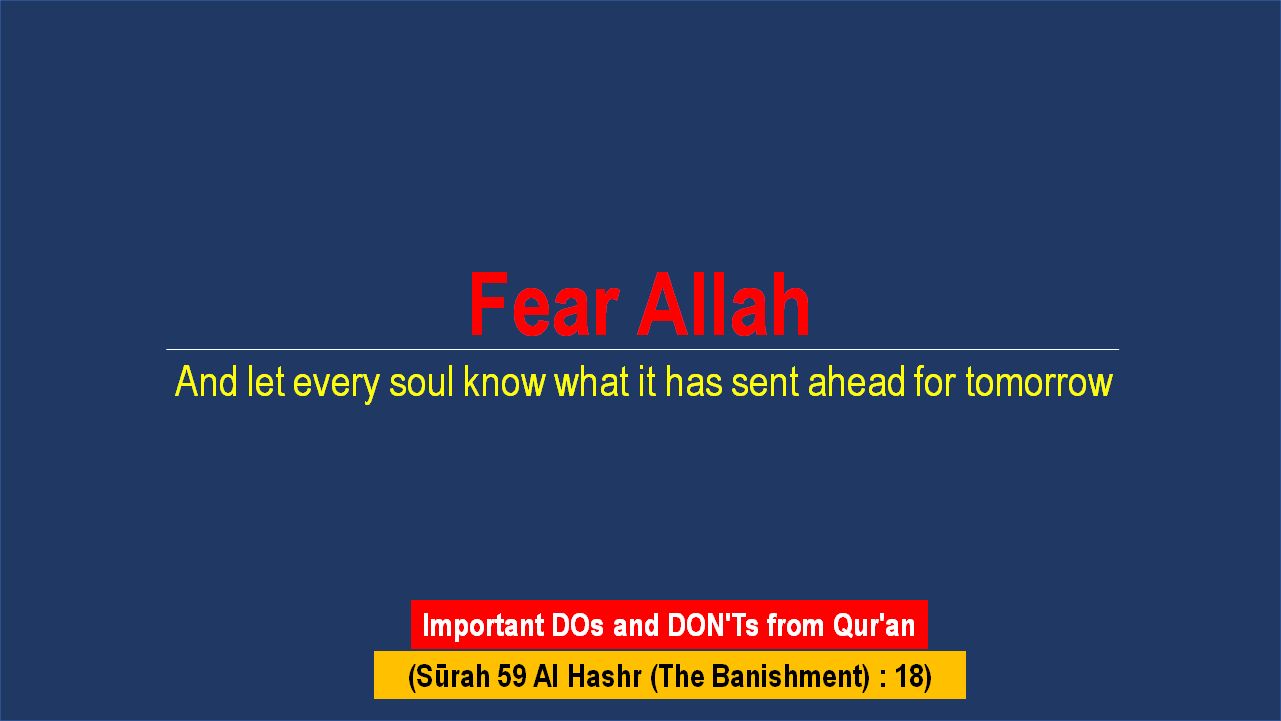
Fear Allah and let every soul know what it has sent ahead for tomorrow

Qur'an is a book of guidance for the mankind. It abounds in directives and commandments for man to walk on the straight path and never ever to disorientate itself for all disorientations are due to machinations of evil forces. Time and again it has been reminded to fear Allah, for those who fear Allah remain steady and do not lend ears to evil whispers. 

Qur'an also reminds man to review his conduct sheet much too often to see what he has sent forward for the Day of Resurrection, which is any day tomorrow. If we keep track of our actions and ensure that these are in accordance with the teachings of Qur'an and Sunnah, we shall never have to worry about our fate tomorrow. But if we have not been fearing Allah and are engrossed in merrymaking, the 18th verse of Surah 59 Al Hashr (The Banishment) draws our attention to be cautioned lest it is too late to even review our actions.

Note: The entire section of Surah Al Hashr from verses 18-24 is cautions to warn men and cautiones them that there is still time to review what they have sent forward and seek forgiveness of Allah lest the angel of death knocks at their door and there is no time to repent. Please read the exegesis / tafsir of Surah Al Hashr already posted to connect to the following verses correctly:

يٰۤاَيُّهَا الَّذِيۡنَ اٰمَنُوۡا اتَّقُوا اللّٰهَ وَلۡتَـنۡظُرۡ نَـفۡسٌ مَّا قَدَّمَتۡ لِغَدٍ​ ۚ وَاتَّقُوا اللّٰهَ​ؕ اِنَّ اللّٰهَ خَبِيۡرٌۢ بِمَا تَعۡمَلُوۡنَ‏  
(18) O you who have believed, fear Allah. And let every soul look to what it has put forth for tomorrow - and fear Allah. Indeed, Allah is Acquainted with what you do.
It is a rule of the Qur'an that whenever the hypocritical Muslims are taken to task for their hypocrisy, they are given admonition also so that whoever of them has some life left in his conscience, may feel remorse for his conduct and attitude and may make an effort, out of the fear of Allah, to come out of the pit into which his worship of the self has thrown him. 

" Fear Allah and let every person look to what he sends forward for the morrow " "For the morrow": for the Hereafter. That is, this whole worldly life is "today", whose "tomorrow" is the Day of Resurrection, which is going to follow it. Adopting this style Allah has, in a wise manner, made man understand the truth that just as that person is highly foolish, who gambles away his all for the enjoyment of today and does not realize whether tomorrow he would be left with anything to eat and a place of shelter or not, so is that person also only working for his own doom, who is too absorbed in making; his world to pay heed to the Hereafter, whereas the Hereafter is to follow this world just as today is to be followed by tomorrow, and there he would find nothing if he has sent nothing ahead for the morrow. Besides, the other wise point here is that every person has been appointed his own censor. Unless a person develops in himself the sense of what is good for him and what is evil, he cannot appreciate whether what he is doing will make his future in the Hereafter or mar it. And when this sense becomes active in himself, he will have to calculate and see for himself whether the way in which he is expending his time, his wealth, his energies and capabilities leads to Heaven or Hell. To do so is in his own interest; for if he does not do so he will ruin his own future itself.

Yusuf Ali Explanation: The "fear of Allah" is akin to love; for it means the fear of offending Him or doing anything wrong that will forfeit His Good Pleasure. This is Taqwa, which implies self-restraint, guarding ourselves from all sin, wrong, and injustice, and the positive doing of good. See ii. 2:
(ii:2) This is the Book; in it is guidance sure without doubt to those who fear Allah. 
Taqwa and the verbs and nouns connected with the root, signify: (1) the fear of God which according to the writer of Proverbs (i.7) in the Old Testament is the beginning of Wisdom; (2) restraint, or guarding one's tongue, hand, and heart from evil; (3) hence righteousness, piety good conduct. All these ideas are implied; in the translation, only one or other of these ideas can be indicated according to the context. See also xivii 17; and ixxiv 56.
The positive side of Taqwa, or "fear of Allah" (see last note) is here emphasized. It is not merely a feeling or an emotion: it is an act, a doing of things which become a preparation and provision for the Hereafter, - the next life, which may be described as "the morrow" in relation to the present Life, which is "to-day". A) The repetition emphasizes both sides of Taqwa: "let your soul fear to do wrong and let it do every act of righteousness; for Allah observes both your inner motives and your acts, and in His scheme of things everything will have its due consequences."

Javed Ahmad Ghamidi Explanation: This refers to what he has done for the Day of Judgement. It is referred to by the word “tomorrow.” The purpose is to direct attention to its proximity as well as to its certainty.

The words اِتَّقُوا اللّٰہَ (fear God) are repeated so that the importance of the matter is driven in the minds of the addressees.

Having asked man to fear Allah and take a look at one's past which has been already recorded, there comes another caution in the next verse, the number 19, which tells man the fate ofthose who did not fear Allah and were forgotten by Allah:

وَلَا تَكُوۡنُوۡا كَالَّذِيۡنَ نَسُوا اللّٰهَ فَاَنۡسٰٮهُمۡ اَنۡفُسَهُمۡ​ؕ اُولٰٓـئِكَ هُمُ الۡفٰسِقُوۡنَ‏ 
(19) And be not like those who forgot Allah, so He made them forget themselves. Those are definitely disobedient.
That is, forgetfulness of God inevitably leads to forgetfulness of one's own self. When man forgets that he is slave to the Almighty, he will inevitably form a wrong view of his position in the world, and his whole life will go wrong because of this basic error. Likewise, when he forgets that he is slave to nobody except Allah, he does not serve the one whose slave actually he is not. This also is a grave and all-pervading misunderstanding, which corrupts his whole life. Man's real position in the world is that of a slave; he is not free and self-sufficient; and he is slave of only One God, and is no one else's slave beside Him. The person who, in not know this truth, does not in fact know himself. And the person who in spite of knowing this, forgets it at any moment, may commit an act at that very moment, which a disbeliever, or a polytheist or a man forgetful of God only would commit. Man's remaining firm and steadfast on the right path entirely depends on his remembering God at all times. For as soon as he, becomes heedless of Him. he becomes heedless of himself and this very heedlessness turns him into sinfulness. 

Javed Ahmad Ghamidi Explanation: This is a reference to the Jews from whom the Hypocrites received guidance and with whom they would connive to oppose Islam and the Muslims. The words فَاَنۡسٰہُمۡ اَنۡفُسَہُمۡ used for them point to a very important reality. 

Imam Amin Ahsan Islahi has explained it thus: … Those who forget God become indifferent to their own good and evil and to their fate. All value, significance and majesty of life depends on understanding the reality that the Almighty has not given it to us to indulge in a few days of luxury; He has given it to us so that we spend it in obedience to Him and earn the eternal kingdom of heaven. This pinnacle can of course be achieved by someone who always keeps in mind that he has not been given life by chance; on the contrary, it is a blessing of a Gracious being and He has given it with a special purpose. If a person leads his life in accordance with this special purpose, it will be a great eternal reward for him, and if he forgets this, it will automatically become an eternal curse for him.(Amin Ahsan Islahi, Tadabbur-i Qur’an, vol. 8, 308)

Having explained the above said verse in detail, you may now listen to explanation of the Ayat by eminent Muslim scholar Nouman Ali Khan:
May Allāh (سبحانه و تعالى‎) help us understand Qur'ān and follow the Sunnah of Prophet Muhammad ﷺ, which is embodiment of commandments of Allah contained in the Qur'ān. May Allah help us to be like the ones He loves and let our lives be lived helping others and not making others' lives miserable or unlivable. May all our wrong doings, whether intentional or unintentional, be forgiven before the angel of death knocks on our door. 
وَمَا عَلَيۡنَاۤ اِلَّا الۡبَلٰغُ الۡمُبِيۡنُ‏ 
(36:17) and our duty is no more than to clearly convey the Message.”
That is Our duty is only to convey to you the message that Allah has entrusted us with. Then it is for you to accept it or reject it. We have not been made responsible for making you accept it forcibly, And if you do not accept it, we shall not be seized in consequence of your disbelief, you will yourselves be answerable for your actions on Day of Resurrection.

Reading the Qur'ān should be a daily obligation of a Muslim - Reading it with translation will make it meaningful. But reading its Exegesis / Tafsir will make you understand it fully. It will also help the Muslims to have grasp over social issues and their answers discussed in the Qur'an and other matter related to inter faith so that they are able to discuss issues with non-Muslims with authority based on refences from Qur'an.

May Allah forgive me if my posts ever imply a piety far greater than I possess. I am most in need of guidance.

Note: When we mention God in our posts, we mean One True God, we call Allah in Islam, with no associates. Allah is the Sole Creator of all things, and that Allah is all-powerful and all-knowing. Allah has no offspring, no race, no gender, no body, and is unaffected by the characteristics of human life.

You may refer to more Selected Verses from Sürah 59 Al Al-Ḥashr (The Gathering),  already published. You may also refer to our exclusive reference page: Selected verses from selected Surahs of Al-Qurʾān for compiled verses from other surahs.

For more DOs and Don'ts, please refer to our reference page: Important DOs and DON'Ts from Qur'anYou may also refer to our Reference Pages: Understanding Al Qur'an and  Selected Verses from the Qur'an for knowing more about Islam and Qur'ān.
Photo | Tafsir References: | 1 | 2 | 3 | 4 | 5 | 6 | 7 | 8 | 9 | 

An effort has been made to gather explanation / exegesis of the surahs of the Qur'ān from authentic sources and then present a least possible condensed explanation of the surah. In that the exegesis of the chapters of the Quran is mainly based on the "Tafhim al-Qur'an - The Meaning of the Qur'an" by one of the most enlightened scholars of the Muslim World Sayyid Abul Ala Maududi.  
In order to augment and add more explanation as already provided, additional input has been interjected from following sources: 
  • Towards Understanding the Quran
  • Tafsir Ibn Khatir
  • Muhammad Asad Translation
  • Javed Ahmad Ghamidi / Al Mawrid
  • Al-Quran, Yusuf Ali Translation
  • Verse by Verse Qur'an Study Circle
In addition, references of other sources which have been explored have also been given above. Those desirous of detailed explanations and tafsir (exegesis), may refer to these sites.

If you like Islam: My Ultimate Decision, and to keep yourself updated on all our latest posts to know more about Islam, follow us on Facebook

Please share this page to your friends and family members through Facebook, WhatsApp or any means on social media so that they can also be benefited by it and better understand Islam and the Qur'ān - Insha Allah (Allah Willing) you shall be blessed with the best of both worlds.
Saturday, 15 October 2022

Are we really returning to religion?

To some of my readers, the topic may seem confusing for many people are returning to religion these days.  Yes, they are, but are all of them returning to religion as a right or as a duty, or in other words is their approach of returning to religion positive or negative?

Before we listen to a lecture by one of the eminent scholars of Muslim world, let me begin with a small premise. There were times when believers were attracted to religion taking as their scared duty. Those were the times when wants of people were less and everyone ran to the masjid as a duty with no worldly needs in mind. But then things started to become difficult and it is now becoming very difficult every day to make one's ends meet. Now people seek their rights, want baraka in their earnings and promotions in the office as rewards for their hard work. The focus from duty-oriented return to religion has turned into a right oriented approach.  Most people are now asking for an increase in wealth, means of sustenance, and very few really stick to the rope of Allah and exhibit sabr / tolerance or patience for they know they will be rewarded for their duty oriented positive approach to religion.

Please note that this post may be more pertinent to the born Muslims rather than the reverts.

Which mode should be adopted: The duty oriented or the right oriented? Listen to an enlightening lecture by Maulana Wahiduddin Khan on this important subject:
Maulana Wahiduddin Khan (1 January 1925 – 21 April 2021) was an Islamic scholar and peace activist known for having written a commentary on the Quran and having translated it into contemporary English and talking on issues related to Islam.

وَمَا عَلَيۡنَاۤ اِلَّا الۡبَلٰغُ الۡمُبِيۡنُ‏ 
(36:17) and our duty is no more than to clearly convey the Message.”
That is our duty to convey only to you the message that Allah has entrusted us with. Then it is for you to accept it or reject it. We have not been made responsible for making you accept it forcibly, and if you do not accept it, we shall not be seized in consequence of your disbelief, you will yourselves be answerable for your actions on Day of Resurrection.

May Allāh (سبحانه و تعالى‎) help us understand Qur'ān and help us to act upon the commandments of Allah contained therein. May Allah help us to be like the ones He loves and let our lives be lived helping others and not making others' lives miserable or unlivable. May all our wrong doings, whether intentional or unintentional, be forgiven before the angel of death knocks on our door. 

May Allah forgive me if my posts ever imply a piety far greater than I possess. I am most in need of guidance.

Disclaimer: The views expressed in the video above are those of the scholar concerned. We have shared this view as added information in better understanding of Islam. The reader may or may not agree with the view owing to their own perception. If anyone differs with the material contained in this post, one may consult the references and their authors.  If someone has more material about the subject, he/she is most welcome to share in the comments box to make the post all encompassing.

Photo | 

For more Scholarly views and videos, please read our reference page: Scholars' Viewpoint on Important Issues Related to Islam.

You may also refer to our Reference Pages for knowing more about Islam and Quran.
If you like Islam: My Ultimate Decision, and to keep yourself updated on all our latest posts to know more about Islam, follow us on Facebook

Please share this page to your friends and family members through Facebook, Twitter, WhatsApp or any means on Social Media so that they can also be benefited by it and better understand Islam and the Holy Qur'an - Insha Allah (Allah Willing) you shall be blessed with the best of both worlds.

Thursday, 13 October 2022

Hadith Prophet Muhammad ﷺ: Rights of the Neighbour

The essence of human relation in Islam is based on love, affection and cooperation. It is expected of Muslims to be show compassion to their brethren and take care of them in times of need. Other than one's close relatives, the close neighbours too assume an added importance and Muslims are advised to look after their neighbours so as to establish a brotherly bondage with each other.

Allah has specially advised Muslims to be kind to their neighbours as it appears in the Qur'an (سورة النساء, An-Nisaa, Chapter #4, Verse #36):

وَاعۡبُدُوا اللّٰهَ وَلَا تُشۡرِكُوۡا بِهٖ شَيۡـئًـا​ ؕ وَّبِالۡوَالِدَيۡنِ اِحۡسَانًا وَّبِذِى الۡقُرۡبٰى وَالۡيَتٰمٰى وَ الۡمَسٰكِيۡنِ وَالۡجَـارِ ذِى الۡقُرۡبٰى وَالۡجَـارِ الۡجُـنُبِ وَالصَّاحِبِ بِالۡجَـنۡۢبِ وَابۡنِ السَّبِيۡلِ ۙ وَمَا مَلَـكَتۡ اَيۡمَانُكُمۡ​ ؕ اِنَّ اللّٰهَ لَا يُحِبُّ مَنۡ كَانَ مُخۡتَالًا فَخُوۡرَا ۙ‏ 
(4:36) Serve Allah and ascribe no partner to Him. Do good to your parents, to near of kin, to orphans, and to the needy, and to the neighbour who is of kin and to the neighbour who is a stranger, and to the companion by your side, and to the wayfarer, and to those whom your right hands possess. Allah does not love the arrogant and the boastful,

The above quoted verse from Qur'an clearly spells out who is a neighbour: A neighbour who physically occupies a house next door, a companion during a journey or any wayfarer that one may come across.

Prophet Muhammad ﷺ has on many occasions advised his companions and others to look after their neighbours and after the close relatives, a share of charity must go to Neighbours if they are in need. \\

In Sahih al-Bukhari Book 78 (Good Manners and Form (Al-Adab) - كتاب الأدب /Chapter 28 (To recommend to be kind to one's neighbour) / Hadith 6014, beloved wife of Aisha has been quoted as saying:

حَدَّثَنَا إِسْمَاعِيلُ بْنُ أَبِي أُوَيْسٍ، قَالَ حَدَّثَنِي مَالِكٌ، عَنْ يَحْيَى بْنِ سَعِيدٍ، قَالَ أَخْبَرَنِي أَبُو بَكْرِ بْنُ مُحَمَّدٍ، عَنْ عَمْرَةَ، عَنْ عَائِشَةَ ـ رضى الله عنها ـ عَنِ النَّبِيِّ صلى الله عليه وسلم قَالَ ‏ "‏ مَا زَالَ يُوصِينِي جِبْرِيلُ بِالْجَارِ حَتَّى ظَنَنْتُ أَنَّهُ سَيُوَرِّثُهُ ‏"‏‏.‏
The Prophet (ﷺ) said "Gabriel continued to recommend me about treating the neighbors Kindly and politely so much so that I thought he would order me to make them as my heirs."

The above quoted Hadith is very clearly lays down the importance of neighbours and our rights towards them. In case one neighbour is rich and other is poor, struggling for life, the former bears the responsibility to look after him.  In another Hadith, the Holy Prophet (peace be upon him) said that a man whose neighbour is not safe from his misdeeds, is not a believer in Islam.
Again, he says that a person who enjoys a full meal while his neighbour is starving really has no faith in Islam. The Holy Prophet (peace be upon him) was once informed of a woman who used to offer prayers regularly and would often keep fasts and give alms frequently, but her neighbours were sick of her abusive tongue. The Holy Prophet (peace be upon him) said that such a woman deserved only the fire of Hell. He was then told of another woman who did not possess these virtues but did not trouble her neighbours and the Holy Prophet (peace be upon him) said that she might be rewarded with a place in Heaven.

The Holy Prophet (peace be upon him) has laid so much emphasis on rights of neighbours that he has advised that whenever a Muslim brings fruits for his children, he should either send some to his neighbours as a gift or at least not throw the peelings outside his house. This would prevent the neighbour from feeling deprived. On one occasion, the Holy Prophet (peace be upon him) said that a man is really good if his neighbours regard him as such and he is bad if they consider him so.

However, this does not mean that it is an Islamic virtue to be partial or unduly lenient towards one’s relations. Such support or partiality towards one’s relations as may result in injustice, is repugnant to Islam, which condemns it as an act of Jahiliya (ignorance). 

On the authority of Abi Hurairah, may God be pleased with him, on the authority of the Prophet, may God bless him and grant him peace, who said: Whoever believes in God and the Last Day will say, and whoever believes in Allah and Last Day, blessed be He. And those who believe in Allah and the Last Day will be rewarded.

A lot more can be added to the importance of looking for the welfare of one's neighbours, but the essence has been presented to apprise our brothers and sisters not to forget about the wellbeing of our neighbours.

May Allāh (سبحانه و تعالى‎) help us understand Qur'ān and follow the Sunnah of Prophet Muhammad ﷺ, which is embodiment of commandments of Allah contained in the Qur'ān. May Allah help us to be like the ones He loves and let our lives be lived helping others and not making others' lives miserable or unlivable. May all our wrong doings, whether intentional or unintentional, be forgiven before the angel of death knocks on our door.  
وَمَا عَلَيۡنَاۤ اِلَّا الۡبَلٰغُ الۡمُبِيۡنُ‏ 
(36:17) and our duty is no more than to clearly convey the Message.”
That is Our duty is only to convey to you the message that Allah has entrusted us with. Then it is for you to accept it or reject it. We have not been made responsible to make you accept it forcibly, And if you do not accept it, we shall not be seized in consequence of your disbelief, You will yourselves be answerable for your actions on Day of Resurrection.

May Allah forgive me if my posts ever imply a piety far greater than I possess. I am most in need of guidance.

Reading the Qur'ān should be a daily obligation of a Muslim - Reading it with translation will make it meaningful. But reading its Exegesis / Tafsir will make you understand it fully. It will also help the Muslims to have grasp over social issues and their answers discussed in the Qur'an and other matter related to inter faith so that they are able to discuss issues with non-Muslims with authority based on refences from Qur'an.

Note: When we mention God in our posts, we mean One True God, we call Allah in Islam, with no associates. Allah is the Sole Creator of all things, and that Allah is all-powerful and all-knowing. Allah has no offspring, no race, no gender, no body, and is unaffected by the characteristics of human life.

Please refer to our reference page: Sunnah and Hadith of Prophet Muhammad ﷺ to know more about sunnah of Prophet of Allah. You may also refer to our Reference Pages for knowing more about Islam and Qur'ān.

Disclaimer: The material for this post has been collected from the references as given below. If any one differs with the material contained in this post, one may consult the references and their authors.  If someone has more material about the subject, he/she is most welcome to share in the comments box to make the post all encompassing.
Photo | References: | Khaleej Times | Ghamdi |

If you like Islam: My Ultimate Decision, and to keep yourself updated on all our latest posts to know more about Islam, follow us on Facebook

Please share this page to your friends and family members through Facebook, WhatsApp or any means on Social Media so that they can also be benefited by it and better understand Islam and the Qur'ān - Insha Allah (Allah Willing) you shall be blessed with the best of both worlds.

Wednesday, 12 October 2022

Prophetic Supplication to seek refuge from helplessness and being overpowered unjustly

It has been narrated by Anas bin Malik that Prophet Muhammad ﷺ oftenly used to recite the following supplication: 

 اللَّهُمَّ إِنِّي أَعُوذُ بِكَ مِنَ الْهَمِّ وَالْحَزَنِ، وَالْعَجْزِ وَالْكَسَلِ، وَالْبُخْلِ وَالْجُبْنِ وَضَلَعِ الدَّيْنِ، وَغَلَبَةِ الرِّجَالِ ‏
"O Allah! I seek refuge with You from, having worries sadness, helplessness, laziness, miserliness, cowardice, from being heavily in debt and from being overpowered by other persons unjustly."

The wording of the supplication shows that this supplication was made by the revered Prophet of Allah when under stress or duress or when fearing being overpowered by his enemies. We should also make this supplication much too often and invoke countless mercies of Allah to be our Guardian and Protector when dark clouds tend to overshadow us.

Note: This is the selected portion of Hadith number 5425 taken from Sahih al-Bukhari Book number 70 on Food, Meals - كتاب الأطعمة » / Chapter number 28: Al-Hais "باب الْحَيْسِ" (dish prepared from dried yoghourt, butter and dates). Complete hadith may be read from here which also makes a mention of preparation of meal Al Hais which was one of the favourites of Prophet Muhammad ﷺ.
May Allāh (سبحانه و تعالى‎) help us understand Qur'ān and follow the Sunnah of Prophet Muhammad ﷺ, which is embodiment of commandments of Allah contained in the Qur'ān. May Allah help us to be like the ones He loves and let our lives be lived helping others and not making others' lives miserable or unlivable. May all our wrong doings, whether intentional or unintentional, be forgiven before the angel of death knocks on our door. 
وَمَا عَلَيۡنَاۤ اِلَّا الۡبَلٰغُ الۡمُبِيۡنُ‏ 
(36:17) and our duty is no more than to clearly convey the Message.”
That is Our duty is only to convey to you the message that Allah has entrusted us with. Then it is for you to accept it or reject it. We have not been made responsible for making you accept it forcibly, and if you do not accept it, we shall not be seized in consequence of your disbelief, you will yourselves be answerable for your actions on Day of Resurrection.

May Allah forgive me if my posts ever imply a piety far greater than I possess. I am most in need of guidance.

Reading the Qur'ān should be a daily obligation of a Muslim - Reading it with translation will make it meaningful. But reading its Exegesis / Tafsir will make you understand it fully. It will also help the Muslims to have grasp over social issues and their answers discussed in the Qur'an and other matter related to inter faith so that they are able to discuss issues with non-Muslims with authority based on refences from Qur'an.

Note: When we mention God in our posts, we mean One True God, we call Allah in Islam, with no associates. Allah is the Sole Creator of all things, and that Allah is all-powerful and all-knowing. Allah has no offspring, no race, no gender, no body, and is unaffected by the characteristics of human life.

Please refer to our reference page: Sunnah and Hadith of Prophet Muhammad ﷺ to know more about sunnah of Prophet of Allah. You may also refer to our Reference Pages for knowing more about Islam and Qur'ān.

Disclaimer: The material for this post has been collected from the references as given below. If anyone differs with the material contained in this post, one may consult the references and their authors.  If someone has more material about the subject, he/she is most welcome to share in the comments box to make the post all encompassing.
Photo

If you like Islam: My Ultimate Decision, and to keep yourself updated on all our latest posts to know more about Islam, follow us on Facebook

Please share this page to your friends and family members through Facebook, WhatsApp or any means on Social Media so that they can also be benefited by it and better understand Islam and the Qur'ān - Insha Allah (Allah Willing) you shall be blessed with the best of both worlds.

Tuesday, 11 October 2022

Do not squander your wealth wastefully

The distribution of wealth has never been equal to every man since time immemorial. The philosophy behind this unequal distribution of wealth is based on Divine Test which is given to both the HAVEs and HAVE NOTs. In fact, those who have wealth beyond their needs are tested more for they are tested whether they squander their wealth for own comforts and spend it wastefully or do they give charities to the HAVE NOTs to help balance out the equation between those who have and those who do not have.

Likewise, there is a test for the poor: Whether they remain patient and continue to await the Divine help and till that they remain contended and pass the test. While there are others who get disheartened by limited means and choose evil ways to rob, cheat and embazzle to make ends meet.

The 26th verse of Surah 17 Al Israa (The Night Journey) is about taking care of near and dear ones and not to be wasteful in spending their wealth for it is needed by those around us, trying hard to sustain their lives:

وَاٰتِ ذَا الۡقُرۡبٰى حَقَّهٗ وَالۡمِسۡكِيۡنَ وَابۡنَ السَّبِيۡلِ وَلَا تُبَذِّرۡ تَبۡذِيۡرًا‏ 
(17:26) Give to the near of kin his due, and also to the needy and the wayfarer. (iv) Do not squander your wealth wastefully,

Yusuf Ali Explanation
In the Jewish Decalogue, which was given to a primitive and hard-hearted people, this refinement of Kindness, -to those in want and to wayfarers (i.e., total strangers whom you come across) finds no place. Nor was there much danger of their wasting their substance out of exuberance. Even the command "to honour thy father and mother" comes after the ceremonial observance of the Sabbath. With us, the worship of Allah is linked with kindness-to parents, kindred, those in want, those who are far from their homes though they may be total strangers to us. It is not mere verbal kindness. They have certain rights which must be fulfilled.

All charity, kindness, and help are conditioned by our own resources. There is no merit if we merely spend out of bravado or for idle show. How many families are ruined by extravagant expenses at weddings, funerals, etc., or (as they may call it) to "obliged friends or relatives", or to give to able-bodied beggars? To no one was this command more necessary than it is to Muslims of the present day.

Muhammad Asad Explanation:
(And give his due to the near of kin) In this instance, "his due" evidently refers to the loving consideration due to one's relatives (Zamakhsharl and Razi); those of them who are in a state of want are included in the subsequent mention of "the needy" (al-miskin).

(as well as to the needy and the wayfarer) Regarding this expression, see surah {2}, note [145].

(But do not squander [thy substance] senselessly) Lit., "with [utter] squandering" (tabdhiran) i.e., senselessly and to no good purpose. It is to be borne in mind that the term tabdhir does not relate to the quantity but, rather, to the purpose of one's spending. Thus, Ibn'Abbas and Ibn Mas'ud (both of them quoted by Tabari) defined tabdhlr as "spending without a righteous purpose" or "in a frivolous (batil) cause": and Mujahid is reported (ibid.) to have said, "If a man were to spend all that he possesses in a righteous cause, it could not be termed squandering; but if he spends even a small amount in a frivolous cause, it is squandering."

Javed Ahmad Ghamidi Explanation:
The implication is that just as a person spends on himself the blessings bestowed upon him by God, he should also spend them on his fellow brethren after fulfilling his personal and business needs. It is evident from the Qur’ān that two things are required for a person if he is to become a true servant of God: Firstly, one’s relationship with God should be established on the right footing. Secondly, this relationship with other human beings should also be established the same way. The first thing is achieved through the prayer which is the foremost expression of one’s love for God, and the second through spending in the way of God for this is the foremost expression of one’s love for one’s fellow human beings. The reward for this spending is also God’s love because whatever one spends he has it saved in the heavens, and in the words of the Prophet Jesus (sws), his heart too remains occupied at this place, (Matthew, 6:19-21). In this verse, it is said that spending in the way of God is the right of one’s relatives, orphans and the needy which must necessarily be fulfilled. It is evident from this mention that any slackness in fulfilling this right can make a person a criminal who extorts the rights of people. Thus, at another instance, the Qur’ān (9:34-35) has clearly stated that if a person starts amassing wealth while remaining indifferent to these rights, then this is hoarding and its punishment is the fire of Hell – from which every believer should seek refuge with the Almighty.

Tafsir Qur'an Wiki:
The Sūrah proceeds to include all relatives and the need to be kind to them, adding also the needy and travelers who may find themselves in difficulty. It expands on family relations so as to include all human bonds in their broadest sense:

Give the near kin their due, and also to the needy and the travelers in need. Do not squander your substance wastefully, for the wasteful squanderers are Satan’s brothers, and Satan has always been ungrateful to his Lord. But if you must turn aside from them in pursuit of an act of kindness you hope to receive from your Lord, then at least speak to them kindly. (Verses 26-28)

The Qur’ān makes it clear that the near of kin, the needy and stranded travelers have a right against us which may only be discharged by financial assistance. This does not come as a favour which one person does to another; it is rather a duty imposed by God and associated with worshipping Him alone. When we fulfil this duty, we are only discharging our responsibility, and cultivating a close relationship between ourselves and those to whom we give. The giver has no favour against the recipient, because he is only fulfilling a duty towards God.

Having explained the above said verse in detail, you may now listen to explanation of the Ayat by eminent Muslim scholar Nouman Ali Khan:
May Allāh (سبحانه و تعالى‎) help us understand Qur'ān and follow the Sunnah of Prophet Muhammad ﷺ, which is embodiment of commandments of Allah contained in the Qur'ān. May Allah help us to be like the ones He loves and let our lives be lived helping others and not making others' lives miserable or unlivable. May all our wrong doings, whether intentional or unintentional, be forgiven before the angel of death knocks on our door. 
وَمَا عَلَيۡنَاۤ اِلَّا الۡبَلٰغُ الۡمُبِيۡنُ‏ 
(36:17) and our duty is no more than to clearly convey the Message.”
That is Our duty is only to convey to you the message that Allah has entrusted us with. Then it is for you to accept it or reject it. We have not been made responsible for making you accept it forcibly, And if you do not accept it, we shall not be seized in consequence of your disbelief, you will yourselves be answerable for your actions on Day of Resurrection.

Reading the Qur'ān should be a daily obligation of a Muslim - Reading it with translation will make it meaningful. But reading its Exegesis / Tafsir will make you understand it fully. It will also help the Muslims to have grasp over social issues and their answers discussed in the Qur'an and other matter related to inter faith so that they are able to discuss issues with non-Muslims with authority based on refences from Qur'an.

May Allah forgive me if my posts ever imply a piety far greater than I possess. I am most in need of guidance.

Note: When we mention God in our posts, we mean One True God, we call Allah in Islam, with no associates. Allah is the Sole Creator of all things, and that Allah is all-powerful and all-knowing. Allah has no offspring, no race, no gender, no body, and is unaffected by the characteristics of human life.

For more Selected Verses, please refer to our reference page: Important DOs and DON'Ts from Qur'anYou may also refer to our Reference Pages: Understanding Al Qur'an and  Selected Verses from the Qur'an for knowing more about Islam and Qur'ān.
Tafsir References: | 1 | 2 | 3 | 4 | 5 | 6 |

An effort has been made to gather explanation / exegesis of the surahs of the Qur'ān from authentic sources and then present a least possible condensed explanation of the surah. In that the exegesis of the chapters of the Quran is mainly based on the "Tafhim al-Qur'an - The Meaning of the Qur'an" by one of the most enlightened scholars of the Muslim World Sayyid Abul Ala Maududi.  
In order to augment and add more explanation as already provided, additional input has been interjected from following sources: 
  • Towards Understanding the Quran
  • Tafsir Ibn Khatir
  • Muhammad Asad Translation
  • Javed Ahmad Ghamidi / Al Mawrid
  • Al-Quran, Yusuf Ali Translation
  • Verse by Verse Qur'an Study Circle
In addition the references of other sources which have been explored have also been given above. Those desirous of detailed explanations and tafsir (exegesis), may refer to these sites.

If you like Islam: My Ultimate Decision, and to keep yourself updated on all our latest posts to know more about Islam, follow us on Facebook

Please share this page to your friends and family members through Facebook, WhatsApp or any means on Social Media so that they can also be benefited by it and better understand Islam and the Qur'ān - Insha Allah (Allah Willing) you shall be blessed with the best of both worlds.

Twitter Delicious Facebook Digg Stumbleupon Favorites More