.

Wednesday, 16 November 2022

Divine Command about Universality of Islam

The race to proclaim one's religion as the best has been going on and on since the first Divine Scripture was revealed. And those who are men of wisdom will find that all Divine Scriptures were an improvement over the previous for the Divine Commands were gradually introduced to man and basically hinged on one central theme: Worship of the One True God.

That is there is really only one true Religion, the Message of Allah submission to the Will of Allah: this is called Islam. It was the religion preached by Moses and Jesus; it was the religion of Abraham, Noah, and all the prophets, by whatever name it may be called. If people corrupt that pure light, and call their religions by different names, we must bear with them, and we may allow the names for convenience. But Truth must prevail over all.

Islam, based on Qur'an, the last of the earlier three Divine Scriptures (Psalms, Torah and Bible), is the last of the Divine religions, revealed through Prophet Muhammad (peace be upon him) to remain as the beacon light for the entire mankind till the end of this earthly world. And it is for this very reason that more and more non-Muslims are embracing Islam for it answers all queries which cannot be answered by earlier scriptures for Qur'an is the final book encompassing the final commandments of Allah.

The verse selected for this post today is the 28th verse from Surah 48. Al Fath (The Victory) in which Allah has proclaimed that He has sent His Messenger with the true religion which will prevail over every religion:

هُوَ الَّذِىۡۤ اَرۡسَلَ رَسُوۡلَهٗ بِالۡهُدٰى وَدِيۡنِ الۡحَـقِّ لِيُظۡهِرَهٗ عَلَى الدِّيۡنِ كُلِّهٖ​ؕ وَكَفٰى بِاللّٰهِ شَهِيۡدًا ؕ‏ 
(48:28) He it is Who sent His Messenger with the True Guidance and the Religion of Truth that He may make it prevail over every religion. Sufficient is Allah as a witness (to this).
The reason why this thing has been mentioned here is that when at Hudaibiyah the peace treaty was going to be written down, the disbelievers had objected to the use of the words Rasul-Allah (Messenger of Allah) with the name of the Holy Prophet, and on their insistence the Holy Prophet himself had wiped off these words from the document. At this Allah says: "Our Messenger's being a Messenger is a reality which remains unaffected whether someone believes in it or not. If some people do not believe in it, they may not, for "Allah is enough for a witness" over it. Their denial will not change the reality, but the Guidance and the true Faith which this Messenger has brought from Us, shall prevail over all religion, no matter how hard the deniers try to obstruct its progress."

"All religion" implies all those ways of life which include the nature of din (religion). We have explained it fully in verse 2 of Surah Az-Zumar, reproduced herein under for easy assimilation:

(Surah 39 Az Zumar verse :2)
اِنَّاۤ اَنۡزَلۡنَاۤ اِلَيۡكَ الۡكِتٰبَ بِالۡحَقِّ فَاعۡبُدِ اللّٰهَ مُخۡلِصًا لَّهُ الدِّيۡنَ ؕ‏ 
(O Prophet), it is We Who have revealed this Book to you with Truth. So serve only Allah, consecrating your devotion to Him.
This is a very important verse which states the real objective of the message of Islam. Therefore, one should not pass over it superficially, but should try to understand its meaning and intention. It has two basic points: (1) That the demand is to worship Allah. (2) That the demand is of such worship as may be performed by making religion exclusively Allah’s. Ibadat is derived from abd, and this word is used as an antonym of freeman for the slave and bondsman in Arabic. Accordingly, ibadat contains two meanings: (1) Worship and devotion. (2) Humble and willing obedience, as is borne out by the well known and authoritative Arabic Lexicon, Lisan al- Arab. Thus, according to the authentic lexical explanation, the demand is not only of Allah’s worship but also of willing and sincere obedience to His commands and laws.
The Arabic word Deen contains several meanings:
  • (1) Domination and sovereignty, rule and political power and authority to enforce one’s decisions on others.
  • (2) Obedience, compliance with commands and servitude.
  • (3) The practice and the way that a man follows.
In view of these three meanings, Deen in this verse means: The way of life and attitude which a man adopts after acknowledging the supremacy and accepting the obedience of another; and to worship Allah making one’s religion exclusively His. This means that one should refrain from combining another’s worship with the worship of Allah, but should worship Allah alone, should follow His guidance alone, and should comply with His commands and injunctions only. 
In the aforesaid verse from Surah 48. Al Fath, what Allah has stated in clear words is: The purpose of the Holy Prophet's appointment as a Prophet was not merely to preach this Religion but to make it prevail over all others. In other words, he did not bring this Religion so that it might survive in a limited compartment of life which is allowed it by the dominant religion, while the rest of the spheres of life, by and large, should remain under the relentless control of some false religion. But he had brought it so that it should be the dominant Religion of life and any other religion should survive, if at all it survives, only within the limits in which it allows it to survive. (For further explanation, see tafsir of Surah Az-Zumar verse 29: "(39:29) Allah propounds a parable: there is a man whose ownership is shared by several quarrelsome masters, each pulling him to himself; and there is another who is exclusively owned by one man. Can the two be alike? All praise and thanks be to Allah. But most of them are unaware."). 

Tafsir Ibn-Kathir:  The Good News that Muslims will conquer the Known World, and ultimately the Entire World: Allah the Exalted and Most Honored said, while delivering the glad tidings to the believers that the Messenger will triumph over his enemies and the rest of the people of the earth,

(He it is Who has sent His Messenger with guidance and the religion of truth, هُوَ الَّذِي أَرْسَلَ رَسُولَهُ بِالْهُدَى وَدِينِ الْحَقِّ) with beneficial knowledge and righteous good deeds. Indeed, the Islamic Shari`ah has two factors, knowledge and deeds. The true religious knowledge is by definition true, and the accepted Islamic acts are by definition accepted. Therefore, the news and creed that this religion conveys are true and its commandments are just:
(That He may make it superior to all religi- ons.) all the religions of the people of the earth, Arabs and non-Arabs alike, whether having certain ideologies or being atheists or idolators.
(And All-Sufficient is Allah as a Witness.) that Muhammad is His Messenger and that He will grant him victory. Allah the Exalted and Most Honored has the best knowledge.

Muhammad Asad Explanation:
Sc., "through the revelations which He grants to His prophets". See also 3:19 - "the only [true] religion in the sight of God is [man's] self-surrender unto Him": from which it follows that any religion (in the widest sense of this term) which is not based on the above principle is, eo ipso, false.

Yusuf Ali Explanation
The divine disposition of events in the coming of Islam and its promulgation by the holy Prophet are themselves evidence of the truth of Islam and its all-reaching character; for there is nothing which it has not influenced. See also lxi. 9, n. 5442, reproduced herein under:
(61:9) It is He Who has sent His Apostle with Guidance and the Religion of Truth that he may proclaim it over all religion even though the Pagans may detest (it). 
"Over all religion": in the singular: not over all other religions, in the plural. There is really only one true Religion, the Message of Allah submission to the Will of Allah: this is called Islam. It was the religion preached by Moses and Jesus; it was the religion of Abraham, Noah, and all the prophets, by whatever name it may be called. If people corrupt that pure light, and call their religions by different names, we must bear with them, and we may allow the names for convenience. But Truth must prevail over all.
Javed Ahmad Ghamidi Explanation:
This is a mention of the last victory. The implication is that they should trust the God Who has shown such exploits. He has not sent His messenger to be subdued. Hence, after this near victory they have achieved at Ḥudaybiyah, the conquest of Makkah is not far off. The established practice of God regarding His messengers is that after they conclusively communicate the truth to their addressees, God grants them dominance over those who disbelieve them.

Tafsir Qur'an Wiki:
The religion of truth prevailed, and not only in the Arabian Peninsula. Within half a century it prevailed across many of the inhabited parts of the earth. It subdued the entire Persian Empire and took over much of the Byzantine Empire. It marched as far as India and China before moving into Malaysia, southern Asia and Indonesia. In the sixth and seventh centuries, these areas constituted most of the then known world.

This true religion continues to prevail over all religions, even after its political retreat from much of the areas it moved into, particularly in Europe and the major islands in the Mediterranean. It prevails even though the power of its people is very weak compared to the new powers that have recently emerged in the East and the West. Indeed, as a religion, Islam prevails over all else. It carries within itself and in its nature the elements of its strength. It moves forward, supported by neither sword nor gun drawn by its people. Its advance is due only to its inherent harmony with human nature and the natural laws of the universe, and to the fact that it satisfies, with perfect ease, the requirements of mind and soul, progress and civilization, regardless of whether people live in tents or in skyscrapers.

Any religious person who looks objectively at Islam is bound to recognize the soundness and inherent strength of this religion. Nor can they help but recognize its ability to lead humanity with wisdom and to answer its progressive needs in an easy and straightforward way: "Sufficient is God as a witness." (Verse 28)

We see, then, that God's promise was fulfilled in the immediate, political form, before one century had elapsed after the Prophet's mission. God's promise continues to be fulfilled in its substantive form, as Islam prevails over all other religions. in fact, it is the only religion that continues to act and lead in all situations. Perhaps only the Muslims do not understand this truth. Other people know it and take it into account as they draw up their policies and programmes.

Now you may listen to the following short clipped video to explanation of the aforesaid Ayat by eminent Muslim scholar Nouman Ali Khan:
May Allāh (سبحانه و تعالى‎) help us understand Qur'ān and follow the Sunnah of Prophet Muhammad ﷺ, which is embodiment of commandments of Allah contained in the Qur'ān. May Allah help us to be like the ones He loves and let our lives be lived helping others and not making others' lives miserable or unlivable. May all our wrong doings, whether intentional or unintentional, be forgiven before the angel of death knocks on our door. 
وَمَا عَلَيۡنَاۤ اِلَّا الۡبَلٰغُ الۡمُبِيۡنُ‏ 
(36:17) and our duty is no more than to clearly convey the Message.”
That is Our duty is only to convey to you the message that Allah has entrusted us with. Then it is for you to accept it or reject it. We have not been made responsible for making you accept it forcibly, and if you do not accept it, we shall not be seized in consequence of your disbelief, you will yourselves be answerable for your actions on Day of Resurrection.

Reading the Qur'ān should be a daily obligation of a Muslim - Reading it with translation will make it meaningful. But reading its Exegesis / Tafsir will make you understand it fully. It will also help the Muslims to have grasp over social issues and their answers discussed in the Qur'an and other matter related to inter faith so that they are able to discuss issues with non-Muslims with authority based on refences from Qur'an.

May Allah forgive me if my posts ever imply a piety far greater than I possess. I am most in need of guidance.

Note: When we mention God in our posts, we mean One True God, we call Allah in Islam, with no associates. Allah is the Sole Creator of all things, and that Allah is all-powerful and all-knowing. Allah has no offspring, no race, no gender, no body, and is unaffected by the characteristics of human life.

For more Selected Verses, please refer to our reference page: Selected Verses from the Qur'anYou may also refer to our Reference Pages  and Understanding Al Qur'an for knowing more about Islam and Qur'ān.
Photo | Tafsir References: | 1 | 2 | 3 | 4 | 5 | 6 | 7 |

An effort has been made to gather explanation / exegesis of the surahs of the Qur'ān from authentic sources and then present a least possible condensed explanation of the surah. In that the exegesis of the chapters of the Quran is mainly based on the "Tafhim al-Qur'an - The Meaning of the Qur'an" by one of the most enlightened scholars of the Muslim World Sayyid Abul Ala Maududi.  
In order to augment and add more explanation as already provided, additional input has been interjected from the following sources: 
  • Tafsir Ibn Khatir
  • Muhammad Asad Translation
  • Yusuf Ali Translation
  • Translation Javed Ahmad Ghamidi / Al Mawrid
  • Qur'an Wiki
  • Verse by Verse Qur'an Study Circle
  • Towards Understanding the Quran
In addition, references of other sources which have been explored have also been given above. Those desirous of detailed explanations and tafsir (exegesis), may refer to these sites.

If you like Islam: My Ultimate Decision, and to keep yourself updated on all our latest posts to know more about Islam, follow us on Facebook

Please share this page to your friends and family members through Facebook, WhatsApp or any means on Social Media so that they can also be benefited by it and better understand Islam and the Qur'ān - Insha Allah (Allah Willing) you shall be blessed with the best of both worlds.

One who cannot afford to marry is advised to fast (Hadith Prophet Muhammad ﷺ)

Relationship between man and woman is a natural requirement, both for establishment of a family and harness sexual desires by restricting these to one's spouse only. The following verse from Surah 24. An Nisa (The women) amply highlights the importance of marriage and Allah's promise to enhance one's means of sustenance:

وَاَنۡكِحُوا الۡاَيَامٰى مِنۡكُمۡ وَالصّٰلِحِيۡنَ مِنۡ عِبَادِكُمۡ وَاِمَآئِكُمۡ​ ؕ اِنۡ يَّكُوۡنُوۡا فُقَرَآءَ يُغۡنِهِمُ اللّٰهُ مِنۡ فَضۡلِهٖ​ ؕ وَاللّٰهُ وَاسِعٌ عَلِيۡمٌ‏ 
(24:32) Marry those of you that are single, (whether men or women), and those of your male and female slaves that are righteous. If they are poor, Allah will enrich them out of His Bounty. Allah is Immensely Resourceful, All-Knowing.

However, despite Divine promise, many men and women pass the age due to lack of resources and availability of adequate means of sustenance and affording a family. This also prompts some to engage in illegitimate relations which are considered Haram in Islam. 

For such an eventuality, there is a Hadith attributed to Prophet Muhammad ﷺ as mentioned in Ṣaḥīḥ al-Bukhārī  (Book 30 Fasting كتاب الصوم / Chapter 10:  As-Saum for those who fear committing illegal sexual acts باب الصَّوْمِ لِمَنْ خَافَ عَلَى نَفْسِهِ الْعُزْبَةَ) as Hadith 1905:

حَدَّثَنَا عَبْدَانُ، عَنْ أَبِي حَمْزَةَ، عَنِ الأَعْمَشِ، عَنْ إِبْرَاهِيمَ، عَنْ عَلْقَمَةَ، قَالَ بَيْنَا أَنَا أَمْشِي، مَعَ عَبْدِ اللَّهِ ـ رضى الله عنه ـ فَقَالَ كُنَّا مَعَ النَّبِيِّ صلى الله عليه وسلم فَقَالَ ‏ "‏ مَنِ اسْتَطَاعَ الْبَاءَةَ فَلْيَتَزَوَّجْ، فَإِنَّهُ أَغَضُّ لِلْبَصَرِ وَأَحْصَنُ لِلْفَرْجِ، وَمَنْ لَمْ يَسْتَطِعْ فَعَلَيْهِ بِالصَّوْمِ، فَإِنَّهُ لَهُ وِجَاءٌ ‏"‏‏.‏
While I was walking with `Abdullah he said, "We were in the company of the Prophet (ﷺ) and he said, 'He who can afford to marry should marry, because it will help him refrain from looking at other women, and save his private parts from committing illegal sexual relation; and he who cannot afford to marry is advised to fast, as fasting will diminish his sexual power."

In view of the above quoted verse from Qur'an and Hadith, it is amply clear that one should not delay his marriage because he cannot afford to for Allah promises means of sustenance to every servant of His. However, one can still not be able to marry and withhold his sexual desires, then he is advised to fast (Saum) for fasting will diminish one's sexual desires. But in no case, one should find an excuse for not having adequate means to marry and then indulge in illegitimate sex which is viewed as a gravest sin after Shirk in Islam and has severe penalties.
May Allāh (سبحانه و تعالى‎) help us understand Qur'ān and follow the Sunnah of Prophet Muhammad ﷺ, which is embodiment of commandments of Allah contained in the Qur'ān. May Allah help us to be like the ones He loves and let our lives be lived helping others and not making others' lives miserable or unlivable. May all our wrong doings, whether intentional or unintentional, be forgiven before the angel of death knocks on our door.  
وَمَا عَلَيۡنَاۤ اِلَّا الۡبَلٰغُ الۡمُبِيۡنُ‏ 
(36:17) and our duty is no more than to clearly convey the Message.”
That is Our duty is only to convey to you the message that Allah has entrusted us with. Then it is for you to accept it or reject it. We have not been made responsible for making you accept it forcibly, and if you do not accept it, we shall not be seized in consequence of your disbelief, you will yourselves be answerable for your actions on Day of Resurrection.

May Allah forgive me if my posts ever imply a piety far greater than I possess. I am most in need of guidance.

Reading the Qur'ān should be a daily obligation of a Muslim - Reading it with translation will make it meaningful. But reading its Exegesis / Tafsir will make you understand it fully. It will also help the Muslims to have grasp over social issues and their answers discussed in the Qur'an and other matter related to inter faith so that they are able to discuss issues with non-Muslims with authority based on refences from Qur'an.

Note: When we mention God in our posts, we mean One True God, we call Allah in Islam, with no associates. Allah is the Sole Creator of all things, and that Allah is all-powerful and all-knowing. Allah has no offspring, no race, no gender, no body, and is unaffected by the characteristics of human life.

Please refer to our reference page: Sunnah and Hadith of Prophet Muhammad ﷺ to know more about sunnah of Prophet of Allah. You may also refer to our Reference Pages for knowing more about Islam and Qur'ān.

Disclaimer: The material for this post has been collected from the references as given below. If anyone differs with the material contained in this post, one may consult the references and their authors.  If someone has more material about the subject, he/she is most welcome to share in the comments box to make the post all encompassing.
Photo

If you like Islam: My Ultimate Decision, and to keep yourself updated on all our latest posts to know more about Islam, follow us on Facebook

Please share this page to your friends and family members through Facebook, WhatsApp or any means on Social Media so that they can also be benefited by it and better understand Islam and the Qur'ān - Insha Allah (Allah Willing) you shall be blessed with the best of both worlds.

Tuesday, 15 November 2022

Compiled Verses from Qur'an on specific subjects: Allah - the Only God

Whenever, the Muslims use the word Allah to address the One True Monotheistic God, non-Muslims instantly believe that "Allah of Muslims" is something different from the Lord, the Creator of the universe, revered as such since Adam appeared as the first human on this earth. Rather the word Allah is mocked by them for they think Muhammad (Prophet Muhammad ﷺ) coined this word and is the same Divine authority as was worshipped by the idolaters and disbeliever before advent of Islam. Some even call Allah as the Moon God Allah and so many other names.

No matter how non-Muslims perceive Allah and interpret the Arabic translation of God, the fact remains that Allah is the same Lord worshipped by all revered prophets of Allah before Prophet Muhammad ﷺ, and as mentioned in all Divine Scriptures (that is Psalms, Torah and Bible, besides Qur'an). However, there is one major difference between God of Muslims and God of most the Christians. While the God of Christians is three (that is the Father, son and the holy ghost), the God or Allah of Muslims is one True God without any associates or partners. Many Christians have now started to understand the reality and everyday many Christians around the world are entering in the fold of Islam by taking Shahada.

Hereinunder are some clarifications about Allah and God:
The Arabic word Allah literally means “The God”. Believers in Islam understand Allah to be the proper name for the Creator as found in the Qur’an. The name Allah is analogous to Eloh, a Semitic term found in the divine scriptures revealed to Muhammad’s predecessors Moses and Jesus (may peace be upon them all).

The use of the term Allah is not confined to believers in Islam alone — Arabic-speaking Christians and Jews also use Allah in reference to God, demonstrating thereby that followers of Islam, Christianity, and Judaism believe in a common monotheistic Creator, a fact that many people are surprised to learn.

Muslims believe that God has no partners or associates who share in His divinity or authority and that God is transcendent, unlike His creations, and thus has no physical form. Nor is God believed to exist in (or be represented by) any material object. A number of divine attributes or “names,” which serve to describe God, are found in the Qur’an (link given below). [1]

We have already shared a number of verses from Qur'an on Allah, the Only God. Herein under we have combined all these posts to serve as a ready reckoner. However, we recommend our readers to first read the following post and attributes of Allah already posted by us to really understand Allah and His countless attributes:
The Qur’an, the divinely-revealed scripture of Islam, contains numerous verses describing the nature of God. The role of human beings as creations of God upon the earth and their relationship with God are also discussed extensively in this sacred text. You may now consult following verses from Qur'an which are about Allah and Faith in Him, beside the connection between Allah and His servants:
We will keep adding more verses so as to make this collection wholesome.

For compiled verses for more specific subjects, please refer to our exclusive reference page: "Selected verses from Al-Qurʾān about a specific subject."

In addition, for more Selected Verses, please refer to our reference page: Selected Verses from the Qur'anYou may also refer to our Reference Pages and Understanding Al Qur'an for knowing more about Islam and Qur'ān.
May Allāh (سبحانه و تعالى‎) help us understand Qur'ān and follow the Sunnah of Prophet Muhammad ﷺ, which is embodiment of commandments of Allah contained in the Qur'ān. May Allah help us to be like the ones He loves and let our lives be lived helping others and not making others' lives miserable or unlivable. May all our wrong doings, whether intentional or unintentional, be forgiven before the angel of death knocks on our door. 
وَمَا عَلَيۡنَاۤ اِلَّا الۡبَلٰغُ الۡمُبِيۡنُ‏ 
(36:17) and our duty is no more than to clearly convey the Message.”
That is Our duty is only to convey to you the message that Allah has entrusted us with. Then it is for you to accept it or reject it. We have not been made responsible for making you accept it forcibly, and if you do not accept it, we shall not be seized in consequence of your disbelief, you will yourselves be answerable for your actions on Day of Resurrection.

Reading the Qur'ān should be a daily obligation of a Muslim - Reading it with translation will make it meaningful. But reading its Exegesis / Tafsir will make you understand it fully. It will also help the Muslims to have grasp over social issues and their answers discussed in the Qur'an and other matter related to inter faith so that they are able to discuss issues with non-Muslims with authority based on refences from Qur'an.

May Allah forgive me if my posts ever imply a piety far greater than I possess. I am most in need of guidance.

Note: When we mention God in our posts, we mean One True God, we call Allah in Islam, with no associates. Allah is the Sole Creator of all things, and that Allah is all-powerful and all-knowing. Allah has no offspring, no race, no gender, no body, and is unaffected by the characteristics of human life.

Photo Courtesy Dr Muhammad Mohsin | Resource References: | 1 |

If you like Islam: My Ultimate Decision, and to keep yourself updated on all our latest posts to know more about Islam, follow us on Facebook

Please share this page to your friends and family members through Facebook, WhatsApp or any means on Social Media so that they can also be benefited by it and better understand Islam and the Qur'ān - Insha Allah (Allah Willing) you shall be blessed with the best of both worlds.

Do not withhold your money by counting it (Hadith Prophet Muhammad ﷺ)

Mush has been written about the importance of charity in Islam in our previous posts, both from verses of Qur'an and Hadiths of Prophet Muhammad ﷺ. The post today is also in the same context where the Prophet Muhammad ﷺ has warned cautioned about hoarding money, for money other than our needs should be given out in charity to those who are in need. 

This Hadith in the context of charity has been mentioned in Ṣaḥīḥ al-Bukhārī  (Book 24 Obligatory Charity Tax (Zakat) كتاب الزكاة / Chapter 21:  To exhort one to give in charity باب التَّحْرِيضِ عَلَى الصَّدَقَةِ وَالشَّفَاعَةِ فِيهَا) as Hadith 1433.

Narrated by Asma:

حَدَّثَنَا صَدَقَةُ بْنُ الْفَضْلِ، أَخْبَرَنَا عَبْدَةُ، عَنْ هِشَامٍ، عَنْ فَاطِمَةَ، عَنْ أَسْمَاءَ ـ رضى الله عنها ـ قَالَتْ قَالَ لِي النَّبِيُّ صلى الله عليه وسلم ‏"‏ لاَ تُوكِي فَيُوكَى عَلَيْكِ ‏"‏‏.‏ حَدَّثَنَا عُثْمَانُ بْنُ أَبِي شَيْبَةَ، عَنْ عَبْدَةَ، وَقَالَ، ‏"‏ لاَ تُحْصِي فَيُحْصِيَ اللَّهُ عَلَيْكِ ‏"‏

The Prophet (ﷺ) said to me, "Do not withhold your money, (for if you did so) Allah would withhold His blessings from you."

Narrated `Abda:

The Prophet (ﷺ) said, "Do not withhold your money by counting it (i.e. hoarding it), (for if you did so), Allah would also withhold His blessings from you."

There are people who are fond of counting their money over and over again, which pleases them and gives them a sense of elation. But they forget the fact that if they keep helping them with their money instead of the pleasure of counting it, their blessings will increase manifold. So let us look for Allah's blessings by helping others rather than stuffing our coffers, not realizing when the angel of death will knock at our door and we would leave our coffers behind and take nothing along. But if we give out our hoarded money in charity, many a blessing will travel with us on our final journey and will be intercessors for us on the fateful Day of Resurrection.
May Allāh (سبحانه و تعالى‎) help us understand Qur'ān and follow the Sunnah of Prophet Muhammad ﷺ, which is embodiment of commandments of Allah contained in the Qur'ān. May Allah help us to be like the ones He loves and let our lives be lived helping others and not making others' lives miserable or unlivable. May all our wrong doings, whether intentional or unintentional, be forgiven before the angel of death knocks on our door.  
وَمَا عَلَيۡنَاۤ اِلَّا الۡبَلٰغُ الۡمُبِيۡنُ‏ 
(36:17) and our duty is no more than to clearly convey the Message.”
That is Our duty is only to convey to you the message that Allah has entrusted us with. Then it is for you to accept it or reject it. We have not been made responsible for making you accept it forcibly, and if you do not accept it, we shall not be seized in consequence of your disbelief, you will yourselves be answerable for your actions on Day of Resurrection.

May Allah forgive me if my posts ever imply a piety far greater than I possess. I am most in need of guidance.

Reading the Qur'ān should be a daily obligation of a Muslim - Reading it with translation will make it meaningful. But reading its Exegesis / Tafsir will make you understand it fully. It will also help the Muslims to have grasp over social issues and their answers discussed in the Qur'an and other matter related to inter faith so that they are able to discuss issues with non-Muslims with authority based on refences from Qur'an.

Note: When we mention God in our posts, we mean One True God, we call Allah in Islam, with no associates. Allah is the Sole Creator of all things, and that Allah is all-powerful and all-knowing. Allah has no offspring, no race, no gender, no body, and is unaffected by the characteristics of human life.

Please refer to our reference page: Sunnah and Hadith of Prophet Muhammad ﷺ to know more about sunnah of Prophet of Allah. You may also refer to our Reference Pages for knowing more about Islam and Qur'ān.

Disclaimer: The material for this post has been collected from the references as given below. If anyone differs with the material contained in this post, one may consult the references and their authors.  If someone has more material about the subject, he/she is most welcome to share in the comments box to make the post all encompassing.
Photo
If you like Islam: My Ultimate Decision, and to keep yourself updated on all our latest posts to know more about Islam, follow us on Facebook

Please share this page to your friends and family members through Facebook, WhatsApp or any means on Social Media so that they can also be benefited by it and better understand Islam and the Qur'ān - Insha Allah (Allah Willing) you shall be blessed with the best of both worlds.
Monday, 14 November 2022

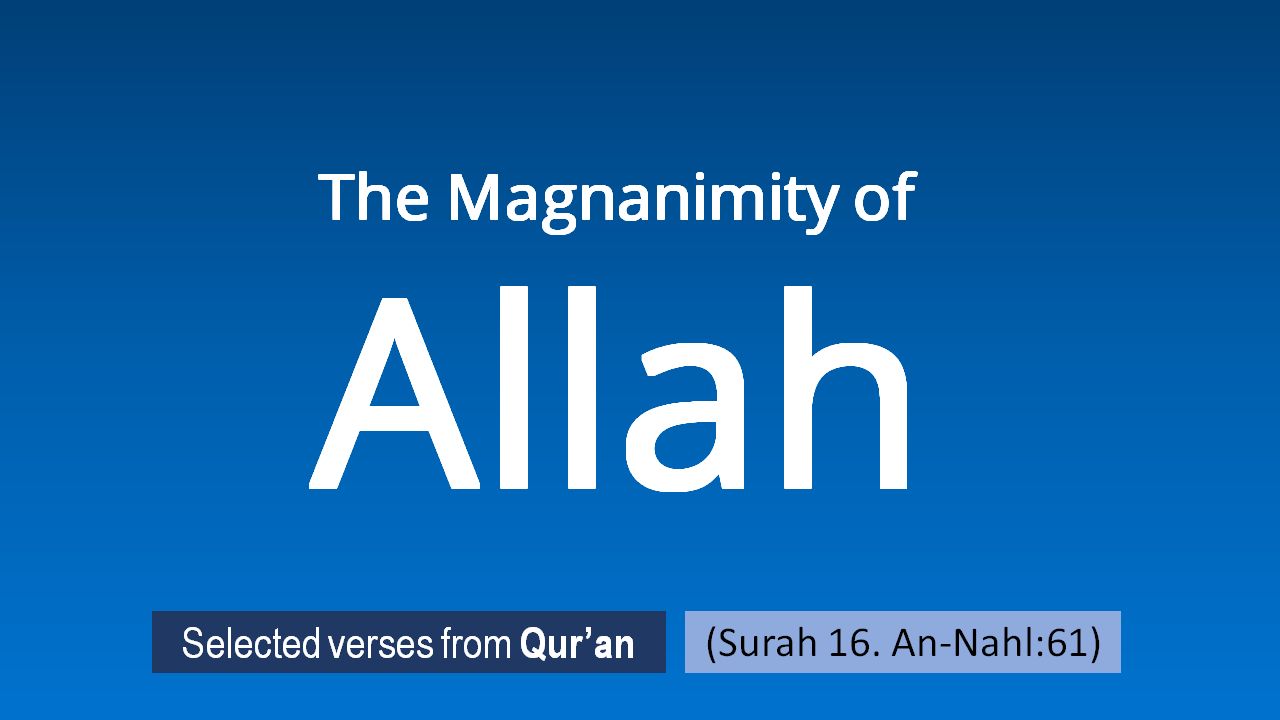
The Magnanimity of Allah

Our world is full of demagogues, cruel usurpers and indecent people due to which the poor and meek live in a aura of fear and deprivation. And when a poor is robbed by these inhuman beings, he often wonders why God does not punish them for their treacheries. They lament and invoke the justice of Allah, but no immediate redressal of grievance is often seen.

Does this mean Allah supports the treacherous and is indifferent to the plight and pleas of the ones being wronged? Well, this is what a helpless man with faint belief thinks. Those who truly believe in Allah know that all this for a short while for Allah does not immediately punish for disobedience, treachery and cruelty. He waits and gives time to them for a stipulated period for maybe they begin to fear Allah and become faithful. But if they do not, then their living in this world is made miserable, what to talk of the horrified end in the life of Hereafter.

The 61st verse of Surah 16. An Nahl selected for our series of posts on Selected Verses from Qur'an, is based on this very theme:

وَلَوۡ يُؤَاخِذُ اللّٰهُ النَّاسَ بِظُلۡمِهِمۡ مَّا تَرَكَ عَلَيۡهَا مِنۡ دَآبَّةٍ وَّلٰـكِنۡ يُّؤَخِّرُهُمۡ اِلٰٓى اَجَلٍ مُّسَمًّى​​ۚ فَاِذَا جَآءَ اَجَلُهُمۡ لَا يَسۡتَـاۡخِرُوۡنَ سَاعَةً​ وَّلَا يَسۡتَقۡدِمُوۡنَ‏ 
(16:61) Were Allah to take people to task for their wrong-doing, He would not have spared even a single living creature on the face of the earth. But He grants them respite until an appointed term. And when that term arrives, they have no power to delay it by a single moment, nor to hasten it.

Tafsir Ibn-Kathir
Allah tells us about His patience with His creatures, even though they do wrong. If He were to punish them for what they have done, there would be no living creature left on the face of the earth, i.e., He would have destroyed every animal on earth after destroying the sons of Adam. But the Lord - magnificent is His glory - is forbearing and He covers people's faults. He waits until the appointed time, i.e., He does not rush to punish them. If He did, then there would be no one left. Ibn Jarir reported that Abu Salamah said: "Abu Hurayrah heard a man saying, `The wrongdoer harms no one but himself.' He turned to him and said, `That is not true, by Allah! Even the buzzard dies in its nest because of the sins of the wrongdoer.'

Yusuf Ali Explanation
Allah's decree works without fail. If He were to punish for every wrong or shortcoming, not a single living creature on earth would escape punishment. But in His infinite mercy and forgiveness, He gives respite: He provides time for repentance. If the repentance is forthcoming. Allah's Mercy is forthcoming without fail, if not, the punishment comes inevitably on the expiry of the Term. The sinner cannot anticipate it by an insolent challenge, nor can he delay it when the time arrives. Let him not think that the respite given to him may mean that he can do what he likes, and that he can escape scot-free from the consequences.

Javed Ahmad Ghamidi Explanation:
 This refers to the disbelief and polytheism which is under discussion. Imām Amīn Aḥsan Iṣlāḥī writes:

The word ظُلْم actual means to suppress rights. Since polytheism and disbelief are the greatest suppression of rights by which a person suppresses the greatest right of his Lord and also inflicts injustice on on his own self, the Qur’ān has called polytheism and disbelief ظُلْم. (Amīn Aḥsan Iṣlāḥī, Tadabbur-i Qur’ān, vol. 4, 420)

Tafsir Qur'an Wiki:
He certainly can punish people for their wrongdoing. Had He chosen to do so, He would have brought everything down over their heads. But in His wisdom, He has decided to give them respite, for a definite term: If God were to take people to task for their wrongdoing, He would not leave a single living creature on the face [of the earth]. But He gives them respite for a set term. When their time arrives, they cannot delay it by an hour, nor can they hasten it. (Verse 61) God has created man and bestowed on him grace and blessings of all types. Man is the only creature on earth that spreads corruption, commits injustice, denies his Creator, allows tyranny within his own social set up and inflicts harm on other species. Yet despite all this, God is merciful to him, gives him one chance after another, and never abandons him altogether. His wisdom goes hand in hand with His might; His grace with His justice. But human beings are short-sighted, deluded by the respite given them. They do not feel how graceful God is to them until His justice brings them to account at the end of the term, He has appointed for them. But

“When their time arrives, they cannot delay it by an hour, nor can they hasten it.” (Verse 61)

Now you may listen to the following short clipped video to explanation of the aforesaid Ayat by eminent Muslim scholar Nouman Ali Khan:
May Allāh (سبحانه و تعالى‎) help us understand Qur'ān and follow the Sunnah of Prophet Muhammad ﷺ, which is embodiment of commandments of Allah contained in the Qur'ān. May Allah help us to be like the ones He loves and let our lives be lived helping others and not making others' lives miserable or unlivable. May all our wrong doings, whether intentional or unintentional, be forgiven before the angel of death knocks on our door. 
وَمَا عَلَيۡنَاۤ اِلَّا الۡبَلٰغُ الۡمُبِيۡنُ‏ 
(36:17) and our duty is no more than to clearly convey the Message.”
That is Our duty is only to convey to you the message that Allah has entrusted us with. Then it is for you to accept it or reject it. We have not been made responsible for making you accept it forcibly, and if you do not accept it, we shall not be seized in consequence of your disbelief, you will yourselves be answerable for your actions on Day of Resurrection.

Reading the Qur'ān should be a daily obligation of a Muslim - Reading it with translation will make it meaningful. But reading its Exegesis / Tafsir will make you understand it fully. It will also help the Muslims to have grasp over social issues and their answers discussed in the Qur'an and other matter related to inter faith so that they are able to discuss issues with non-Muslims with authority based on refences from Qur'an.

May Allah forgive me if my posts ever imply a piety far greater than I possess. I am most in need of guidance.

Note: When we mention God in our posts, we mean One True God, we call Allah in Islam, with no associates. Allah is the Sole Creator of all things, and that Allah is all-powerful and all-knowing. Allah has no offspring, no race, no gender, no body, and is unaffected by the characteristics of human life.

For more Selected Verses, please refer to our reference page: Selected Verses from the Qur'anYou may also refer to our Reference Pages  and Understanding Al Qur'an for knowing more about Islam and Qur'ān.
Tafsir References: | 1 | 2 | 3 | 4

An effort has been made to gather explanation / exegesis of the surahs of the Qur'ān from authentic sources and then present a least possible condensed explanation of the surah. In that the exegesis of the chapters of the Quran is mainly based on the "Tafhim al-Qur'an - The Meaning of the Qur'an" by one of the most enlightened scholars of the Muslim World Sayyid Abul Ala Maududi.  
In order to augment and add more explanation as already provided, additional input has been interjected from the following sources: 
  • Tafsir Ibn Khatir
  • Muhammad Asad Translation
  • Yusuf Ali Translation
  • Translation Javed Ahmad Ghamidi / Al Mawrid
  • Qur'an Wiki
  • Verse by Verse Qur'an Study Circle
  • Towards Understanding the Quran
In addition, references of other sources which have been explored have also been given above. Those desirous of detailed explanations and tafsir (exegesis), may refer to these sites.

If you like Islam: My Ultimate Decision, and to keep yourself updated on all our latest posts to know more about Islam, follow us on Facebook

Please share this page to your friends and family members through Facebook, WhatsApp or any means on Social Media so that they can also be benefited by it and better understand Islam and the Qur'ān - Insha Allah (Allah Willing) you shall be blessed with the best of both worlds.

Sunday, 13 November 2022

The Divine Command to establish Prayer and Charity

Qur'an lays excessive importance to As Salat (Prayer) and Charity (both obligatory and voluntary) for prayers establish a one-to-one communication of man with Allah without any need for an intermediary and charity allows help to those who have been given less than the others. There are numerous Ayats in Qur'an where both As Salat and Zakat come together, thus the importance of these acts for a believer.

Today we share the 31st verse of Surah 14. Ibraheem (Abrham) based on the same theme:

قُلْ لِّـعِبَادِىَ الَّذِيۡنَ اٰمَنُوۡا يُقِيۡمُوا الصَّلٰوةَ وَيُنۡفِقُوۡا مِمَّا رَزَقۡنٰهُمۡ سِرًّا وَّعَلَانِيَةً مِّنۡ قَبۡلِ اَنۡ يَّاۡتِىَ يَوۡمٌ لَّا بَيۡعٌ فِيۡهِ وَلَا خِلٰلٌ‏ 
(14:31) (O Prophet), tell those of My servants who believe that they should establish Prayer and spend out of what We have provided them with, both secretly and openly, before there arrives the Day when there will be no bargaining, nor any mutual befriending.

Tafsir Ibn-Kathir: 
Allah orders His servants to obey Him, fulfill His rights and be kind to His creatures. He ordained the prayer, which affirms the worship of Allah alone, without partners, and to spend from the provisions that He has granted them, by paying the due Zakah, spending on relatives and being kind to all others. Establishing the prayer requires performing it on time, perfectly, preserving its act of bowing having humility during it, and preserving its prostrations. Allah has ordained spending from what He granted, in secret and public, so that the people save themselves:

(Before the coming of a Day), the Day of Resurrection, (on which there will be neither mutual bargaining nor befriending.) on which no ransom will be accepted from anyone, if he seeks to buy himself. 
Allah said in another Ayah, (So this Day no ransom shall be taken from you, nor of those who disbelieved.) [57:15] 
Allah said here, (nor befriending.) Ibn Jarir commented, "Allah says that on that Day, there will be no friendship between friends that might save those deserving punishment from it. Rather, on that Day, there will be fairness and justice.' Qatadah said, "Allah knows that in this life, there is mutual bargaining and there are friendships which people benefit from. A man chooses his friends and the reasons behind befriending them; if it was for Allah's sake, their friendship should be maintained, but if it was for other than Allah, their friendship is bound to be cutoff.'' I say that the meaning of this, is that Allah the Exalted is declaring that on that Day, no mutual bargaining or ransom will avail anyone, even if he ransoms himself with the earth's fill of gold if he could find that amount! No friendship or intercession shall avail one if he meets Allah while a disbeliever. 

Allah the Exalted also said:
 (And fear the Day when no person shall avail another, nor shall compensation be accepted from him, nor shall intercession be of use to him, nor shall they be helped.) [2:123] and,
O you believe! Spend of that with which We have provided for you, before a Day comes when there will be no bargaining, nor friendship, nor intercession. And it is the disbelievers who are the wrongdoers.) [2:254]

Yusuf Ali Explanation:
Putting ourselves back in the position in which the Muslim community found themselves in Makkah just before the Hijrat, we can imagine how much encouragement and consolation they needed from the preaching, the Faith, and the steadfast character of Al-Mustafa. Intolerant persecution was the order of the day; neither the life nor the property or reputation of the Muslims was safe. They are asked to find strength and tranquility in prayer and in helping each other according to their needs and resources.

Here, as elsewhere, "Sustenance" is to be taken in the literal as well as the metaphorical sense. There were many among the Muslims who were poor, or slaves, or depressed, because they were deprived of the means of livelihood on account of their Faith. They were to be fed, clothed, and sheltered, by those who had means. Charity was to be ordinarily secret, so as to cut out all show or parade, and perhaps also lest the enemy should dry up those sources by unprincipled violence; but there must be much that had to be open and organized, so that all the needy could know where to go to be relieved.

The great Day of Reckoning would be one on which all values would be changed. Wealth, as understood in this world, would no longer count. Should we not therefore use any wealth we have in this life, to give here and receive there? Bai includes all bargaining, -barter, purchase and sale, etc. In this world, where wealth has some value, let us spend it and get for ourselves "treasures in heaven." In the next life each man will stand on his merits and personal responsibility. One man cannot help another. Let us here help each other to become true and righteous, so that our personal account may be favourable there.

Tafsir Qur'an Wiki:
In this verse, the Prophet ﷺ is asked to address God’s servants who have accepted the faith. These are the people who will take heed when they are warned against evil. They accept God’s blessings and appreciate them, and will never exchange them for disbelief. The Prophet is to address these people and teach them how to be grateful for God’s blessings. They should express their gratitude through worship, obedience to God and kindness to His servants.

God commands His Messenger to say to those who have attained to faith that they should express their gratitude to God by establishing regular prayer, for prayer is the most express form of gratitude to God. They should also spend in charity out of the sustenance God provides for them, and make such spending both in secret and in public. Secret charity protects the dignity of the taker and enhances the virtue of the giver. This ensures that charity does not become a source of pride and arrogance. Charitable spending in public serves to demonstrate obedience to God’s orders, and provides a good example to others in the community. Both ways are left to the discretion and sensitivities of every believer.

The believers are told to spend on others now so that their balance which is preserved for them increases through gains they make by charitable spending. This they have to do before a day comes when there is no longer any possibility for wealth to grow, or friendship to bring any benefit. What is of benefit to people is only the good works they have already done, for their reward is stored.

Please listen to explanation of the Ayat by eminent Muslim scholar Nouman Ali Khan:
May Allāh (سبحانه و تعالى‎) help us understand Qur'ān and follow the Sunnah of Prophet Muhammad ﷺ, which is embodiment of commandments of Allah contained in the Qur'ān. May Allah help us to be like the ones He loves and let our lives be lived helping others and not making others' lives miserable or unlivable. May all our wrong doings, whether intentional or unintentional, be forgiven before the angel of death knocks on our door. 
وَمَا عَلَيۡنَاۤ اِلَّا الۡبَلٰغُ الۡمُبِيۡنُ‏ 
(36:17) and our duty is no more than to clearly convey the Message.”
That is Our duty is only to convey to you the message that Allah has entrusted us with. Then it is for you to accept it or reject it. We have not been made responsible for making you accept it forcibly, and if you do not accept it, we shall not be seized in consequence of your disbelief, you will yourselves be answerable for your actions on Day of Resurrection.

Reading the Qur'ān should be a daily obligation of a Muslim - Reading it with translation will make it meaningful. But reading its Exegesis / Tafsir will make you understand it fully. It will also help the Muslims to have grasp over social issues and their answers discussed in the Qur'an and other matter related to inter faith so that they are able to discuss issues with non-Muslims with authority based on refences from Qur'an.

May Allah forgive me if my posts ever imply a piety far greater than I possess. I am most in need of guidance.

Note: When we mention God in our posts, we mean One True God, we call Allah in Islam, with no associates. Allah is the Sole Creator of all things, and that Allah is all-powerful and all-knowing. Allah has no offspring, no race, no gender, no body, and is unaffected by the characteristics of human life.

For more Selected Verses, please refer to our reference page: Selected Verses from the Qur'anYou may also refer to our Reference Pages  and Understanding Al Qur'an for knowing more about Islam and Qur'ān.
Photo | Tafsir References: | 1 | 2 | 3 | 4 | 5 | 6 |

An effort has been made to gather explanation / exegesis of the surahs of the Qur'ān from authentic sources and then present a least possible condensed explanation of the surah. In that the exegesis of the chapters of the Quran is mainly based on the "Tafhim al-Qur'an - The Meaning of the Qur'an" by one of the most enlightened scholars of the Muslim World Sayyid Abul Ala Maududi.  
In order to augment and add more explanation as already provided, additional input has been interjected from the following sources: 
  • Tafsir Ibn Khatir
  • Muhammad Asad Translation
  • Yusuf Ali Translation
  • Translation Javed Ahmad Ghamidi / Al Mawrid
  • Qur'an Wiki
  • Verse by Verse Qur'an Study Circle
  • Towards Understanding the Quran
In addition, references of other sources which have been explored have also been given above. Those desirous of detailed explanations and tafsir (exegesis), may refer to these sites.

If you like Islam: My Ultimate Decision, and to keep yourself updated on all our latest posts to know more about Islam, follow us on Facebook

Please share this page to your friends and family members through Facebook, WhatsApp or any means on Social Media so that they can also be benefited by it and better understand Islam and the Qur'ān - Insha Allah (Allah Willing) you shall be blessed with the best of both worlds.

Saturday, 12 November 2022

Compiled verses from Qur'an on Specific Subjects: As Salat (Prayers)

After one pronounces the Shahada, the declaration to become a Muslim, the first obligation imposed on him is to offer five obligatory prayers between pre-dawn to later after dusk timeframe. This highlights the importance of As Salat, without observing which one's faith in Allah cannot be cemented. 
The observance of Salat is the key to other acts of worship. The Muslim worshipper, who observes the Salat at the right time and in the manner in which it has been stipulated or prescribed, positions himself for a series of blessings from Almighty Allah. In fact, Salat provides an excellent means of communication between a believer and God. Each word of Salat is in fact a form of a supplication to invoke countless blessings of Allah. During Salt, a believer opens up his heart to Allah and can make any legitimate request to Allah for realization. However, care must be taken not to address Allah during Salat to ask for anything which is not legitimate or calls for harming someone.

Thus, the goal of Salat is to bring the Muslims closer to Allah. By attending prayers in the masjid, one also gets closer to other members of the community which furthers add up to building of a bondage between believers and make them a useful member of community. By getting together, one can share each other's happiness and grief, and may come to know of suffering of someone who can then be helped through obligatory and voluntary charity, that is Zakat and alms.

The importance of Salat can be known from the fact that even during war believers are asked to make two groups: While one group offers Salat, the other guards them against any surprise by the enemy. And when one group finishes, they replace their positions so that the second group too gets to offer their prayers. 

Even during travel, one is not absolved of this obligatory act. However, due to discomfort of travel, the even number cycles of the prayer are cut to half.  

Throughout Qur'an, the emphasis on observing Salat, followed by Zakat, is in abundance. It has been amply highlighted that those who do not guard their prayers slowly and gradually drift away from remembrance and evil overshadows him from whose shackles it becomes difficult to free oneself. Thus, it is only adherence to Salat regularly five times a day that one can avert the enticement of the Evil and remain steadfast.

We have already compiled all matters related to As Salat in our Reference Page: As Salat (Prayers), which contains reference to posts already published on all queries regarding Salat and general information.

This reference page is a compilation of verses from Qur'an on the subject of As Salat. This is just the beginning and in time we add more verses to make it a comprehensive compilation and to serve as a ready reckoner:
We will keep adding more verses so as to make this collection wholesome.

For compiled verses for more specific subjects, please refer to our exclusive reference page: "Selected verses from Al-Qurʾān about a specific subject."

In addition, for more Selected Verses, please refer to our reference page: Selected Verses from the Qur'anYou may also refer to our Reference Pages and Understanding Al Qur'an for knowing more about Islam and Qur'ān.
May Allāh (سبحانه و تعالى‎) help us understand Qur'ān and follow the Sunnah of Prophet Muhammad ﷺ, which is embodiment of commandments of Allah contained in the Qur'ān. May Allah help us to be like the ones He loves and let our lives be lived helping others and not making others' lives miserable or unlivable. May all our wrong doings, whether intentional or unintentional, be forgiven before the angel of death knocks on our door. 
وَمَا عَلَيۡنَاۤ اِلَّا الۡبَلٰغُ الۡمُبِيۡنُ‏ 
(36:17) and our duty is no more than to clearly convey the Message.”
That is Our duty is only to convey to you the message that Allah has entrusted us with. Then it is for you to accept it or reject it. We have not been made responsible for making you accept it forcibly, and if you do not accept it, we shall not be seized in consequence of your disbelief, you will yourselves be answerable for your actions on Day of Resurrection.

Reading the Qur'ān should be a daily obligation of a Muslim - Reading it with translation will make it meaningful. But reading its Exegesis / Tafsir will make you understand it fully. It will also help the Muslims to have grasp over social issues and their answers discussed in the Qur'an and other matter related to inter faith so that they are able to discuss issues with non-Muslims with authority based on refences from Qur'an.

May Allah forgive me if my posts ever imply a piety far greater than I possess. I am most in need of guidance.

Note: When we mention God in our posts, we mean One True God, we call Allah in Islam, with no associates. Allah is the Sole Creator of all things, and that Allah is all-powerful and all-knowing. Allah has no offspring, no race, no gender, no body, and is unaffected by the characteristics of human life.

Photo

If you like Islam: My Ultimate Decision, and to keep yourself updated on all our latest posts to know more about Islam, follow us on Facebook

Please share this page to your friends and family members through Facebook, WhatsApp or any means on Social Media so that they can also be benefited by it and better understand Islam and the Qur'ān - Insha Allah (Allah Willing) you shall be blessed with the best of both worlds.

Twitter Delicious Facebook Digg Stumbleupon Favorites More