.

Wednesday, 19 April 2023

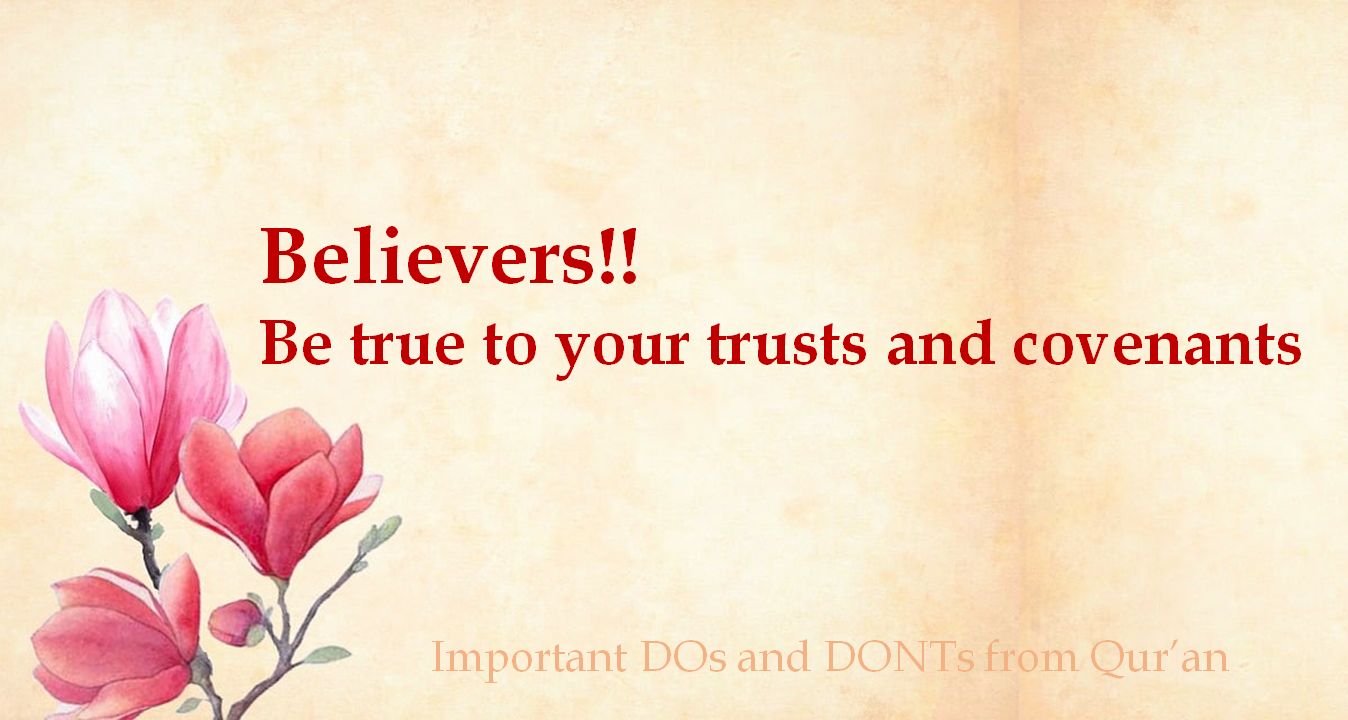
Believers!! Be true to your trusts and covenants

Surah 23. Al-Muminun is one of those chapters of Qur'an which spells out many traits of the successful believers. We have already shared all these traits in one of our earlier posts: Characteristics of Believers who will inherit Paradise - Jannah الۡفِرۡدَوۡسَؕ. Today, we take out one of the important traits upon which the moral fiber of a Muslim society hinges: Keeping one's trusts and covenants. A society deficcit in trust among its members is most likely to fail and collapse. In fact, this trait is a very comprehensive expression for all moral directives in Islam. This is especially true for the leaders and administrators and representatives of people who make promises but then fail their people in their expectations from them.

وَالَّذِيۡنَ هُمۡ لِاَمٰنٰتِهِمۡ وَعَهۡدِهِمۡ رَاعُوۡنَ ۙ‏ 
(23:8) who are true to their trusts and their covenants,
The Believers fulfill the terms of the trusts which are placed in their charge. In this connection it should be noted that the Arabic word amanat is very comprehensive and includes all those trusts which are placed in their charge by Allah or society or individuals. Likewise, `ahd includes all those compacts, pledges, and promises which are made between Allah and man, and man and man. The Holy Prophet himself used to impress the importance of the fulfillment of pledges in his addresses: "The one, who does not fulfil the terms of his trust, has no Faith, and the one, who does not keep promises and pledges has no Islam. " (Baihaqi) According to a Tradition reported both by Bukhari and Muslim, he said: Four characteristics are such that if a person has all the four in him, he is beyond any doubt a hypocrite, and the one who has one of these, is a hypocrite to that extent till he gives it up:

(a) When something is placed in his trust, he commits breach of the trust,

(b) when he speaks, he tells a lie,

(c) when he makes a promise, he breaks it, and

(d) when he has a quarrel with somebody, he exceeds all limits (of decency and morality)"

Tafsir Ibn-Kathir
(Those who are faithfully true to their Amanat and to their covenants) When they are entrusted with something, they do not betray that trust, but they fulfill it, and when they make a promise or make a pledge, they are true to their word. 

This is not like the hypocrites about whom the Messenger of Allah said: (The signs of the hypocrite are three: when he speaks, he lies, when he makes a promise he breaks it, and when he is entrusted with something he betrays that trust.)

Yusuf Ali Explanation
Trusts may be express or implied. Express trusts are those where property is entrusted or duties are assigned by someone to some other whom he trusts, to carry out either immediately or in specified contingencies, such as death. Implied trusts arise out of power, or position, or opportunity; e.g., a king holds his kingdom on trust from Allah for his subjects. The subject of covenants, express and implied, has been discussed in n. 682 to v.1. Covenants create obligations, and express and implied trusts and covenants taken together cover the whole field of obligations.

Javed Ahmad Ghamidi Explanation:
This is a very comprehensive expression for all moral directives in religion. 
Imām Amīn Aḥsan Iṣlāḥī writes: اَمٰنٰت  refers to all trusts which our Lord has blessed us with in the form of strengths, abilities, obligations and responsibilities or in the shape of favours, blessings, riches and offspring. Also included in them are things people have been entrusted with or those discharging, which is our responsibility according to the norms. In a similar way, also included in it are the covenants and promises our Lord has taken from our nature in the unseen world or taken in this world in the form of the sharī‘ah through His messengers. Moreover, it also comprises all those promises and covenants which we made with God through our nature or through His prophets. Similarly, it also consists of promises made with a group or an individual in this world, whether they are written or oral or are thought to be understood in a civilized society even if they are not made orally or in writing. It is stated by the Almighty that it is these servants of His who abide by all these trusts and promises. They are neither dishonest and rebellious in the matter of their Lord nor are ones who are unfaithful to His creatures or go back on their word with them. (Amīn Aḥsan Iṣlāḥī, Tadabbur-i Qur’ān, vol. 5, 299)
Tafsir Qur'an Wiki:
They, individuals and community alike, honour their pledges and discharge their trust. Both the individual and the community have many types of trust to maintain, the first of which is the trust encapsulated in their own nature, i.e. they are created by God in an upright fashion so as to be in harmony with the rest of the universe to which they belong. This testifies to God’s oneness by the natural feeling of unity that governs the universe. Believers are faithful to this great trust, and they protect their nature from deviation so that it continues to testify to God’s oneness. Other trusts are derived from this basic element.

The first pledge is that God has taken from, and made ingrained in human nature, committing it to believe in His existence and His oneness. All other pledges, covenants and treaties derive from this first one. When a believer commits himself to something, he makes God his witness. Honouring his commitments is, to a believer, part of being God-fearing, of taqwā.

The Muslim community is also responsible for honouring its public trust, and for the fulfilment of its pledges to God and the duties that result from these pledges. The sūrah gives its statement in very general terms so as to include every type of trust and pledge. Believers are faithful to all these, at all times. Being faithful is part of their character. No community can hope to have a straightforward life unless pledges and trusts are fulfilled, so that every individual and group are certain of this basic rule of community life. It is a rule that gives everyone a sense of trust and security.
May Allāh (سبحانه و تعالى‎) help us understand Qur'ān and follow the Sunnah of Prophet Muhammad ﷺ, which is embodiment of commandments of Allah contained in the Qur'ān. May Allah help us to be like the ones He loves and let our lives be lived helping others and not making others' lives miserable or unlivable. May all our wrong doings, whether intentional or unintentional, be forgiven before the angel of death knocks on our door. 
وَمَا عَلَيۡنَاۤ اِلَّا الۡبَلٰغُ الۡمُبِيۡنُ‏ 
(36:17) and our duty is no more than to clearly convey the Message.”
That is Our duty is only to convey to you the message that Allah has entrusted us with. Then it is for you to accept it or reject it. We have not been made responsible for making you accept it forcibly, and if you do not accept it, we shall not be seized in consequence of your disbelief, you will yourselves be answerable for your actions on Day of Resurrection.

Reading the Qur'ān should be a daily obligation of a Muslim - Reading it with translation will make it meaningful. But reading its Exegesis / Tafsir will make you understand it fully. It will also help the Muslims to have grasp over social issues and their answers discussed in the Qur'an and other matter related to inter faith so that they are able to discuss issues with non-Muslims with authority based on refences from Qur'an.

May Allah forgive me if my posts ever imply a piety far greater than I possess. I am most in need of guidance.

Note: When we mention God in our posts, we mean One True God, we call Allah in Islam, with no associates. Allah is the Sole Creator of all things, and that Allah is all-powerful and all-knowing. Allah has no offspring, no race, no gender, no body, and is unaffected by the characteristics of human life.

For more Selected Verses, please refer to our reference page: Selected Verses from the Qur'an and Important DOs and DONTs from Qur'anYou may also refer to our Reference Pages  and Understanding Al Qur'an for knowing more about Islam and Qur'ān.
Photo | Tafsir References1 | 2 | 3 | 4 | 5 | 6 |

An effort has been made to gather explanation / exegesis of the surahs of the Qur'ān from authentic sources and then present a least possible condensed explanation of the surah. In that the exegesis of the chapters of the Quran is mainly based on the "Tafhim al-Qur'an - The Meaning of the Qur'an" by one of the most enlightened scholars of the Muslim World Sayyid Abul Ala Maududi.  
In order to augment and add more explanation as already provided, additional input has been interjected from the following sources: 
  • Tafsir Ibn Khatir
  • Muhammad Asad Translation
  • Yusuf Ali Translation
  • Translation Javed Ahmad Ghamidi / Al Mawrid
  • Qur'an Wiki
  • Verse by Verse Qur'an Study Circle
  • Towards Understanding the Quran
In addition, references of other sources which have been explored have also been given above. Those desirous of detailed explanations and tafsir (exegesis), may refer to these sites.

If you like Islam: My Ultimate Decision, and to keep yourself updated on all our latest posts to know more about Islam, follow us on Facebook

Please share this page to your friends and family members through Facebook, WhatsApp or any means on Social Media so that they can also be benefited by it and better understand Islam and the Qur'ān - Insha Allah (Allah Willing) you shall be blessed with the best of both worlds.

Tuesday, 18 April 2023

Give full measures and weight - With Justice

Justice is the hallmark of the social system as enunciated in the Qur'an. At a number of places in Qur'an, Allah has cautioned believers to abide by justice, both in weights and measures and in dealings with others. We have already shared a number of these verses under the heading Justice / Rules of Islamic Law in our reference page Selected Verses from Qur'an

Today, through this post, we add yet another Divine reminder to the believers to abide by justice. However, it must be kept in view that Jusitce here refers metonymically to all dealings between men and not only to commercial transactions: hence the interpolation "in all your dealings".

Note: The selected verse is part of a long verse, that is verse 152 of Surah 6. Al An'am,  in which a number of Divine Commandments are given, which have already been shared as the Divine Commandments in Qur'an.

 وَاَوۡفُوۡا الۡكَيۡلَ وَالۡمِيۡزَانَ بِالۡقِسۡطِ​
(7:152) ... and give full measures and weight with justice

Tafsir Ibn-Kathir
(.. and give full measure and full weight with justice.) is a command to establish justice while giving and taking. 

Allah has also warned against abandoning this commandment, when He said: (83:1-6: Woe to Al-Mutaffifin. Those who, when they have to receive by measure from men, demand full measure. And when they have to give by measure or weight to (other) men, give less than due. Do they not think that they will be resurrected (for reckoning). On a Great Day the Day when (all) mankind will stand before the Lord of all that exists) Allah destroyed an entire nation that was accustomed to giving less in weights and measures. 

Javed Ahmad Ghamidi Explanation:
This is a great commandment and, in its essence, a corrollary of the scale of justice on which this world exists. Thus, if anyone deviates from this, it means that his concept of justice and fairness has become contaminated and the fact that God is just has been forgotten. Obviously, after this, the whole socio-economic system is uprooted and the fabric of the society is totally decimated. The blessings of weighing with full measure are referred to in verse 35 of Sūrah Banī Isrā’īl. It is said that this is the right attitude with regard to its consequences and carries great blessings for the people as well. 

Imām Amīn Aḥsan Iṣlāḥī writes: ... The blessings of this conduct in the Hereafter are evident. In this world also, with regard to the consequences ... This attitude will reap benefits for people for the prosperity of their livelihood, economic activity, business, trade and a just society. Nations who are dishonest have neither prospered in this world nor will they ever do so. This evil is not a singular evil. It is actually a sign of the existence of many other evils. A nation fraught with this evil is devoid of the concept of justice and fairness. For this reason, it is not only devoid of the ability to create a healthy society, it also sows seeds of disorder in God’s earth. (Amīn Aḥsan Iṣlāḥī, Tadabbur-i Qur’ān, vol. 3, 202)

Tafsir Qur'an Wiki:
“Give just weight and full measure. We do not charge a soul with more than it can bear.” (Verse 152) This clearly applies to commercial transactions and requires people to do their best to ensure that everyone gets what is due to them. The surah provides a direct link between these transactions and faith, because this is the Islamic attitude. It is God who gives this directive and who urges people to give just weight and full measure.

Let us establish true justice within ourselves and in our dealings both with others and commercial dealings wherein physical dealings of weights and measures are involved. Remember, one may earn a few coins more by giving less measure or deceive someone with lies and false statements. But all such evil lapses are being recorded and will be produced as evidence against the culprits on the Day of Judgement. And then, there will be no going back to making amends. Tere will be but remorse and shame. Time is slipping away fast, so let us reshape our lives based on Divine Commandments of Allah. 
May Allāh (سبحانه و تعالى‎) help us understand Qur'ān and follow the Sunnah of Prophet Muhammad ﷺ, which is embodiment of commandments of Allah contained in the Qur'ān. May Allah help us to be like the ones He loves and let our lives be lived helping others and not making others' lives miserable or unlivable. May all our wrong doings, whether intentional or unintentional, be forgiven before the angel of death knocks on our door. 
وَمَا عَلَيۡنَاۤ اِلَّا الۡبَلٰغُ الۡمُبِيۡنُ‏ 
(36:17) and our duty is no more than to clearly convey the Message.”
That is Our duty is only to convey to you the message that Allah has entrusted us with. Then it is for you to accept it or reject it. We have not been made responsible for making you accept it forcibly, and if you do not accept it, we shall not be seized in consequence of your disbelief, you will yourselves be answerable for your actions on Day of Resurrection.

Reading the Qur'ān should be a daily obligation of a Muslim - Reading it with translation will make it meaningful. But reading its Exegesis / Tafsir will make you understand it fully. It will also help the Muslims to have grasp over social issues and their answers discussed in the Qur'an and other matter related to inter faith so that they are able to discuss issues with non-Muslims with authority based on refences from Qur'an.

May Allah forgive me if my posts ever imply a piety far greater than I possess. I am most in need of guidance.

Note: When we mention God in our posts, we mean One True God, we call Allah in Islam, with no associates. Allah is the Sole Creator of all things, and that Allah is all-powerful and all-knowing. Allah has no offspring, no race, no gender, no body, and is unaffected by the characteristics of human life.

For more Selected Verses, please refer to our reference page: Selected Verses from the Qur'an and Important DOs and DONTs from Qur'anYou may also refer to our Reference Pages  and Understanding Al Qur'an for knowing more about Islam and Qur'ān.
Photo | Tafsir References: | 1 | 2 | 3 | 4 |

An effort has been made to gather explanation / exegesis of the surahs of the Qur'ān from authentic sources and then present a least possible condensed explanation of the surah. In that the exegesis of the chapters of the Quran is mainly based on the "Tafhim al-Qur'an - The Meaning of the Qur'an" by one of the most enlightened scholars of the Muslim World Sayyid Abul Ala Maududi.  
In order to augment and add more explanation as already provided, additional input has been interjected from the following sources: 
  • Tafsir Ibn Khatir
  • Muhammad Asad Translation
  • Yusuf Ali Translation
  • Translation Javed Ahmad Ghamidi / Al Mawrid
  • Qur'an Wiki
  • Verse by Verse Qur'an Study Circle
  • Towards Understanding the Quran
In addition, references of other sources which have been explored have also been given above. Those desirous of detailed explanations and tafsir (exegesis), may refer to these sites.

If you like Islam: My Ultimate Decision, and to keep yourself updated on all our latest posts to know more about Islam, follow us on Facebook

Please share this page to your friends and family members through Facebook, WhatsApp or any means on Social Media so that they can also be benefited by it and better understand Islam and the Qur'ān - Insha Allah (Allah Willing) you shall be blessed with the best of both worlds.

Monday, 17 April 2023

What is Zakatul-Fitr? Why, when and to whom it is given

The ongoing month of Ramadan is about to end and with the siting of the new moon a few days from now, the festival of Eid al-Fitr (عيد الفطر) will take place on the first day of the Islamic month of Shawwal. On this day the believers thank Allah for having blessed them the strength to endure the hunger and thirst during the month long fasting in Ramadan.

On this day, men and women move out happily to the central places or masjid to offer the special Eid prayers. However, before one leaves for Eid prayers, one has to give out Zakatul-Fitr, a form of charity. Zakatul-Fitr is called as Sadaqat al-Fitr /  صَدَقَةِ الْفِطْرِ or simply Fitrana in some countries. The question here arises that what form of charity is this? Is it other than the mandatory Zakat, which is paid on yearly basis or other alms and sadaqat? Why is this paid before the Eid prayers and to whom?

We share a hadith attributed to Prophet Muhammad ﷺ that answer the question and is mentioned in Sunan Ibn Majah, Book 8 The Chapters Regarding Zakat - كتاب الزكاة ,  Chapter 21 Sadaqat al-Fitr / باب صَدَقَةِ الْفِطْرِ as Hadith 1827

حَدَّثَنَا عَبْدُ اللَّهِ بْنُ أَحْمَدَ بْنِ بَشِيرِ بْنِ ذَكْوَانَ، وَأَحْمَدُ بْنُ الأَزْهَرِ، قَالاَ حَدَّثَنَا مَرْوَانُ بْنُ مُحَمَّدٍ، حَدَّثَنَا أَبُو يَزِيدَ الْخَوْلاَنِيُّ، عَنْ سَيَّارِ بْنِ عَبْدِ الرَّحْمَنِ الصَّدَفِيِّ، عَنْ عِكْرِمَةَ، عَنِ ابْنِ عَبَّاسٍ، قَالَ فَرَضَ رَسُولُ اللَّهِ ـ صلى الله عليه وسلم ـ زَكَاةَ الْفِطْرِ طُهْرَةً لِلصَّائِمِ مِنَ اللَّغْوِ وَالرَّفَثِ وَطُعْمَةً لِلْمَسَاكِينِ فَمَنْ أَدَّاهَا قَبْلَ الصَّلاَةِ فَهِيَ زَكَاةٌ مَقْبُولَةٌ وَمَنْ أَدَّاهَا بَعْدَ الصَّلاَةِ فَهِيَ صَدَقَةٌ مِنَ الصَّدَقَاتِ ‏.‏

Ibn Abbas said: “The Messenger of Allah (ﷺ) enjoined Zakatul-Fitr as a purification for the fasting person from idle talk and obscenities, and to feed the poor. Whoever pays it before the (Eid) prayer, it is an accepted Zakah, and whoever pays it after the prayer, it is (ordinary) charity.”

Grade: Hasan (Darussalam)

While the payment of this form of charity cleanses one's fasts from the idle talk while fasting, the ultimate beneficiary of Zakatul-Fitr is the poor and needy so that they can also join in the festivities of Eid by buying clothes for the children or preparing a few dishes. Here care must be taken that  Zakatul-Fitr be given only to the poor and not to the beggars, which is usually the case. This is the beauty of Islam that the poor are always remembered and helped on special occasions, besides helping them through Zakat and alms. And remember, give out  Zakatul-Fitr before the Eid prayer, the best would be a day or two earlier so that the poor can buy clothes or food for the family.

Let us expand the meaning of the hadith in more detail:

This hadith, narrated by Ibn Abbas, explains the significance of Zakatul-Fitr (the alms given at the end of Ramadan) and its purpose. In the hadith, the Messenger of Allah (ﷺ) is reported to have stated that Zakatul-Fitr serves as a purification for the fasting person from any idle talk and obscenities during the month of fasting, as well as a means to feed the poor. The hadith also specifies the timing of the payment, emphasizing that it is an accepted form of zakat if given before the Eid prayer, but if given after the prayer, it is considered ordinary charity.

Key Themes of the Hadith:
  • Purification for the Fasting Person:
    • Zakatul-Fitr is described as a form of purification for the fasting person. It helps cleanse the fast from any shortcomings, such as idle chatter or inappropriate behavior, which might have occurred during the fasting period.
    • Idle talk (e.g., gossip, negative speech) and obscenities (inappropriate or sinful language) are discouraged in Islam, especially during fasting. The hadith suggests that Zakatul-Fitr acts as a spiritual cleanser for any such lapses.
  • Charity for the Poor:
    • The purpose of Zakatul-Fitr is also to provide for those in need, ensuring that everyone can partake in the joy of Eid al-Fitr.
    • It serves as a means of distributing wealth and ensuring that the poor are able to celebrate Eid along with others, without suffering from hunger or need.
  • Timing of Zakatul-Fitr: The hadith makes a distinction between paying Zakatul-Fitr before or after the Eid prayer. If given before the prayer, it is regarded as an accepted Zakah (obligatory almsgiving). However, if paid after the prayer, it is treated as regular charity (sadaqah).
Explanation in Light of the Qur'an:
  • Purification and Fasting: The idea of purification is important in the context of fasting. In the Qur'an, fasting is a means of attaining taqwa (God-consciousness), and purification of both body and soul is emphasized. Fasting requires not just abstaining from food and drink but also from sinful actions, including idle talk or obscenities.
    • Surah Al-Baqarah (2:183-185): "O you who have believed, decreed upon you is fasting as it was decreed upon those before you that you may become righteous." The goal of fasting is to attain righteousness or taqwa, which requires spiritual purity and moral refinement. Zakatul-Fitr assists in this by purifying the fast from any deficiencies in conduct.
    • Surah Al-Ahzab (33:70): “O you who have believed, fear Allah and speak words of appropriate justice.” This highlights the importance of maintaining good speech and avoiding sinful words, which is one of the things Zakatul-Fitr seeks to purify the fast from.
  • Feeding the Poor: The Qur'an emphasizes the importance of charity and feeding the poor, particularly during moments of celebration like Eid. Zakatul-Fitr ensures that those less fortunate can join in the happiness of Eid, reinforcing the principle of social justice in Islam.
    • Surah Al-Baqarah (2:177): “It is not righteousness that you turn your faces toward the East or the West, but righteousness is in one who believes in Allah, the Last Day, the Angels, the Book, and the Prophets, and gives his wealth, desiring the Face of Allah, to relatives, orphans, the needy, the traveler, those who ask [for help], and for freeing slaves.”
    • Surah Al-Insan (76:8-9): "And they give food, in spite of love for it, to the poor, the orphan, and the captive, [saying], 'We feed you only for the face of Allah. We wish not from you reward or gratitude.'" This highlights the importance of feeding the poor, which is the central function of Zakatul-Fitr.
  • Timing of the Payment: The distinction between paying Zakatul-Fitr before or after the Eid prayer is also consistent with the Qur'anic injunctions related to the timing and acceptance of charity. The prescribed timing ensures that the charity is distributed while it is still a part of the Eid celebration.
    • Surah Al-Baqarah (2:261): “The example of those who spend their wealth in the way of Allah is like that of a seed which grows seven spikes. In each spike is a hundred grains.” While this verse speaks more generally about charity, it reinforces the idea that charity, when given at the right time, brings greater reward.
    • The importance of giving at the prescribed time is reflected in this hadith. Giving Zakatul-Fitr before the prayer ensures that it fulfills its intended purpose, whereas giving it after the prayer makes it fall into the category of voluntary charity, which is good but does not carry the same significance as the obligatory Zakah.
Theological and Spiritual Insights
Purification of the Fasting Person: Zakatul-Fitr serves as a way to correct any minor flaws in the fasting process, such as speech errors, by purifying the fast. It reminds us that even in our acts of worship, such as fasting, we should seek continuous improvement and strive to remove any blemishes, even the ones we might overlook.
  • Social Responsibility: Zakatul-Fitr reinforces the Islamic principle that charity is not only a personal act of devotion but also a means of ensuring social welfare and justice. It serves as a reminder that those who are less fortunate should not be excluded from community events and celebrations.
  • Comprehensive Charity: The hadith highlights the balance between individual piety and social responsibility. By purifying the fast and providing for the poor, Zakatul-Fitr nurtures both spiritual and social dimensions of the Muslim community.
In conclusion, the hadith on Zakatul-Fitr, when viewed in light of the Qur'an, emphasizes purification of the soul, feeding the poor, and the importance of timing in charity. It aligns with Qur'anic principles of attaining taqwa, promoting social justice, and ensuring that acts of charity fulfill their intended purpose within the community.
May Allāh (سبحانه و تعالى‎) help us understand Qur'ān and follow the Sunnah of Prophet Muhammad ﷺ, which is embodiment of commandments of Allah contained in the Qur'ān. May Allah help us to be like the ones He loves and let our lives be lived helping others and not making others' lives miserable or unlivable. May all our wrong doings, whether intentional or unintentional, be forgiven before the angel of death knocks on our door. 
وَمَا عَلَيۡنَاۤ اِلَّا الۡبَلٰغُ الۡمُبِيۡنُ‏ 
(36:17) and our duty is no more than to clearly convey the Message.”
That is Our duty is only to convey to you the message that Allah has entrusted us with. Then it is for you to accept it or reject it. We have not been made responsible for making you accept it forcibly, and if you do not accept it, we shall not be seized in consequence of your disbelief, you will yourselves be answerable for your actions on Day of Resurrection.

May Allah forgive me if my posts ever imply a piety far greater than I possess. I am most in need of guidance.

Reading the Qur'ān should be a daily obligation of a Muslim - Reading it with translation will make it meaningful. But reading its Exegesis / Tafsir will make you understand it fully. It will also help the Muslims to have grasp over social issues and their answers discussed in the Qur'an and other matter related to inter faith so that they are able to discuss issues with non-Muslims with authority based on refences from Qur'an.

Note: When we mention God in our posts, we mean One True God, we call Allah in Islam, with no associates. Allah is the Sole Creator of all things, and that Allah is all-powerful and all-knowing. Allah has no offspring, no race, no gender, no body, and is unaffected by the characteristics of human life.

Please refer to our reference page: Sunnah and Hadith of Prophet Muhammad ﷺ to know more about sunnah of Prophet of Allah. You may also refer to our Reference Pages for knowing more about Islam and Qur'ān.

Disclaimer: The material for this post has been collected from the references as given below. If anyone differs with the material contained in this post, one may consult the references and their authors.  If someone has more material about the subject, he/she is most welcome to share in the comments box to make the post all encompassing.

If you like Islam: My Ultimate Decision, and to keep yourself updated on all our latest posts to know more about Islam, follow us on Facebook

Please share this page to your friends and family members through Facebook, WhatsApp or any means on social media so that they can also be benefited by it and better understand Islam and the Qur'ān - Insha Allah (Allah Willing) you shall be blessed with the best of both worlds.

Sunday, 16 April 2023

Who is a self-reproaching soul by whom Allah swears in Qur’an (Surah 75. Al Qiyama (The Resurrection) )

At many a place in Qur'an, Allah swears to instill upon the non-believers the truth of end game which they for now shrug away in a lighter mood and mock the prophets of something they are unlikely to see.

Right in the beginning of Surah 75. Al Qiyama (The Resurrection), Allah swears of by the Day of Resurrection and then swears by the self-reproaching soul. We pick up this verse to know why a self-reproaching soul has been sworn by and who could be a soul that qualifies this status.

Let us read the verse and know - but first let us reconnect the selected verse with the first of the Surah in which Allah swears by the Day of Resurrection:

لَاۤ اُقۡسِمُ بِيَوۡمِ الۡقِيٰمَةِۙ‏ 
(75:1) Nay, I swear by the Day of Resurrection;
To begin the discourse with "Nay" by itself indicates that the Surah was sent down to refute some argument which was already in progress. The theme that follows shows that the argument was about Resurrection and life after death, which the people of Makkah were denying and also mocking at it at the same time. This can be understood by an example. If a person only wants to affirm the truth of the Messenger, he will say: "By God, the Messenger has come with the truth." But if some people might be denying the truth of the Messenger, he in response would rejoin, thus: “Nay, by God, the Messenger has come with the truth." It would mean: "That which you say is not true. I swear that the truth is this and this."

And then Allah swears by the self-reproaching soul:

وَلَاۤ اُقۡسِمُ بِالنَّفۡسِ اللَّوَّامَةِؕ‏ 
(75:2) and nay, I swear by the self-reproaching soul!

Renowned exegete of Qur'an Yusuf Ali explains: Three states or stages of the development of the human soul: 
  • (1) Ammara (xii. 53), which is prone to evil, and, if not checked and controlled, will lead to perdition:
وَمَاۤ اُبَرِّئُ نَفۡسِىۡ​ۚ اِنَّ النَّفۡسَ لَاَمَّارَةٌۢ بِالسُّوۡٓءِ اِلَّا مَا رَحِمَ رَبِّىۡ ؕاِنَّ رَبِّىۡ غَفُوۡرٌ رَّحِيۡمٌ‏ 
 I do not seek to acquit myself; for surely one's self prompts one to evil except him to whom my Lord may show mercy. Verily my Lord is Ever Forgiving, Most Merciful." (12:53)
  • (2) Lawwama, as here, which feels conscious of evil, and resists it, asks for Allah's grace and pardon after repentance and tries to amend; it hopes to reach salvation; 
  • (3) Mutmainna (lxxxix 27), the highest stage of all, when it achieves full rest and satisfaction. 
يٰۤاَيَّتُهَا النَّفۡسُ الۡمُطۡمَـئِنَّةُ
 (On the other hand, it will be said): “O serene soul! (89:27)

Our second stage may be compared to Conscience, except that in English usage Conscience is a faculty and not a stage in spiritual development. And this is the soul by whom Allah is swearing for such a soul is a subject to one's conscious and each action of his undergoes a self-analysis before one takes the final decision. And these decisions are always positive for such souls are God fearing and always desist the Satanic machinations to overshadow their decision-making thought process. And even if he does an evil deed, he is immediately rebuked from within, forces him to repent and ask forgiveness of Allah, and steers him back to the righteous path.

Tafsir Ibn-Kathir
In reference to An-Nafs Al-Lawwamah, Qurrah bin Khalid reported from Al-Hasan Al-Basri that he said about this Ayah, "Verily, by Allah, we think that every believer blames himself. He says (questioning himself), `What did I intend by my statement What did I intend by my eating What did I intend in what I said to myself' However, the sinner proceeds ahead and he does not blame himself.''

Javed Ahmad Ghamidi Explanation:
The implication is that a person’s conscience that rebukes him for his sins bears witness by its very existence that the Day of Judgement is certain to come. The reason is that within him his reproaching soul is always present to rebuke him on any evil he does; this internal court of justice delivers its verdict at every instance; this only means that he will not be left unaccountable for his deeds. Thus, he shall definitely be called to account. It is for this accountability that the Almighty has appointed the Day of Judgement. His messengers have always informed man of this day. 

Imām Amīn Aḥsan Iṣlāḥī writes:
… If a person will not be held accountable for his deeds, then where has this chiding conscience come into him from? If his Creator is unconcerned about the good and evil which emanate from him, then why and from where has He given him the feeling of being elated at a good deed and being pricked by his conscience at a bad one? Then from here another question arises: If God has set up a miniature court of justice in every person, why will He not set up a greater court of justice which will hold the whole world accountable for good and evil which emanate from it and not reward and punish people accordingly? Any person who deliberates on these questions while disregarding his desires will reach the conclusion that the very being of a person bears witness that he has innate knowledge of good and evil; he will not be left unaccountable; there definitely shall come one day when he will be punished for any misdeeds he may have done and be rewarded for his good deeds. To remind a person of this day, the Almighty has placed a miniature court of justice within a person’s soul so that he does not remain indifferent to it, and if ever he becomes iindifferent,he can catch a glimpse of it by merely reflecting on his inner-self. It is this reality which sages have taught us by saying that a human being is a miniature world and within this miniature world there is a reflection of the greater world. If a person has a true comprehension of his own self, he is able to comprehend both God and the Hereafter. (Amīn Aḥsan Iṣlāḥī, Tadabbur-i Qur’ān, vol. 9, 80)

Sayyid Abul Ala Maududi continues to explain the verse: Here an oath by the Day of Resurrection is only an argument for the truth that this system will one day be upset. As for the truth that after that man shall be resurrected and called upon to account for his deeds and made to see the good or evil results thereof, another oath has been sworn by the self-reproaching soul. No man exists in the world who may not have a faculty called conscience in him. This conscience is necessarily conscious of the good and evil, and no matter how perverted and degraded a man might be, his conscience always checks him on doing evil and for not doing good irrespective of the fact whether the criterion of good and evil that he had set for himself might in itself be right or wrong. This is an express pointer that man is not merely an animal but a moral being. He naturally can distinguish good from evil; he regards himself as responsible for the good or the evil he does; and even if he might feel pleased suppressing the reproaches of his conscience over the evil, he has done to another, he, on the contrary, feels and demands from within that the other one who has done the same evil to him, must deserve punishment. Now, if the existence of a self-reproaching soul of this kind in man himself is an undeniable truth, then this truth too is undeniable that the same self-reproaching soul is evidence of the life hereafter, which exists in man’s own nature itself. For this demand of nature that man must be rewarded or punished for his good or evil deeds for which he himself is responsible, cannot be met in any other way than in the life hereafter. No sensible man can deny that if man becomes nonexistent after death, he will certainly be deprived of the rewards of his good deeds and escape the just and lawful punishment of many of his evil deeds. Therefore, unless one comes to believe in the absurd idea that a rational being like man has stumbled into an irrational system of the universe and a moral being like man has happened to be born in a world which basically has nothing to do with morality, he cannot deny the life hereafter. Likewise, the philosophy of the transmigration of souls also is no reply to this demand of nature, for if man goes on being born and reborn in this very world for the sake of being rewarded and punished for his moral acts, in every cycle of life he will perform some additional moral acts, which again will need to be rewarded and punished, thus making his account more and more lengthy and complicated in an endless way instead of being settled finally and for good. Therefore, this demand of nature is fulfilled only in case man in this world should have only one life and then, after the whole human race has been brought to an end, there should be another life in which all acts of man should be judged and assessed rightly and justly and he should be fully rewarded or punished in consequence thereof. 

Let us, then, be men of self-reproaching soul, and let our inner system of self-appraisal and justice always prevails upon us to defeat the evil and misleading thoughts. This is the first stage to finally achieve the Nafs al Mutmainna النَّفۡسُ الۡمُطۡمَـئِنَّةُ - the highest stage of all, when it achieves full rest and satisfaction.

May Allāh (سبحانه و تعالى‎) help us understand Qur'ān and follow the Sunnah of Prophet Muhammad ﷺ, which is embodiment of commandments of Allah contained in the Qur'ān. May Allah help us to be like the ones He loves and let our lives be lived helping others and not making others' lives miserable or unlivable. May all our wrong doings, whether intentional or unintentional, be forgiven before the angel of death knocks on our door. 

وَمَا عَلَيۡنَاۤ اِلَّا الۡبَلٰغُ الۡمُبِيۡنُ‏ 
(36:17) and our duty is no more than to clearly convey the Message.”
That is Our duty is only to convey to you the message that Allah has entrusted us with. Then it is for you to accept it or reject it. We have not been made responsible for making you accept it forcibly, and if you do not accept it, we shall not be seized in consequence of your disbelief, you will yourselves be answerable for your actions on Day of Resurrection.

Reading the Qur'ān should be a daily obligation of a Muslim - Reading it with translation will make it meaningful. But reading its Exegesis / Tafsir will make you understand it fully. It will also help the Muslims to have grasp over social issues and their answers discussed in the Qur'an and other matter related to inter faith so that they are able to discuss issues with non-Muslims with authority based on refences from Qur'an.

May Allah forgive me if my posts ever imply a piety far greater than I possess. I am most in need of guidance.

Note: When we mention God in our posts, we mean One True God, we call Allah in Islam, with no associates. Allah is the Sole Creator of all things, and that Allah is all-powerful and all-knowing. Allah has no offspring, no race, no gender, no body, and is unaffected by the characteristics of human life.

For more Selected Verses, please refer to our reference page: Selected Verses from the Qur'anYou may also refer to our Reference Pages  and Understanding Al Qur'an for knowing more about Islam and Qur'ān.
Photo | Tafsir References: | 1 | 2 | 3 | 4 | 5

An effort has been made to gather explanation / exegesis of the surahs of the Qur'ān from authentic sources and then present a least possible condensed explanation of the surah. In that the exegesis of the chapters of the Quran is mainly based on the "Tafhim al-Qur'an - The Meaning of the Qur'an" by one of the most enlightened scholars of the Muslim World Sayyid Abul Ala Maududi.  
In order to augment and add more explanation as already provided, additional input has been interjected from the following sources: 
  • Tafsir Ibn Khatir
  • Muhammad Asad Translation
  • Yusuf Ali Translation
  • Translation Javed Ahmad Ghamidi / Al Mawrid
  • Qur'an Wiki
  • Verse by Verse Qur'an Study Circle
  • Towards Understanding the Quran
In addition, references of other sources which have been explored have also been given above. Those desirous of detailed explanations and tafsir (exegesis), may refer to these sites.

If you like Islam: My Ultimate Decision, and to keep yourself updated on all our latest posts to know more about Islam, follow us on Facebook

Please share this page to your friends and family members through Facebook, WhatsApp or any means on Social Media so that they can also be benefited by it and better understand Islam and the Qur'ān - Insha Allah (Allah Willing) you shall be blessed with the best of both worlds.

Friday, 14 April 2023

Surely in remembrance of Allah do hearts find rest

There is a Hadith attribute to Prophet Muhammad ﷺ that reads: There is a piece of flesh in the body if it becomes good (reformed) the whole body becomes good but if it gets spoilt the whole body gets spoilt and that is the heart. A sound heart refers to one that is free from arrogance and tries to please Allah. That is the more one cleans one's heart of worldly wants and puts complete trust in Allah, the more peace and tranquility one finds, for then one is reassured that no harm can come to him as long as love for Allah resides in his heart. 

Have you ever seen the bright radiance on the faces of the people who are closer to Allah, the ones whose time is spent in remembrance of Allah and doing things as ordained by their Creator? That is the more one remembers Allah the more his heart is cleansed of evil thoughts and takes him away from the worldly thoughts and worries. This is exactly the theme of the 28th verse of Surah 13. Ar Ra'ad (The Thunder) as shared below:

اَلَّذِيۡنَ اٰمَنُوۡا وَتَطۡمَـئِنُّ قُلُوۡبُهُمۡ بِذِكۡرِ اللّٰهِ​ ؕ اَلَا بِذِكۡرِ اللّٰهِ تَطۡمَـئِنُّ الۡقُلُوۡبُ ؕ‏ 
(13:28) Such are the ones who believe (in the message of the Prophet) and whose hearts find rest in the remembrance of Allah. Surely in Allah's remembrance do hearts find rest.
That is to say that to the degree that you remember Allah, your heart will be calm and cheerful. His remembrance carries with it the meaning of total dependence upon Him, of turning to Him for aid, of having good thoughts about Him, and of waiting for victory from Him. Truly, He is near when supplicated: He hears when He is called and He answers when He is invoked, so humble yourself before Him and ask of Him sincerely. Repeat His beautiful blessed name, and mention Him as being alone worthy of worship. Mention His praises, supplicate to Him, and ask forgiveness from Him: you will then find - by the will of Allah- happiness, peace, and illumination. [1]

How can we remember Allah so that our hearts are at rest, peaceful and comforted? Herein under are some tips:

  • Unflinching Faith in Allah
  • Total trust in Allah (Tawakkul). ...
  • Constant mention of Allah (Dhikrullah). ...
  • Supplication (Duah)
  • Positive attitude for every distress 
Let us read how Muslim scholars interpret this verse:

Yusuf Ali Explanation:
The Sign or Miracle is not something external: it is something internal, something in your mind, heart, and soul. It depends on your inner spiritual experience. If you turn to Allah, that light, that experience, will come. If you do not, Allah will not force you.

Javed Ahmad Ghamidi Explanation:
Ie., not through marvels and miracles, but through the Qur’ān when it fully expounds the attributes of God, His established practices and the arguments of His comprehension. However, for this it is necessary that a person is prepared to recognize the truth per se.

Tafsir Qur'an Wiki:
This is followed by an image of believing hearts which enjoy a congenial atmosphere of reassurance, happiness and peace. They find comfort in their feeling that their bond with God is a real one, and that they are close to Him, secure with His support.

They are without worry, and worry is normally only generated when one is left alone or when one is unsure of one’s way. Such people understand God’s wisdom behind man’s creation, origin and destiny. They also find comfort in feeling secure against aggression, harm or evil, except as God wills for them. This is coupled with a resigned acceptance of whatever trial God wishes to test them with. They are reassured that God will always bestow on them His grace, giving them guidance, abundance and security in this life and in the life to come.

Such comfort in the heart is a profound reality in the hearts of believers who deeply and truly feel the meaning of faith. They have a bond with God which they recognize. They cannot express the meaning of such a bond in words.

It touches their hearts, generating a feeling of happiness and reassurance that they do not stand alone in this universe. Whatever surrounds them is a friend, because it is all made by God under whose protection they live.

No one on earth is more miserable than those who are deprived of the blessing of a close relationship with God. Those who, having severed the most essential bond with their Creator, feel that they have no relationship with all around them are bound to suffer great misery. Who can be more wretched than one who does not realize why he has been created, or where he is heading, or why he suffers? Forlorn indeed is the one who goes about his life feeling isolated in an endless desert, having to strive without support, guidance or help.

In life we often experience moments which none can withstand unless we are certain of God’s support and protection, regardless of whatever resources of fortitude, perseverance and power may be at our command. There are moments in life that render all that useless. But such moments can be faced easily by those who find their comfort in God.

Now you may listen to the following short clipped video to explanation of the aforesaid Ayat by eminent Muslim scholar Nouman Ali Khan:
May Allāh (سبحانه و تعالى‎) help us understand Qur'ān and follow the Sunnah of Prophet Muhammad ﷺ, which is embodiment of commandments of Allah contained in the Qur'ān. May Allah help us to be like the ones He loves and let our lives be lived helping others and not making others' lives miserable or unlivable. May all our wrong doings, whether intentional or unintentional, be forgiven before the angel of death knocks on our door. 
وَمَا عَلَيۡنَاۤ اِلَّا الۡبَلٰغُ الۡمُبِيۡنُ‏ 
(36:17) and our duty is no more than to clearly convey the Message.”
That is Our duty is only to convey to you the message that Allah has entrusted us with. Then it is for you to accept it or reject it. We have not been made responsible for making you accept it forcibly, and if you do not accept it, we shall not be seized in consequence of your disbelief, you will yourselves be answerable for your actions on Day of Resurrection.

Reading the Qur'ān should be a daily obligation of a Muslim - Reading it with translation will make it meaningful. But reading its Exegesis / Tafsir will make you understand it fully. It will also help the Muslims to have grasp over social issues and their answers discussed in the Qur'an and other matter related to inter faith so that they are able to discuss issues with non-Muslims with authority based on refences from Qur'an.

May Allah forgive me if my posts ever imply a piety far greater than I possess. I am most in need of guidance.

Note: When we mention God in our posts, we mean One True God, we call Allah in Islam, with no associates. Allah is the Sole Creator of all things, and that Allah is all-powerful and all-knowing. Allah has no offspring, no race, no gender, no body, and is unaffected by the characteristics of human life.

For more Selected Verses, please refer to our reference page: Selected Verses from the Qur'anYou may also refer to our Reference Pages  and Understanding Al Qur'an for knowing more about Islam and Qur'ān.
Photo | Tafsir References: | 1 | 2 | 3 | 4

An effort has been made to gather explanation / exegesis of the surahs of the Qur'ān from authentic sources and then present a least possible condensed explanation of the surah. In that the exegesis of the chapters of the Quran is mainly based on the "Tafhim al-Qur'an - The Meaning of the Qur'an" by one of the most enlightened scholars of the Muslim World Sayyid Abul Ala Maududi.  
In order to augment and add more explanation as already provided, additional input has been interjected from the following sources: 
  • Tafsir Ibn Khatir
  • Muhammad Asad Translation
  • Yusuf Ali Translation
  • Translation Javed Ahmad Ghamidi / Al Mawrid
  • Qur'an Wiki
  • Towards Understanding the Quran
In addition, references of other sources which have been explored have also been given above. Those desirous of detailed explanations and tafsir (exegesis), may refer to these sites.

If you like Islam: My Ultimate Decision, and to keep yourself updated on all our latest posts to know more about Islam, follow us on Facebook

Please share this page to your friends and family members through Facebook, WhatsApp or any means on Social Media so that they can also be benefited by it and better understand Islam and the Qur'ān - Insha Allah (Allah Willing) you shall be blessed with the best of both worlds.

Thursday, 13 April 2023

Reward of providing food for a fasting person to break his fast

The time of breaking fast is very crucial for a fasting believer for by that time all his energies are at the lowest level. Many fasting believers may be travelling and may not have provisions to break their fast. Likewise, many poor people who, despite their poverty and no provisions in sight top break their fast need our special attention, and those who can afford should lay down a table full of provisions for others to break their fast. 

Prophet Muhammad ﷺ has specially instructed the believers to help others by providing food so that they could break their fast. This noble act fetches great rewards for those who do it to please Allah and not as an act of show off.

Scroll down for an informative video on the subject

This Hadith is mentioned Jami` at-Tirmidhi  (Book # 8 The Book on Fasting كتاب الصوم عن رسول الله صلى الله عليه وسلم / Chapter # 82 What Has Been Revealed About One Who Provides the Food for a Fasting Person to Break His Fast باب مَا جَاءَ فِي فَضْلِ مَنْ فَطَّرَ صَائِمًا ) as Hadith number # 807:

حَدَّثَنَا هَنَّادٌ، حَدَّثَنَا عَبْدُ الرَّحِيمِ بْنُ سُلَيْمَانَ، عَنْ عَبْدِ الْمَلِكِ بْنِ أَبِي سُلَيْمَانَ، عَنْ عَطَاءٍ، عَنْ زَيْدِ بْنِ خَالِدٍ الْجُهَنِيِّ، قَالَ قَالَ رَسُولُ اللَّهِ صلى الله عليه وسلم ‏ "‏ مَنْ فَطَّرَ صَائِمًا كَانَ لَهُ مِثْلُ أَجْرِهِ غَيْرَ أَنَّهُ لاَ يَنْقُصُ مِنْ أَجْرِ الصَّائِمِ شَيْئًا ‏"‏ ‏.‏ قَالَ أَبُو عِيسَى هَذَا حَدِيثٌ حَسَنٌ صَحِيحٌ ‏.‏

Zaid bin Khalid Al-Juhani narrated that:
The Messenger of Allah said: "Whoever provides the food for a fasting person to break his fast with, then for him is the same reward as his (the fasting person's), without anything being diminished from the reward of the fasting person."

Grade: Sahih (Darussalam)

It is the month of goodwill, during which provisions are multiplied. Whoever feeds hungry and a fasting person will be compensated with forgiveness of sins and salvation of his soul from Hell. He will also receive a reward equal to that of the person he feeds, without causing him any reduction."

Please watch an informative video on the subject:
May Allāh (سبحانه و تعالى‎) help us understand Qur'ān and follow the Sunnah of Prophet Muhammad ﷺ, which is embodiment of commandments of Allah contained in the Qur'ān. May Allah help us to be like the ones He loves and let our lives be lived helping others and not making others' lives miserable or unlivable. May all our wrong doings, whether intentional or unintentional, be forgiven before the angel of death knocks on our door. 
وَمَا عَلَيۡنَاۤ اِلَّا الۡبَلٰغُ الۡمُبِيۡنُ‏ 
(36:17) and our duty is no more than to clearly convey the Message.”
That is Our duty is only to convey to you the message that Allah has entrusted us with. Then it is for you to accept it or reject it. We have not been made responsible for making you accept it forcibly, and if you do not accept it, we shall not be seized in consequence of your disbelief, you will yourselves be answerable for your actions on Day of Resurrection.

May Allah forgive me if my posts ever imply a piety far greater than I possess. I am most in need of guidance.

Reading the Qur'ān should be a daily obligation of a Muslim - Reading it with translation will make it meaningful. But reading its Exegesis / Tafsir will make you understand it fully. It will also help the Muslims to have grasp over social issues and their answers discussed in the Qur'an and other matter related to inter faith so that they are able to discuss issues with non-Muslims with authority based on refences from Qur'an.

Note: When we mention God in our posts, we mean One True God, we call Allah in Islam, with no associates. Allah is the Sole Creator of all things, and that Allah is all-powerful and all-knowing. Allah has no offspring, no race, no gender, no body, and is unaffected by the characteristics of human life.

This post is part of series of posts on the subject of: Are you among the best Muslims, as mentioned by Prophet Muhammad ﷺ?

Please refer to our reference page: Sunnah and Hadith of Prophet Muhammad ﷺ to know more about sunnah of Prophet of Allah. You may also refer to our Reference Pages for knowing more about Islam and Qur'ān.

Disclaimer: The material for this post has been collected from the references as given below. If anyone differs with the material contained in this post, one may consult the references and their authors.  If someone has more material about the subject, he/she is most welcome to share in the comments box to make the post all encompassing.

If you like Islam: My Ultimate Decision, and to keep yourself updated on all our latest posts to know more about Islam, follow us on Facebook

Please share this page to your friends and family members through Facebook, WhatsApp or any means on social media so that they can also be benefited by it and better understand Islam and the Qur'ān - Insha Allah (Allah Willing) you shall be blessed with the best of both worlds.

Prophetic Supplication for Night of Al Qadr

The month of Ramadan brings countless blessings for the believers who fast during the month only to please Allah, for Allah has promised that the reward of fasting is something that is between Him and His servant. And certainly, every fasting believer should expect a special reward for him for the love of his Creator, imposes upon himself strict restrictions and stays away from everything which is otherwise Halal / permissible to him. 

However, the rewards and blessings are multiplied manifold during the last ten days of Ramadan for in it falls a night which better than a thousand months - the Night of Qadr. We have already shared the importance of this night in our earlier posts (link given below). Today we share a special supplication which Prophet Muhammad ﷺ recommended to be recited during the last ten days of the sacred month.

This Hadith is mentioned Jami` at-Tirmidhi  (Book # 48 Chapters on Supplication كتاب الدعوات عن رسول الله صلى الله عليه وسلم / Chapter # 84 Concerning "The Virtue of Asking for Al-Afiyah and Al-Mu’afah")s Hadith number # 3513:

حَدَّثَنَا قُتَيْبَةُ بْنُ سَعِيدٍ، حَدَّثَنَا جَعْفَرُ بْنُ سُلَيْمَانَ الضُّبَعِيُّ، عَنْ كَهْمَسِ بْنِ الْحَسَنِ، عَنْ عَبْدِ اللَّهِ بْنِ بُرَيْدَةَ، عَنْ عَائِشَةَ، قَالَتْ قُلْتُ يَا رَسُولَ اللَّهِ أَرَأَيْتَ إِنْ عَلِمْتُ أَىُّ لَيْلَةٍ لَيْلَةُ الْقَدْرِ مَا أَقُولُ فِيهَا قَالَ ‏ "‏ قُولِي اللَّهُمَّ إِنَّكَ عَفُوٌّ كَرِيمٌ تُحِبُّ الْعَفْوَ فَاعْفُ عَنِّي ‏"‏‏.‏ قَالَ هَذَا حَدِيثٌ حَسَنٌ صَحِيحٌ ‏.‏
Narrated by Aishah:
“I said: ‘O Messenger of Allah, what is your view if I know when the Night of Al-Qadr is, then what should I say in it?” He said: ‘Say: “O Allah, indeed You are Pardoning, [Generous,] You love pardon, so pardon me (Allāhumma innaka `Afuwwun [Karīmun], tuḥibbul-`afwa fa`fu `annī).’”

It is a small yet very powerful Dua which can be easily remembered and recited. Let us my brothers and sisters of Islam stay awake during the odd nights of the last days of the Ramadan and recite the above quoted supplication as much as we can, for who know our supplication coincides with the blessed hour on the night of Al Qadr and we are rewarded profusely by our Lord.
May Allāh (سبحانه و تعالى‎) help us understand Qur'ān and follow the Sunnah of Prophet Muhammad ﷺ, which is embodiment of commandments of Allah contained in the Qur'ān. May Allah help us to be like the ones He loves and let our lives be lived helping others and not making others' lives miserable or unlivable. May all our wrong doings, whether intentional or unintentional, be forgiven before the angel of death knocks on our door. 
وَمَا عَلَيۡنَاۤ اِلَّا الۡبَلٰغُ الۡمُبِيۡنُ‏ 
(36:17) and our duty is no more than to clearly convey the Message.”
That is Our duty is only to convey to you the message that Allah has entrusted us with. Then it is for you to accept it or reject it. We have not been made responsible for making you accept it forcibly, and if you do not accept it, we shall not be seized in consequence of your disbelief, you will yourselves be answerable for your actions on Day of Resurrection.

May Allah forgive me if my posts ever imply a piety far greater than I possess. I am most in need of guidance.

Reading the Qur'ān should be a daily obligation of a Muslim - Reading it with translation will make it meaningful. But reading its Exegesis / Tafsir will make you understand it fully. It will also help the Muslims to have grasp over social issues and their answers discussed in the Qur'an and other matter related to inter faith so that they are able to discuss issues with non-Muslims with authority based on refences from Qur'an.

Note: When we mention God in our posts, we mean One True God, we call Allah in Islam, with no associates. Allah is the Sole Creator of all things, and that Allah is all-powerful and all-knowing. Allah has no offspring, no race, no gender, no body, and is unaffected by the characteristics of human life.

Please refer to our reference page: Supplications attributed to Prophet Muhammad ﷺ for more prophetic Supplications attributed to Prophet Muhammad ﷺ

You may also refer to our reference page: Sunnah and Hadith of Prophet Muhammad ﷺ to know more about sunnah of Prophet of Allah. You may also refer to our Reference Pages for knowing more about Islam and Qur'ān.

Disclaimer: The material for this post has been collected from the references as given below. If anyone differs with the material contained in this post, one may consult the references and their authors.  If someone has more material about the subject, he/she is most welcome to share in the comments box to make the post all encompassing.

If you like Islam: My Ultimate Decision, and to keep yourself updated on all our latest posts to know more about Islam, follow us on Facebook

Please share this page to your friends and family members through Facebook, WhatsApp or any means on social media so that they can also be benefited by it and better understand Islam and the Qur'ān - Insha Allah (Allah Willing) you shall be blessed with the best of both worlds.

Twitter Delicious Facebook Digg Stumbleupon Favorites More