.

Monday, 28 February 2022

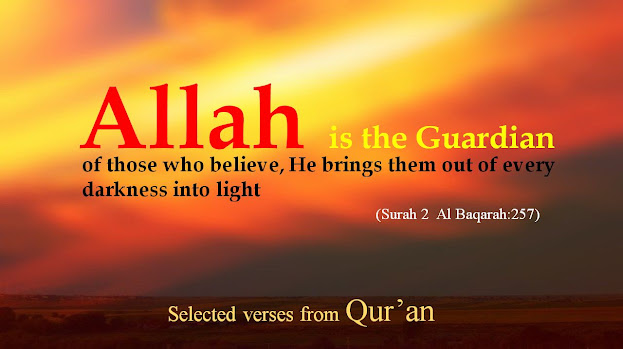
Allah is the Guardian of those who believe, He brings them out of every darkness into light

Strong and unflinching faith and belief in Allah is the key to success for believers, both in this world and the hereafter. Once a believer attains that level of belief and faith that he sees no one other than Allah to be his guardian and deliverer from all his difficulties, misdeeds and sins. It is for these strong hearted and firm believers that Allah promises to be their Guardian and promises them to take them out of the fathomless darkness of ignorance and misbeliefs.

But at the same time, Allah disassociates Him from those who are followers of the evil, who fall from grace, from lightness into darkness and promises them the fire of hell where they would stay forever. 

The 257th verse of Surah 2. Al Baqarah (The Cow), in our series of posts on "Selected Verses from Qur'an," is about these believers and evil followers:

اَللّٰهُ وَلِىُّ الَّذِيۡنَ اٰمَنُوۡا يُخۡرِجُهُمۡ مِّنَ الظُّلُمٰتِ اِلَى النُّوۡرِ​  وَالَّذِيۡنَ كَفَرُوۡۤا اَوۡلِيٰٓـُٔهُمُ الطَّاغُوۡتُۙ يُخۡرِجُوۡنَهُمۡ مِّنَ النُّوۡرِ اِلَى الظُّلُمٰتِ​ؕ اُولٰٓـئِكَ اَصۡحٰبُ النَّارِ​​ۚ هُمۡ فِيۡهَا خٰلِدُوۡنَ
(2:257) Allah is the Guardian of those who believe, He brings them out of every darkness into light. And those who disbelieve, their guardians are the evil ones; they bring them out of light into all kinds of darkness. These are destined for the Fire, and there shall they abide.
"Darkness" stands for the darkness of ignorance that causes one to go astray from the Right Way, and to spend all one's efforts and energies in wrong way. In contrast to this, "light" stands for the light of the Truth which enables one to see clearly the Reality and perceive the real aim of life and follow consciously and deliberately the Right Way.
Literally  لطَّاغُوۡتُۙ  taghut applies to everyone who transgresses the limits. The Qur'an uses this word for one who rebels against Allah and claims himself to be the master and sovereign of His servants and forces them to become his servants.

Man's rebellion against Allah has three degrees of criminality: (1) One is fasiq (disobedient) if one professes to be His subject but practically acts against His commandments; (2) One is kafir (disbeliever) if one becomes independent of Him or owes allegiance to someone else; (3) One is taghut if one rebels against Allah and exerts to make His subjects subservient to himself. Such a one may be Satan or a priest or a religious or a political leader or a king or a state. Therefore no one can be a true believer of Allah unless he disowns taghut. 
Though taghut is singular in form, here it is plural in meaning, for the one who rejects Allah becomes a slave not of one but of several forms of taghut, One of these is Satan who goes on tempting him with many false and alluring temptations. Another is his own self that makes him a slave of passions and lusts and misleads him into crooked ways. Then there are others, his wife and children, his kith and kin, his clan and family, his friends and nation, his political and religious leaders and his government. All these are taghut for him and desire to make him a slave of their wishes and ambitions. And this slave of all these masters wastes his whole life in trying to accomplish the impossible feat of pleasing each and every one of them.

Javed Ahmad Ghamidi Explanation:
The actual words are: يُخْرِجُهُمْ مِّنَ الظُّلُمٰتِ اِلَي النُّوْرِ. Here the word النُّوۡر is singular and الظُّلُمٰت is plural. The reason for this is that the light mentioned here is the light of one’s faith, intellect and character. It is obvious that its source is one – the Almighty and there is no disparity in this source. On the other hand, the various types of darkness that come because of a lack of faith, intellect and character come from various sources and there is also great disparity among these sources as well.

The law of guidance that is mentioned in this verse is explained by Imām Amīn Aḥsan Iṣlāḥī in the following words:
… The main point in the law of guidance is whether a person seeks it from the Almighty or from someone else. If he holds on to the Almighty for this purpose, the Almighty guides and helps him, and His grace gradually takes him out from the desolate darkness of base desires and hypocrisy, religious innovation and polytheism and places him on the path that leads to faith and monotheism. However, if a person turns away from the Almighty and seeks someone else, he ends up with Satan and his progeny; Satan then leads him astray and deprives him of the light of his intellect and guidance. It is said that an empty mind is the devil’s playground; quite similarly, a heart which is devoid of faith becomes the devil’s playground and then these devils misguide and mislead these people forever. (Amīn Aḥsan Iṣlāḥī, Tadabbur-i Qur’ān, vol. 1, 598)

Qur'an Wiki:

The sūrah then goes on to present a vivid and graphic scene depicting the two paths of guidance and error. It indicates how God kindly and gently takes the believers by the hand and leads them out of the darkness, into the light, and how the false deities sponsor the unbelievers and lead them, too, by the hand, but out of the light into the darkness.

Faith is light that permeates man’s soul and conscience to radiate from within his being and illuminate all things, ideas and values around him. It gives the believer a clear vision and a steady and confident understanding that enable him to identify, discern and choose. It lights his route to God, His laws and teachings, putting man in perfect concord with the world around him. He proceeds through life in total harmony, free of all conflict and at peace with his human nature. 

Please listen to the tafsir of the above said verse by eminent scholar Nouman Ali Khan:
May Allah help us understand Qur'ān and help us to act upon the commandments of Allah contained therein. Aameen.

For more Selected Verses, please refer to our reference page: Selected Invocations / Dua " دُعا " from the Qur'anYou may also refer to our Reference Pages for knowing more about Islam and Qur'ān.
Photo | Reference: | 1 | 2 | 3 |
Reading the Qur'ān should be a daily obligation of a Muslim - Reading it with translation will make it meaningful. But reading its Exegesis / Tafsir will make you understand it fully.

An effort has been made to gather explanation / exegesis of the surahs of the Qur'ān from authentic sources and then present a least possible condensed explanation of the surah. In that the exegesis of the chapters of the Quran is mainly based on the "Tafhim al-Qur'an - The Meaning of the Qur'an" by one of the most enlightened scholars of the Muslim World Sayyid Abul Ala Maududi.  

In order to augment and add more explanation as already provided, additional input has been interjected from following sources: 
  • Towards Understanding the Quran
  • Tafsir Ibn Khatir
  • Muhammad Asad Translation
  • Javed Ahmad Ghamidi / Al Mawrid
  • Al-Quran, Yusuf Ali Translation
  • Verse by Verse Qur'an Study Circle
In addition the references of  other sources which have been explored have also been given above. Those desirous of detailed explanations and tafsir (exegesis), may refer to these sites.

If you like Islam: My Ultimate Decision, and to keep yourself updated on all our latest posts to know more about Islam, follow us on Facebook

Please share this page to your friends and family members through Facebook, WhatsApp or any means on Social Media so that they can also be benefited by it and better understand Islam and the Qur'ān - Insha Allah (Allah Willing) you shall be blessed with the best of both worlds.

Friday, 25 February 2022

Share of women in what their parents and kinsfolk leave behind

The non Muslim world often laments that Islam suppresses the rights of women, specially when it comes to wearing of Hijab by Muslim women, But no one ever appreciates Islam for it is the first ever religion that protects the rights of the women and gives them opportunities to live a comfortable life even when orphaned or divorced. The laws of inheritance spelt out in Qur'an dwell at length at the share of women and ordains men to give share to the women in what their parents and kinsfolk have left behind.

Surah 4. An Nisa talks at length at the rights and conduct of women. The 7th verse of the surah selected for today's post in the series of posts on Selected Verses from Qur'an, is in particular refer3ence to the share from inheritance for the women, side by side the men. This must be an eye opener for all those Muslims, specially in the Indian sub continent who for one reason and excuse or the other deprive women from their right of share in inheritance. The following verse gives out the general order to give share to women. For breakdown of shares, read our earlier post: Laws of Inheritance in Islam.

لِلرِّجَالِ نَصِيۡبٌ مِّمَّا تَرَكَ الۡوَالِدٰنِ وَالۡاَقۡرَبُوۡنَ وَلِلنِّسَآءِ نَصِيۡبٌ مِّمَّا تَرَكَ الۡوَالِدٰنِ وَالۡاَقۡرَبُوۡنَ مِمَّا قَلَّ مِنۡهُ اَوۡ كَثُرَ ​ؕ نَصِيۡبًا مَّفۡرُوۡضًا‏ 
(4:7) Just as there is a share for men in what their parents and kinsfolk leave behind, so there is a share for women in what their parents and kinsfolk leave behind - be it little or much - a share ordained (by Allah).
This verse contains five legal regulations about inheritance. First, that not only men but the women also have a share in the inheritance. Second, that it must be divided among all heirs, however little or insignificant it is; so much so that even if the deceased has left one yard of cloth and there are ten heirs, it must also be cut into ten parts. However, an heir may buy the shares of others by mutual consent. Third, that the verse also implies that this law applies to all sorts of property, transferable or non-transferable, agricultural or industrial, or of any other type. Fourth, that the right of inheritance becomes valid only when the deceased leaves some property behind him. Fifth, that when the nearest relatives are alive the distant relatives have no right in the inheritance.

Tafsir Ibn-Kathir
The Necessity of Surrendering the Inheritance According to the Portions that Allah Ordained:  Sa`id bin Jubayr and Qatadah said, "The idolators used to give adult men a share of inheritance and deprive women and children of it. 

Allah revealed;  (There is a share for men from what is left by parents and those nearest in relation).'' Therefore, everyone is equal in Allah's decision to inherit, even though their shares vary according to the degree of their relationship to the deceased, whether being a relative, spouse, etc. 

Ibn Marduwyah reported that Jabir said, "Umm Kujjah came to the Messenger of Allah and said to him, `O Messenger of Allah! I have two daughters whose father died, and they do not own anything.' So Allah revealed; (There is a share for men from what is left by parents and those nearest in relation.)''  Allah knows best. 

Yusuf Ali  Explanation
I have resisted the temptation to translate "next to kin," as this phrase has a technical meaning in Indian Law, referring to certain kinds of heirs, whereas here the people meant are those whose inheritance is to be divided. The shares are specified. Here the general principles are laid down that females inherit as well as males, and that relatives who have no legal shares, orphans, and indigent people are not to be treated harshly, if present at the division.

Javed Ahmad Ghamidi Explanation:
This is a reference to the shares of inheritance which have been prescribed in the subsequent verses so that a person receives guidance in a matter about which he cannot decide himself and no chance remains for powerful inheritors to usurp and snatch the legacy of a deceased person. Imām Amīn Aḥsan Iṣlāḥī writes:

… Before the advent of Islam, the situation in Arabia, in fact, the whole world was that all the weak, and not merely women and orphans were at the mercy of powerful heirs. At one instance, the Qur’ān has referred to this by the words: وَ تَاۡكُلُوۡنَ التُّرَاثَ اَكۡلًا لَّمًّا  (19:89) (and grab hold of the inheritance to usurp it, (89:19)). To address this situation, the Qur’ān prescribed the shares of all the heirs whether men or women. When a person, after reciting the previous verses reaches this verse, he thinks that it is as if by the blessings of the rights of the orphans the door to ascertain the rights of others has also been opened. In other words, not only those who were themselves devoid of rights were granted these rights, others too by virtue of these were granted these rights. Women were mentioned in particular because it was for the first time that they too got a place right next to men as far as rights were concerned, and in the legacy of the parents and kin, a prescribed share from God –whether little or big – was made mandatory. (Amīn Aḥsan Iṣlāḥī, Tadabbur-i Qur’ān, vol. 2, 256)

Qur'an Wiki:
In the days of jāhiliyyah, or ignorance, in pre-Islamic Arabia, no share of inheritance was given to females, and little, if any, was given to young boys. The reason being that neither group could fight against any aggressor. God’s law, on the other hand, made inheritance due to all kinsfolk, according to their degree of kinship and their shares, which will be detailed later. It is the view of Islam that members of the same family should help and look after one another. Everyone is required to look after his relatives when they are in need, and to share their liability in paying compensation in cases of causing death to or inflicting injury or bodily harm on others. Hence, it is only right that relatives should inherit each other, when they leave behind some property, according to their respective kinship. This gives practical effect to the rule that: “gain is commensurate with liability”. Islam is a complete and perfectly coherent system. This is reflected most clearly in the distribution of rights and obligations. This is the general rule of inheritance. Some people may question the concept of inheritance, but this only betrays their rudeness towards God, their ignorance of human nature and the requirements of practical life.

It is enough to understand the principles which form the Islamic social system to put an end to such futile arguments. The basic characteristic of this system is mutual care. In order to give mutual care a sound basis, Islam builds its structure on a solid foundation of natural human inclinations that have a basic role to fulfil in human life.
 
Family ties are genuine and natural. They have not been invented by any generation of humanity, nor indeed by the cumulative wisdom of all generations. These ties have a profound effect on human life, its preservation and betterment. No argument against the seriousness of these ties and their effect is worth any consideration. In view of this, Islam makes mutual care within the family the cornerstone of its system of social care and security. Inheritance is one aspect of that. It is also an essential element of the Islamic economic system.
 
Should this provision fall short of looking after all cases which need help, the next step, which is care within the local community, will complement it. If this also falls short, then the Islamic state will look after all those who need care after the family and the local community have fulfilled their duties. In this way, the burden is not thrown totally on the shoulders of the state. The reason being that care within the family or the local community is bound to create feelings of compassion which, in turn, promote co-operation in a most natural way. Moreover, these feelings of compassion constitute a net gain for humanity which cannot be dismissed by any person who has the interests of humanity at heart. Furthermore, family care in particular is bound to leave certain effects that are in harmony with human nature. When a person realises that the effort he exerts to improve his situation will also benefit his relatives, especially his offspring, he will have the motive to double his efforts. His increased productivity benefits the community indirectly. Islam does not create barriers between the individual and the community. Whatever an individual owns belongs to the community as a whole when it needs it.
 
This last rule is enough to make invalid all superficial objections to inheritance, which argue that inheritance gives money to people who have not worked or made an effort for it. The fact is that an heir is an extension of the person from whom he inherits. From another point of view, an heir is the very person to look after his relatives, should he be well off and they be in need. Moreover, all property belongs to the community when it needs it, on the basis of the rules of Islamic social security.
 
Furthermore, the relationship between testator and heir, especially offspring, is not confined to money and property alone. Relatives, both immediate and extended, also pass on their good and bad tendencies, susceptibility to certain illnesses, physical features, intelligence or the lack of it, and so on. All these inherited aspects stay with those who receive them throughout their lives. They cannot get rid of them, no matter how hard they try. It is only fair, then, that they should also inherit property when they cannot avoid, even with the help of the state and all its power, inheriting illness, evil tendencies and stupidity.
 
For all these practical and natural aspects of human life, and for many other social interests, God has laid down the general rule of inheritance: “Men shall have a share in what parents and kinsfolk leave behind, and women shall have a share in what parents and kinsfolk leave behind; whether it be little or much. It is an apportioned share.” This is the general principle by which Islam gave women, fourteen centuries ago, the same rights as men to have a share of inheritance and by which it has preserved the rights of youngsters who were treated unfairly during the days of ignorance. Ignorant society looked at individuals according to their value in war and productivity. Islam, which is a Divine code of living, looks first at the human value of man. This is his intrinsic value of which he cannot be deprived. His duties and obligations within the family and the community take a secondary position.

May Allah help us understand Qur'ān and help us to act upon the commandments of Allah contained therein, and let us not be the violators of Allah's commandments with reference to inheritance, specially about share of women. Aameen.

For more Selected Verses, please refer to our reference page: Selected Verses from the Qur'anYou may also refer to our Reference Pages for knowing more about Islam and Qur'ān.
Photo | Reference: | 1 | 2 | 3 | 4 | 5 |
Reading the Qur'ān should be a daily obligation of a Muslim - Reading it with translation will make it meaningful. But reading its Exegesis / Tafsir will make you understand it fully.

An effort has been made to gather explanation / exegesis of the surahs of the Qur'ān from authentic sources and then present a least possible condensed explanation of the surah. In that the exegesis of the chapters of the Quran is mainly based on the "Tafhim al-Qur'an - The Meaning of the Qur'an" by one of the most enlightened scholars of the Muslim World Sayyid Abul Ala Maududi.  
In order to augment and add more explanation as already provided, additional input has been interjected from following sources: 
  • Towards Understanding the Quran
  • Tafsir Ibn Khatir
  • Muhammad Asad Translation
  • Javed Ahmad Ghamidi / Al Mawrid
  • Al-Quran, Yusuf Ali Translation
  • Verse by Verse Qur'an Study Circle
In addition the references of other sources which have been explored have also been given above. Those desirous of detailed explanations and tafsir (exegesis), may refer to these sites.

If you like Islam: My Ultimate Decision, and to keep yourself updated on all our latest posts to know more about Islam, follow us on Facebook

Please share this page to your friends and family members through Facebook, WhatsApp or any means on Social Media so that they can also be benefited by it and better understand Islam and the Qur'ān - Insha Allah (Allah Willing) you shall be blessed with the best of both worlds.

Wednesday, 23 February 2022

Usurping Property of Orphans is a Grievous Sin in Islam

Surah An Nisa (The Women) is a very important chapter of the Qur'an for it lays down many Divine commandments relating to relations between man and woman and laws relating to family and in heritance. The powerful opening to the sūrah, which mentions the rights of the orphans, is followed with an outline of the foundation upon which the Islamic social system is built: mutual co-operation within the family and the community, care for the weak and vulnerable, protection and honour for women, looking after the property of the community, and the distribution of inheritance among heirs according to a system which ensures justice to individuals and prosperity to the community.

The mere fact that the very second verse of the surah is about the rights of orphans and the protection of their property shows how much importance has been given to the protection of the rights of the orphans in Islam and how the guardians have been warned against usurping their properties and termed as a grievous sin:

وَاٰ تُوا الۡيَتٰمٰٓى اَمۡوَالَهُمۡ​ وَلَا تَتَبَدَّلُوا الۡخَبِيۡثَ بِالطَّيِّبِ وَلَا تَاۡكُلُوۡۤا اَمۡوَالَهُمۡ​ اِلٰٓى اَمۡوَالِكُمۡ​ؕ اِنَّهٗ كَانَ حُوۡبًا كَبِيۡرًا‏‏  
(4:2) Give orphans their property, and do not exchange the bad for the good, and do not eat up their property by mixing it with your own. This surely is a mighty sin.
That is, as long "As the orphans are under age, spend their property only in their interest; and when they come of age, return their rightful property to them."  This is a comprehensive sentence, which may mean, "Do not make your Income unclean in any unlawful way." It may also mean, "Do not exchange your worthless things for the valuable things of the orphans." 

Tafsir Ibn-Kathir:
Allah commands that the property of the orphans be surrendered to them in full when they reach the age of adolescence, and He forbids using or confiscating any part of it. 

So He said; (and do not exchange (your) bad things for (their) good ones;) Sa`id bin Al-Musayyib and Az-Zuhri commented, "Do not substitute a weak animal of yours for a fat animal (of the orphans).'' Ibrahim An-Nakha`i and Ad-Dahhak commented, "Do not give something of bad quality for something of good quality.'' As-Suddi said, "One of them (caretakers of orphans) would take a fat sheep from the orphan's property and put in its place, a weak sheep of his, saying, `A sheep for a sheep.' He would also take a good Dirham and exchange it for a fake Dirham, saying, `A Dirham for a Dirham.''' 

Allah's statement, (and devour not their substance to your substance.) means, do not mix them together so that you eat up both, as Mujahid, Sa`id bin Jubayr, Muqatil bin Hayyan, As-Suddi and Sufyan bin Hassin stated. 

Allah said, (Surely, this is a great sin. ), a major and substantial sin, according to Ibn `Abbas. This was also reported from Mujahid, `Ikrimah, Sa`id bin Jubayr, Al-Hasan, Ibn Sirin, Qatadah, Muqatil bin Hayyan, Ad-Dahhak, Abu Malik, Zayd bin Aslam and Abu Sinan. The meaning above is: adding their property to your property is a grave sin and a major mistake, so avoid it.

Yusuf Ali  Explanation
Justice to orphans is enjoined, and three things are particularly mentioned as temptations in the way of a guardian: (I) He must not postpone restoring all his ward's property when the time comes; subject to iv. S below. (2) If there is a list of property, it is not enough that that list should be technically followed: the property restored must be of equal value to the property received: the same principle applies where there is no list. (3) If property is managed together, or where perishable goods must necessarily be consumed, the strictest probity is necessary when the separation takes place, and this is insisted on. See also ii. 220 Reproduced herein under:
"(Their bearings) on this life and the Hereafter. They ask thee concerning orphans. Say: "The best thing to do is what is for their good; if ye mix their affairs with yours they are your brethren; but Allah knows the man who means mischief from the man who means good. And if Allah had wished He could have put you into difficulties: He is indeed Exalted in Power Wise."
Javed Ahmad Ghamidi Explanation:
"[Fear God] and give the orphans the wealth which belongs to them. And do not exchange for them their good wealth" The actual words are: خَبِيۡث and طَيِّب. Just as these are used for what is evil and good in the moral sense, they are also used for what is defective and good in the material sense.

" with your bad wealth and do not devour their wealth by mixing it with yours " The actual words are: وَلَا تَاْكُلُوْ٘ا اَمْوَالَهُمْ اِلٰ٘ي اَمْوَالِكُمْ. The preposition اِلٰي is related to ضَمًّا or some similar word which has been suppressed as per linguistic principles.

" because this is a grievous sin " The whole verse means that guardians of the orphans should return their wealth to them and should not think of devouring it themselves. They should know that unjustly consuming the wealth of orphans is like filling one’s belly with fire. So no one should try to swap his poor merchandise and assets for their good ones. Neither should a person try to benefit from their wealth while mixing it with his own feigning administrative ease. If such intermingling needs to be done, then it should only be for the orphans’ welfare and well-being and not to usurp their wealth.

Qur'an Wiki:
Guardians of orphans are commanded here to hand over to them all their property when they have attained the age associated with sound judgement. Moreover, they are commanded not to marry under-age orphan girls who are in their charge in the hope of absorbing their wealth. As for the weak-minded who, it is feared, will squander their wealth once it is given to them, they should not be handed their property, because it, in fact, belongs to the community which has an interest in it. Hence, it should not he given up to anyone who may use it improperly. Men are also ordered to maintain justice and fairness in their treatment of women generally.

These emphatic orders give us an impression of what was common practice in the days of ignorance in pre-Islamic Arabia where the rights of the weak in general, and orphans and women in particular, were either usurped or denied them altogether. Some of these practices continued to exist in the Muslim community, which was originally carved out of the ignorant Arabian society, until the Qur’ān began to eradicate them altogether. At the same time, the Qur’ān gave the Muslim community new concepts, aspirations, traditions and a whole new face with distinctive features. “Give the orphans their property. Do not substitute bad things of your own for their good things, and do not absorb their wealth into your own wealth. That is surely a great crime.” 
 
The Muslims are ordered here to give to the orphans what belongs to them of property that is under their control. They must not exchange any good part of it for something inferior of their own, such as taking their good land, cattle, shares or cash — for even cash may differ a great deal in value — or any other property in which value differences occur. They must not absorb the wealth of the orphans, in whole or in part, by joining it to their own property. Any such action is a great sin which God here warns the Muslim community against.
 
All these practices were known in the first society to be addressed by this verse. Their mention suggests that at least some of the addressees practised some of these ways, inherited as they were from the days of ignorance. In every ignorant society such practices are committed. We even see examples of these in our present-day ignorance, in our cities, towns and villages. Orphans’ property is often absorbed or squandered by their guardians in spite of all the legal precautions and safeguards and in spite of the official institutions which are specifically set up to protect the interests and the property of minors. This is a problem wherein legislation and official control cannot seem to make any great headway. Success depends on one element, namely, fear of God. It is this fear that watches over our minds and consciences, and this, in turn, gives to legislation its value and proper effect. This is exactly what happened after this verse was revealed. Guardians began to act with much greater caution, so much so that they separated the property of any orphan in their charge from their own property. Moreover, they even separated the orphans’ food from their own; this to guard against any possibility of committing what God warned them of as a great crime.

God knows very well His servants, their nature and their psychology, since it is He who created them. For this reason, He has made the law and the code of living His own in order to impart to them of His own authority. Thus, they acquire respect that they cannot otherwise have. God is aware that no law is ever obeyed well unless it comes from the One who is genuinely feared, because people know that He is aware of all intentions and feelings. People may obey the law enacted by their fellow human beings when it is backed by force and authority and when there is some form of supervision to ensure the implementation of that law. That supervision, however, cannot monitor what is in people’s minds. People will inevitably try to break the law whenever they have a chance or whenever the supervising authority cannot detect their violation. They will always feel unduly checked, and they will always try to break loose whenever a chance to do so presents itself to them.

Please listen to explanation of the ayat by eminent Muslim scholar Nouman Ali Khan:
May Allah help us understand Qur'ān and help us to act upon the commandments of Allah contained therein. Aameen.

For more Selected Verses, please refer to our reference page: Selected Verses from the Qur'anYou may also refer to our Reference Pages for knowing more about Islam and Qur'ān.
Photo | Reference: | 1 | 2 | 3 | 4 | 5 |
Reading the Qur'ān should be a daily obligation of a Muslim - Reading it with translation will make it meaningful. But reading its Exegesis / Tafsir will make you understand it fully.

An effort has been made to gather explanation / exegesis of the surahs of the Qur'ān from authentic sources and then present a least possible condensed explanation of the surah. In that the exegesis of the chapters of the Quran is mainly based on the "Tafhim al-Qur'an - The Meaning of the Qur'an" by one of the most enlightened scholars of the Muslim World Sayyid Abul Ala Maududi.  
In order to augment and add more explanation as already provided, additional input has been interjected from following sources: 
  • Towards Understanding the Quran
  • Tafsir Ibn Khatir
  • Muhammad Asad Translation
  • Javed Ahmad Ghamidi / Al Mawrid
  • Al-Quran, Yusuf Ali Translation
  • Verse by Verse Qur'an Study Circle
In addition the references of other sources which have been explored have also been given above. Those desirous of detailed explanations and tafsir (exegesis), may refer to these sites.

If you like Islam: My Ultimate Decision, and to keep yourself updated on all our latest posts to know more about Islam, follow us on Facebook

Please share this page to your friends and family members through Facebook, WhatsApp or any means on Social Media so that they can also be benefited by it and better understand Islam and the Qur'ān - Insha Allah (Allah Willing) you shall be blessed with the best of both worlds.

System of Economic Justice in Islam

Economy and economic management is central to efficient working of any government or institution. Unless a well thought out economic system is in place, the legitimate needs of people and the employees cannot be ensured. Islam is often called as Deen and not merely a religion for it addresses all issues like religious matters, family laws and economic management besides giving out a complete code of conduct based on ethics as commanded by Allah in the Qur'an.

We all know that no government can ensure equal distribution of wealth to its people. There have to be disparities due availability of economic resources and its distribution according to the abilities and capabilities of people.  This leaves out a large number of people who are resourceless and live a life of 
utter poverty. No religion other than Islam addresses this problem by its efficient economic system. The system of Zakat and charity ensures a gap filler between haves and haves not. 

Thus the economic system of Islam is based upon the fundamental principles of Islam, which ensures social and economic justice, human brotherhood, equitable distribution of wealth and individual freedom related to social welfare. On the contrary, under Capitalism or Socialism, neither social and economic justice nor equitable distribution of income is fully achieved. According to Islam, Source of income and earning Halal(lawful) livelihood is essential. It is permissible to earn whatever one can but by fair means. Also, he has to pay “Zakat” and Sadaqaat to the needy people, performing Hajj when becomes due and spend money on Jihad and for the welfare of the poor people. In this way Islam ensures equitable distribution of wealth.

The Islamic economic system is negation of human ownership since everything belongs to Allah and human beings are just the custodians. 
According to the Holy Quran, every thing including wealth, belongs to Allah, and Allah the Al mighty delegates the right of property to man. In this context, the Holy Quran says, “Give to them from the property of Allah which He has bestowed upon you:”.(24:33)
Everything that a man earns is Fazl, that is gift of Allah and even then it is not entirely one's wealth. As it has been gifted from Allah, the man must, after fulfilling his legitimate needs gifts out the surplus to people in need in the form of interest free loans to the needy, the obligatory Zakat to the poor and charities to help people in need.
The main objective of Islamic Economics is to establish social justice, elimination of poverty, tangible reduction in economic disparities, free society of corruption through the institution of Zakat.
Islam encourages trade but cautions for legitimate profits only. Man is also cautioned to “ Give full measure and correct weighment, do not cheat and do not spread evil in the land after it has been set on the right path”.(7:84). Abu Huraira (R.A), a companion of Prophet Muhammad ﷺ, is reported to have quoted that the Holy Prophet ﷺ said, Allah is Righteous and accepts right things. He has directed the Muslims to do that, He has directed to His Messengers. As per another Hadith, Rafio bin Khadij (R.A) when asked the Holy Prophet that which job is superior, he said that what has been earned by a man with his physical labor and every trade Free from unfair means and lies. As per Jabir Ibn-E-Abdullah(R.A), the Holy Prophet (S.A.W) said, may Allah be kind to the person who facilitates the people in buying and selling.

There is lot to be written about basics of system of economic justice in Islam. But for it, we share a useful and informative lecture by the eminent Musli scholar Dr Israr Ahmed.
Dr. Israr Ahmad, (1975–2002) was a Pakistani Islamic theologian, philosopher, and Islamic scholar who was followed particularly in South Asia as well as by South Asian Muslims in the Middle East, Western Europe, and North America.

Do listen to this lecture which elaborates the system of economic justice based on references from Qur'an and Hadiths of Prophet Muhammad ﷺ:

وَمَا عَلَيۡنَاۤ اِلَّا الۡبَلٰغُ الۡمُبِيۡنُ‏ 
(36:17) and our duty is no more than to clearly convey the Message.”
That is our duty to convey only to you the message that Allah has entrusted us with. Then it is for you to accept it or reject it. We have not been made responsible for making you accept it forcibly, and if you do not accept it, we shall not be seized in consequence of your disbelief, you will yourselves be answerable for your actions on Day of Resurrection.

May Allāh (سبحانه و تعالى‎) help us understand Qur'ān and help us to act upon the commandments of Allah contained therein. May Allah help us to be like the ones He loves and let our lives be lived helping others and not making others' lives miserable or unlivable. May all our wrong doings, whether intentional or unintentional, be forgiven before the angel of death knocks on our door. 

May Allah forgive me if my posts ever imply a piety far greater than I possess. I am most in need of guidance.

Disclaimer: The views expressed in the video above are those of the scholar concerned. We have shared this view as added information in better understanding of Islam. The reader may or may not agree with the view owing to their own perception. If anyone differs with the material contained in this post, one may consult the references and their authors.  If someone has more material about the subject, he/she is most welcome to share in the comments box to make the post all encompassing.

Photo | References: | 1 | 2 | 

For more Scholarly views and videos, please read our reference page: Scholars' Viewpoint on Important Issues Related to Islam.

You may also refer to our Reference Pages for knowing more about Islam and Quran.
If you like Islam: My Ultimate Decision, and to keep yourself updated on all our latest posts to know more about Islam, follow us on Facebook

Please share this page to your friends and family members through Facebook, Twitter, WhatsApp or any means on Social Media so that they can also be benefited by it and better understand Islam and the Holy Qur'an - Insha Allah (Allah Willing) you shall be blessed with the best of both worlds.

He who purified himself shall prosper

Purity is defined as freedom from adulteration or contamination. Thus a believer is commanded to purify himself from despised characteristics. Purity entails both physical and spiritual and moral purity. The latter is the state of being unsullied by sin or moral wrong. It is this purity that is stressed mor for unless one's inner self is clean and free from clattering, he cannot have a strong character, needed for true faith.

This purity if being referred to in the 14th verse of Surah 87. Al-A’la:

قَدۡ اَفۡلَحَ مَنۡ تَزَكّٰىۙ‏ 
(87:14) He who purified himself shall prosper
"Who purified himself": who affirmed the faith giving up disbelief and polytheism, adopted good morals giving up evil morals, and performed good deeds giving up evil deeds. Success does not imply worldly prosperity, but true and real success whether worldly prosperity accompanies it or not. 

Thus anyone who has guilt in himself, is not likely to succeed. In the 17th verse of Surah 10. Yunus, it is being said:
(10:17) Who, then, is a greater wrong-doer than he who forges a lie against Allah or rejects His signs as false? Surely the guilty shall not prosper.

In the 4th verse of Surah 31 Luqman, it is clarified who will be successful in their life:

(31:4) who establish Prayer and pay Zakah, and have firm faith in the Hereafter. 

(31:5) It is they who are on true guidance from their Lord, and it is they who shall prosper. 

And here too, the next verse mentions about those who establish and guard their prayers that they will succeed:
وَذَكَرَ اسۡمَ رَبِّهٖ فَصَلّٰى​ ؕ‏ 
(87:15) remembering his Lord's name and praying.
Yusuf Ali  Explanation
Prosper. in the highest sense; attain to Bliss or Salvation; as opposed to "enter the Fire". The first process in godliness is to cleanse ourselves in body, mind, and soul. Then we shall be in a fit state to see and proclaim the Glory of Allah. That leads us to our actual absorption in Praise and Prayer.

Javed Ahmad Ghamidi Explanation:
It is this purification which is the objective of religion and whose reward will be given to a human being in the Hereafter in the form of Paradise. 

The next verse also substantiated the previous verse and explains that it is also the prayer which purifies the man:

(" وَ ذَکَرَ اسۡمَ رَبِّہٖ فَصَلّٰی " and for this he remembered his Lord’s name, then prayed [87:15] ) The Almighty has very concisely mentioned here the way to achieve this objective: one should adhere to God’s remembrance with a true comprehension of His attributes and should submit to Him with all his being. The prayer is the greatest manifestation of this remembrance and this submission.

Qur'an Wiki:
Purification is used here in the widest sense of the word: purification from everything filthy or sinful. The person who seeks to purify himself, glorifies his Lord, feels His power and majesty in his inmost soul and prays, [whether praying is taken in its general sense or its specific Islamic sense] will definitely be successful, as God states here. He will achieve success here in this life as he enjoys his relationship with God and the perfect bliss that results from his glorification of God. He will achieve even greater success in the hereafter as he escapes hell and is rewarded with perfect happiness in heaven. How different the two destinies are.
Thus, whoever engages in the act of trying to cleanse themselves from within, whoever has the time and effort to look inside themselves and say, ‘How can I become a better person, how can I cleanse myself, is there anything good inside me that I can nourish?’ – has succeeded. So look inside yourself, find something good inside of you, harvest it, and let it come out. The person who is concerned with cleaning themselves attained the ultimate success because now they have the right concern, the right attitude, the right priority.
Please listen to explanation of the ayat by eminent Muslim scholar Nouman Ali Khan:
May Allah help us understand Qur'ān and help us to act upon the commandments of Allah contained therein. Aameen.

For more Selected Verses, please refer to our reference page: Selected Verses from the Qur'anYou may also refer to our Reference Pages for knowing more about Islam and Qur'ān.
Photo | Reference: | 1 | 2 | 3 | 4 | 5 |
Reading the Qur'ān should be a daily obligation of a Muslim - Reading it with translation will make it meaningful. But reading its Exegesis / Tafsir will make you understand it fully.

An effort has been made to gather explanation / exegesis of the surahs of the Qur'ān from authentic sources and then present a least possible condensed explanation of the surah. In that the exegesis of the chapters of the Quran is mainly based on the "Tafhim al-Qur'an - The Meaning of the Qur'an" by one of the most enlightened scholars of the Muslim World Sayyid Abul Ala Maududi.  
In order to augment and add more explanation as already provided, additional input has been interjected from following sources: 
  • Towards Understanding the Quran
  • Tafsir Ibn Khatir
  • Muhammad Asad Translation
  • Javed Ahmad Ghamidi / Al Mawrid
  • Al-Quran, Yusuf Ali Translation
  • Verse by Verse Qur'an Study Circle
In addition the references of other sources which have been explored have also been given above. Those desirous of detailed explanations and tafsir (exegesis), may refer to these sites.

If you like Islam: My Ultimate Decision, and to keep yourself updated on all our latest posts to know more about Islam, follow us on Facebook

Please share this page to your friends and family members through Facebook, WhatsApp or any means on Social Media so that they can also be benefited by it and better understand Islam and the Qur'ān - Insha Allah (Allah Willing) you shall be blessed with the best of both worlds.

Tuesday, 22 February 2022

Patience (Sabr) is not surrendering to the circumstances - But to the Will of Allah

Patience (Arabic: صَّبْرِ ) is the ability of the man for the bearing of provocation, annoyance, misfortune, or pain, without complaint, loss of temper, irritation, or the like. However, there are many who when confronted with a loss or setback give in and surrender them to the circumstances, and generally go  into depression. In fact patience defines the level of endurance of sufferer based on his strength, belief in himself and faith in Allah.

Thus while people of with weak or no faith will surrender them to their setbacks, believers with strong faith in Allah will take their present position and situation as a test of Allah and will take solace from the fact that all good or bad things happen due to Will of Allah and that after every setback there is always hope and sunshine. In fact a true believer always accepts his circumstances and doesn't get disturbed even for a moment nor keeps a grudge in his heart against the one who wronged him nor pledges to take a revenge despite being able to do so. 

In Qur'an, there are many occasions when believers have been asked to be patient and have faith in Allah. For example in the 177th verse of Surah 2. Al Baqarah (The Cow), Allah asks believers to be patient on three occasions: 
 ... True righteousness are those who remain steadfast in adversity and affliction and at the time of battle (between Truth and falsehood).
It is in these three circumstances in which the determination and resolve of a person are tested. If a person remains steadfast in them, he would attain a high position in loyalty to God and in God-consciousness. This is precisely what the Qur’ān has said and in this manner has made it clear that those who want to fulfil the rights entailed by loyalty to God by merely offering some rituals and customs are neither God-conscious nor truthful in their commitment to His loyalty. 

And in the 44th verse of Surah 38. Al Qasas, Allah mentions a fine tribute to His servant Prophet Ayub (Job, peace be upon him) who had been inflicted with an incurable disease in which his entire body was plagued with virus. Yet the Prophet of Allah remained steadfast. And it is his extreme level of patience that Allah commends him and says:

وَخُذۡ بِيَدِكَ ضِغۡثًا فَاضۡرِبْ بِّهٖ وَلَا تَحۡنَثۡ​ؕ اِنَّا وَجَدۡنٰهُ صَابِرًا​ ؕ نِعۡمَ الۡعَبۡدُ​ ؕ اِنَّـهٗۤ اَوَّابٌ‏ 
(38:44) (and We said to him): “Take in your hand a bundle of rushes and strike with it, and do not break your oath.” Indeed We found him steadfast. How excellent a servant (of Ours) he was. Indeed he constantly turned (to his Lord).

In the 17th verse of Surah 31. Luqman, the wise man Luqman has been quoted advising his son on the observance of patience:

یٰبُنَیَّ اَقِمِ الصَّلٰوۃَ وَ اۡمُرۡ بِالۡمَعۡرُوۡفِ وَ انۡہَ عَنِ الۡمُنۡکَرِ وَ اصۡبِرۡ عَلٰی مَاۤ اَصَابَکَ ؕ اِنَّ ذٰلِکَ مِنۡ عَزۡمِ الۡاُمُوۡرِ 
Son! Be diligent in the prayer, urge what is good and forbid evil and whatever mishap strikes you [in this path], be steadfast on it. It is because these are the tasks which have been emphasized.

Javed Ahmed Ghamidi in his explanation of the verse notes that This is because this steadfastness is the fountainhead of resolve and determination and the splendour of all facets of character and conduct. It engenders the courage in a person to accept whole-heartedly the unpleasant experiences of life and to greet them regarding them to be from God instead of brooding and complaining. For this, it is required even more in urging others to the right path and stopping them from vice and in treading the path of virtue.

Readers are requested to read our earlier post " And resort to patience and prayer for Divine Help" inn which verse of Surah 2. Al Baqarah is explained.

Here I would like to draw the attention of my readers to Surah 103. Al Asr, wherein Allah lists down the four attributes of a true believer in the last verse:

In this Surah an oath has been sworn by the Time to impress the point that man is in sheer loss and only those people are an exception from the loss who are characterized by four qualities:

اِلَّا الَّذِيۡنَ اٰمَنُوۡا وَ عَمِلُوا الصّٰلِحٰتِ وَتَوَاصَوۡا بِالۡحَقِّ  ۙ وَتَوَاصَوۡا بِالصَّبۡرِ‏ 
( 3 )   Except for those who have believed and done righteous deeds and advised each other to truth and advised each other to patience.
  • (1) Faith.
  • (2) Righteous deeds.
  • (3) Exhorting one another to truth.
  • 4) Exhorting one another to patience.
Javed Ahmed Ghamidi explaining the verse notes that The words حَقّ (ḥaqq) and صَبْر (ṣabr) mentioned in the verse need deliberation. The Almighty did not say: “they urged others to righteous deeds.” On the contrary, His words are: “they urged one another to the truth and urged one another to remain steadfast on it.” What is the reason for this? Imām Amīn Aḥsan Iṣlāḥī writes:
… This style has not only included in it what is found in the first part, it has also made very important additions to it: i#mān is included to the utmost in al-ḥaqq because it is the right of God and in fact the greatest right of God. Similarly, righteous deeds either relate to the rights towards God or rights towards human beings; hence righteous deeds are also included in ḥaqq. It is evident from this discussion that believers do all these things as an obligation, urge others to adopt them and also counsel others that discharging these obligations is no easy a task; it requires patience and forbearance. Those who do not have this characteristic will find it very difficult to carry out these obligations. (Amīn Aḥsan Iṣlāḥī, Tadabbur-i Qur’ān, vol. 9, 536)
So my dear brothers and sisters, let built up a strong faith in Allah and must satisfy our hearts to the fact that whatever good or otherwise happen to us it is by Will of Allah and we must surrender to it and not lament by surrendering ourselves to the circumstances. If and when we attain this level of faith and patience, let me assure you we will be the most satisfied servants of Allah.

May Allah help us understand Qur'ān and help us to act upon the commandments of Allah contained therein. Aameen.

You may read more posts on similar theme in our series of posts related to: Selected verses from Al-Qurʾān about Sabr   "صبر "   / Patience

For more Q&A about Understanding Islamplease refer to our reference page: Understanding Islam - Frequently asked Q&A You may also refer to our Reference Pages for knowing more about Islam and Qur'ān.
Photo | Reference: | 1 | 2 | 3 | 4 |
Reading the Qur'ān should be a daily obligation of a Muslim - Reading it with translation will make it meaningful. But reading its Exegesis / Tafsir will make you understand it fully.

An effort has been made to gather explanation / exegesis of the surahs of the Qur'ān from authentic sources and then present a least possible condensed explanation of the surah. In that the exegesis of the chapters of the Quran is mainly based on the "Tafhim al-Qur'an - The Meaning of the Qur'an" by one of the most enlightened scholars of the Muslim World Sayyid Abul Ala Maududi.  
In order to augment and add more explanation as already provided, additional input has been interjected from following sources: 
  • Towards Understanding the Quran
  • Tafsir Ibn Khatir
  • Muhammad Asad Translation
  • Javed Ahmad Ghamidi / Al Mawrid
  • Al-Quran, Yusuf Ali Translation
  • Verse by Verse Qur'an Study Circle
In addition the references of other sources which have been explored have also been given above. Those desirous of detailed explanations and tafsir (exegesis), may refer to these sites.

If you like Islam: My Ultimate Decision, and to keep yourself updated on all our latest posts to know more about Islam, follow us on Facebook

Please share this page to your friends and family members through Facebook, WhatsApp or any means on Social Media so that they can also be benefited by it and better understand Islam and the Qur'ān - Insha Allah (Allah Willing) you shall be blessed with the best of both worlds.

Monday, 21 February 2022

Allah alone is the Deliverer - Yet you associate others with Allah in His Divinity

Shirk, associating someone other than Allah inn His Divinity, is one of the gravest and unpardonable sin. Yet people right from olden days till today try to find others besides Allah for deliverance and ease of their hardships and wordily wants. Despite all Divine Scriptures that strictly forbid man from committing this grave shirk, man continues to commit shirk with no fear of wrath from one true God, Who has no associates or likes of Him.

We have been sharing verses from Qur'an on shirk, and yet again we select a verse (64th verse from Surah 6. Al An'Am) to remind the man to open their eyes and seek forgiveness of the sin they have been committing. And the sad thing is that a large number of Muslims, specially from India, Pakistan and Bangladesh with weak faith in Allah waver in face of difficulties and seek help from their wordily gods.

The selected verse in fact is the continuation of the previous 63rd verse, which says  your calling upon Him in times of danger shows that in the depths of your hearts you feel His need; (1) God's Providence saves you, and yet you ungratefully run after false gods; (2) it is not only physical calamities that you have to fear; your mutual discords and vengeances are even more destructive, and only faith in God can save you from them.

قُلۡ مَنۡ يُّنَجِّيۡكُمۡ مِّنۡ ظُلُمٰتِ الۡبَرِّ وَالۡبَحۡرِ تَدۡعُوۡنَهٗ تَضَرُّعًا وَّخُفۡيَةً ۚ لَـئِنۡ اَنۡجٰٮنَا مِنۡ هٰذِهٖ لَـنَكُوۡنَنَّ مِنَ الشّٰكِرِيۡنَ‏  
(6:63) Ask them (O Muhammad!): 'Who is it that delivers you from dangers in the deep darknesses of the land and the sea, and to whom do you call in humility and in the secrecy of your hearts? To whom do you pray: "If He will but save us from this distress, we shall most certainly be among the thankful?"

And then Allah asks:
قُلِ اللّٰهُ يُنَجِّيۡكُمۡ مِّنۡهَا وَمِنۡ كُلِّ كَرۡبٍ ثُمَّ اَنۡـتُمۡ تُشۡرِكُوۡنَ‏  
(6:64) Say: "It is Allah alone Who delivers you from this and from every distress, and yet you associate others with Allah in His divinity."
That is, "You yourselves are a witness that Allah alone is All-Powerful: He alone has the sole authority and your prosperity and adversity wholly lie in His power and He alone is the maker of your destinies. That is why you turn to Him in your affliction, when you find that no other means of rescue has been left for you. In the face of this clear Sign, you have set up, without any reason or rhyme, others as partners in His Godhead. You live on His provisions but treat others as your providers: you get help from Him in your need, but set up others as your helpers and protectors: He rescues you from your distress, yet you regard others (besides Him) as your rescuers: it is He Whom you humbly invoke in your affliction, yet you take your offerings to others when he removes it. In short, you witness the proofs of His Godhead, day and night, yet you serve and bow down before others.

Qur'an Wiki:
God commands His Messenger to remind them of the truth: “Say: God alone saves you from these and from every distress.” There is no one to respond to them other than He, and no one else to remove their distress.
But the Prophet is also commanded to remind them of their singularly queer attitude: “Still, you associate partners with Him.” 
At times, it is sufficient to visualize danger and remember distress to soften people’s hearts and help them restrain their wild desires. People can then remember their feelings of weakness as they remember God’s grace when He alleviates their distress.

The above verse thus clearly mentions that it is only Allah Who can be your deliverer and no wordily god can ease your sufferings and difficulties no matter how pious they may be. And even if they pray for you, even then it would be Allah alone Who will be your ultimate helper. So believe in Him and do not associate anyone with Allah in His  Divinity.

You may listen to explanation of the verse by eminent Muslim scholar Nouman Ali Khan:
May Allah help us understand Qur'ān and help us to act upon the commandments of Allah contained therein. Aameen.

For more Selected Verses, please refer to our reference page: Selected Verses from the Qur'anYou may also refer to our Reference Pages for knowing more about Islam and Qur'ān.
Reference: | 1 | 2 | 3
Reading the Qur'ān should be a daily obligation of a Muslim - Reading it with translation will make it meaningful. But reading its Exegesis / Tafsir will make you understand it fully.

An effort has been made to gather explanation / exegesis of the surahs of the Qur'ān from authentic sources and then present a least possible condensed explanation of the surah. In that the exegesis of the chapters of the Quran is mainly based on the "Tafhim al-Qur'an - The Meaning of the Qur'an" by one of the most enlightened scholars of the Muslim World Sayyid Abul Ala Maududi.  
In order to augment and add more explanation as already provided, additional input has been interjected from following sources: 
  • Towards Understanding the Quran
  • Tafsir Ibn Khatir
  • Muhammad Asad Translation
  • Javed Ahmad Ghamidi / Al Mawrid
  • Al-Quran, Yusuf Ali Translation
  • Verse by Verse Qur'an Study Circle
In addition the references of other sources which have been explored have also been given above. Those desirous of detailed explanations and tafsir (exegesis), may refer to these sites.

If you like Islam: My Ultimate Decision, and to keep yourself updated on all our latest posts to know more about Islam, follow us on Facebook

Please share this page to your friends and family members through Facebook, WhatsApp or any means on Social Media so that they can also be benefited by it and better understand Islam and the Qur'ān - Insha Allah (Allah Willing) you shall be blessed with the best of both worlds.

Twitter Delicious Facebook Digg Stumbleupon Favorites More