.

Thursday, 3 November 2022

The virtue of the NIGHT Prayer تهجد

In our series of posts on Hadiths of Prophet Muhammad ﷺ, we share yet another Hadit, called Hadith Qudsi which is about the night prayer. But before do that, let us say what Hadith Qudsi is and how it differs from ordinary Hadiths of Prophet Muhammad ﷺ:

Hadith Qudsi is a narration from the Prophet Muhammad ﷺ which is supposed to be from Allah (SWT) in its meanings and from the Prophet Muhammad ﷺ) in its wordings. Hadith Qudsi is not like Qur'an because the whole Qur'an is absolutely authentic and every letter in Qur'an is from Allah the Glorious in the meaning and the words, while Hadith Qudsi is a narration which must be authentic and if it is proves authentic, then the meanings is from Allah but the wordings is from Prophet Muhammad ﷺ.

Now coming over to the Hadith Qudsi selected for this post which is narrated by Abu Huraira, may Allah be pleased with him:

حَدَّثَنَا عَبْدُ اللَّهِ بْنُ مَسْلَمَةَ، عَنْ مَالِكٍ، عَنِ ابْنِ شِهَابٍ، عَنْ أَبِي سَلَمَةَ، وَأَبِي عَبْدِ اللَّهِ الأَغَرِّ، عَنْ أَبِي هُرَيْرَةَ ـ رضى الله عنه ـ أَنَّ رَسُولَ اللَّهِ صلى الله عليه وسلم قَالَ ‏ "‏ يَنْزِلُ رَبُّنَا تَبَارَكَ وَتَعَالَى كُلَّ لَيْلَةٍ إِلَى السَّمَاءِ الدُّنْيَا حِينَ يَبْقَى ثُلُثُ اللَّيْلِ الآخِرُ يَقُولُ مَنْ يَدْعُونِي فَأَسْتَجِيبَ لَهُ مَنْ يَسْأَلُنِي فَأُعْطِيَهُ مَنْ يَسْتَغْفِرُنِي فَأَغْفِرَ لَهُ ‏"‏‏.‏

Allah's Messenger (ﷺ) (p.b.u.h) said, "Our Lord, the Blessed, the Superior, comes every night down on the nearest Heaven to us when the last third of the night remains, saying: "Is there anyone to invoke Me, so that I may respond to invocation? Is there anyone to ask Me, so that I may grant him his request? Is there anyone seeking My forgiveness, so that I may forgive him?"

From the wordings of the Hadith, the importance of the Night Prayer (Tahajjad) is amply highlighted. It is the time when a man, dead tired from a hard day's work, elects to get up voluntarily and offers the Tahajjad salat. The darkness of night with all its quietness provides just the right kind of environment in which a man can "talk" to his Creator and can invoke Him as much as he can to be blessed and his worries redressed. So let us make a habit of getting up before it is time for the pre-dawn prayer, Fajr, and ask for forgiveness and blessings. 

[This Hadith Qudsi has been mentioned in Sahih al-Bukhari (Book 19   Prayer at Night (Tahajjud) كتاب التهجد / Chapter 14: Offering Salat (prayer) and invoking Allah in the last hours of the night باب الدُّعَاءِ وَالصَّلاَةِ مِنْ آخِرِ اللَّيْلِ/) as Hadith 1145]
May Allāh (سبحانه و تعالى‎) help us understand Qur'ān and follow the Sunnah of Prophet Muhammad ﷺ, which is embodiment of commandments of Allah contained in the Qur'ān. May Allah help us to be like the ones He loves and let our lives be lived helping others and not making others' lives miserable or unlivable. May all our wrong doings, whether intentional or unintentional, be forgiven before the angel of death knocks on our door.  
وَمَا عَلَيۡنَاۤ اِلَّا الۡبَلٰغُ الۡمُبِيۡنُ‏ 
(36:17) and our duty is no more than to clearly convey the Message.”
That is Our duty is only to convey to you the message that Allah has entrusted us with. Then it is for you to accept it or reject it. We have not been made responsible to make you accept it forcibly, And if you do not accept it, we shall not be seized in consequence of your disbelief, You will yourselves be answerable for your actions on Day of Resurrection.

May Allah forgive me if my posts ever imply a piety far greater than I possess. I am most in need of guidance.

Reading the Qur'ān should be a daily obligation of a Muslim - Reading it with translation will make it meaningful. But reading its Exegesis / Tafsir will make you understand it fully. It will also help the Muslims to have grasp over social issues and their answers discussed in the Qur'an and other matter related to inter faith so that they are able to discuss issues with non-Muslims with authority based on refences from Qur'an.

Note: When we mention God in our posts, we mean One True God, we call Allah in Islam, with no associates. Allah is the Sole Creator of all things, and that Allah is all-powerful and all-knowing. Allah has no offspring, no race, no gender, no body, and is unaffected by the characteristics of human life.

Please refer to our reference page: Sunnah and Hadith of Prophet Muhammad ﷺ to know more about sunnah of Prophet of Allah. You may also refer to our Reference Pages for knowing more about Islam and Qur'ān.

Disclaimer: The material for this post has been collected from the references as given below. If anyone differs with the material contained in this post, one may consult the references and their authors.  If someone has more material about the subject, he/she is most welcome to share in the comments box to make the post all encompassing.
Photo | References: | 1 | 2 |

If you like Islam: My Ultimate Decision, and to keep yourself updated on all our latest posts to know more about Islam, follow us on Facebook

Please share this page to your friends and family members through Facebook, WhatsApp or any means on Social Media so that they can also be benefited by it and better understand Islam and the Qur'ān - Insha Allah (Allah Willing) you shall be blessed with the best of both worlds.

Selected verses from Qur'an on Justice / Rules of Islamic Law

Impartial, unbiased and fair justice is the hallmark of Islamic Law as deduced from Qur'an and Sunnah of Prophet Muhammad ﷺ. The main purpose of justice under Islamic Law is providing preventive and precautionary measures to minimize the commission of crimes. At the same time, it is to compensate the losses incurred to the aggrieved. Justice should be so impartial that even the wealthiest, positional or occupier of a governmental position be prosecuted against the meek and poor. 

Special instructions are contained in Qur'an about the property of orphans placed under the guardianship of someone who is made dutybound to hand over the orphan's property to them as left by the heirs. Likewise, people are cautioned against bribing the judges to guard against giving false and one-sided decisions to please the rich and famous.

The law of Qisas (retaliation), the practices of conciliation or Suluh, restitution or compensation (Diyya, meaning blood money), isolation, forgiveness, community service, warning, fining and reintegration are all components of the Islamic law. This concept is analogous to the concept of restorative justice. In all these matters, the role of the victim is dominant and central, a mandatory precondition of contemporary restorative practices. [1]

We have already posted a number of verses from Qur'an related to Islamic Justice and its rules. In this post we have compiled all such posts for easy reference and as a ready reckoner:
Concept of Punishment / Forgiveness
It is strange and unbelievable that despite clear instructions as to how to implement and interpret the law, justice is generally not meted out to the victim and high and sundry get scot-free. Our judges, lawyers and believers in general should read relevant verses and ensure justice is upheld without any pressures and or being lured in by hefty bribes. If impartial and unbiased justice is not upheld, Qur'an wars: Do the Evil Doers suppose that they will escape the Divine Grasp? (Surah 29. Al-Ankabut:4)

For compiled verses for more specific subjects, please refer to our exclusive reference page: "Selected verses from Al-Qurʾān about a specific subject."

In addition, for more Selected Verses, please refer to our reference page: Selected Verses from the Qur'anYou may also refer to our Reference Pages and Understanding Al Qur'an for knowing more about Islam and Qur'ān.
May Allāh (سبحانه و تعالى‎) help us understand Qur'ān and follow the Sunnah of Prophet Muhammad ﷺ, which is embodiment of commandments of Allah contained in the Qur'ān. May Allah help us to be like the ones He loves and let our lives be lived helping others and not making others' lives miserable or unlivable. May all our wrong doings, whether intentional or unintentional, be forgiven before the angel of death knocks on our door. 
وَمَا عَلَيۡنَاۤ اِلَّا الۡبَلٰغُ الۡمُبِيۡنُ‏ 
(36:17) and our duty is no more than to clearly convey the Message.”
That is Our duty is only to convey to you the message that Allah has entrusted us with. Then it is for you to accept it or reject it. We have not been made responsible for making you accept it forcibly, and if you do not accept it, we shall not be seized in consequence of your disbelief, you will yourselves be answerable for your actions on Day of Resurrection.

Reading the Qur'ān should be a daily obligation of a Muslim - Reading it with translation will make it meaningful. But reading its Exegesis / Tafsir will make you understand it fully. It will also help the Muslims to have grasp over social issues and their answers discussed in the Qur'an and other matter related to inter faith so that they are able to discuss issues with non-Muslims with authority based on refences from Qur'an.

May Allah forgive me if my posts ever imply a piety far greater than I possess. I am most in need of guidance.

Note: When we mention God in our posts, we mean One True God, we call Allah in Islam, with no associates. Allah is the Sole Creator of all things, and that Allah is all-powerful and all-knowing. Allah has no offspring, no race, no gender, no body, and is unaffected by the characteristics of human life.

Photo | References: | 1 | 2 | 3 | 4 | 5 | 6 |

If you like Islam: My Ultimate Decision, and to keep yourself updated on all our latest posts to know more about Islam, follow us on Facebook

Please share this page to your friends and family members through Facebook, WhatsApp or any means on Social Media so that they can also be benefited by it and better understand Islam and the Qur'ān - Insha Allah (Allah Willing) you shall be blessed with the best of both worlds.
Wednesday, 2 November 2022

Selected verses from Qur'an on Social Relations and Etiquettes

Aristotle, the Greek philosopher was the first thinker who called man a social animal, merely for the reason that man cannot exist among mindless animals in the wilderness and live in isolation. He needs company of thinking and responsive men like him to be socially alive. His thinking mind needs him to interact with others so that he is not lost in the crowd. 

However, living without rules, etiquettes and adhering to the social values of the group of people or society can make him just sit on the wall, all by himself for people need to integrate based on some moral values and laws enacted by man or religion so as to avoid chaos and confusion on earth. The birth of a baby and its further growth from learning to walk, holding hands, responding to calls by its parents is but one example of how so many people is involved in rearing a child, both at home, school, colleges and on and on. 
It is said that “Man only becomes man among Men”. Man is born with some inborn potentialities. It is society and the social heritage, which determines the manner in which his innate potentialities express themselves in society. Emotional development and intellectual maturity is not possible without society. Therefore, society determines our mental equipment’s. It shapes our identity, our thoughts and our emotions. [1]
Islam, which some think it a mere religion, is much more than just Divine Commandments of DOs and DONTs. Islam gives out a complete conduct of life which allows a man, a group of people and societies to coexist peacefully, respecting each other's rights and bounds. We have been sharing verses from Qur'an related to social relations and etiquettes. In this post, we have gathered all such posts to provide a ready reckoner to know what Islam says about Social Relations and Etiquettes. 

Herein under are already published posts on the subject and we will keep adding new posts as and when published:
We hope this compilation will help our readers to know Islam better than before.
May Allāh (سبحانه و تعالى‎) help us understand Qur'ān and follow the Sunnah of Prophet Muhammad ﷺ, which is embodiment of commandments of Allah contained in the Qur'ān. May Allah help us to be like the ones He loves and let our lives be lived helping others and not making others' lives miserable or unlivable. May all our wrong doings, whether intentional or unintentional, be forgiven before the angel of death knocks on our door. 
وَمَا عَلَيۡنَاۤ اِلَّا الۡبَلٰغُ الۡمُبِيۡنُ‏ 
(36:17) and our duty is no more than to clearly convey the Message.”
That is Our duty is only to convey to you the message that Allah has entrusted us with. Then it is for you to accept it or reject it. We have not been made responsible for making you accept it forcibly, and if you do not accept it, we shall not be seized in consequence of your disbelief, you will yourselves be answerable for your actions on Day of Resurrection.

Reading the Qur'ān should be a daily obligation of a Muslim - Reading it with translation will make it meaningful. But reading its Exegesis / Tafsir will make you understand it fully. It will also help the Muslims to have grasp over social issues and their answers discussed in the Qur'an and other matter related to inter faith so that they are able to discuss issues with non-Muslims with authority based on refences from Qur'an.

May Allah forgive me if my posts ever imply a piety far greater than I possess. I am most in need of guidance.

Note: When we mention God in our posts, we mean One True God, we call Allah in Islam, with no associates. Allah is the Sole Creator of all things, and that Allah is all-powerful and all-knowing. Allah has no offspring, no race, no gender, no body, and is unaffected by the characteristics of human life.

For more Selected Verses, please refer to our reference page: Selected Verses from the Qur'anYou may also refer to our Reference Pages  and Understanding Al Qur'an for knowing more about Islam and Qur'ān.
Photo | Refrences |1

If you like Islam: My Ultimate Decision, and to keep yourself updated on all our latest posts to know more about Islam, follow us on Facebook. You may also refer to our Facebook  Group Islam: The Ultimate Truth for more on Islam and Da'wah.

Please share this page to your friends and family members through Facebook, WhatsApp or any means on Social Media so that they can also be benefited by it and better understand Islam and the Qur'ān - Insha Allah (Allah Willing) you shall be blessed with the best of both worlds.

Selected verses from Qur'an on Importance of Charity in Islam

Islam is not only name of a religion but a complete code of life for it addresses all social issues and recommends their solution. That is why it emphasizes the need to take care of the poor. Although no two are men are blessed equally, the majority is composed of the poor, in terms of means of sustenance, lesser than the others. This makes a test case for the rich to take care of the poor and test case for the poor to test their patience, called Sabr in Arabic.

Thus, for helping the poor, Islam has institutionalized the distribution of wealth in the form of obligatory charity, called Zakat, and voluntary alms called Sadakat. Owing to its importance, Zakat is placed at third place among the Five Pillars of Islam, and comes best after the declaration of faith (shahada) and prayer (salat). Therefore, being charitable and looking after the weak and poor assume an essential duty of each Muslim. 

In Surah Adh-Dhariyat, Ayat 19, it has been said: In their wealth there is a right of the beggar and the needy. And in 24-25th verses of Surah 70. Al-Ma'arij it is said that in their wealth there is a due share of the beggar and the needy. Thus, by giving charity, every Muslim fulfills his duty to those in need.

Before our readers go over to selected verses on Charity from Qur'an, we would like them to read our introductory post on importance of charity in Islam:
Herein under we have combined all these posts as a ready reckoner to consult verses specific to charity and spending in the way of Allah:
For Hadits related to Sadaqah / charity, please visit our reference page: Collection of Hadiths attributed to Prophet Muhammad ﷺ about Sadaqah صدقة  / Voluntary Charity 

We will keep adding more verses so as to make this collection wholesome.

For compiled verses for more specific subjects, please refer to our exclusive reference page: "Selected verses from Al-Qurʾān about a specific subject."

In addition, for more Selected Verses, please refer to our reference page: Selected Verses from the Qur'anYou may also refer to our Reference Pages and Understanding Al Qur'an for knowing more about Islam and Qur'ān.
May Allāh (سبحانه و تعالى‎) help us understand Qur'ān and follow the Sunnah of Prophet Muhammad ﷺ, which is embodiment of commandments of Allah contained in the Qur'ān. May Allah help us to be like the ones He loves and let our lives be lived helping others and not making others' lives miserable or unlivable. May all our wrong doings, whether intentional or unintentional, be forgiven before the angel of death knocks on our door. 
وَمَا عَلَيۡنَاۤ اِلَّا الۡبَلٰغُ الۡمُبِيۡنُ‏ 
(36:17) and our duty is no more than to clearly convey the Message.”
That is Our duty is only to convey to you the message that Allah has entrusted us with. Then it is for you to accept it or reject it. We have not been made responsible for making you accept it forcibly, and if you do not accept it, we shall not be seized in consequence of your disbelief, you will yourselves be answerable for your actions on Day of Resurrection.

Reading the Qur'ān should be a daily obligation of a Muslim - Reading it with translation will make it meaningful. But reading its Exegesis / Tafsir will make you understand it fully. It will also help the Muslims to have grasp over social issues and their answers discussed in the Qur'an and other matter related to inter faith so that they are able to discuss issues with non-Muslims with authority based on refences from Qur'an.

May Allah forgive me if my posts ever imply a piety far greater than I possess. I am most in need of guidance.

Note: When we mention God in our posts, we mean One True God, we call Allah in Islam, with no associates. Allah is the Sole Creator of all things, and that Allah is all-powerful and all-knowing. Allah has no offspring, no race, no gender, no body, and is unaffected by the characteristics of human life.

Photo

If you like Islam: My Ultimate Decision, and to keep yourself updated on all our latest posts to know more about Islam, follow us on FacebookYou may also refer to our Facebook  Group Islam: The Ultimate Truth for more on Islam and Da'wah.

Please share this page to your friends and family members through Facebook, WhatsApp or any means on Social Media so that they can also be benefited by it and better understand Islam and the Qur'ān - Insha Allah (Allah Willing) you shall be blessed with the best of both worlds.

Tuesday, 1 November 2022

Prophetic Supplication To seek refuge with Allah from the difficult times

We are all prone to difficult times and haunted by evil forces. In such trying times, there is no one to turn to for help and ease of our sufferings other than our Creator. Prophets too had been through difficult times and bombarded with Satanic machinations to take them away from the true path as shown by our Creator. We have shared many supplications attributed to prophets and that of last of the prophets Prophet Muhammad ﷺ.

Today we share yet another supplication attributed to Prophet Muhammad ﷺ as it appears in Sahih al-Bukhari (Book of Invocations - كتاب الدعوات  - Chapter 28. To seek refuge with Allah from the difficult moments of a calamity) as Hadith 6347: 

حَدَّثَنَا عَلِيُّ بْنُ عَبْدِ اللَّهِ، حَدَّثَنَا سُفْيَانُ، حَدَّثَنِي سُمَىٌّ، عَنْ أَبِي صَالِحٍ، عَنْ أَبِي هُرَيْرَةَ، كَانَ رَسُولُ اللَّهِ صلى الله عليه وسلم يَتَعَوَّذُ مِنْ جَهْدِ الْبَلاَءِ، وَدَرَكِ الشَّقَاءِ، وَسُوءِ الْقَضَاءِ، وَشَمَاتَةِ الأَعْدَاءِ‏.‏ قَالَ سُفْيَانُ الْحَدِيثُ ثَلاَثٌ زِدْتُ أَنَا وَاحِدَةً، لاَ أَدْرِي أَيَّتُهُنَّ هِيَ‏.

The above quoted Hadith is narrated Abu Huraira:
Allah's Messenger (ﷺ) used to seek refuge with Allah from the difficult moment of a calamity and from being overtaken by destruction and from being destined to an evil end, and from the malicious joy of enemies. Sufyan said, "This narration contained three items only, but I added one. I do not know which one that was."
We should remember these supplications by heart and often recite these to invoke many blessings of Allah to avert any difficult times or as protection from evil forces so as to avoid an evil end.
May Allāh (سبحانه و تعالى‎) help us understand Qur'ān and follow the Sunnah of Prophet Muhammad ﷺ, which is embodiment of commandments of Allah contained in the Qur'ān. May Allah help us to be like the ones He loves and let our lives be lived helping others and not making others' lives miserable or unlivable. May all our wrong doings, whether intentional or unintentional, be forgiven before the angel of death knocks on our door.  
وَمَا عَلَيۡنَاۤ اِلَّا الۡبَلٰغُ الۡمُبِيۡنُ‏ 
(36:17) and our duty is no more than to clearly convey the Message.”
That is Our duty is only to convey to you the message that Allah has entrusted us with. Then it is for you to accept it or reject it. We have not been made responsible for making you accept it forcibly, and if you do not accept it, we shall not be seized in consequence of your disbelief, you will yourselves be answerable for your actions on Day of Resurrection.

May Allah forgive me if my posts ever imply a piety far greater than I possess. I am most in need of guidance.

Reading the Qur'ān should be a daily obligation of a Muslim - Reading it with translation will make it meaningful. But reading its Exegesis / Tafsir will make you understand it fully. It will also help the Muslims to have grasp over social issues and their answers discussed in the Qur'an and other matter related to inter faith so that they are able to discuss issues with non-Muslims with authority based on refences from Qur'an.

Note: When we mention God in our posts, we mean One True God, we call Allah in Islam, with no associates. Allah is the Sole Creator of all things, and that Allah is all-powerful and all-knowing. Allah has no offspring, no race, no gender, no body, and is unaffected by the characteristics of human life.

Please refer to our reference page: Sunnah and Hadith of Prophet Muhammad ﷺ to know more about sunnah of Prophet of Allah. You may also refer to our Reference Pages for knowing more about Islam and Qur'ān.

Disclaimer: The material for this post has been collected from the references as given below. If anyone differs with the material contained in this post, one may consult the references and their authors.  If someone has more material about the subject, he/she is most welcome to share in the comments box to make the post all encompassing.
Photo

If you like Islam: My Ultimate Decision, and to keep yourself updated on all our latest posts to know more about Islam, follow us on Facebook

Please share this page to your friends and family members through Facebook, WhatsApp or any means on Social Media so that they can also be benefited by it and better understand Islam and the Qur'ān - Insha Allah (Allah Willing) you shall be blessed with the best of both worlds.

Monday, 31 October 2022

The reward for looking after a widow or a poor

The menace of poverty is unendurable. Those who have plenty can never feel the pain of sleeping with an empty stomach and living in rag tags that become waterfalls during rain. The excellent system of obligatory charity (zakat) and voluntary charity (alms) is a great stride towards helping out the poor or widows who find it difficult to make their two ends meet.

There are many verses in Qur'an, which we have shared in our earlier posts, there are also many Hadiths of Prophet Muhammad ﷺ which emphasize the need to help the poor and widows and a great reward is promised to the helpers, provided the help is made not as boasting one's piety but simply to please Allah for Allah has provided many of us more than our needs which instead of being put away in the banks should be used to help the needy.
"Those who in charity spend of their goods by night and by day, in secret and in public, have their reward with their Lord: on them shall be no fear, nor shall they grieve" (2:274)
The Hadith of Prophet Muhammad ﷺ selected today is mentioned in Sahih al-Bukhari (Book 69 - Supporting the Family - كتاب النفقات / Chapter-1: The superiority of providing for one's family باب فَضْلِ النَّفَقَةِ عَلَى الأَهْلِ  ) Hadith 5353 as under:

حَدَّثَنَا يَحْيَى بْنُ قَزَعَةَ، حَدَّثَنَا مَالِكٌ، عَنْ ثَوْرِ بْنِ زَيْدٍ، عَنْ أَبِي الْغَيْثِ، عَنْ أَبِي هُرَيْرَةَ، قَالَ قَالَ النَّبِيُّ صلى الله عليه وسلم ‏ "‏ السَّاعِي عَلَى الأَرْمَلَةِ وَالْمِسْكِينِ كَالْمُجَاهِدِ فِي سَبِيلِ اللَّهِ، أَوِ الْقَائِمِ اللَّيْلَ الصَّائِمِ النَّهَارَ ‏"‏‏.

Narrated Abu Huraira: The Prophet (ﷺ) said, "The one who looks after a widow or a poor person is like a Mujahid (warrior) who fights for Allah's Cause, or like him who performs prayers all the night and fasts all the day."

A simple yet powerful saying of the Prophet (ﷺ) which equates helping the poor or a widow to a Mujahid (warrior) who fights for Allah's Cause, or like him who performs prayers all the night and fasts all the day. It is not necessary that one needs a colossal coffer to open it out to the poor, it may be just a small amount of money (the lower limit to anything as large as anything) to the poor, especially the widows or women whose husband is invalid or sick or cannot earn much for the family. 

However, care must be taken to differentiate between the poor and the street beggars. While the poor may not come out in the open to ask for help for, they too have honour and dignity, the beggars are shameless people whose tummy cannot be filled even if much is given to them. The stories concocted by beggars is usually very heart moving, but one can ignore these and be on the lookout for the genuinely needed poor and help them out as much one can and may even convince others to help them.

Read our earlier posts on Charity / Spending in Way of Allah, as mentioned in Qur'an:
May Allāh (سبحانه و تعالى‎) help us understand Qur'ān and follow the Sunnah of Prophet Muhammad ﷺ, which is embodiment of commandments of Allah contained in the Qur'ān. May Allah help us to be like the ones He loves and let our lives be lived helping others and not making others' lives miserable or unlivable. May all our wrong doings, whether intentional or unintentional, be forgiven before the angel of death knocks on our door.  
وَمَا عَلَيۡنَاۤ اِلَّا الۡبَلٰغُ الۡمُبِيۡنُ‏ 
(36:17) and our duty is no more than to clearly convey the Message.”
That is Our duty is only to convey to you the message that Allah has entrusted us with. Then it is for you to accept it or reject it. We have not been made responsible for making you accept it forcibly, And if you do not accept it, we shall not be seized in consequence of your disbelief, You will yourselves be answerable for your actions on Day of Resurrection.

May Allah forgive me if my posts ever imply a piety far greater than I possess. I am most in need of guidance.

Reading the Qur'ān should be a daily obligation of a Muslim - Reading it with translation will make it meaningful. But reading its Exegesis / Tafsir will make you understand it fully. It will also help the Muslims to have grasp over social issues and their answers discussed in the Qur'an and other matter related to inter faith so that they are able to discuss issues with non-Muslims with authority based on refences from Qur'an.

Note: When we mention God in our posts, we mean One True God, we call Allah in Islam, with no associates. Allah is the Sole Creator of all things, and that Allah is all-powerful and all-knowing. Allah has no offspring, no race, no gender, no body, and is unaffected by the characteristics of human life.

For more Hadiths on the subject, please refer to our reference page: Collection of Hadiths attributed to Prophet Muhammad ﷺ about Sadaqah صدقة  / Voluntary Charity

This post is also part of series of posts on the subject of: Are you among the best Muslims, as mentioned by Prophet Muhammad ﷺ?

Please refer to our reference page: Sunnah and Hadith of Prophet Muhammad ﷺ to know more about sunnah of Prophet of Allah. You may also refer to our Reference Pages for knowing more about Islam and Qur'ān.

Disclaimer: The material for this post has been collected from the references as given below. If anyone differs with the material contained in this post, one may consult the references and their authors.  If someone has more material about the subject, he/she is most welcome to share in the comments box to make the post all encompassing.
Photo

If you like Islam: My Ultimate Decision, and to keep yourself updated on all our latest posts to know more about Islam, follow us on Facebook

Please share this page to your friends and family members through Facebook, WhatsApp or any means on Social Media so that they can also be benefited by it and better understand Islam and the Qur'ān - Insha Allah (Allah Willing) you shall be blessed with the best of both worlds.
Sunday, 30 October 2022

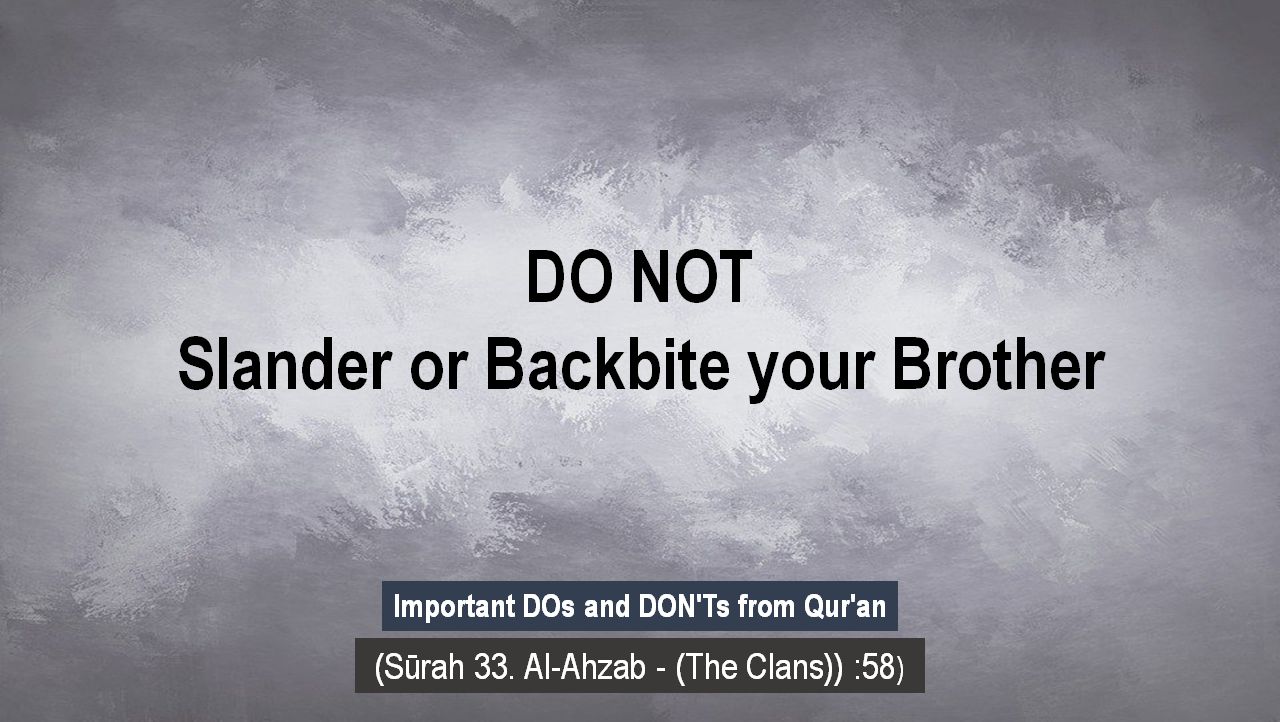
DO NOT Slander or Backbite your brother

Strength of character is the hallmark of every true believer. He does not talk bad or ill of his brethern in his absences, what to talk of in their presence. It speaks very low of a man when he talks ill of others in their absence, but is all smiles in their presence. Passing slanders and backbiting is the lowest display of a man's character.

Allah and His Prophet Muhammad ﷺ have always forbade believers to talk ill of others in their absence, even if it is true. In fact, backbiting and slandering are two sins are forbidden by Allah because they sow enmity, evil and discord among people and lead to destruction. Remember, slandering and backbiting often cause hostilities between people of the same household and between neighbours and relatives. These can decrease good deeds and increase evil ones and lead to dishonor and ignominy.
Backbiting and slandering are shame and disgrace. Their perpetrator is detested and he shall not have a noble death. Allah forbids these acts, as He says in the Holy Quran: "Backbiting and gossiping are from the vilest and most despicable of things, yet the most widely spread amongst mankind, such that no one is free from it except for a few people." [5]
The 58th verse of Surah 33. Al Ahzab is one such verse from Qur'an revolving around this theme:

وَالَّذِيۡنَ يُؤۡذُوۡنَ الۡمُؤۡمِنِيۡنَ وَالۡمُؤۡمِنٰتِ بِغَيۡرِ مَا اكۡتَسَبُوۡا فَقَدِ احۡتَمَلُوۡا بُهۡتَانًا وَّاِثۡمًا مُّبِيۡنًا‏ 
(33:58) Those who cause hurt to believing men and to believing women have invited upon themselves a calumny and a manifest sin.
At another place in Qur'an, it is said: ... Nor backbite one another; would any of you like to eat the flesh of his dead brother? You would abhor it. (Qur'an 49:12)

“Woe to every persistent slanderer, persistent defamer” (Surah Al Humazah Ayah 1) 

This verse determines the definition of slander. It is to ascribe a fault to a person which he does not have, or an error which he has not committed. The Holy Prophet also explained it. According to Abu Da'ud and Tirmidhi, when he was asked as to what is ghibat (backbiting), he replied: 'It is to make mention of your brother in a manner derogatory to him. " The questioner said, "And if the fault is there in my brother?". The Holy Prophet replied: `If the fault that you mentioned is there in him, you backbite him; if it is not there, you slandered him." Such an act is not only a moral sin, which will entail punishment in the Hereafter, but this verse also requires that in the law of an Islamic State also false allegation should be held as a culpable offense.

Tafsir Ibn-Kathir
(And those who annoy believing men and women undeservedly,) means, they attribute to them things of which they are innocent, which they do not know and do not do.

(They bear the crime of slander and plain sin.) This is the most serious slander, to tell or transmit things about the believing men and women that they have not done, in order to bring shame upon them and accuse them of shortcomings. Among those to whom the description most applies are those who disbelieve in Allah and His Messengers, followed by the Rafidites who accuse the Companions of shortcomings and faults of which Allah has stated that they are innocent, and describe them as the opposite of what Allah has said about them. 

Allah, may He be exalted, has told us that He is pleased with the Migrants and Ansar, and has praised them, but these foolish and ignorant people inveigh against them and accuse them of shortcomings, and say things about them that they did not do and could never have done. In reality, their hearts are misguided, for they condemn those who deserve praise and praise those who deserve condemnation. Abu Dawud recorded that Abu Hurayrah said that it was said: "O Messenger of Allah, what is backbiting (Ghibah)'' he said, (It is when you mention something about your brother that he dislikes. )

It was asked, "But what if what I say about my brother is true' he said, (If it is true, then you have committed backbiting (Ghibah) about him, and if it is not true, then you have slandered him.) This was also recorded by At-Tirmidhi, who said, "Hasan Sahih.'

Yusuf Ali Explanation
Cf. iv. 112. In that passage we were told that anyone who was himself guilty but accused an innocent man of his guilt, was obviously placing himself in double jeopardy; first, for his own original guilt, and secondly for the guilt of a false accusation. Here we take two classes of men instead of two individuals. The men and women of faith (if they deserve the name) and doing all they can to serve Allah and humanity. If they are insulted, hurt, or annoyed by those whose sins they denounce, the latter suffer the penalties of double guilt, viz., their sins to start with, and the insults or injuries they offer to those who correct them. Instead of resenting the preaching of Truth, they should welcome it and profit from it.

Tafsir Qur'an Wiki:
The sūrah then speaks of giving offence to believers generally, men and women, and falsely attributing to them what they do not have. This strong condemnation suggests that there was in Madinah at the time a group of people who schemed in this way against believers: they defamed them, conspired against them and circulated false allegations about them. This takes place in all communities at all times with believers in particular being so maligned. God therefore undertakes to reply to their accusers, describing them as hypocrites guilty of calumny and injustice. He certainly says only what is absolutely true.
As Muslims it is our responsibility to guard our tongues and to avoid things which are forbidden. The instructions from the Qur’an and hadith are clear regarding the stance on backbiting and slandering. [6]
Having explained the above said verse in detail, you may now listen to explanation of the Ayat by eminent Muslim scholar Nouman Ali Khan:
May Allāh (سبحانه و تعالى‎) help us understand Qur'ān and follow the Sunnah of Prophet Muhammad ﷺ, which is embodiment of commandments of Allah contained in the Qur'ān. May Allah help us to be like the ones He loves and let our lives be lived helping others and not making others' lives miserable or unlivable. May all our wrong doings, whether intentional or unintentional, be forgiven before the angel of death knocks on our door. 
وَمَا عَلَيۡنَاۤ اِلَّا الۡبَلٰغُ الۡمُبِيۡنُ‏ 
(36:17) and our duty is no more than to clearly convey the Message.”
That is Our duty is only to convey to you the message that Allah has entrusted us with. Then it is for you to accept it or reject it. We have not been made responsible for making you accept it forcibly, And if you do not accept it, we shall not be seized in consequence of your disbelief, you will yourselves be answerable for your actions on Day of Resurrection.

Reading the Qur'ān should be a daily obligation of a Muslim - Reading it with translation will make it meaningful. But reading its Exegesis / Tafsir will make you understand it fully. It will also help the Muslims to have grasp over social issues and their answers discussed in the Qur'an and other matter related to inter faith so that they are able to discuss issues with non-Muslims with authority based on refences from Qur'an.

May Allah forgive me if my posts ever imply a piety far greater than I possess. I am most in need of guidance.

Note: When we mention God in our posts, we mean One True God, we call Allah in Islam, with no associates. Allah is the Sole Creator of all things, and that Allah is all-powerful and all-knowing. Allah has no offspring, no race, no gender, no body, and is unaffected by the characteristics of human life.

For more Selected Verses, please refer to our reference page: Important DOs and DON'Ts from Qur'anYou may also refer to our Reference Pages: Understanding Al Qur'an and  Selected Verses from the Qur'an for knowing more about Islam and Qur'ān.
Photo | Tafsir References: | 1 | 2 | 3 | 4 | 5 | 6 | 7 |

An effort has been made to gather explanation / exegesis of the surahs of the Qur'ān from authentic sources and then present a least possible condensed explanation of the surah. In that the exegesis of the chapters of the Quran is mainly based on the "Tafhim al-Qur'an - The Meaning of the Qur'an" by one of the most enlightened scholars of the Muslim World Sayyid Abul Ala Maududi.  
In order to augment and add more explanation as already provided, additional input has been interjected from the following sources: 
  • Towards Understanding the Quran
  • Tafsir Ibn Khatir
  • Muhammad Asad Translation
  • Javed Ahmad Ghamidi / Al Mawrid
  • Al-Quran, Yusuf Ali Translation
  • Verse by Verse Qur'an Study Circle
In addition, references of other sources which have been explored have also been given above. Those desirous of detailed explanations and tafsir (exegesis), may refer to these sites.

If you like Islam: My Ultimate Decision, and to keep yourself updated on all our latest posts to know more about Islam, follow us on Facebook

Please share this page to your friends and family members through Facebook, WhatsApp or any means on Social Media so that they can also be benefited by it and better understand Islam and the Qur'ān - Insha Allah (Allah Willing) you shall be blessed with the best of both worlds.

Twitter Delicious Facebook Digg Stumbleupon Favorites More