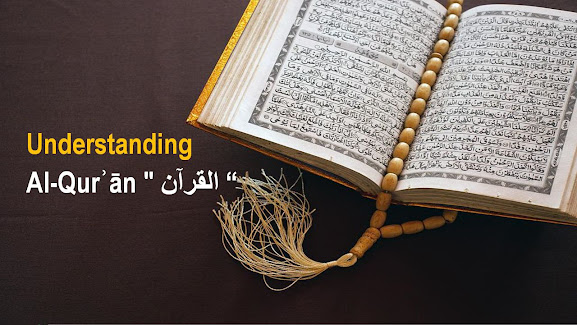
Accepting One Divine Being as the sole creator of this universe has always contested by many people by rejecting the very concept One True God without any associates as mentioned in the four major Divine Scriptures revealed to the four chosen prophets from eternity to some fourteen centuries when Al Qur'an, the fourth Divine Scripture, was revealed to Prophet Muhammad as the final Divine guiding book for the entire humanity till the end of our earthly world. Yet despite the presence of these noble scriptures, many have clung to the belief of the forefathers and remain oblivious to what is being ordained Divinely.
Of the present times, Atheism is one such faction which out rightly reject the concept of a Creator and associating His countless signs, like mountains, crops, animals, rain and snow and many means of sustenance beside the celestial world above us, and relate everything to science.
Islam and atheism begin from very different starting points about reality, purpose, and human destiny. Islam holds that the universe is created and sustained by Allah, that human life has a divinely assigned purpose, and that every person will return to God for judgment. Atheism, by contrast, does not accept belief in God as necessary. It is also important to be fair here: atheism is not one organized religion with a single scripture, moral code, or philosophy. Individual atheists may differ widely in how they explain morality, meaning, consciousness, and the origin of the universe.
The Basic Claim
The Qur’an’s most basic claim is that Allah is the Creator: “Allah is the Creator of all things” (39:62). It also rejects the idea that creation is meaningless or merely playful: “We did not create the heaven and the earth… in play” (21:16). From the Islamic point of view, existence is intentional. Human beings are part of that intention and are given moral responsibility. The Qur’an describes human creation in passages such as 23:12–14 and 32:7–9, and states the purpose of human life in 51:56: “I did not create jinn and mankind except to worship Me.”
An atheistic outlook usually does not accept a divinely assigned purpose. Life may instead be understood in terms of natural processes, including biological evolution, and individuals may find meaning in relationships, knowledge, compassion, achievement, creativity, or other human pursuits. Atheism itself, however, does not provide one official answer to the question, “Why are we here?”
A major difference also concerns knowledge. Islam values observation and reason, but does not limit knowledge to them. Revelation is also treated as a source of truth. The Qur’an repeatedly urges reflection on creation, as in 3:190–191 and 88:17–20. Atheistic approaches generally rely on reason, empirical evidence, experience, and science, while supernatural revelation is not accepted as authoritative unless independently demonstrated.
Morality
The difference becomes especially clear in morality. Islam teaches that moral truth ultimately rests in Allah’s command and in the moral order He has established. Qur’an 16:90 says: “Indeed Allah commands justice and excellence…” Atheists may also strongly value justice, honesty, compassion, human dignity, and the protection of others, but may explain those values through human welfare, empathy, reason, rights, reciprocity, or moral philosophy rather than divine command. Thus, a Muslim and an atheist may sometimes behave similarly in practical ethical matters while disagreeing deeply about the ultimate foundation of morality.
Individual Accountability
The Qur’an also places great emphasis on individual accountability. “No bearer of burdens will bear the burden of another” (53:38–39). In Islam, every person is responsible before Allah, and perfect justice is completed in the Hereafter. Qur’an 99:7–8 teaches that even the smallest deeds will be seen, and 21:47 describes the absolute justice of the final judgment. In most atheistic frameworks, moral accountability is understood within this life—toward oneself, other people, society, and the consequences of one’s actions—without assuming a divine judgment after death.
The Sharpest Difference
This leads to one of the sharpest differences between the two worldviews: what happens after death. Islam teaches resurrection and judgment. Qur’an 23:15–16 says that human beings die and will then be raised again. Qur’an 36:78–79 answers the objection, “Who will give life to these bones when they have decayed?” with: “He who produced them the first time will give them life.” Most atheistic views hold that personal consciousness ends with biological death, though atheism by itself does not provide one unified philosophical theory of consciousness.
The Qur’an directly records a materialistic view in 45:24: “There is nothing but our worldly life; we die and we live, and nothing destroys us except time.” It rejects this as a complete account of human destiny. From the Qur’anic perspective, life is not merely a temporary biological episode but a moral test. Qur’an 67:2 says that Allah “created death and life to test you as to which of you is best in deeds.” Suffering, therefore, may have a dimension of trial, discipline, patience, or moral growth. Atheistic explanations generally understand suffering through natural causes, human wrongdoing, chance, disease, social conditions, or other non-divine causes, without assuming an ultimate spiritual purpose behind it.
The Qur’an’s argument for God is often framed as an appeal to reason rather than mere assertion. Surah At-Tur asks:
“Or were they created by nothing, or were they themselves the creators? Or did they create the heavens and the earth?” — Qur’an 52:35–36
The point is to challenge the reader to consider the origin of existence. Human beings did not create themselves, nor did they create the cosmos. The Qur’an therefore directs thought toward an originating Creator.
The Story of Prophet Ibraheem (Abraham)
The story of Abraham in 6:75–79 follows a similar pattern. Abraham reflects on the star, moon, and sun, but rejects them as ultimate objects of worship because they rise and disappear. He finally declares:
“Indeed, I have turned my face toward Him who created the heavens and the earth…”
— Qur’an 6:79
Qur'an's insistence on Reflection rather than believing without thinking
For this reason, the Qur’anic approach is not simply “believe without thinking.” It repeatedly appeals to reflection: “In the creation of the heavens and the earth… are signs for people of understanding” (3:190), and, “And in yourselves. Will you not then see?” (51:21).
The teachings of the Prophet ﷺ reinforce the same worldview by connecting faith with intention and moral conduct. He said: “Actions are only according to intentions.” — Sahih al-Bukhari 1; Sahih Muslim 1907
In Islamic ethics, therefore, morality is not judged only by outward results; intention before God also matters. He also said: “Whoever believes in Allah and the Last Day should speak good or remain silent.” — Sahih al-Bukhari 6018; Sahih Muslim 47
The ethical conduct explicitly connected to belief in God and the Last Day
The famous Hadith of Jibril describes Islam through Islam, Iman, and Ihsan. Iman includes belief in Allah, the angels, revelation, the messengers, the Last Day, and divine decree, while Ihsan is to worship Allah “as though you see Him.” — Sahih Muslim 8.
This creates a profound difference from an atheistic worldview: the Muslim tries to live with the awareness that even when no human observer is present, one remains morally accountable before God.
At the same time, the Qur’an does not teach that belief should be forced. It states:
لَا إِكْرَاهَ فِي الدِّينِ “There is no compulsion in religion.” — Qur’an 2:256
It also instructs believers to invite others “in the best manner” (16:125), and says: “The truth is from your Lord; whoever wills, let him believe, and whoever wills, let him disbelieve” (18:29). Thus, Qur’anic faith is presented as something to be accepted through recognition and conviction, not imposed through coercion.
The Deepest Contrast
The deepest contrast, then, is not simply “religion versus science.” Islam does not reject investigation of the physical world. The more basic disagreement concerns what lies behind that world. Atheism asks whether the universe and human existence can be adequately explained without God. Islam answers that creation, moral responsibility, human purpose, and final justice ultimately make sense because they come from Allah and return to Him.
That Islamic worldview is captured in one brief Qur’anic statement:
إِنَّا لِلَّهِ وَإِنَّا إِلَيْهِ رَاجِعُونَ “Indeed, we belong to Allah, and indeed to Him we shall return.” — Qur’an 2:156
Viewpoint of Classical and Present day Muslim Scholars
A useful way of understanding major scholarly approaches is this:
1. Al-Ghazālī treated denial of a Creator as intellectually untenable because contingent things cannot ultimately explain their own existence. In works such as Tahāfut al-Falāsifah, his primary debates were with philosophers rather than modern atheists, but his basic argument was that the universe depends upon a necessary Creator. At the same time, he strongly distinguished between philosophical errors of different kinds rather than treating every disagreement identically.
2. Ibn Taymiyyah placed considerable emphasis on fiṭrah, the innate human disposition toward recognition of God. He argued that knowledge of the Creator is not merely the result of a complicated philosophical proof; human nature, reason and the signs of creation all point toward God. This corresponds closely with the Prophetic statement: “Every child is born upon the fiṭrah.” — Sahih al-Bukhari 1358; Sahih Muslim 2658.
3. Ibn Rushd (Averroes) emphasized rational reflection on the natural world. For him, studying creation could lead the reasoning person toward knowledge of the Creator. Qur’anic passages inviting observation of the heavens, animals and nature were therefore particularly significant. In this approach, reason and revelation are not natural enemies.
4. Ibn Kathīr, when explaining verses such as 52:35–36 — “Were they created by nothing, or were they themselves the creators?” — reads the passage as a rational challenge: neither self-creation nor creation from absolute nothingness provides an adequate explanation; therefore creation points beyond itself to its Creator.
5. Abul A‘la Maududi often treats modern materialism and atheism as consequences of restricting reality to what can be physically observed. His Qur’anic commentary repeatedly argues that scientific knowledge describes many of the mechanisms of creation but does not by itself answer the ultimate questions of why existence exists, why moral responsibility matters, or what humanity's final destiny is.
6. Javed Ahmad Ghamidi places considerable weight on human nature, conscience and the ordered structure of the universe. His approach is generally that recognition of God is supported by the human moral sense and the signs within the world, while revelation clarifies truths toward which human nature already points. He also stresses that people are ultimately accountable according to the knowledge and evidence actually made clear to them.
Final Reflection
So, in the end, Islam and atheism differ most clearly over four fundamental questions: where human beings come from, why they exist, on what basis they should live morally, and what—if anything—comes after death. Islam answers all four through God, revelation, accountability, and the Hereafter; atheistic worldviews seek their answers without appealing to a divine Creator.
May Allāh (سبحانه و تعالى) help us understand Qur'ān and follow the Sunnah of Prophet Muhammad ﷺ, which is embodiment of commandments of Allah contained in the Qur'ān. May Allah help us to be like the ones He loves and let our lives be lived helping others and not making others' lives miserable or unlivable. May all our wrong doings, whether intentional or unintentional, be forgiven before the angel of death knocks on our door.
وَمَا عَلَيۡنَاۤ اِلَّا الۡبَلٰغُ الۡمُبِيۡنُ
(36:17) and our duty is no more than to clearly convey the Message.”
That is Our duty is only to convey to you the message that Allah has entrusted us with. Then it is for you to accept it or reject it. We have not been made responsible for making you accept it forcibly, and if you do not accept it, we shall not be seized in consequence of your disbelief, you will yourselves be answerable for your actions on Day of Resurrection.
May Allah forgive me if my posts ever imply a piety far greater than I possess. I am most in need of guidance.
Note: When we mention God in our posts, we mean One True God, we call Allah in Islam, with no associates. Allah is the Sole Creator of all things, and that Allah is all-powerful and all-knowing. Allah has no offspring, no race, no gender, no body, and is unaffected by the characteristics of human life.
| Photo |
References Resources for further study: | 1 | 2 | 3 |
For more Q&A about Understanding Islam, please refer to our reference page: Understanding Islam - Frequently asked Q&A. You may also refer to our refference page: Scholars' Viewpoint on important issue related to Islam to know more about Islam.
If you like Islam: My Ultimate Decision, and to keep yourself updated on all our latest posts to know more about Islam, follow us on Facebook. You may also refer to our Facebook Group Islam: The Ultimate Truth for more on Islam and Da'wah.
Please share this page to your friends and family members through Facebook, WhatsApp or any means on Social Media so that they can also be benefited by it and better understand Islam and the Holy Qur'an - Insha Allah (Allah Willing) you shall be blessed with the best of both worlds.